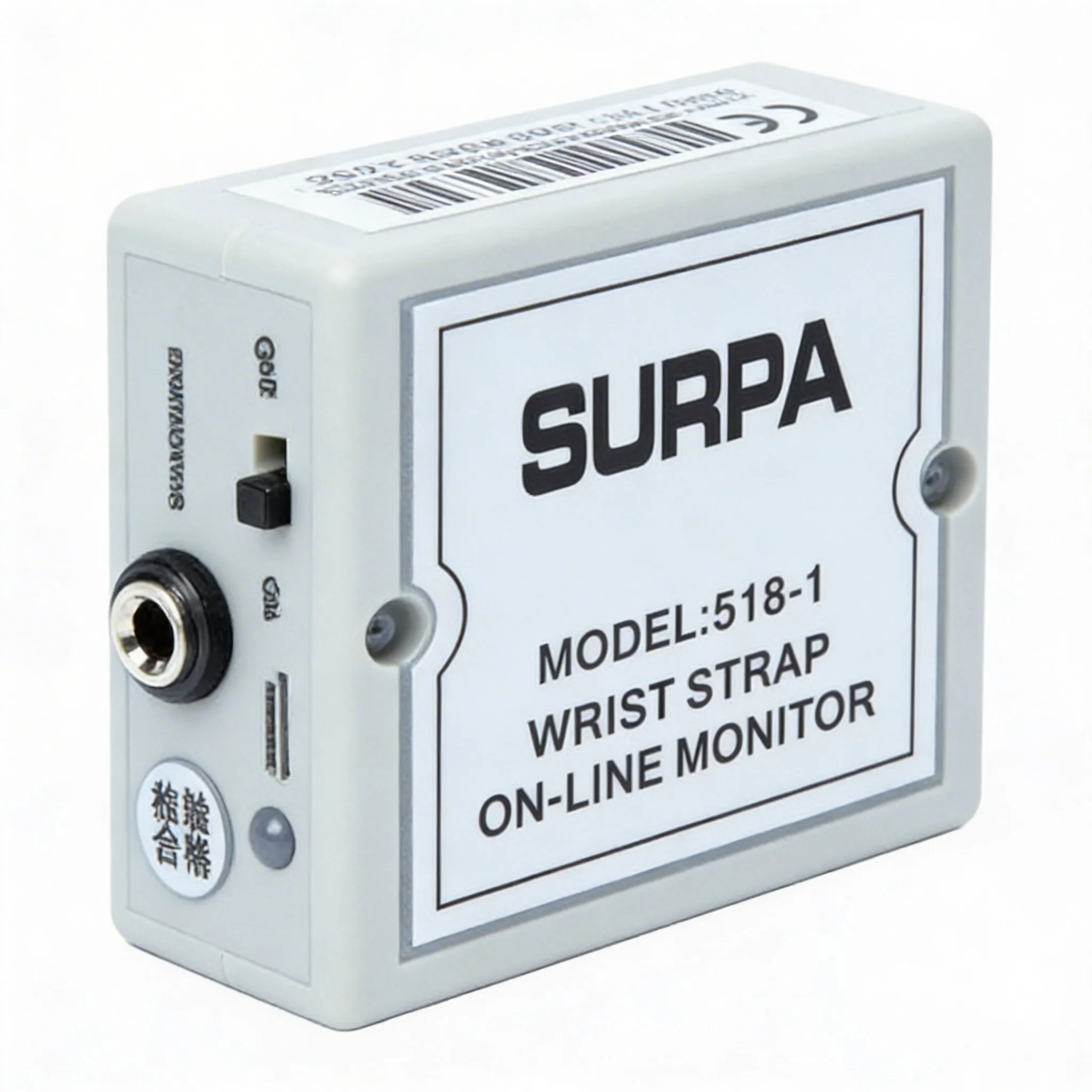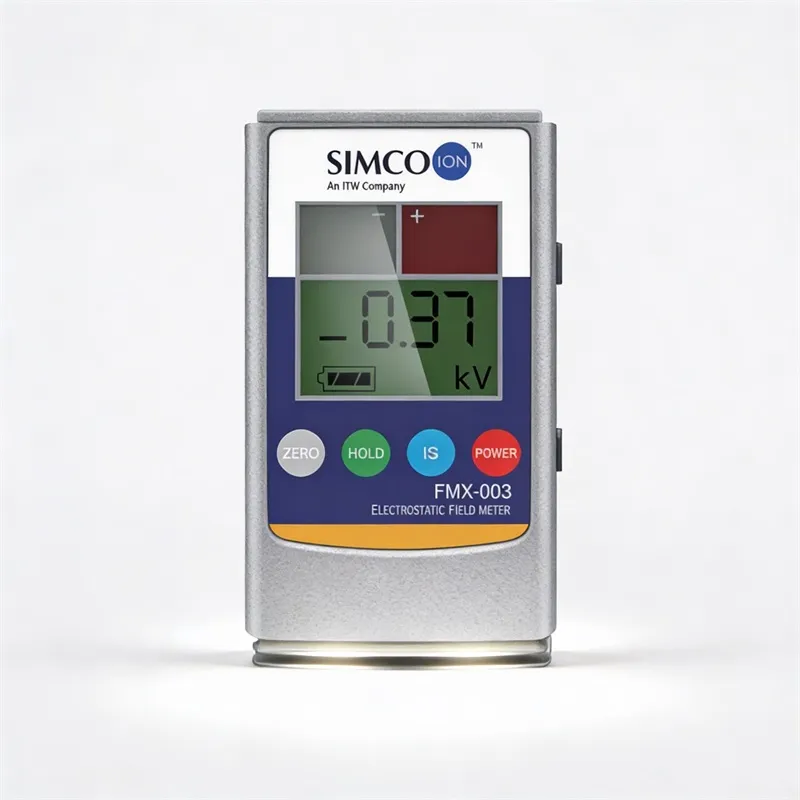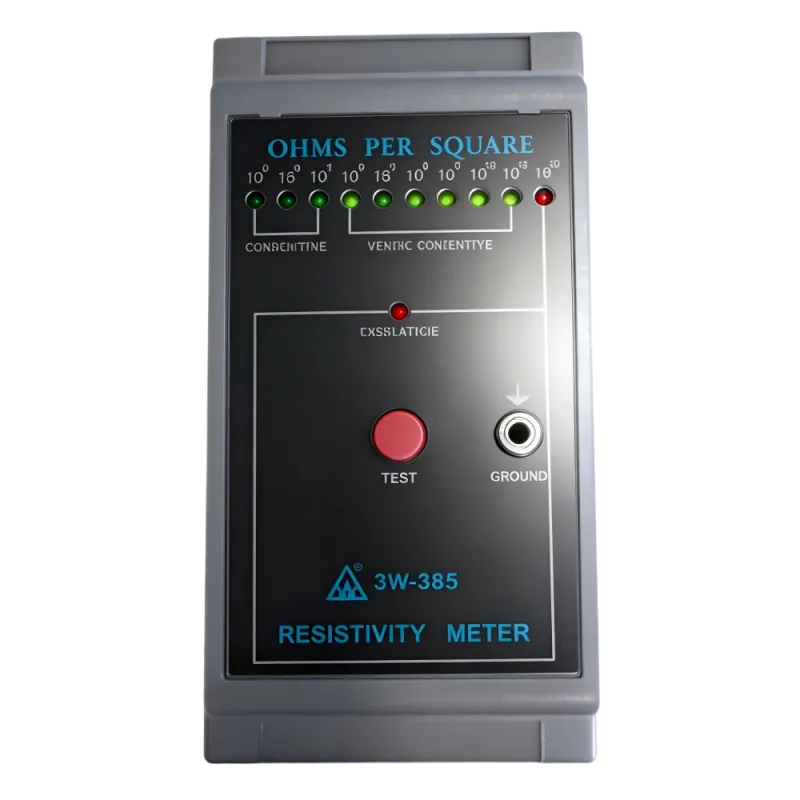
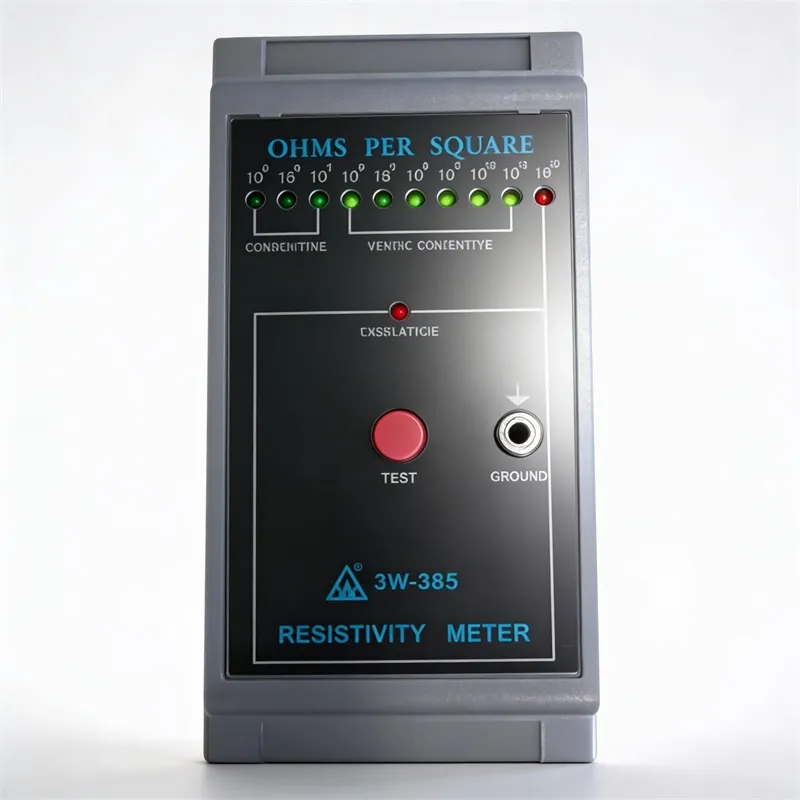
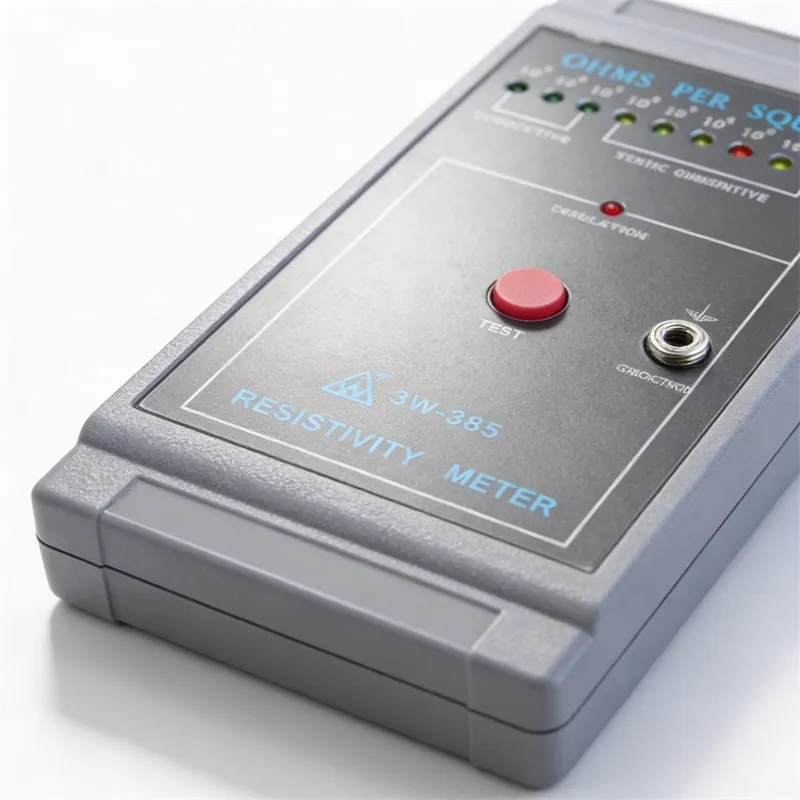
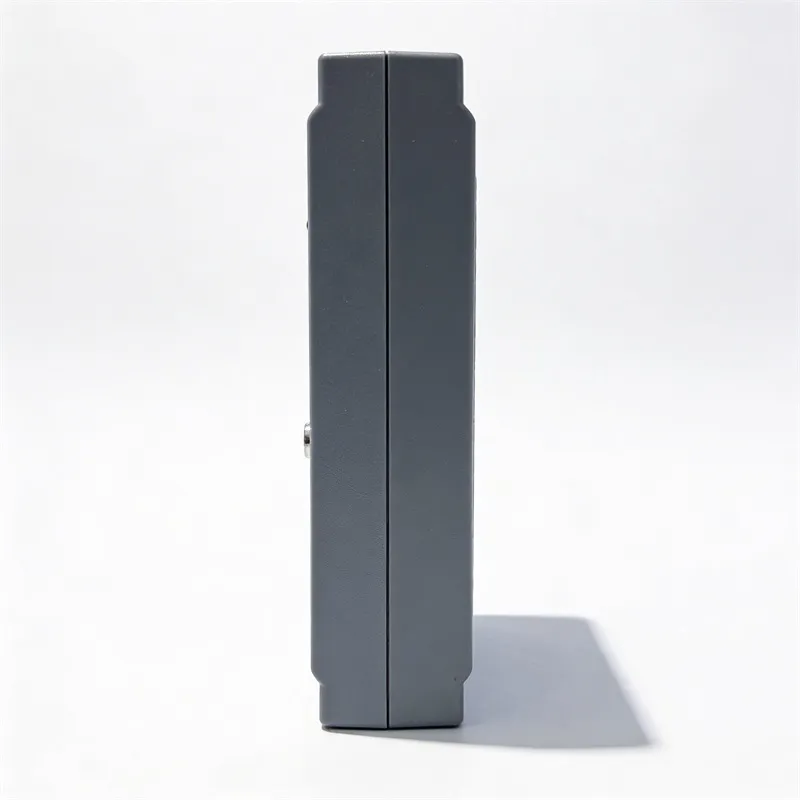
Surface Resistance Tester Handheld ESD Resistivity Measuring Instrument
Przegląd:
The tester rezystancji powierzchniowej (also referred to as an tester rezystancji powierzchniowej ESD or surface resistivity tester) is a dedicated measurement instrument designed to accurately determine the surface resistance value of materials, thereby evaluating their conductive properties, static dissipative capability, and insulating characteristics.
Working Principle and Core Technology
The surface resistance tester operates on the principle of DC voltage resistance measurement. It applies a known voltage to the surface of the material under test and measures the resulting current flowing across the surface. The resistance value is then calculated according to Ohm’s law. Most modern instruments offer two test voltages – 10 V and 100 V – with automatic range switching: for example, when the resistance is ≥1×10⁶ Ω, the instrument applies 100 V; when the resistance lies between 1×10⁴ Ω and 1×10⁶ Ω, it uses 10 V. This ensures optimal measurement accuracy across different material types.
Wide Measurement Range and Precision Classification
A high‑quality surface resistance tester typically covers a broad measurement range from 10³ Ω to 10¹² Ω, making it suitable for testing everything from conductive materials to insulators. Different models feature various display methods – some use LED indicators to visually show the resistance range: green for conductive (10³–10⁶ Ω), yellow for static‑dissipative (10⁷–10¹¹ Ω), and red for insulative (≥10¹² Ω). Others employ LCD or OLED digital displays for more precise numeric readings. Measurement accuracy generally reaches ±10 %, with high‑end models achieving up to ±0.5 order of magnitude.
Flexible Test Methods and Electrode Configurations
The surface resistivity test method complies with multiple international standards, including ASTM D257, IEC 62631‑3‑2, i GB/T 1410. To accommodate diverse testing scenarios, a surface resistance tester is usually equipped with or offers optional electrodes: parallel electrodes for rapid screening, weighted electrodes (2.27 kg or 2.5 kg) for point‑to‑point surface resistance measurement, concentric ring electrodes for surface resistivity testing in accordance with EOS/ESD S11.11, and two‑point electrodes for small‑area measurements. The dimensions, contact pressure, and material of these electrodes are specified by the relevant standards to ensure consistency and repeatability of test results.
Multi‑Scenario Applications and Industry Value
Surface resistivity testing plays an indispensable role across various industries:
-
Electronics manufacturing – inspecting the surface resistance of anti‑static workstations, ESD flooring, and packaging materials to safeguard the production environment.
-
Semiconductor and precision instrumentation – testing wafer carriers, PCB protective coatings, and containers for static‑sensitive devices to prevent electrostatic damage.
-
Laboratories and R&D – studying the static performance of new materials and characterising their surface resistivity.
-
Warehousing and logistics – verifying the resistance of ESD trays, tote boxes, and shipping tubes to avoid electrostatic discharge during storage and transport.
-
Medical and aerospace – measuring the surface resistance of equipment housings and operating tables to ensure user safety and operational reliability.
Portable Design and Smart Features
Modern surface resistance testers are typically designed to be compact and lightweight (often 120–170 g), allowing for easy on‑site testing. Many models also incorporate data logging and transfer capabilities – exporting data via USB, generating comprehensive test reports with companion software, and some advanced versions even storing up to 50,000 measurement records. Built‑in environmental temperature and humidity sensors further enhance traceability, ensuring that every test is performed under documented conditions.
Specyfikacja techniczna
| Measurement Range | 10³-10¹²Ω |
| Accuracy | ±0.5 |
| Size (L×W×H) | 70*27*130mm |
| Weight | 0.14G |
| Power Supply | 9V |
Światowej klasy potencjał produkcyjny ESD
Wybierając współpracę z Sanwei, partnerujesz bezpośrednio z wiodącym w branży producentem OEM/ODM. Posiadamy nowoczesne Zintegrowany zakład produkcyjny o powierzchni ponad 70 000 m² w Centralnym Parku Przemysłowym Yueqing w prowincji Zhejiang, zarządzając każdym pojedynczym procesem, od opracowania własnych formulacji materiałowych po ostateczne formowanie produktów o wysokiej precyzji.
Zintegrowana skala
Ponad 70 000 m² nowoczesnego zakładu wyposażonego w wytrzymałe, precyzyjne wtryskarki do obsługi hurtowych zamówień masowych z zachowaniem stabilnych terminów realizacji.
Kontrola całego łańcucha
Pełna kontrola wewnętrzna obejmująca badania i rozwój własnych materiałów antyelektrostatycznych, projektowanie form konstrukcyjnych, zautomatyzowaną produkcję oraz szybką globalną logistykę dostaw.
Rygorystyczna inspekcja
Rygorystyczne badania surowców w połączeniu z wielopunktowym pomiarem rezystywności powierzchniowej na linii produkcyjnej gwarantują zgodność modelu 100% z wytycznymi międzynarodowych norm dotyczących ochrony przed wyładowaniami elektrostatycznymi (ESD).
Antystatyczny Produkty i rozwiązania
Zapewnienie kompleksowej ochrony elektrostatycznej w całym cyklu produkcyjnym i operacyjnym.
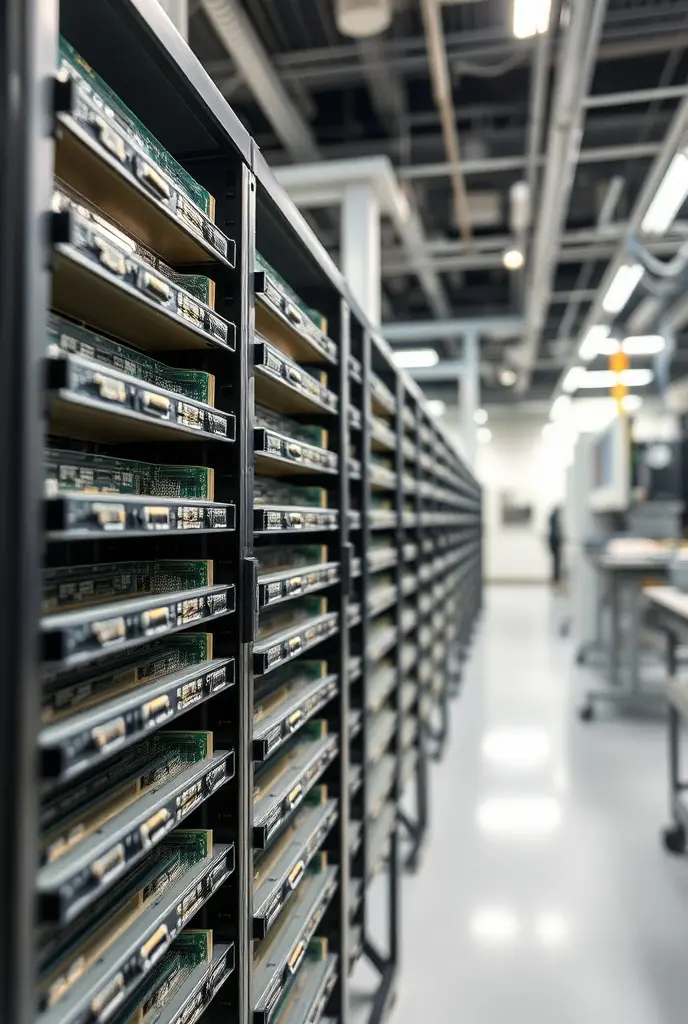
Sprzęt SMT
Antystatyczne pojemniki zbiorcze i stojaki do linii zautomatyzowanych.

Magazynowanie i logistyka
Wózki technologiczne, półki, skrzynie, tace i pojemniki na komponenty.
Stanowisko robocze i ŚOI
Antystatyczne krzesła, maty, paski na nadgarstek oraz ochrona osobista.
Wdrożenia dedykowane
Rozwój niestandardowych form oraz specjalne materiały antystatyczne.
NASZE ZALETY OEM/ODM

Zaawansowane prace B+R i innowacje materiałowe
Własne materiały antystatyczne opracowane wewnątrz firmy, objęte krajowymi patentami na wynalazki i odporne na temperaturę do 200℃. My nie tylko formujemy – my tworzymy związki chemiczne.

Pełnomocna zdolność produkcyjna
Fabryka o powierzchni 30 000 m² z kompletinymi systemami formowania wtryskowego, granulacji i przetwarzania wspomagającego dla zapewnienia stabilnych i wydajnych dostaw.

Kompleksowa personalizacja
Rezystywność materiału, kolor, rozmiar, logo, opakowanie i certyfikaty – możliwość dostosowania do norm IEC61340-5-1, ANSI/ESD S20.20 lub norm wojskowych.

Certyfikowana jakość i globalna zgodność z przepisami
“Firma Sanwei z powodzeniem opracowała niestandardowe, odporne na wysokie temperatury tace o czystym, naturalnym kolorze dla naszej linii montażowej półprzewodników, zastępując produkty importowane, zapewniając doskonałe bezpieczeństwo ESD i spełniając wysokie wymagania dotyczące czystości warsztatu.”
ZAUFALI MIĘDZYNARODOWYM LIDEROM RYNKOWYM Z LISTY FORTUNE 500
Nasze autorskie rozwiązania ESD są wdrażane w elitarnych zakładach produkcyjnych na całym świecie, w tym: Intel, Motorola, Siemens, IBM, Panasonic, Nokia i Dell.
Szukasz niestandardowych rozmiarów lub hurtowych cen?
Wspierani przez nasz silny, wewnętrzny zespół Badawczo-Rozwojowy (R&D), oferujemy kompleksowe opcje OEM/ODM dostosowane do Twoich konkretnych linii produkcyjnych SMT lub układu magazynu. Skontaktuj się z naszymi specjalistami już dziś w sprawie niestandardowych form, kodowania kolorami lub zintegrowanego doradztwa w zakresie magazynowania 5S.
Często zadawane pytania (FAQ)
1. What is the standard for surface resistivity?
The primary standards for measuring surface resistivity are ASTM D257 i IEC 62631-3-2. ASTM D257 is a key standard that details techniques for measuring both surface and volume resistivity using a guarded electrode system. IEC 62631-3-2 serves as the international equivalent.
2. What is surface insulation resistance?
Surface Insulation Resistance (SIR) is a measure of the electrical resistance across the surface of an insulating material between two conductors. It is a key indicator of a material’s ability to resist electrical leakage and electrochemical failures, especially under humid conditions.
3. What equipment is used to test insulation resistance?
The most common equipment used to test insulation resistance is an insulation resistance tester, often generically called a Megger. These are portable, high-range resistance meters (ohmmeters) with a built-in DC generator that provide direct readings of insulation resistance.
4. What is the surface insulation resistance test?
The surface insulation resistance test is a method used to measure the resistance across a material’s surface. It’s a non-destructive test often used to evaluate the reliability of electronic assemblies. The test typically involves measuring the resistance between two comb-shaped electrodes on a test board under controlled conditions.
5. What is the surface resistance instrument?
A surface resistance instrument (or tester) is a device used to measure the electrical resistance directly on the surface of a material. It expresses resistance in ohms (Ω) and is commonly used for field audits of ESD workstations, mats, and floors to determine if materials are conductive or static dissipative.