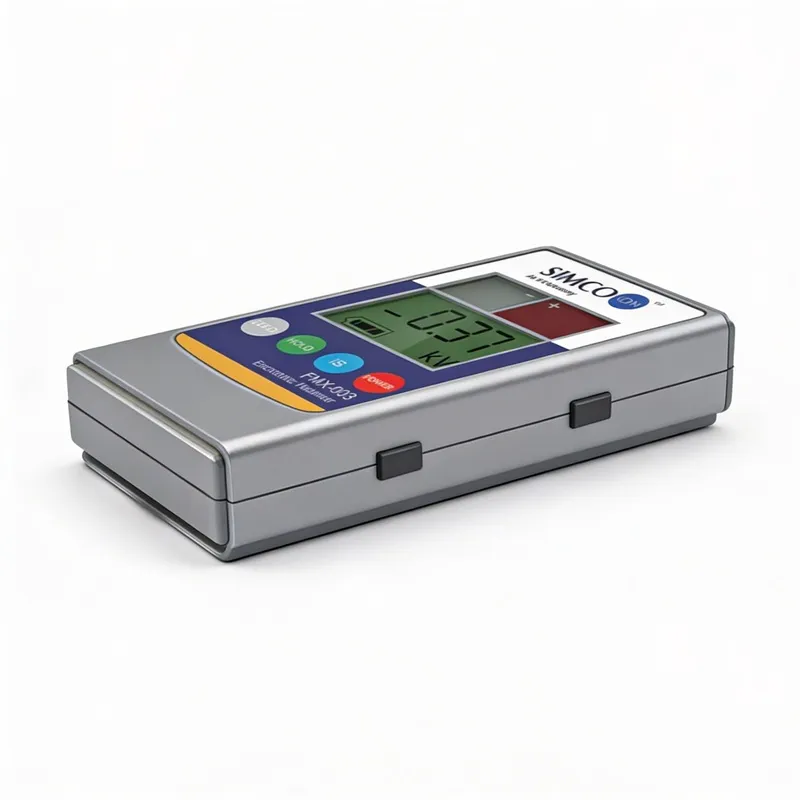
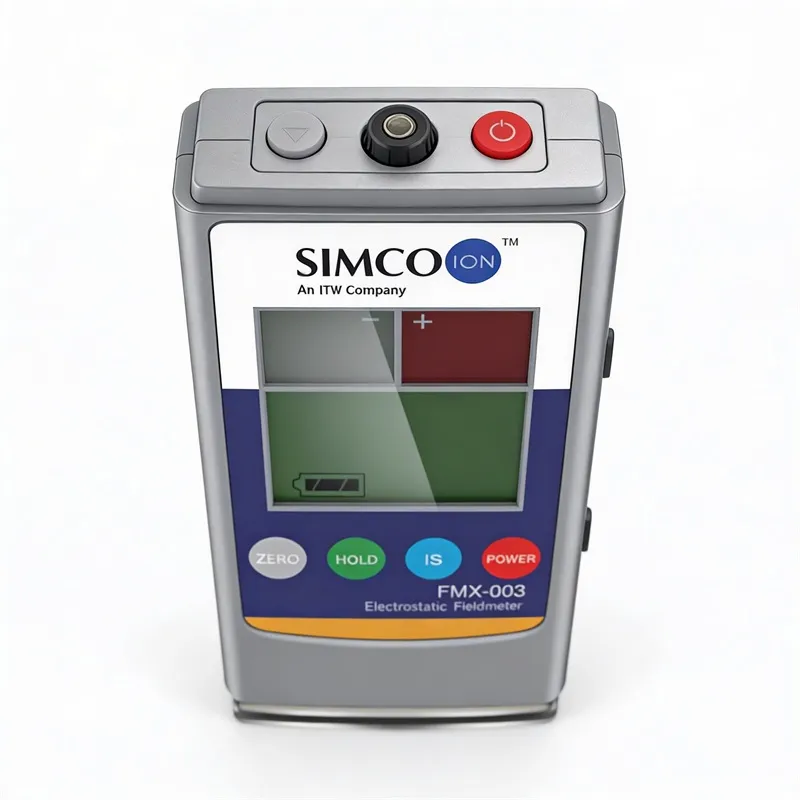
Elektrostatische veldmeter FMX-003 handbediende statische spanningsdetector
Overzicht:
Introduction
If you’ve ever had to track down the source of an unexplained ESD failure or verify whether your ionisers are actually doing their job, you know that static charge is invisible but anything but harmless. That’s where an elektrostatische veldmeter comes in. Unlike resistance testers that require physical contact, these handheld devices let you measure static charge on surfaces from a safe distance—quickly, reliably, and without disturbing the object under test. Whether you’re auditing a production floor, troubleshooting a cleanroom issue, or simply doing routine static surveys, a good electrostatic field meter is your eyes for the invisible.
What Exactly Is an Electrostatic Field Meter?
At its core, an elektrostatische veldmeter is a non‑contact instrument that detects the electric field generated by a charged object. It works on the principle of electrostatic induction—sensing the field strength and converting it into a voltage reading, typically in kilovolts per unit distance. Because it doesn’t draw any current from the object, it can measure delicate electronic components, packaging materials, and even human body charges without affecting the charge itself. This makes it fundamentally different from a surface resistance tester, which measures ohmic conductivity.
The SIMCO FMX‑003 Electrostatic Field Meter
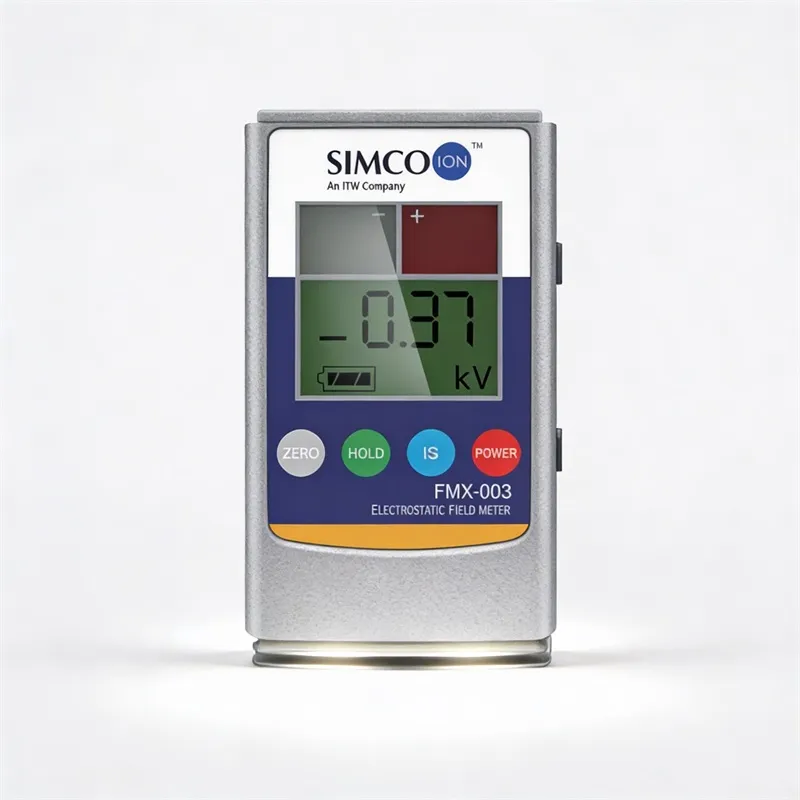
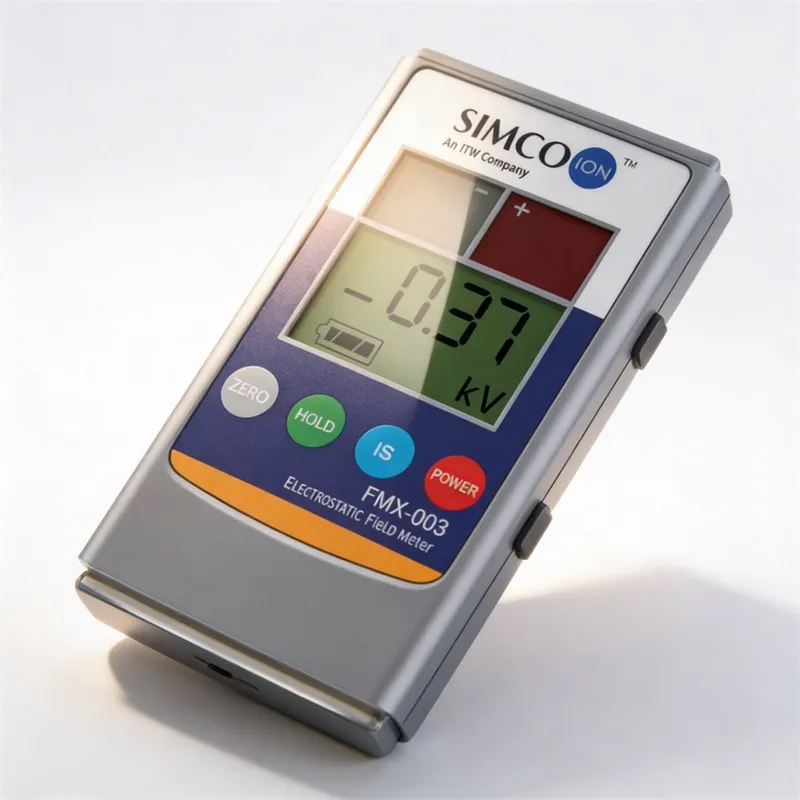
If there’s one model that has earned a reputation for reliability in the ESD community, it’s the SIMCO FMX‑003 electrostatic field meter. This pocket‑sized unit measures static voltages up to ±22 kV at a fixed distance of 1 inch (25 mm) – a distance that’s easily maintained thanks to two built‑in LED guide lights that show you exactly where to position the sensor. The display gives you both a numerical value and a colour‑coded bar graph (red for positive, blue for negative), so you can read results at a glance even in dim lighting. It also includes an ion balance mode for checking ioniser offset voltage (0 to ±220 V), a HOLD function to freeze readings, and an audible alarm for out‑of‑range measurements. Weighing just 170 g and featuring a conductive case with a grounding snap, it’s designed for real‑world field use—not just lab conditions.
Why Electrostatic Field Meter Calibration Matters
You might have the best instrument on the market, but without regular electrostatic field meter calibration, your readings are just educated guesses. Calibration ensures that the sensor’s response remains linear and accurate over time, compensating for component drift and environmental factors. Reputable manufacturers typically provide NIST‑traceable calibration certificates with each unit, and industry best practice recommends recalibration at least annually—or more frequently if the meter sees heavy use. Standards like IEC 61340 outline specific procedures for verifying performance, including test voltage levels, distance accuracy, and environmental conditions. Skipping calibration isn’t worth the risk: a false low reading could leave you with an unchecked static hazard, while a false high reading might send you chasing problems that don’t exist.
Where You’ll Actually Use a Handheld Electrostatic Field Meter
The list of applications for a handheld electrostatic field meter is longer than most people think. In electronics assembly, it’s the go‑to tool for auditing ESD workstations, checking charge buildup on PCBs and components, and verifying that packaging materials aren’t generating excessive static. In cleanrooms and medical device manufacturing, it helps prevent particle attraction—static charges can pull in dust and contaminants, compromising product sterility. In printing and converting, it identifies static issues that cause ink misregistration or material misalignment. And in R&D labs, it’s used for material characterisation and comparative studies. Essentially, any environment where static charge could affect quality, safety, or reliability is a candidate for regular electrostatic field meter use.
Technische specificatie
| Model | Measurement Range | Accuracy Range | Test Distance | Size (L×W×H) | Weight |
| 3W-7802(FMX-003) | ±20KV | 10% | 25mm | 122×65×27mm | 130G |
Wereldwijde ESD-productiecapaciteit
Wanneer u inkoopt bij Sanwei, werkt u direct samen met een toonaangevende OEM/ODM-fabrikant. Wij beheren een ultramoderne 70.000+ m² geïntegreerde productiefaciliteit in het Centrale Industriepark van Yueqing, Zhejiang, waarbij elk afzonderlijk proces wordt beheerd, van eigen materiaalformulering tot het uiteindelijke zeer nauwkeurige productvormproces.
Geïntegreerde schaal
70.000+ m² geavanceerde productiefaciliteit, uitgerust met zware precisie-spuitgietmachines om grote wholesalebestellingen te verwerken met stabiele levertijden.
Volledige ketenbeheersing
Volledige beheer in eigen huis, variërend van R&D van eigen antistatisch materiaal, structurele malengineering, geautomatiseerde productie tot snelle wereldwijde logistieke levering.
Grوندige inspectie
Strenge grondstofcontroles in combinatie met meerpuntsmetingen van de oppervlakteweerstand op de productielijn garanderen dat 100% voldoet aan de internationale ESD-richtlijnen.
Antistatisch Producten en Oplossingen
Het leveren van uitgebreide elektrostatische bescherming gedurende uw gehele productie- en operationele levenscyclus.
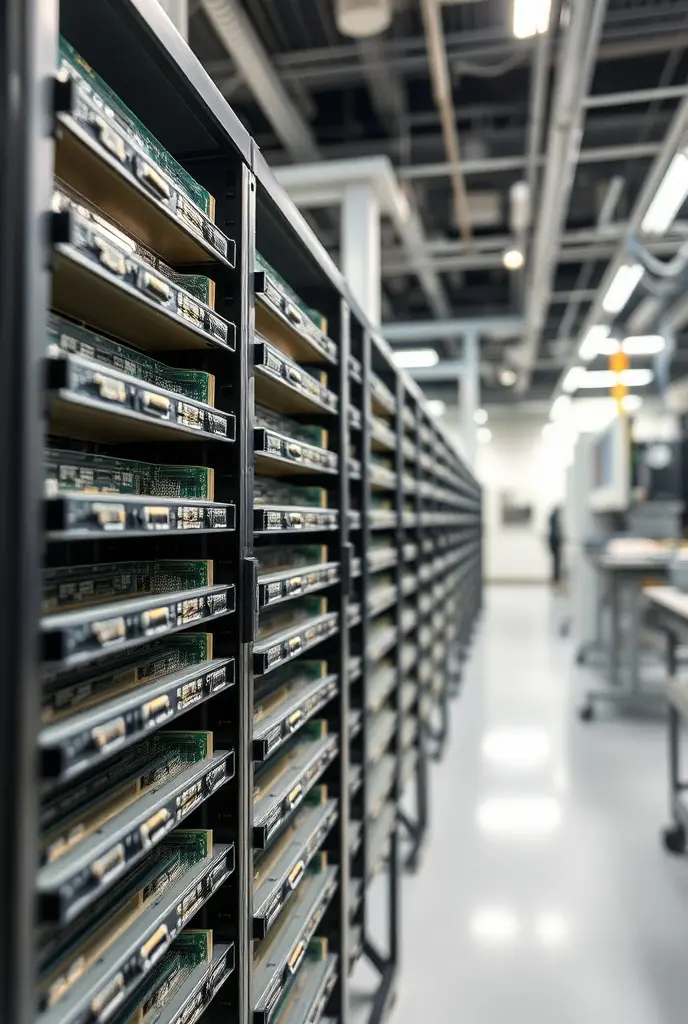
SMT-apparatuur
Antistatische verzamelbakken en rekken voor geautomatiseerde lijnen.

Opslag & Logistiek
Veilingkarren, legborden, bakken, schalen en onderdelenbakken.

Werkplek & PBM
Antistatische stoelen, matten, polsbandjes en persoonlijke bescherming.
Maatwerkontwikkeling
Ontwikkeling van aangepaste matrijzen en speciale antistatische materialen.
ONZE OEM/ODM-VOORDELEN

Geavanceerde R&D & Materiaalinnovatie
Interne ontwikkelde antistatische materialen met nationale uitvindingsoctrooien en hittebestendigheid tot 200℃. Wij vormen niet alleen — we formuleren compounds.

Volledige productiecapaciteit
30.000㎡ fabriek met complete spuitgiet-, granulatie- en ondersteunende verwerkingssystemen voor een stabiele en efficiënte levering.

Volledig op maat gemaakt proces
Materiaalweerstand, kleur, afmetingen, logo, verpakking en certificeringen — aanpasbaar om te voldoen aan IEC61340-5-1, ANSI/ESD S20.20 of militaire normen.

Gecertificeerde Kwaliteit & Wereldwijde Naleving
“Sanwei heeft met succes aangepaste, hittebestendige, schone trays in natuurlijke kleur ontwikkeld voor onze halfgeleidermontagelijn, ter vervanging van geïmporteerde producten, waarmee uitstekende ESD-veiligheid wordt gewaarborgd en aan de hoge reinheidseisen van de werkplaats wordt voldaan.”
BEVERTROUWD DOOR WERELDWIJDE FORTUNE 500 INDUSTRIELEADERS
Onze propriëtaire ESD-oplossingen worden wereldwijd ingezet in geavanceerde productiefaciliteiten, waaronder: Intel, Motorola, Siemens, IBM, Panasonic, Nokia en Dell.
Op zoek naar aangepaste maten of bulk groothandelsprijzen?
Ondersteund door ons robuuste eigen R&D-team biedt Sanwei complete OEM/ODM-opties die zijn afgestemd op uw specifieke SMT-productielijnen of magazijnindeling. Neem vandaag nog contact op met onze specialisten voor aangepaste matrijzen, kleurcodering of geïntegreerd 5S-opslagadvies.
Veelgestelde Vragen (FAQ)
1. What is an electrostatic field meter used for?
It detects and measures static charge on surfaces without touching them, helping you find ESD risks in manufacturing, cleanrooms, packaging, and labs.
2. What is the principle of electrostatic field meter?
It senses the electric field from a charged object by induction – the field induces a charge on the meter’s sensor, which is then converted into a voltage reading.
3. What is the electrostatic field meter FMX 004?
It’s a compact handheld model from Simco‑Ion, measuring up to ±30 kV at 1‑inch distance, with LED guides, colour‑coded display, and ion‑balance mode.
4. How does the electrostatic field meter work?
It places a sensor near the charged surface, picks up the field strength, converts that into an electrical signal, and displays the result as a voltage value.
5. What is the difference between electrostatic field meter and electrostatic voltmeter?
A field meter measures the overall field over a larger area; a voltmeter measures the exact voltage at a tiny, specific spot. Field meters are quicker for surveys; voltmeters are more precise for detailed analysis.