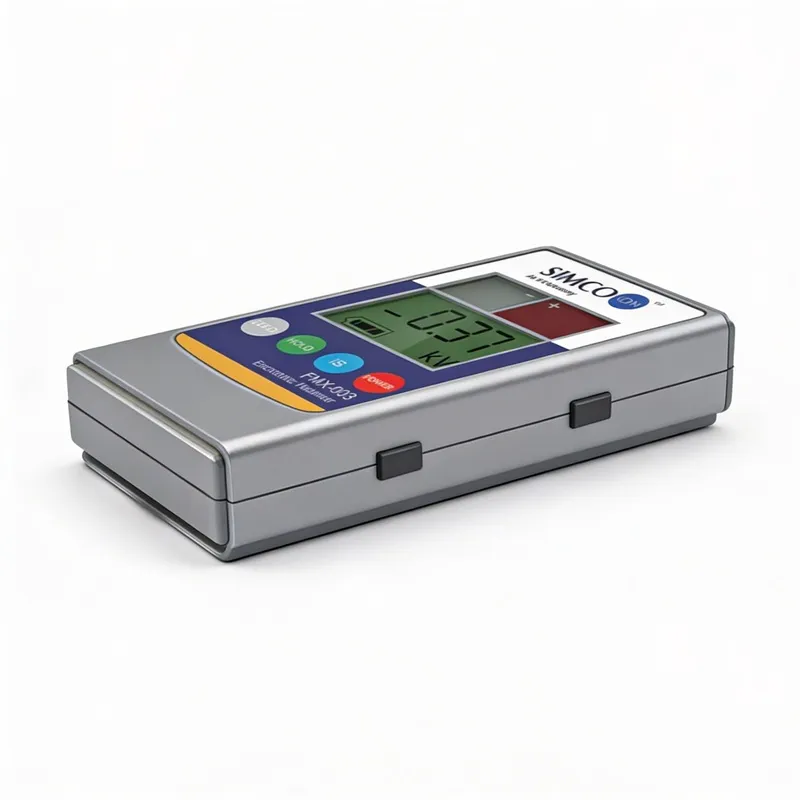
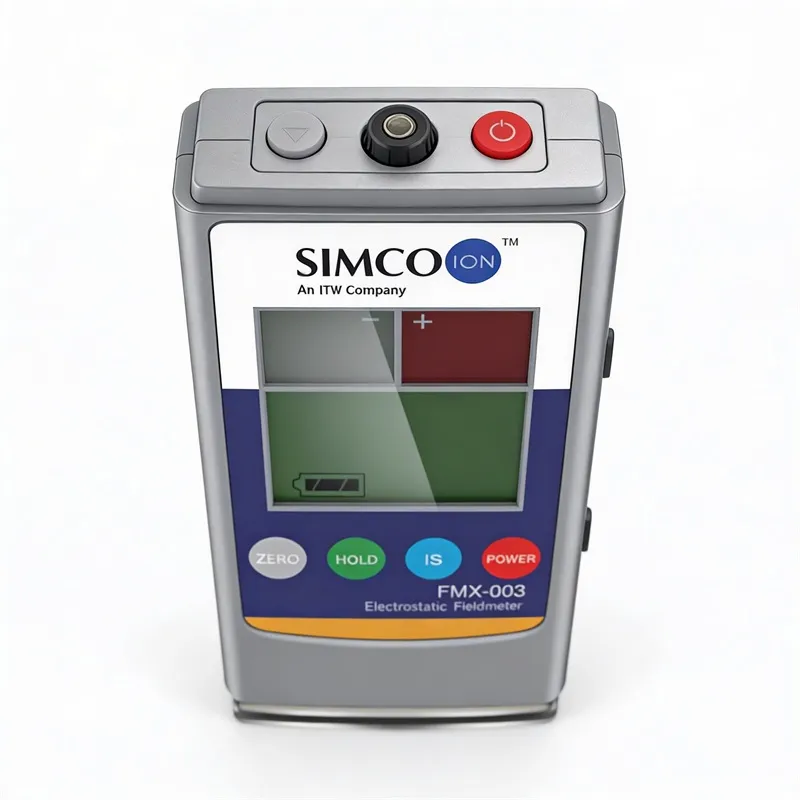
Mesurant de champ électrostatique FMX-003 détecteur de tension statique portable
Aperçu
Introduction
If you’ve ever had to track down the source of an unexplained ESD failure or verify whether your ionisers are actually doing their job, you know that static charge is invisible but anything but harmless. That’s where an appareil de mesure de champ électrostatique comes in. Unlike resistance testers that require physical contact, these handheld devices let you measure static charge on surfaces from a safe distance—quickly, reliably, and without disturbing the object under test. Whether you’re auditing a production floor, troubleshooting a cleanroom issue, or simply doing routine static surveys, a good electrostatic field meter is your eyes for the invisible.
What Exactly Is an Electrostatic Field Meter?
At its core, an appareil de mesure de champ électrostatique is a non‑contact instrument that detects the electric field generated by a charged object. It works on the principle of electrostatic induction—sensing the field strength and converting it into a voltage reading, typically in kilovolts per unit distance. Because it doesn’t draw any current from the object, it can measure delicate electronic components, packaging materials, and even human body charges without affecting the charge itself. This makes it fundamentally different from a surface resistance tester, which measures ohmic conductivity.
The SIMCO FMX‑003 Electrostatic Field Meter
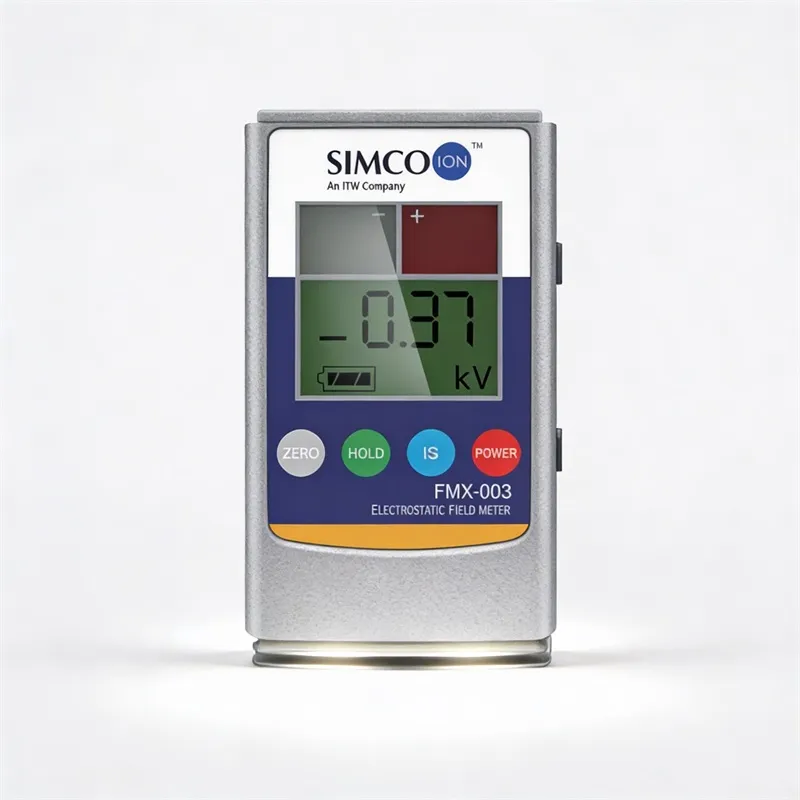
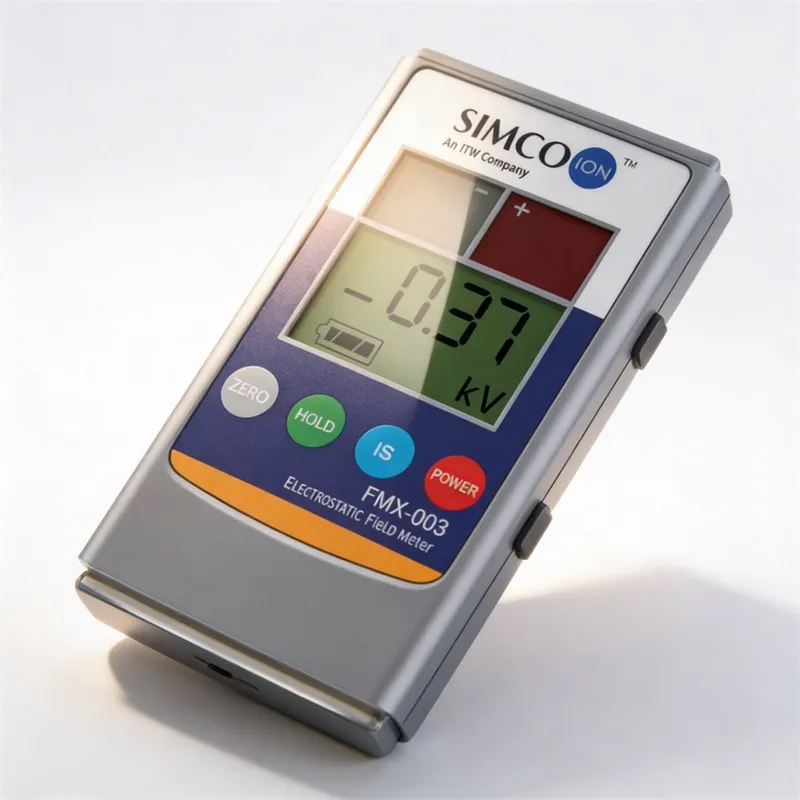
If there’s one model that has earned a reputation for reliability in the ESD community, it’s the SIMCO FMX‑003 electrostatic field meter. This pocket‑sized unit measures static voltages up to ±22 kV at a fixed distance of 1 inch (25 mm) – a distance that’s easily maintained thanks to two built‑in LED guide lights that show you exactly where to position the sensor. The display gives you both a numerical value and a colour‑coded bar graph (red for positive, blue for negative), so you can read results at a glance even in dim lighting. It also includes an ion balance mode for checking ioniser offset voltage (0 to ±220 V), a HOLD function to freeze readings, and an audible alarm for out‑of‑range measurements. Weighing just 170 g and featuring a conductive case with a grounding snap, it’s designed for real‑world field use—not just lab conditions.
Why Electrostatic Field Meter Calibration Matters
You might have the best instrument on the market, but without regular electrostatic field meter calibration, your readings are just educated guesses. Calibration ensures that the sensor’s response remains linear and accurate over time, compensating for component drift and environmental factors. Reputable manufacturers typically provide NIST‑traceable calibration certificates with each unit, and industry best practice recommends recalibration at least annually—or more frequently if the meter sees heavy use. Standards like IEC 61340 outline specific procedures for verifying performance, including test voltage levels, distance accuracy, and environmental conditions. Skipping calibration isn’t worth the risk: a false low reading could leave you with an unchecked static hazard, while a false high reading might send you chasing problems that don’t exist.
Where You’ll Actually Use a Handheld Electrostatic Field Meter
The list of applications for a handheld electrostatic field meter is longer than most people think. In electronics assembly, it’s the go‑to tool for auditing ESD workstations, checking charge buildup on PCBs and components, and verifying that packaging materials aren’t generating excessive static. In cleanrooms and medical device manufacturing, it helps prevent particle attraction—static charges can pull in dust and contaminants, compromising product sterility. In printing and converting, it identifies static issues that cause ink misregistration or material misalignment. And in R&D labs, it’s used for material characterisation and comparative studies. Essentially, any environment where static charge could affect quality, safety, or reliability is a candidate for regular electrostatic field meter use.
Spécification technique
| Modèle | Plage de mesure | Gamme de précision | Distance de test | Dimensions (L×l×H) | Poids |
| 3W-7802(FMX-003) | ±20 kV | 10% | 25 millimètres | 122×65×27 mm | 130g |
Capacité de fabrication ESD de classe mondiale
En vous approvisionnant auprès de Sanwei, vous vous associez directement à un fabricant OEM/ODM leader de l'industrie. Nous exploitons un site de pointe Installation de production intégrée de plus de 70 000 m² dans le parc industriel central de Yueqing, dans le Zhejiang, en gérant chaque processus, de la formulation des matériaux propriétaires au moulage final de produits de haute précision.
Échelle intégrée
Base de production avancée de plus de 70 000 m² équipée de machines de moulage par injection de haute précision pour charges lourdes afin de traiter les commandes en gros avec des délais stables.
Contrôle de bout en bout
Maîtrise interne complète couvrant la R&D de matériaux antistatiques propriétaires, l'ingénierie des moules structurels, la fabrication automatisée et la livraison logistique mondiale rapide.
Inspection rigoureuse
Des contrôles rigoureux des matières premières, associés à des mesures multipoints de la résistivité de surface effectuées sur la chaîne de production, garantissent la conformité du 100% aux directives des normes internationales en matière d'ESD.
Antistatique Produits et Solutions
Fournir une protection électrostatique complète tout au long de votre cycle de fabrication et d'exploitation.
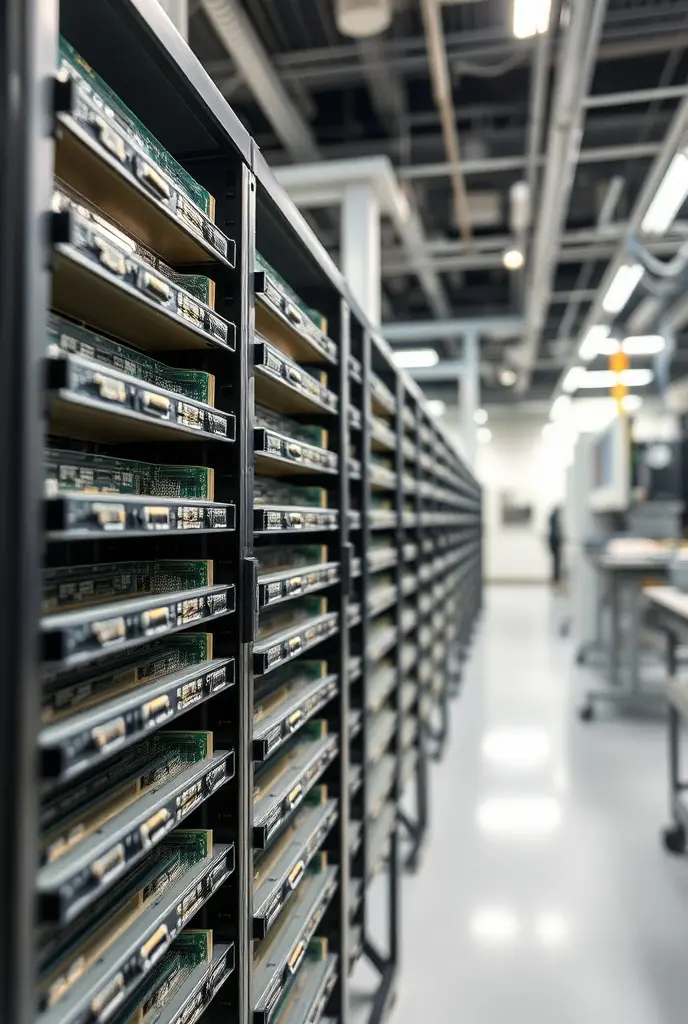
Matériel SMT
Boîtes et racks antistatiques pour lignes automatisées.

Stockage et Logistique
Chariots de manutention, étagères, boîtes, plateaux et conteneurs de composants.

Poste de travail & EPI
Chaises antistatiques, tapis, bracelets antistatiques et protection personnelle.
Développement personnalisé
Développement de moules sur mesure et matériaux antistatiques spéciaux.
NOS AVANTAGES OEM/ODM

R&D Avancé & Innovation en Matériaux
Matériaux antistatiques développés en interne bénéficiant de brevets d'invention nationaux et d'une résistance à la chaleur allant jusqu'à 200 °C. Nous ne faisons pas que mouler, nous formulons des composés.

Capacité de production à grande échelle
Usine de 30 000 m² dotée de systèmes complets de moulage par injection, de granulation et de traitement auxiliaire pour un approvisionnement stable et efficace.

Personnalisation complète du processus
Résistivité du matériau, couleur, taille, logo, emballage et certifications — personnalisables pour répondre aux normes CEI 61340-5-1, ANSI/ESD S20.20 ou militaires.

Qualité Certifiée & Conformité Globale
“Sanwei a développé avec succès des plateaux sur mesure résistants aux hautes températures, de couleur naturelle propre, pour notre chaîne d'assemblage de semi-conducteurs, remplaçant ainsi des produits importés, garantissant une excellente sécurité ESD et répondant aux exigences élevées de propreté de l'atelier.”
LA CONFIANCE DES LEADERS MONDIAUX DU FORTUNE 500
Nos solutions ESD propriétaires sont déployées dans des usines de production d'élite du monde entier, notamment : Intel, Motorola, Siemens, IBM, Panasonic, Nokia et Dell.
Vous recherchez des tailles sur mesure ou des tarifs de gros ?
Soutenue par notre solide équipe interne de R&D, Sanwei propose des options complètes d'OEM/ODM adaptées à vos lignes de production SMT ou à la disposition de votre entrepôt. Contactez nos spécialistes dès aujourd'hui pour des moules sur mesure, un code couleur ou un conseil en stockage 5S intégré.
Foire aux questions (FAQ)
1. What is an electrostatic field meter used for?
It detects and measures static charge on surfaces without touching them, helping you find ESD risks in manufacturing, cleanrooms, packaging, and labs.
2. What is the principle of electrostatic field meter?
It senses the electric field from a charged object by induction – the field induces a charge on the meter’s sensor, which is then converted into a voltage reading.
3. What is the electrostatic field meter FMX 004?
It’s a compact handheld model from Simco‑Ion, measuring up to ±30 kV at 1‑inch distance, with LED guides, colour‑coded display, and ion‑balance mode.
4. How does the electrostatic field meter work?
It places a sensor near the charged surface, picks up the field strength, converts that into an electrical signal, and displays the result as a voltage value.
5. What is the difference between electrostatic field meter and electrostatic voltmeter?
A field meter measures the overall field over a larger area; a voltmeter measures the exact voltage at a tiny, specific spot. Field meters are quicker for surveys; voltmeters are more precise for detailed analysis.