- Turbo
- Blog
ESD foam water absorption should be evaluated for the exact material, exposure and packaging function rather than assumed from color, density or a general ESD description. Ask whether moisture uptake could change mass, fit, handling or the evidence required for the application, then agree an appropriate material test and package trial. A water-absorption result is not a moisture-barrier rating, a resistance result or permission to wet an electronic component. This guide helps buyers distinguish the measurement from the broader packaging decision and request traceable evidence without assigning one universal limit to every foam family.
Define the exposure that the packaging may encounter
Describe the normal storage and handling route. Identify whether the foam is expected to remain dry, experience controlled humidity, undergo an approved cleaning process or face a credible accidental-wetting event. These are different conditions and should not be combined into one vague moisture-resistant claim. Record the enclosure, duration and environmental boundary relevant to the actual use.
If liquid exposure would violate the approved packaging or component procedure, a foam test does not make that exposure acceptable. Define containment and replacement rules separately. The study should answer the engineering question that actually exists, such as material comparison or recovery after a permitted process, rather than create a new operating practice around an attractive laboratory result.
Identify the exact polymer and construction
Record the supplier’s product code, polymer family, controlled grade, thickness and construction. Ask whether the specimen includes any facing, adhesive, coating or cut surface relevant to the final insert. A foam sheet, laminated pad and molded carrier can present different specimen questions. Do not transfer a result between them solely because their visible color is similar.
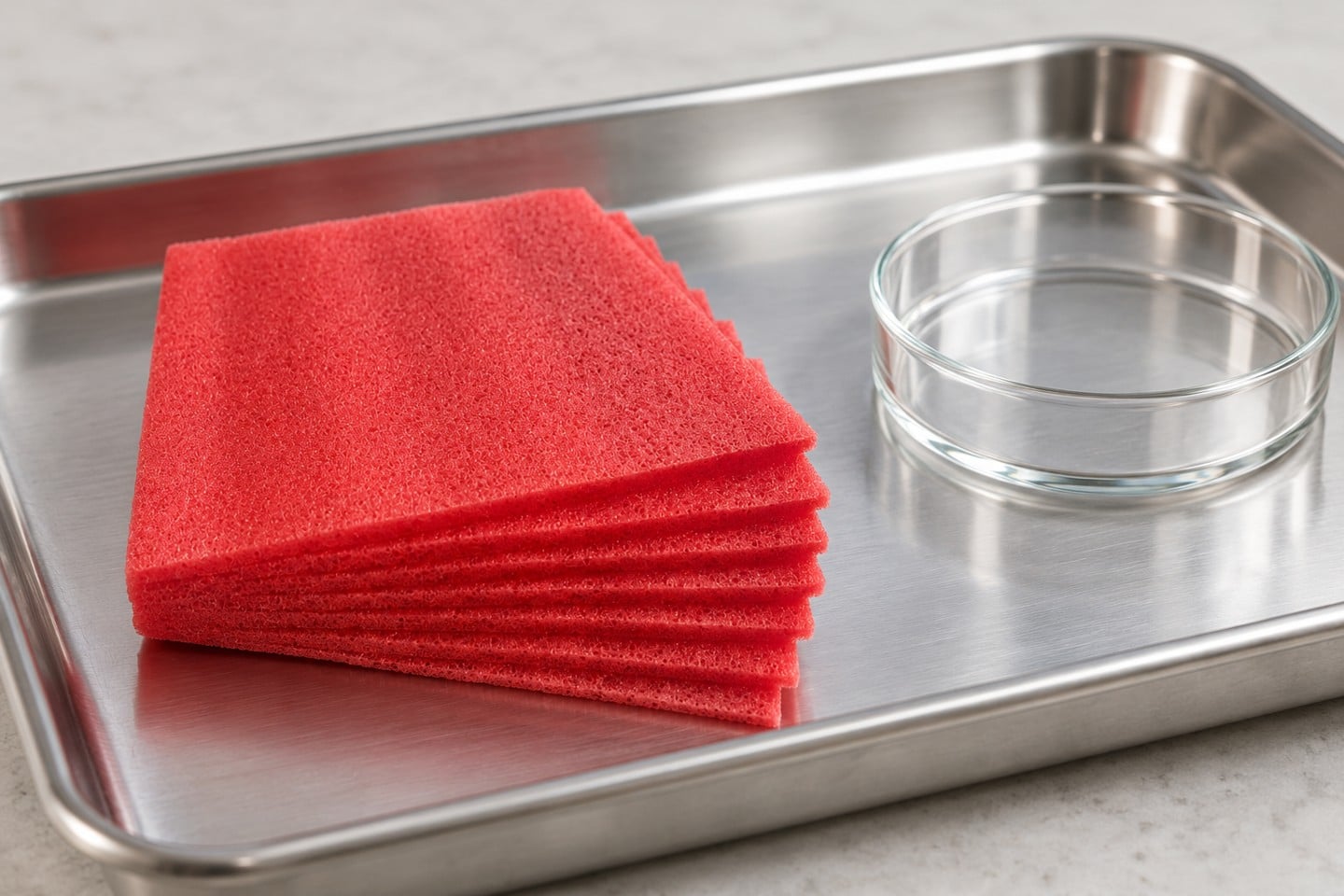
The SWESD foam sheet product lists several material families. That listing does not establish common water uptake, mechanical response or electrical performance. Request the exact offered specification and identify which material a report represents. Keep production-intent samples traceable so that the eventual purchase refers to the evaluated construction rather than only a family name.
Select the method with the laboratory
The ASTM D3575 overview concerns flexible cellular materials made from olefin polymers. The ASTM D570 overview concerns water absorption of plastics. Their public scopes are useful starting points, not permission to apply either procedure automatically to every ESD foam. Ask the laboratory which current complete method fits the actual material and engineering decision.
Agree specimen preparation, conditioning, exposure, post-exposure handling and calculation with the laboratory before testing. Record any deviations and their effect on interpretation. A custom engineering study can be useful when a standard procedure does not represent the application, but it must be labeled accurately. Do not describe it as standard compliance if the prescribed method and its applicability have not been established.
Separate absorbed moisture from surface liquid
A mass reading after exposure can be affected by how liquid remaining on the specimen is handled. Follow the chosen procedure rather than shaking, blotting, squeezing or waiting an arbitrary time until a preferred result appears. Record the preparation and timing that define the measurement. An unrecorded handling difference can make two reports incomparable even if both display the same units.
Keep initial and final observations, specimen identity and relevant equipment information with the calculation. Where a result is expressed relative to initial mass, retain the exact definition and reporting basis. Do not compare that result directly with a quantity expressed per volume or specimen without a justified interpretation. Unit conversion cannot remove a difference in the underlying exposure or preparation procedure.
| Decision input | Evidence to retain | Avoid assuming |
|---|---|---|
| Exposure | Actual storage or permitted process boundary | A lab test permits accidental wetting |
| Material | Exact family, grade and construction | Color identifies water uptake |
| Method | Applicable procedure and specimen preparation | Every plastic or foam uses the same method |
| Post-exposure handling | Defined surface-liquid treatment and timing | An arbitrary squeeze gives a comparable result |
| Package approval | Fit, cleanliness and ESD where required | Material uptake proves moisture-barrier protection |
Make open surfaces and final geometry part of the review
A cut insert can expose different surfaces from those represented by an uncut material sample. Cavities, thin walls and bonded layers may also change the practical configuration. Identify which specimen surfaces the laboratory evaluated and how they relate to the production part. Do not assume that a small material coupon establishes every feature of a finished carrier.
Review how the insert is supported, enclosed and removed from its carrier. If the application includes an approved wet process, establish whether liquid can remain in pockets or interfaces under that process. Keep such observations separate from the material test result. A useful package trial records the complete geometry and conditions rather than converting a coupon value into an unsupported claim about the whole assembly.
Evaluate dimensional and mechanical consequences separately
Where moisture exposure is relevant, assess the resulting fit, support and handling under an approved plan. Use representative safe samples while the configuration remains unaccepted. Record whether an item moves, contacts an unintended surface or becomes difficult to remove. Do not expose valuable components merely to see whether a candidate foam appears to work after wetting.
The foam compression recovery guide addresses a different property: remaining thickness loss after defined compression and recovery. The density and firmness guide separates mass-per-volume information from mechanical response. Use these assessments as complementary evidence where needed; none can be inferred solely from a water-uptake measurement.
Keep electrical verification independent
The EOS/ESD Association materials guidance places packaging within a complete control program. A water-absorption result cannot establish resistance, charging characteristics or shielding. If the accepted application includes a relevant conditioning state, the ESD owner should determine the required electrical method and acceptance criteria for that state.
Do not infer performance from a temporarily damp specimen or apply an improvised probe reading as a substitute for the specified method. Record the exact conditioning and measurement arrangement in the electrical report. Keep the material and electrical decisions traceable to the same product identity, while preserving their separate procedures and scope. A favorable result in one category does not erase a failure or missing requirement in another.
Do not confuse water uptake with package moisture protection
A foam’s behavior in a material test does not establish the moisture transmission of a sealed bag, the condition of a component or the validity of a storage extension. Those questions involve their own requirements and evidence. Identify the role of any protective bag, desiccant or other constituent under the approved component and packaging procedure rather than asking foam to provide an unverified barrier function.
For a complete carrier, the EVA tray guide explains the broader positioning and support decision. If the application involves long storage, keep component requirements separate from packaging-material condition. Do not release an exposed or wet electronic item simply because the insert appears dry or a supplier describes the foam as moisture resistant.
Set acceptance criteria and recovery rules in advance
The responsible materials or process owner should define the study objective, method, acceptable result and decision scope before reviewing the data. This guide provides no universal absorption limit or drying time. If the application has no established criterion, label an initial comparison as exploratory and state what additional assessment is required for release.
Define what happens after accidental wetting or an unapproved storage excursion. Isolate the affected configuration and retain identity and observations. Do not assume that drying restores its original mechanical, contamination or electrical state. Manufacturer instructions and the site’s qualified process govern whether recovery is permitted, what must be checked and when replacement or disposal is the appropriate controlled disposition.
Turn the evidence into a clear supplier request
Provide the intended route, material identity, insert geometry, exposure question and required application trial. Ask for reports with their method, preparation, units and limitations. Request clarification when the supplier offers only a broad water-resistant statement. The useful response should connect the offered foam to evidence relevant to the actual decision.
Preserve the accepted specification, sample and reports for repeat orders. Define which changes to material, processing, thickness, adhesive or maintenance require review. Incoming inspection should confirm the supplied identity and route unexplained substitutions for approval. This approach supports consistent purchasing without claiming that one material measurement predicts all humidity, wetting, component-storage or ESD outcomes.
Educational background
The EOS/ESD Association video below introduces electrostatic control. It does not measure foam water absorption or qualify a moisture-protection package. Use the applicable material procedure and approved application assessment for those separate decisions.
Frequently asked questions
Does low water absorption prove ESD suitability?
No. The applicable electrical requirements need their own evidence for the exact material and evaluated state.
Can the same method be applied to every foam family?
Confirm applicability with the laboratory using the current method and actual material.
Does this test establish a moisture barrier?
No. It does not establish a sealed package's transmission performance or the condition of the protected component.
Can a wet insert simply be dried and reused?
Follow manufacturer instructions and the qualified site process; drying alone does not prove restoration of all relevant properties.
What should a report identify?
The specimen, method, preparation, exposure, post-exposure handling, calculation basis, units and decision scope.
Leave a Reply