- Turbo
- Blog
A cleanroom wipe absorbency test should identify both the amount of liquid a wipe can take up and how quickly it wets under the chosen procedure. Those are related but different questions. Neither result alone establishes that a wipe cleans a sensitive surface effectively, leaves acceptable residue or meets an ESD requirement. Buyers should compare the exact construction and supplied state under matched conditions, then verify the intended wiping task. This guide explains the evidence to request, the variables that can prevent a fair comparison and how to connect a laboratory uptake result to a practical purchasing decision.
Begin with the liquid and the cleaning task
Describe the actual residue, permitted cleaning liquid, surface and work sequence. A wipe used to remove a small localized spill has a different job from one used to apply a controlled amount of liquid to a surface. Record whether the wipe is supplied dry or prewetted and whether an operator adds liquid at the station. Do not select a candidate solely because its catalogue claims the largest capacity.
Define the desired outcome: removal, liquid delivery, final dryness or another application requirement. Include surface sensitivity and any restrictions from the equipment or product manufacturer. The operator’s work instruction should determine the trial boundary. A laboratory result obtained with a convenient liquid does not automatically describe the wipe’s behavior with the approved production liquid or contact sequence.
Distinguish uptake capacity from wetting behavior
Capacity describes the amount retained under a defined preparation, exposure and draining procedure. Wetting or sorption rate concerns the time-dependent behavior measured by the selected method. A report must state what it measured. Avoid comparing a time value with an amount value as though they answer the same question, and do not infer practical cleaning performance from either in isolation.
The IEST wiping-material practice overview is a starting point for discussing wipe evaluation with a qualified laboratory. Use the current complete method and application criteria to select procedures. This article does not reproduce a test method or assign a universal capacity or speed requirement. Ask which exact procedure supports a supplier’s claim before putting that claim into a purchase specification.
Identify the offered wipe rather than its family name
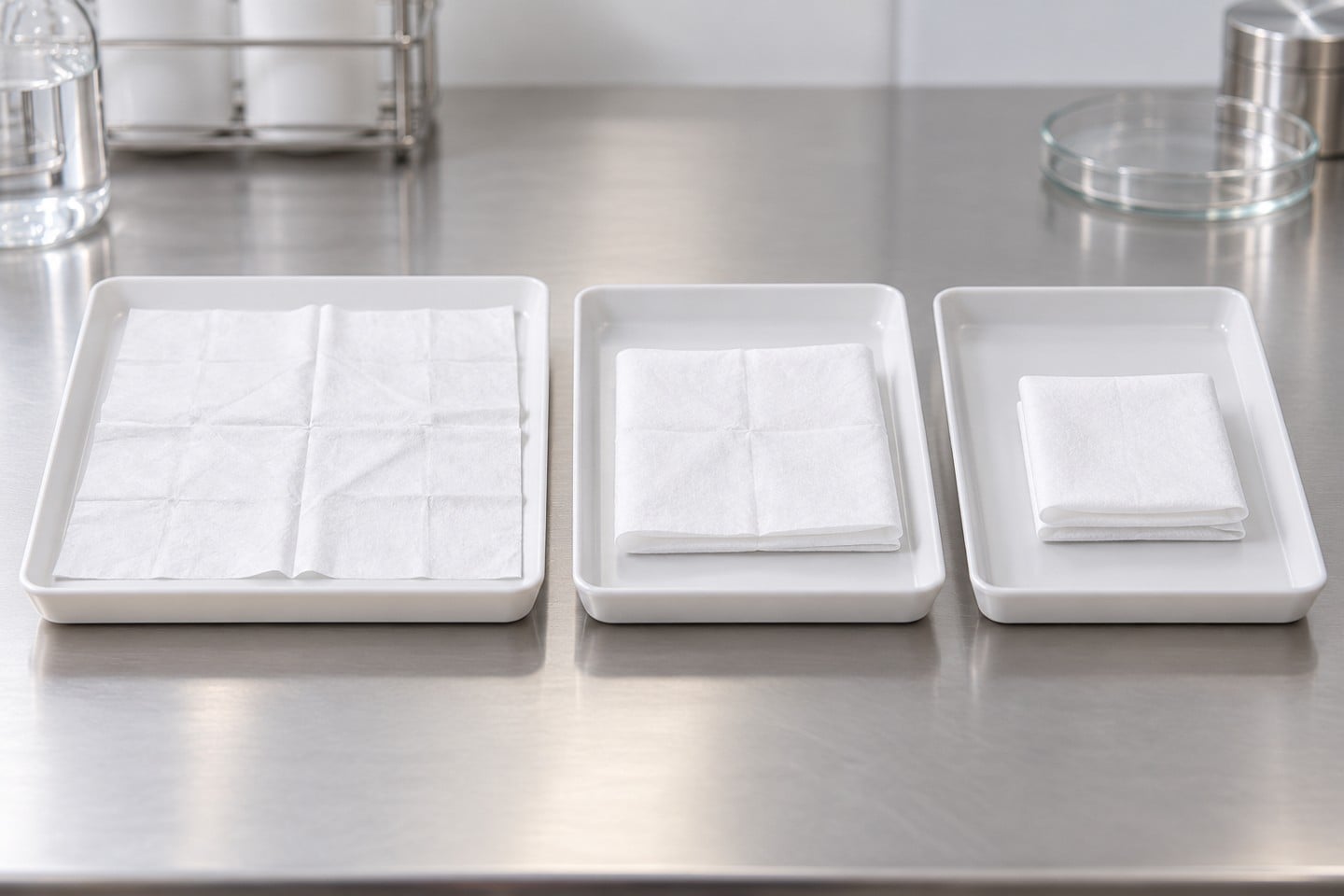
Record product code, material, construction, dimensions, edge treatment, processing and packaging. Ask whether the sample represents the version actually being offered. A report for a related size or a differently processed construction cannot be silently transferred to the delivery item. Keep sample identity and lot information connected to the result so that later orders can be reviewed against the same accepted configuration.
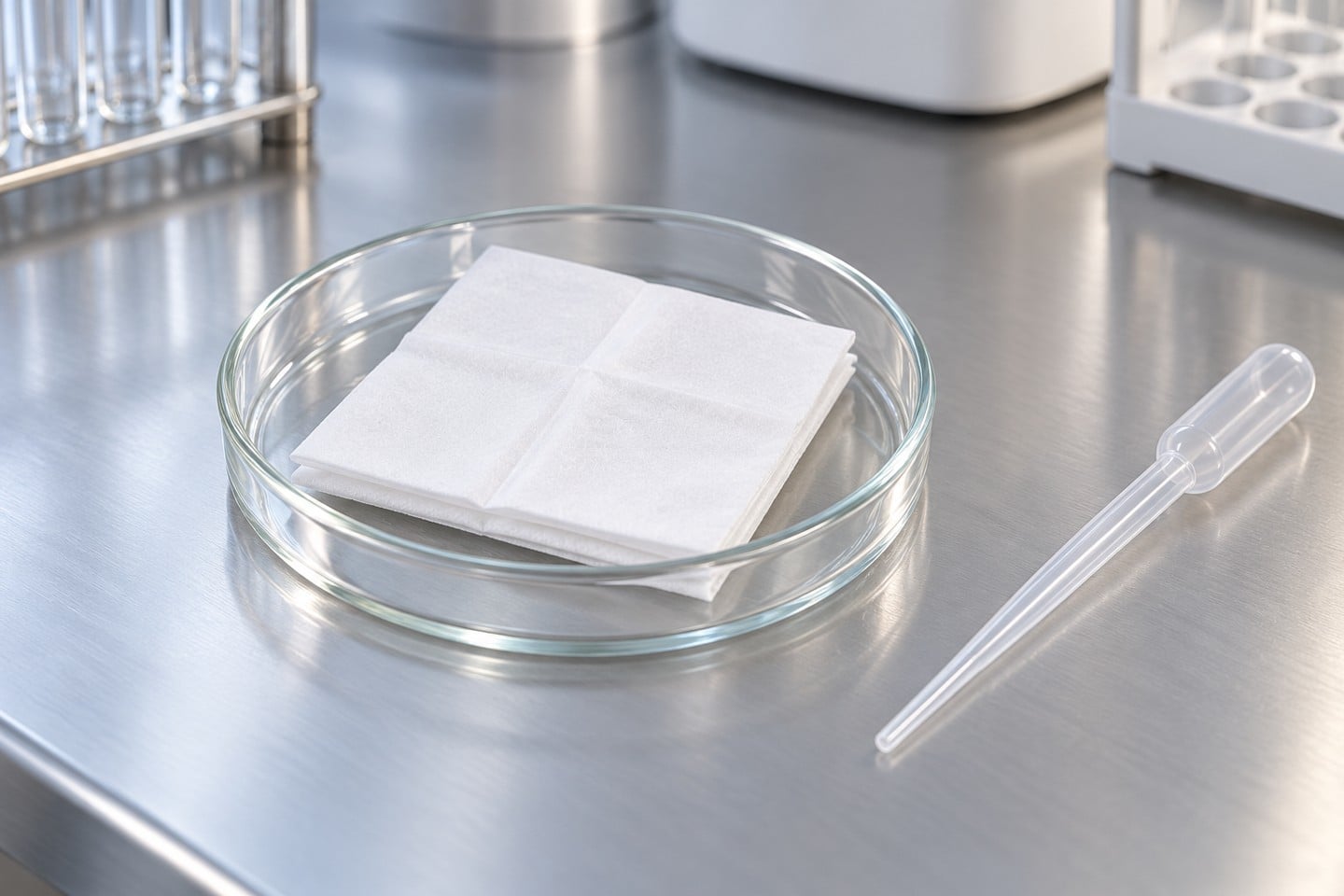
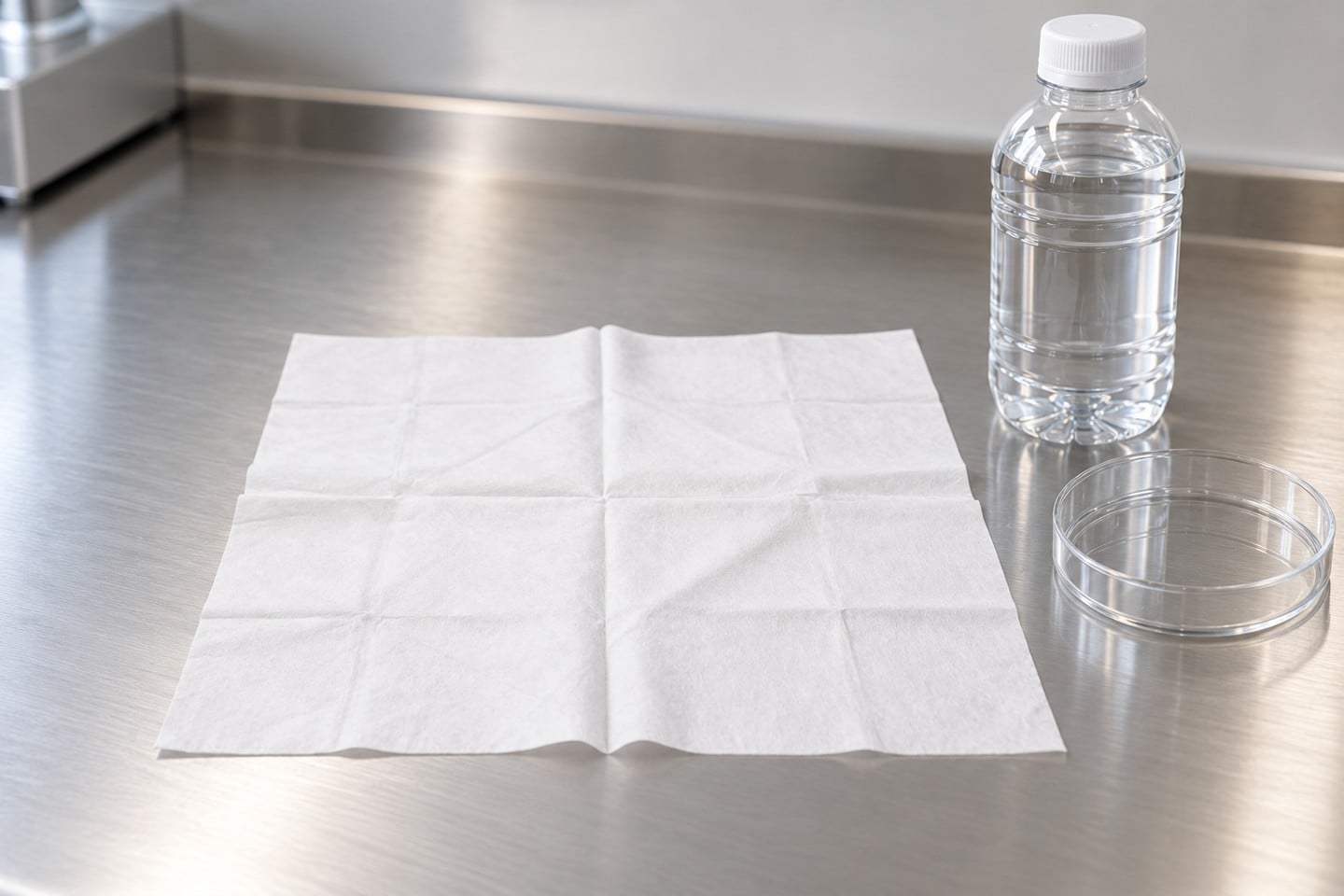
For a SWESD precision wiper sample, state the liquid and intended use rather than requesting only an absorbent wipe. The visible white square product and its folds do not establish a numerical uptake result or suitability for a particular process liquid. Request the current specification and production-intent samples, then confirm what the supplied evidence covers and which application checks remain necessary.
Make the specimen basis and units explicit
Ask whether capacity is reported per wipe, per unit area, relative to dry mass or on another defined basis. These forms can help answer different purchasing questions. Two wipes of different dimensions may have different total uptake simply because their sizes differ. A direct ranking needs a common basis appropriate to the actual task, rather than a preference for whichever headline number is largest.
Retain the original measured quantities, units and calculation definition. If a unit conversion is needed, document it and confirm that the underlying methods are otherwise comparable. A mathematical conversion cannot reconcile different preparation, liquid, draining or specimen conditions. Do not manufacture a common result from incomplete supplier summaries; ask the laboratory or supplier to clarify the missing basis first.
| Reported property | Required context | Do not infer |
|---|---|---|
| Capacity | Liquid, specimen basis and retained amount procedure | Largest capacity is always best for cleaning |
| Wetting behavior | Method and time-dependent endpoint | Rate and capacity are interchangeable |
| Units | Per wipe, area, mass or stated basis | Unlike sample sizes compare fairly without review |
| Application trial | Liquid, folding, contact and cleaning endpoint | Laboratory uptake alone qualifies the surface |
| Other evidence | Particles, extractables and ESD where required | Absorbency proves all protective properties |
Control liquid exposure and draining conditions
The selected procedure should specify the liquid, specimen preparation, exposure arrangement and how retained liquid is determined. Follow its requirements rather than varying contact time, agitation or draining informally between candidates. These details define what a capacity result means. An unrecorded squeeze or extra waiting period can change the measurement and prevent a defensible comparison.
Use the controls and equipment required by the chosen method. Record relevant deviations and sample handling. If the application uses a liquid different from the laboratory method, discuss a separate engineering comparison with the responsible process owner. Label it accurately and preserve its limitations. An application experiment should not be described as standard compliance when the prescribed method was not followed.
Evaluate liquid delivery as well as retention
For some processes, retaining all liquid inside the wipe is not the desired outcome. The task may require consistent wetting of a defined surface with controlled contact. Assess whether the accepted work instruction produces the required coverage and removal without uncontrolled pooling or redistribution. Keep the amount added, folding and wiping sequence consistent during the approved comparison.
Do not introduce an unapproved liquid to improve a candidate’s apparent performance. Follow the liquid safety information, ventilation and equipment restrictions. A wipe that takes up a liquid well can still be unsuitable because of residue, material compatibility or surface effects. The result should support the complete task rather than only a convenient demonstration of how much liquid disappears from a dish.
Check what remains after the wiping task
Inspect the approved trial surface using the process’s chosen observation or measurement method. Record streaks, residue, retained contamination, surface effects and the cleaning outcome as applicable. A visually dry surface is not proof of chemical cleanliness, and a clean-looking wipe does not establish that a sensitive surface meets its contamination requirement. Keep those decisions tied to suitable evidence.
The wipe ionic contamination guide explains why extraction conditions and analytical results matter separately. The wipe particle testing guide covers a different measurement family. Uptake, particles and extractables should remain distinct report fields, even when all three contribute to selecting the same wipe for a particular process.
Run a practical comparison with a clear endpoint
Use representative safe samples and an approved fixture or nonproduction surface while the candidate remains unqualified. Give operators the same work instruction and record the wipe identity, liquid, folding, contact and endpoint. Choose repetitions and sample selection with the process owner. The trial evaluates the configuration, not the relative skill or speed of individual operators.
Record unsuccessful attempts as well as acceptable outcomes. If a wipe requires more repetitions or changes the amount of liquid consumed, retain that information rather than reporting only its laboratory capacity. Time and cost can inform the decision, but an apparently fast or inexpensive method is not acceptable if it misses the required cleaning outcome or adds a new contamination problem.
Keep other qualification requirements separate
The IEST ISO 14644-18 overview addresses cleanroom consumable suitability in relation to requirements. A room classification or one absorbency figure is not complete product approval. Identify the construction, contamination, chemical, handling and electrostatic requirements relevant to the station, with a responsible owner and supporting evidence for each.
The ESD wipe selection guide provides the broader procurement framework. If ESD control is required, do not treat liquid uptake as proof of low charging or resistance behavior. Likewise, an ESD description cannot establish compatibility with a liquid or cleanliness of the final surface. The release record should explain which decision each result supports.
Translate the evidence into a repeatable purchase
Specify the accepted product and construction, required method and reporting basis, application trial and any approved restrictions. Keep the manufacturer’s current information with the accepted sample and report. Ask how changes to material, processing or packaging are communicated before delivery. A repeat order should refer to the controlled specification rather than a general request for the most absorbent option.
For receiving and production, define how missing identity, a changed construction or an unexpected cleaning result is handled. Keep suspect stock identifiable while the responsible person reviews it. A useful purchasing decision states what was tested, what the result establishes and where the application boundary lies, without claiming that one uptake measurement predicts every cleaning task or future liquid combination.
Educational background
The EOS/ESD Association video below introduces electrostatic control for electronics work. It does not demonstrate an absorbency method or validate cleaning performance. Use the agreed wipe evaluation and process trial for those separate decisions.
Frequently asked questions
Are capacity and wetting speed the same?
No. They describe different outcomes and must be interpreted with their methods.
Can results per wipe be compared across sizes?
Consider size and the reporting basis before ranking products; a larger wipe can hold more because of its dimensions.
Does high capacity prove effective cleaning?
No. Evaluate the actual liquid, surface, residue removal and final condition under an approved process.
Can a different liquid be used just to improve the result?
Do not substitute an unapproved liquid. Any engineering comparison must be authorized and accurately labeled.
What belongs in the RFQ?
Identify the exact wipe, liquid, task, required method and units, contamination requirements and application trial.
Leave a Reply