- Blog
Independent drawer-style ESD bins and stacked drawer columns use the same drawer family to solve different workstation problems. Keep drawers independent when the station holds few part numbers, needs prime-reach access, or moves often; build a column when bench footprint is scarce, the part count is high, and column height, load, and pull rules are documented. Confirm the selected model and layout in the RFQ, not from a photo.
Both layouts live inside the ESD Bin category and draw on the same enclosed pull-out format. What changes is the arrangement: a few drawers at reach height on the bench, or an interlocked vertical column beside it. For what the drawer format itself is — materials, sizing, and procurement basics — see the live stackable drawer storage overview; this comparison stays on the layout decision.
Part 1. What separates the two drawer layouts at a workstation?
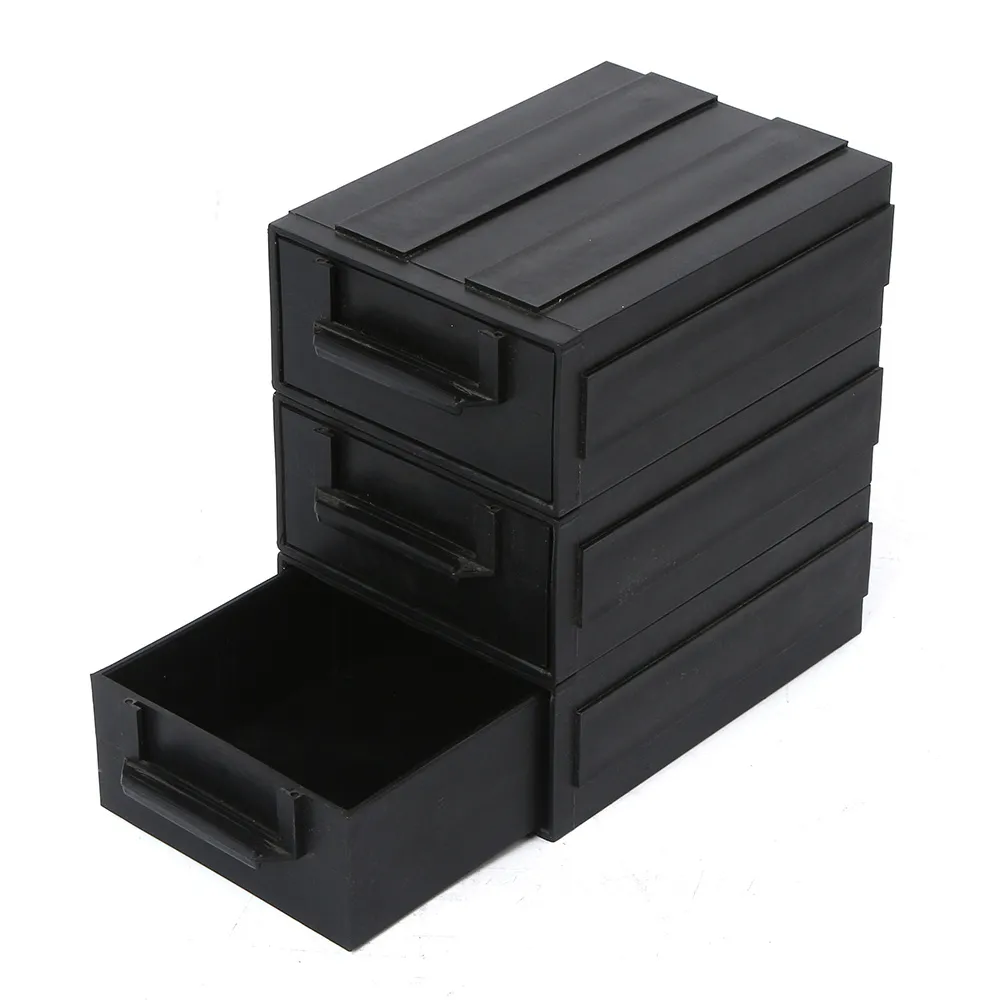
One format, two arrangements. An independent drawer bin sits alone on the bench or a shelf, opens toward the operator, and can be picked up and moved as a unit. A stacked column interlocks several drawer bins vertically — and sometimes side by side — so one footprint serves many part numbers.
| Attribute | Independent drawer bins | Stacked drawer column |
|---|---|---|
| Footprint use | One footprint per unit | One footprint for the whole column |
| Access height | Wherever each unit is placed | Fixed by position in the column |
| Relocation | Move units one by one | Move as a column or rebuild it |
| Part-number density | Low to moderate | Moderate to high |
| Failure mode to manage | Bench clutter and lost units | Stability, top-heavy loading, and pull conflicts |
The question is not which arrangement is better in general. Bench measurements, part counts, and how often the cell changes decide it, and those inputs belong to the buyer’s layout review rather than a catalogue page.
Part 2. When do independent drawer bins fit the bench?
Few part numbers, high touch frequency. A repair bench pulling the same connectors all shift, a test station with a handful of consumables, or a kitting desk that swaps stock per work order all favor two or three drawers placed exactly at reach height.
Relocation matters more than teams expect. Cells that get rearranged quarterly punish tall assemblies; an independent unit survives every move, while a rebuilt column invites skipped interlocks and undocumented height creep.
Reach is the third driver. A drawer at elbow height opens with one hand and closes with a push, but the same drawer at the bottom of a column asks the operator to crouch below the bench line for every pick. Where the container-role guide points to point-of-use presentation as the main job, keep the count small and the height right.
Part 3. When does a stacked drawer column fit the station?
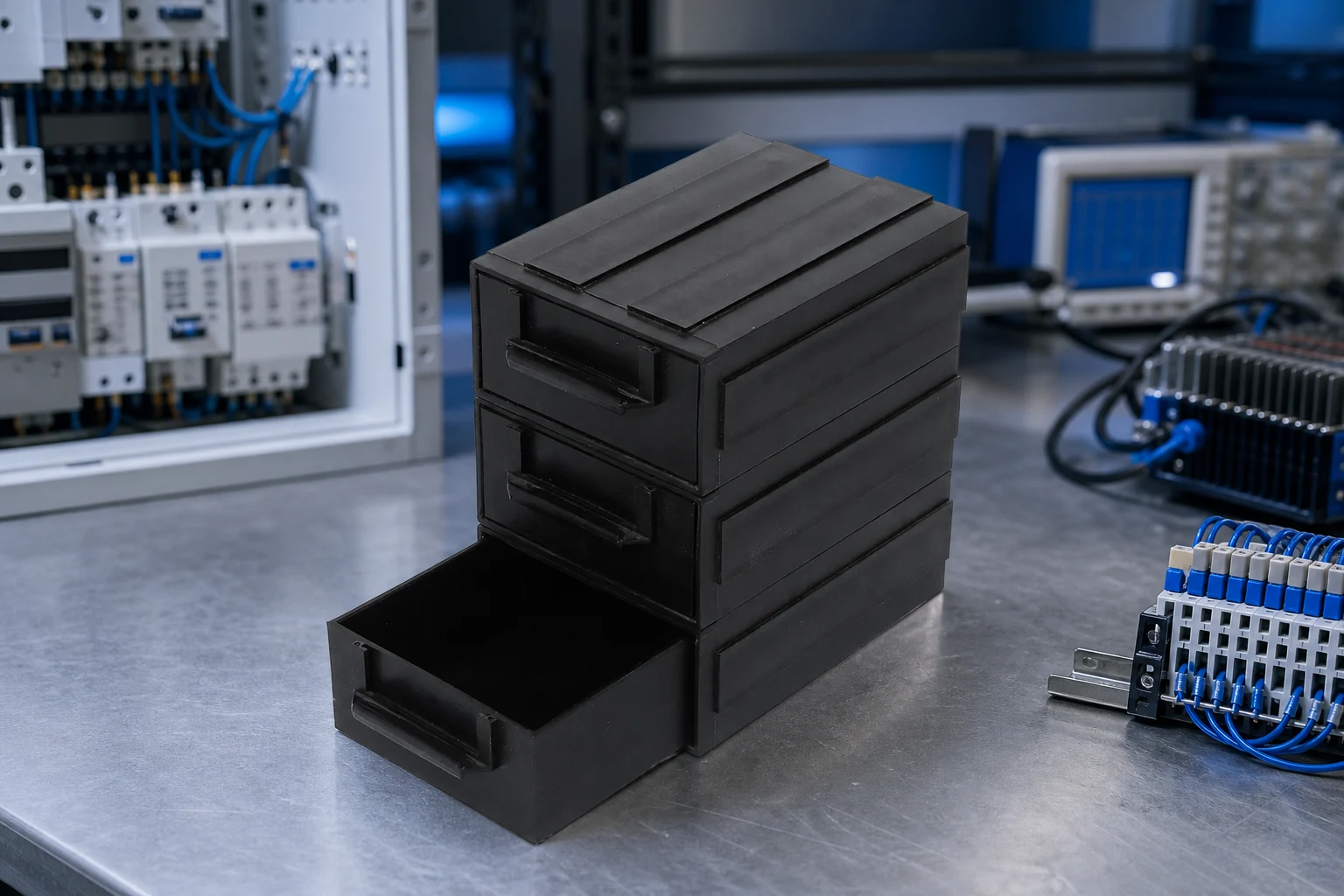
High-mix stations run out of horizontal space before they run out of parts. A column concentrates ten or twenty small-part locations in the footprint of one bin, which is why interlocked stacks appear beside assembly cells and in kitting corners.
Columns introduce process rules that independent units never need. Someone must own the maximum height, the heaviest-drawer-lowest rule, and what happens when two open drawers shift the center of gravity. Buyer questions about stability and load are verified with the supplier against the selected model and on a sample — a marketing photo of a tall stack is not a limit.
Position assignments also become fixed. In a column, each part number gets a level, so slow movers drift to the bottom and fast movers hold the reach band. That discipline is a benefit when the team maintains it and a hidden cost when nobody does; the drawer box product introduction shows the enclosed format this discipline protects.
Part 4. Which layout factors decide between the two?
Score the station before quoting. Five factors settle most cases.
| Factor | Favors independent drawers | Favors a stacked column |
|---|---|---|
| Bench depth and free footprint | Depth to spare at reach height | Footprint is the scarce resource |
| Part-number count at the station | Under roughly a dozen locations | Dozens of small-part locations |
| Relocation frequency | Frequent cell changes | Stable, long-lived station |
| Weight profile | Heavier or mixed part weights | Light parts with documented load rules |
| Ownership of layout rules | No owner for column discipline | A named owner maintains height and pull rules |
Labels follow the layout. Independent units can carry identification on the drawer face alone; a column needs both a drawer-face label and a column map so a missing drawer is noticed and returned to the right level. Field content stays the same in both cases: part number, description, location, and a revision or date.
Replenishment differs, too. Bench drawers usually refill from a kitting cart, while a column often becomes the kitting point itself, which changes who opens which drawer and how often.
Part 5. What do the cited Sanwei pages support, and where are the boundaries?
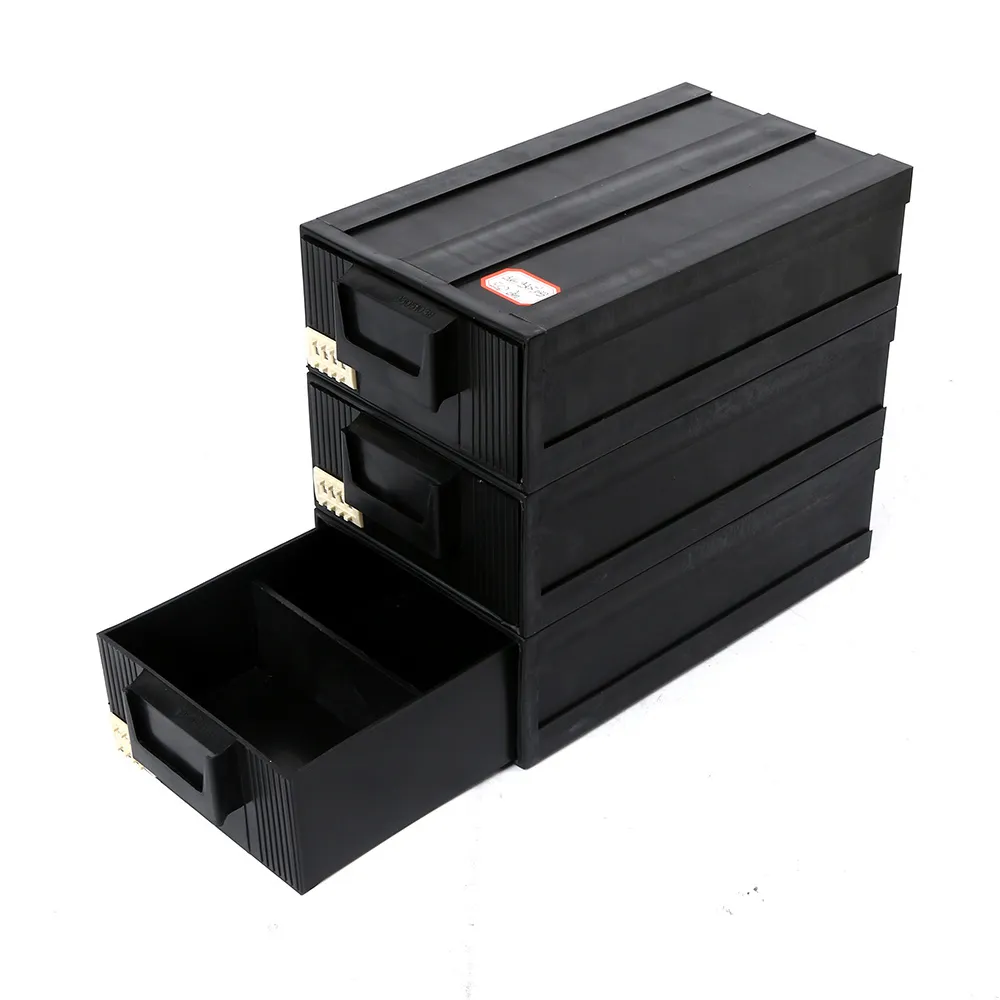
The published Sanwei ESD Component Bin With Drawer page describes enclosed pull-out storage with divider slots and optional plug-in panels, interlocking slots on the top, bottom, left, and right for modular combination, an ergonomic drawer handle, a digital-counter option, optional anti-static label and partition, temperature-resistance customization, and a static index range of 10e4–10e8 ohm for listed models.
| Buyer requirement | What the cited pages support | What still needs RFQ confirmation |
|---|---|---|
| Enclosed drawer format | Family-level pull-out design language | Dimensions and drawer count for the selected model |
| Column building | Interlocking-slot combination on listed models | Column height, load behavior, and stability for the intended stack |
| Segregation inside a drawer | Divider slots and optional plug-in panels | Divider layout for the buyer’s part mix |
| Identification | Label option and label-holder language on the solution page | Label position, fields, and print method |
| Electrical class | Published 10e4–10e8 ohm family range | Model-level evidence against the buyer’s criteria |
Where bins and racks are specified together, the ESD Bin & ESD Rack solution page adds system-level context, including label-holder and grounding-compatibility language. None of the cited pages states a price, MOQ, lead time, or a bench fit for a particular station, so those stay in the quotation.
Part 6. Which ESD evidence and fit boundaries still apply?
Layout does not change the evidence discipline. Program-level context comes from IEC 61340-5-1 and the ANSI/ESD standards route, and the buyer’s EPA procedure defines grounding, handling, and acceptance regardless of how the drawers are arranged.
| Evidence request | Why it belongs in the file | Boundary |
|---|---|---|
| Quoted model and accessory list | Ties the layout to one configuration | Family pages are not model confirmation |
| Material identification | States what will be supplied | Color does not identify a material |
| Electrical evidence with test method | Matches the EPA acceptance rule | The family ohm range is confirmed per model |
| Column plan confirmation | Records the intended stack against the model | An interlock feature is not a load rating |
| Sample or lot traceability | Connects evidence to delivered goods | Keep it with receiving records |
Fit Boundary
| Buyer situation | Reasonable path | Avoid |
|---|---|---|
| Few part numbers, frequent cell changes | Independent drawers at reach height | Building a column no one will maintain |
| High-mix station with scarce footprint | Documented column with a named rule owner | Copying a stack height from a photo |
| Heavy hardware or mixed weights | Weight review in the RFQ before stacking | Assuming any drawer position carries any load |
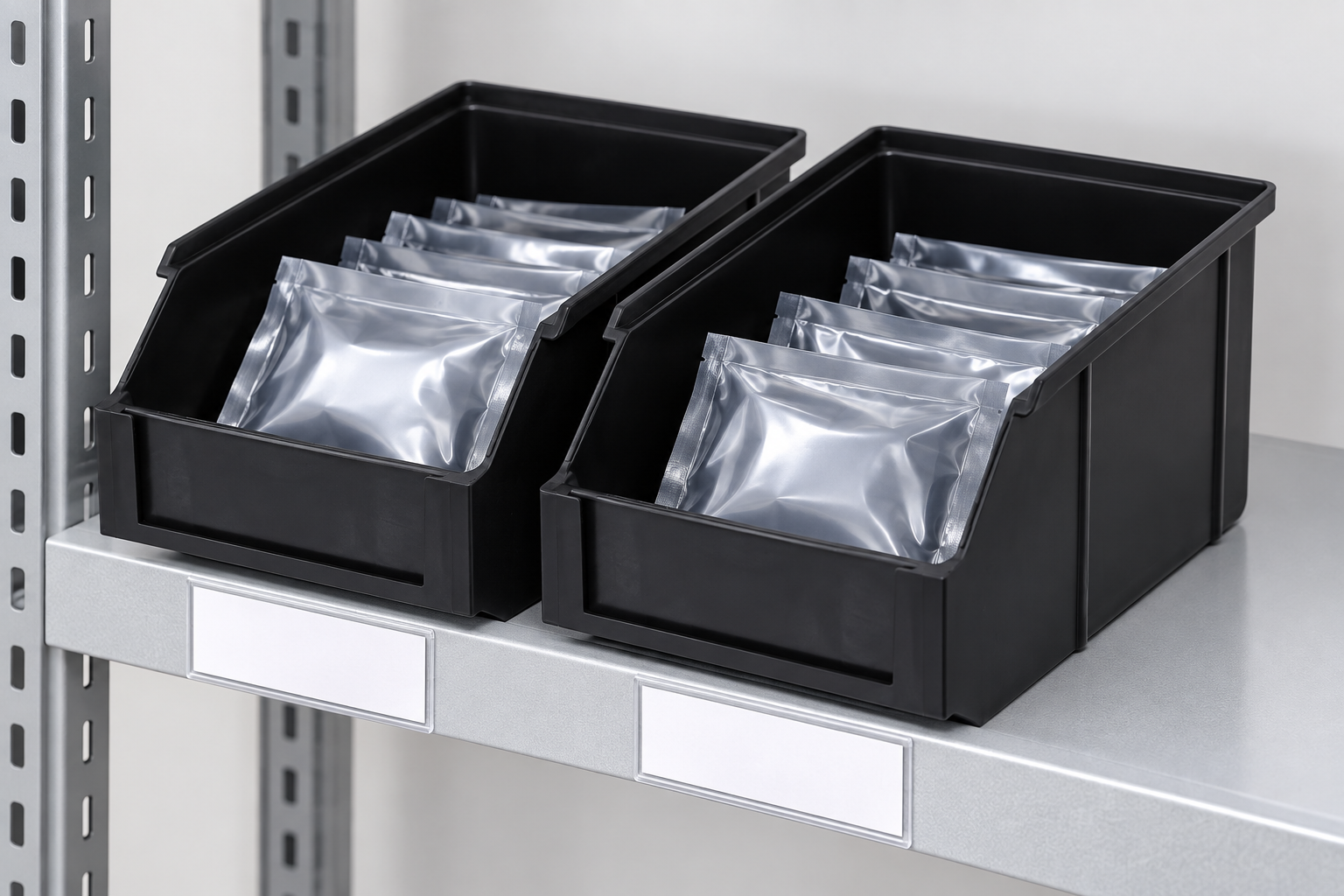
| Reels, trays, or moisture-controlled stock | Format review outside the drawer family | Forcing packaging into drawers to keep the look |
Part 7. What should the RFQ and sample review include?
State the layout decision inside the RFQ so the supplier quotes one configuration instead of a guess.
| RFQ field | Buyer input |
|---|---|
| Station summary | Cell type, bench measurements, and relocation frequency |
| Layout direction | Independent units, column intent, or both, with height intent |
| Part data | Part numbers per drawer, envelope, and weight class |
| Segregation | Divider or plug-in panel needs per drawer |
| Identification | Drawer-face fields, column map plan, and label method |
| Accessories | Digital-counter, label, or partition options to confirm |
| ESD requirement | Buyer-defined electrical criteria, test method, and acceptance rule |
| Commercial request | Quantity bands, destination, and required documentation |
| Sample plan | Station trial covering pull feel, stability, and label readability |
Product Recommendation
Start the model review with the Sanwei ESD Component Bin With Drawer once the layout direction is chosen — the same published family serves both arrangements through stacking and interlock options confirmed per model. This is an RFQ starting point, not a claim that a listed model or column height fits a specific bench.
Do not lock a column design from an image or from another site’s stack. Ask Sanwei to confirm the selected model, intended column plan, accessories, electrical evidence, and commercial terms in writing, then rehearse the layout with samples at the actual station.
Send the bench measurements, layout direction, part data, label plan, and acceptance criteria through Contact Sanwei for quotation review.
FAQ
What is a drawer-style ESD bin used for?
It provides enclosed, pull-out storage for small ESD-sensitive parts at benches, kitting desks, and repair stations, keeping stock covered between picks while staying at hand. The published Sanwei family adds divider slots and optional panels for internal segregation.
Are stackable drawer ESD bins stable at a workstation?
Stability depends on column height, drawer loads, and pull behavior, which the buyer verifies with the supplier against the selected model and on a sample. Interlocking slots are a published family feature, not a load rating.
Should drawers sit on the bench or in a stacked column?
Keep them on the bench when part counts are low, reach matters most, or the cell relocates often. Build a column when footprint is scarce, part counts are high, and a named owner maintains the height and pull rules.
How many drawer bins can be stacked safely?
No cited page states a universal limit, so treat the intended column as an RFQ question: state the height, loads, and environment, and ask for confirmation against the selected model before committing the layout.
What should be labeled on a drawer-style bin?
Use the drawer face for part number, description, location, and a revision or date. Columns add a column map so a removed drawer returns to the correct level.
What ESD evidence applies to drawer bins?
Request the quoted model, material identification, electrical evidence against the buyer’s own criteria with the test method stated, and traceability from the reviewed sample to supplied lots.
How is this different from the stackable drawer storage overview?
The live overview explains the format itself — materials, sizing, and procurement. This comparison assumes the format and decides the workstation layout: independent units at reach height versus a documented column.
What should be confirmed on a sample?
Check drawer pull feel, divider layout, label readability, the intended column behavior with realistic loads, and the ESD evidence required by the buyer’s program at the actual station.
Leave a Reply