- Blog
“Heat resistant” only becomes a specification when it meets a documented exposure profile. Sanwei’s tray pages publish concrete temperature wording — 120°C and 150°C customization options, a 160°C row-group note, and IC tray rows with a temperature MAX of 150 — and the buyer’s job is to match a measured duty to those notes, then confirm the row and evidence in the quotation.
The tray families sit on the ESD Tray category page. For the lidded-container side of the same heat question, see the heat-resistant ESD box guide.
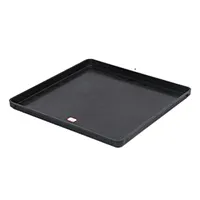
Part 1. Define the heat job on a high-turnover line
High-turnover lines put trays near warmth far more often than in it. Boards leave a dryer or oven still warm and land in trays; assemblies queue beside heated processes; wash bays run hot water and heated drying; and the same trays repeat that loop many times per shift.
That repetition is the actual duty. A tray that tolerates one warm board can still creep, cup, or soften over hundreds of warm cycles, and a deformed tray then fails at its real job — stable staging, stacking, and turnover.
Name the job before the number. A tray holding warm boards at a dryer exit, a tray cycling through a hot wash, and a chip tray entering a bake oven are three different specifications that happen to share the word “heat.” The reflow rack staging guide covers the rack case, which is a fourth.
| Heat scenario | What the tray experiences | Specification driver |
|---|---|---|
| Warm parts off process | Contact heat from the carried item | Part temperature and dwell per cycle |
| Staging beside heated equipment | Ambient warmth, long hours | Zone temperature and residence time |
| Hot wash and heated drying | Water and air temperature plus chemistry | Cycle temperature, frequency, agents |
| Component bake (chip formats) | Oven exposure by procedure | Published bake-capable rows |
Part 2. Document the exposure profile before shopping
Four numbers and two facts turn “heat resistant” into a requirement: peak temperature at the tray surface, dwell time per cycle, cycles per shift, and the total service expectation, plus what the tray carries while warm and where the contact happens.
Measure at the tray, not at the process setpoint. A dryer set high may deliver far less at the tray surface; a dense stack of warm boards may deliver more, for longer, than the zone reading suggests. A simple surface probe during a normal shift usually settles the argument.
| Worksheet field | Quoi enregistrer |
|---|---|
| Peak at tray surface | Measured value during normal operation |
| Dwell per cycle | Minutes the tray stays at or near the peak |
| Cycles per shift | How often the loop repeats |
| Carried load while warm | Item, weight, and contact area |
| Wash and dry exposure | Temperatures, frequency, and agents in use |
| Service expectation | Months of duty before replacement review |
Include the wash bay even if it feels routine. Heated washing is a thermal-plus-chemical duty at high cycle counts, and it belongs in the same profile the supplier sees.
Part 3. Read the published ESD Tray temperature notes
The published Sanwei ESD Tray product page treats temperature as a configurable attribute. Model-row groups show temperature resistance customization checkboxes for 120°C and 150°C, so the heat capability is requested per row rather than assumed for the family.
Two more published details sharpen the reading. One row group carries a High temperature resistant 160°C note — worth naming in the quotation so the exact model attribution is confirmed — and a footnote defines temperature resistance as the maximum temperature the carrier can withstand with the PCB board, which tells the buyer what the numbers claim and what they do not.
Published rows also record dimensions, wall thickness, weight, and a 10e4-10e8 Ω static index, so the thermal request rides on a complete row selection. Ask for the temperature option in writing for the selected row; the checkboxes mark what can be requested, not what every row ships with.
| Published note | How to use it | Do not infer |
|---|---|---|
| 120°C / 150°C customization checkboxes | Request the option for the selected row against the profile | That every row carries either option by default |
| High temperature resistant 160°C row-group note | Name the row group and confirm the model in the quote | Which other models share that note |
| Footnote defining temperature resistance | Align the wording with the carried-PCB duty | Coverage of wash chemistry or unstated loads |
| Row-level static index 10e4-10e8 Ω | Keep electrical evidence tied to the same row | Acceptance under the buyer’s own method |
Part 4. Add the IC tray bake evidence where chips are involved
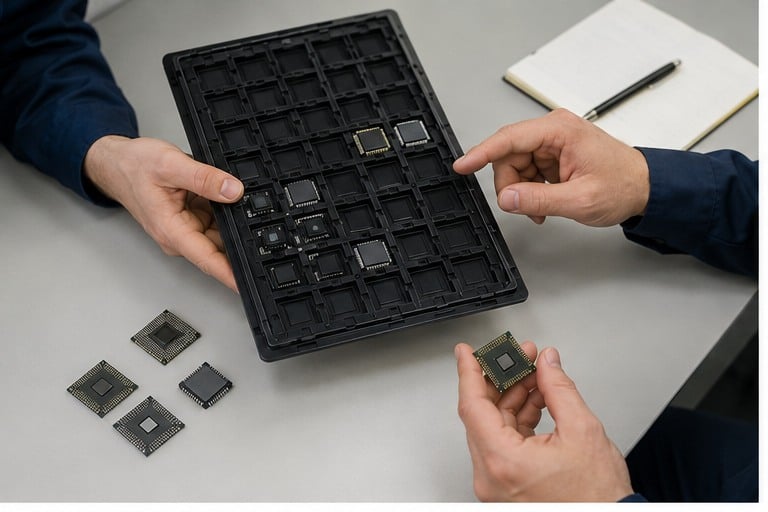
Chip formats change the reference page. The published Sanwei IC Tray product page explains that chips must be baked before terminal assembly and that tray material must therefore be heat resistant, and its listed BGA and QFN rows record a temperature MAX of 150 alongside matrix counts and surface resistance ranges.
That is the strongest published thermal evidence in the tray category, and it is scoped: it belongs to listed IC tray rows doing a bake-driven job, not to staging trays holding warm boards. Use it when the duty is actually a chip bake, and keep the two requests separate when a line runs both.
Part 5. Combine tray role and temperature need
Temperature never selects a tray alone. The role — open staging, partitioned kits, chip presentation — still decides the family, and the exposure profile then decides which published temperature wording the request must cite.
| Duty from the worksheet | Reasonable starting point | Request to confirm |
|---|---|---|
| Warm-board staging within a modest peak | ESD Tray rows with the 120°C option | Option availability and evidence for the selected row |
| Higher or longer warm cycles | ESD Tray rows with the 150°C option, or the 160°C row group | Exact model attribution and the exposure match |
| Chip bake procedures | Published IC tray rows at temperature MAX 150 | Format, matrix, and bake profile alignment |
| Hot wash as the dominant duty | Row selection plus the wash details in the RFQ | Combined heat-and-chemistry behavior on a sample |
Mixed lines usually end with two specifications: a staging tray with a requested temperature option, and a bake-capable chip tray where formats demand it. Writing both into one “heat resistant tray” line item is how mismatches reach the floor. The line-side tray staging guide helps keep the staging role itself well defined.
Part 6. Confirm evidence boundaries for heat and ESD claims
Hold every claim to its published scope. The tray pages support the 120°C and 150°C options, the 160°C row-group note, the footnote definition, and the IC tray temperature MAX 150 rows — nothing else thermal. Reflow or wave survival, resin softening data, and wash-chemistry ratings are not published for these trays and should be treated as quotation and sample questions.
Electrical evidence follows the same discipline under heat. Request the static index or resistance evidence for the selected row, the test method and conditions, and — where the duty is thermal — whether the evidence reflects the exposure the profile describes. ESD Association standards information frames the program requirement; it does not rate any tray for temperature.
Price, MOQ, lead time, and custom configurations stay in the quotation. A supplier can only answer those against the documented profile and the named row, which is precisely what the RFQ in Part 7 sends.
Part 7. Build the RFQ and sample plan
Attach the exposure worksheet, name the candidate row and temperature option, and define the trial that will settle acceptance. A heat-exposed sample check on the real loop beats any adjective in a catalogue.
| RFQ or sample input | Buyer should provide |
|---|---|
| Exposure profile | Peak at tray surface, dwell, cycles per shift, service expectation |
| Carried load | Item, weight, contact area, and state while warm |
| Wash and dry duty | Temperatures, frequency, and agents |
| Row and option request | Candidate row plus 120°C / 150°C option or the 160°C row group |
| Electrical evidence | Static index or resistance target, method, and format for the row |
| Sample trial | Real-loop exposure with flatness, stacking, and identification checks |
| Acceptance criteria | Written pass rules and who signs them |
| Quantities | Bands after the row and option are confirmed |
Product recommendation
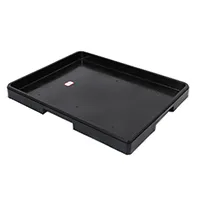
Start from the Sanwei ESD Tray product page when the documented profile fits tray-scale staging and the published temperature options, and from the Sanwei IC Tray product page when the duty is a chip bake. Send the exposure worksheet through Contacter Sanwei to confirm the selected row, the temperature option, and the evidence for the quotation.
Ajuster la limite
| Situation de l'acheteur | Chemin approprié | Éviter |
|---|---|---|
| Warm boards and staging duty | Match the profile to the 120°C / 150°C options on a selected row | Buying on the phrase “heat resistant” |
| Duty near the top of the profile | Name the 160°C row group and confirm the model | Assuming the note covers other rows |
| Chip bake procedures | Published IC tray rows at temperature MAX 150 | Sending staging trays into a bake |
| Hot wash dominates | Put wash temperatures and agents in the RFQ | Treating wash as a non-thermal duty |
| Reflow or wave exposure | A process review and explicit supplier confirmation | Inferring survival from any published note |
FAQ
What makes an ESD tray heat resistant?
For the buyer, it is a match between a documented exposure profile and the supplier’s published temperature wording for a named row, confirmed by evidence and a sample — not a material adjective.
What temperature options does Sanwei publish for ESD trays?
The ESD Tray page shows 120°C and 150°C temperature-resistance customization checkboxes on model-row groups, one row group with a High temperature resistant 160°C note, and a footnote defining what temperature resistance means.
Does Sanwei publish an IC tray temperature limit?
Yes. Listed IC tray rows record a temperature MAX of 150, with bake before terminal assembly described as the reason heat resistance matters.
Can an ESD tray go through reflow or wave soldering?
No published note supports that, so treat it as unconfirmed. Reflow and wave exposure need a process review and explicit supplier confirmation for a specific request.
How should a buyer state thermal exposure in an RFQ?
Give the measured peak at the tray surface, dwell per cycle, cycles per shift, the carried load while warm, wash details, and the expected service period.
Do washing and drying cycles count as heat exposure?
Yes. Heated washing combines temperature, chemistry, and high cycle counts, and it belongs in the same exposure profile as process-side warmth.
Is a heat resistant tray also chemical resistant?
Not automatically. The published temperature notes say nothing about chemistry, so list the agents in use and confirm combined behavior on a sample.
What should be checked on a heat-exposed tray sample?
Run the real loop: exposure at the documented peak and dwell, then flatness, stacking, identification, and electrical checks against written acceptance criteria.
Laisser un commentaire