- Blog
Un ESD tray for SMT is a conductive or dissipative staging container—often with dividers, grids, or lids—used to organize reels, waffle packs, and small assemblies beside pick-and-place and inspection stations. This guide explains tray types, material classes, sizing for SMT workflows, and what procurement teams should document before quoting. Written for global electronics manufacturing and EPA teams; specify 50 or 60 Hz plant power only where grounding interfaces matter, not for tray material selection.
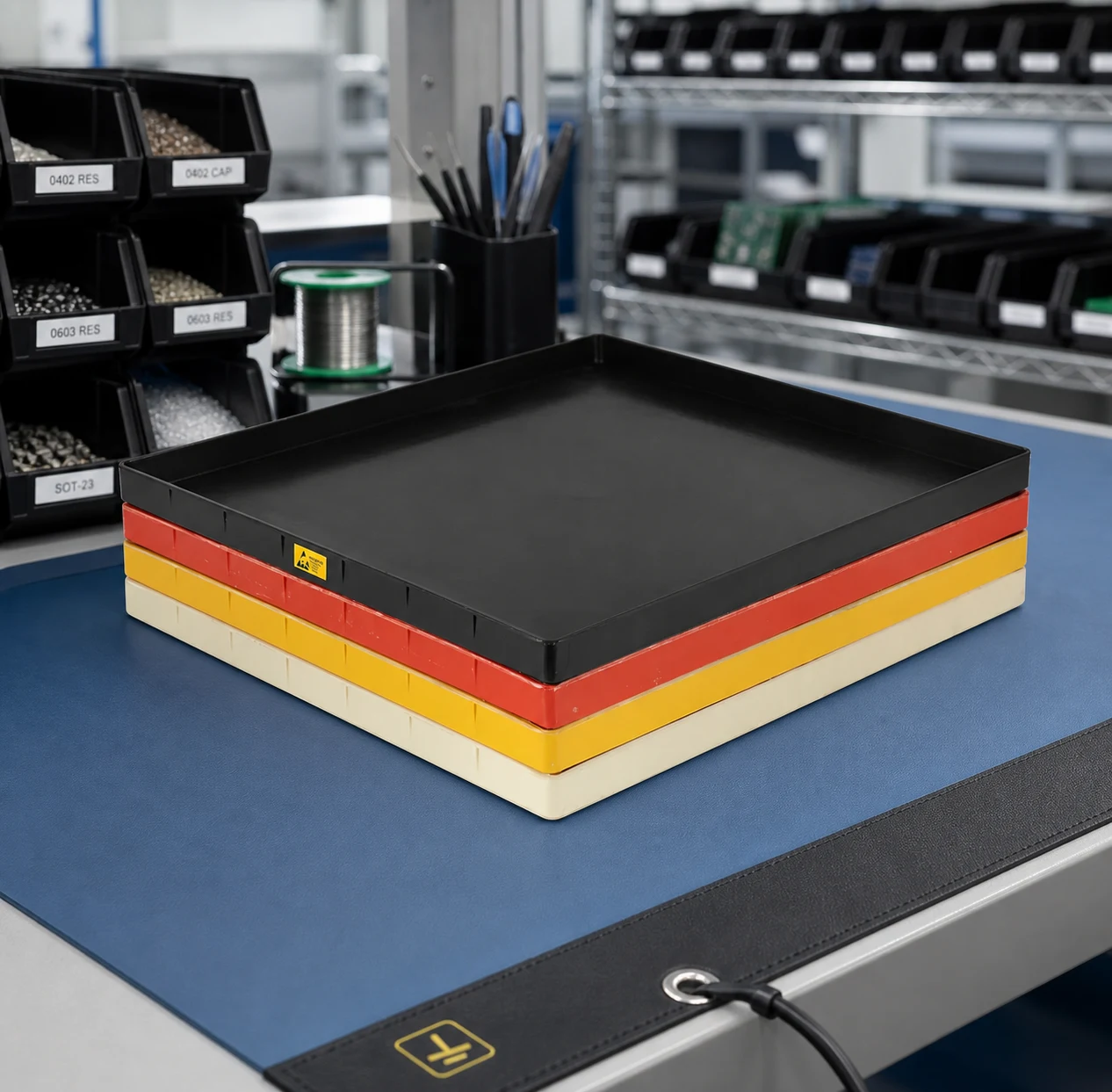
Part 1. What is an ESD tray for SMT?
SMT-oriented ESD trays are shallow or compartmented carriers molded from carbon-filled polypropylene, conductive PS, or thermoformed ESD sheet. They keep static-sensitive parts in a controlled resistance range while operators transfer kits between warehouse, line-side, and QC.
Unlike deep totes, trays emphasize fast visual access and cell-level organization—dividers separate lots, reel hubs, or waffle-pack lanes without mixing leads.
Trays are not magazine racks: they stage components and subkits, while racks buffer PCBs between machines. Most plants use trays upstream of placement and racks between process steps.
Cross-site tray standards prevent regional buyers from ordering incompatible divider inserts during MRO emergencies.
Returnable tray loops need damage criteria—cracked cells can harbor insulative debris that fails audits.
Tray families buyers encounter
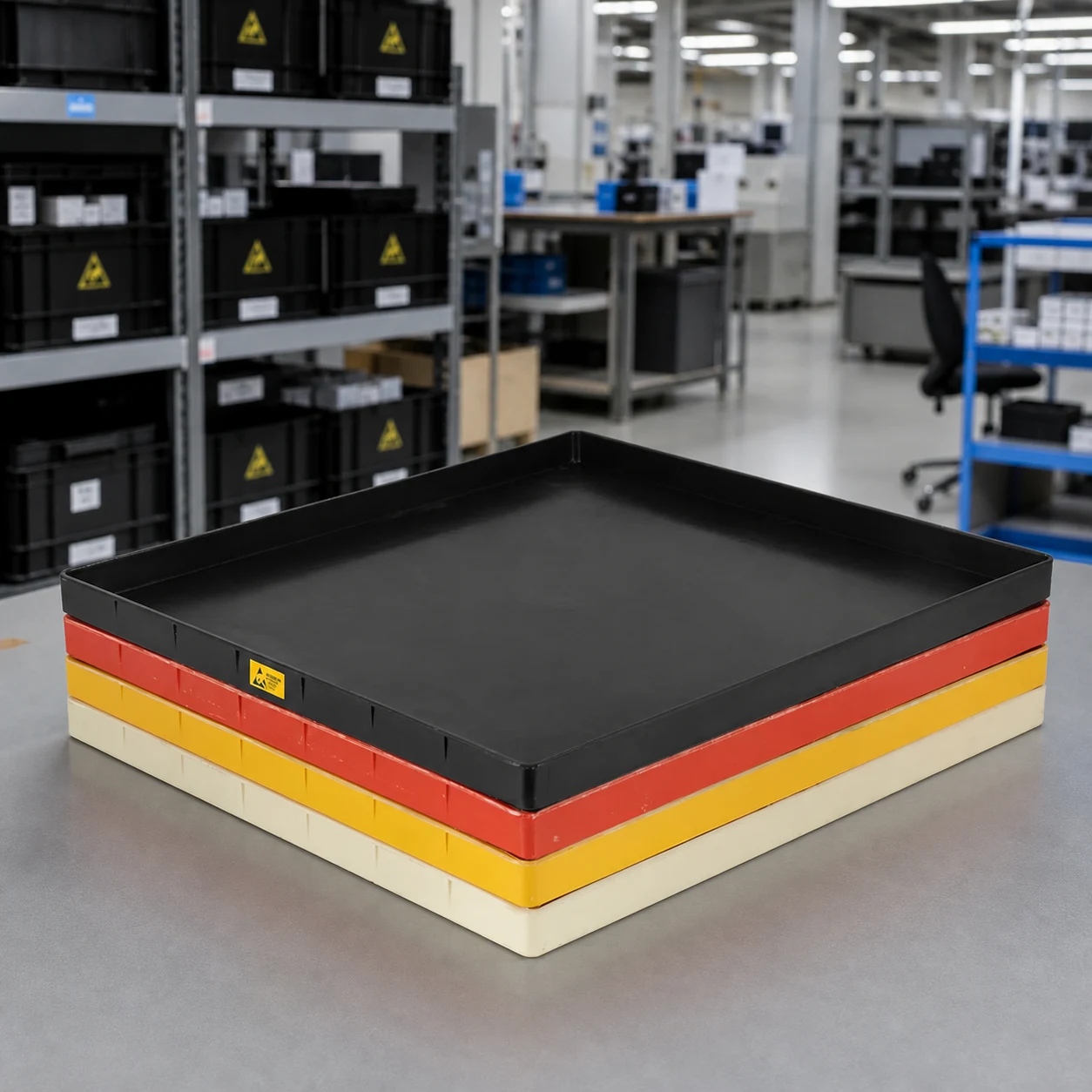
Injection-molded Euro-footprint trays (for example 600×400 mm class) stack on pallets and conveyors. Thermoformed precision trays target IC packaging and automation pick cells. Divider grids snap into tote bases for configurable compartments.
| Tray style | Typical contents | SMT fit |
|---|---|---|
| Shallow stackable tray | Waffle packs, labels | Line-side staging |
| Divider grid insert | ICs, connectors | Kitting desks |
| Reel-oriented cell | 7″/13″ hubs | Changeover buffers |
| Lidded tray | Dust-sensitive lots | Short warehouse moves |
Part 2. Where trays sit in the SMT workflow
Kitting desks preload trays with the next BOM line while the current product runs. Operators slide trays to the line on grounded carts rather than carrying loose reels.
Between printer and placement, small mechanical inserts or odd-form parts often live in divided trays when feeders cannot hold them.
QC hold and rework benches use separate tray colors or labels so quarantined lots never share cells with released material.
Digital photos of grounded cart setups accelerate export desk quoting more than verbal descriptions alone.
Engineering reviews should include EHS, quality, and logistics—not only unit price—before locking a global tray standard.
Tray versus bin versus rack
Bins excel at bulk and drawer access; trays excel at shallow, visible cells. Racks move PCBs—do not substitute a tray for inter-machine panel buffering unless your program explicitly allows short manual carries in shielding packaging.
| Zone | Typical tray role | Grounding note |
|---|---|---|
| Kitting | BOM line preload | Cart to mat common point |
| Line side | Odd-form staging | Tray on dissipative bench |
| QC hold | Quarantine cells | Physically separate colors |
| Warehouse | Inbound samples | Bag if long storage |
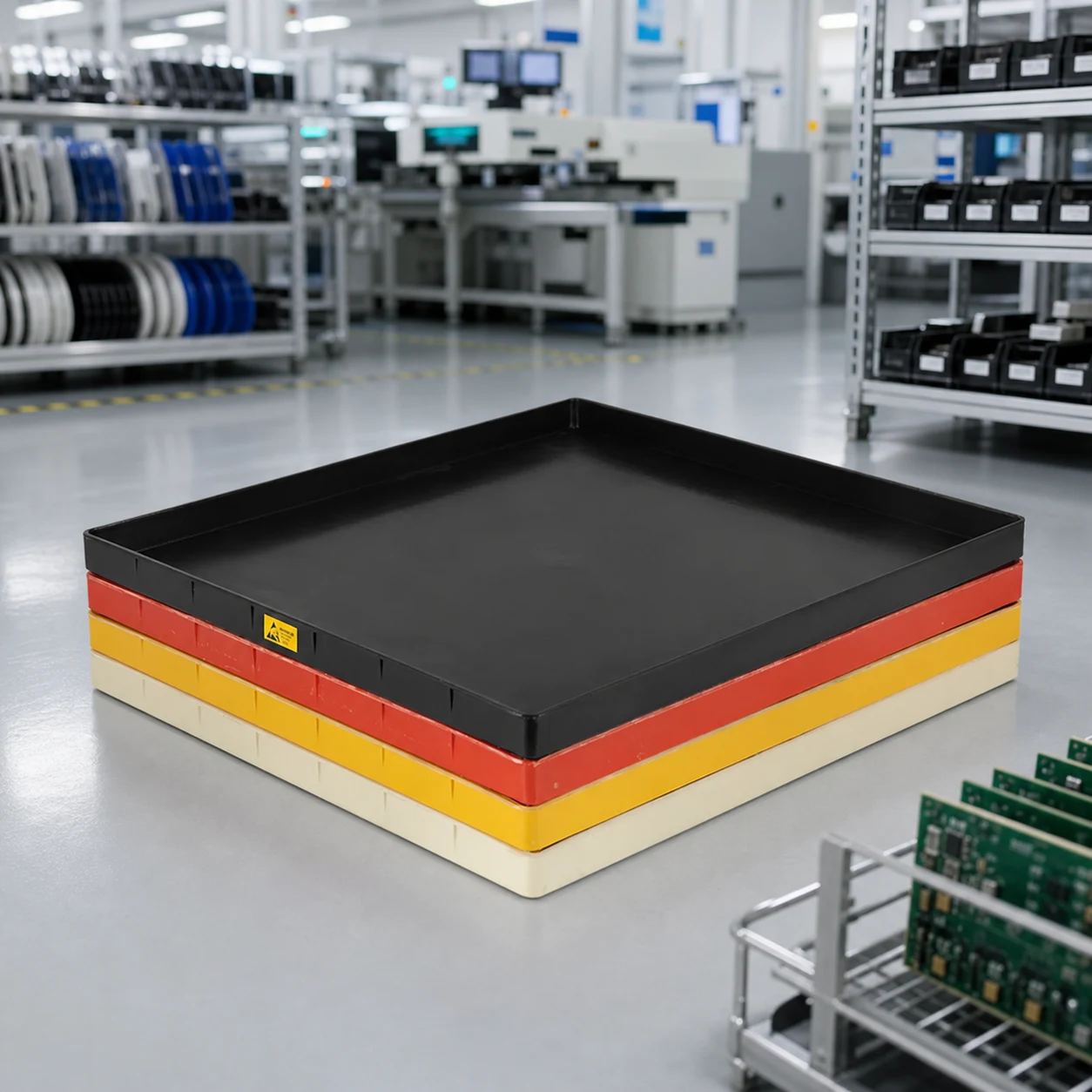
Part 3. Material, resistance, and permanence
Permanent conductive or dissipative PP/PS is preferred over topical coatings that wear in wash cycles. Suppliers often cite 10⁴–10¹⁰ Ω depending on filler loading and test method—align readings to IEC 61340-5-1 and your ANSI/ESD S20.20 program tier.
Thermoformed trays may use thinner sheet (0.8–2.0 mm class) than injection shells; match wall thickness to handling abuse and stack load.
Lids and dividers must be the same material class as the base—an insulative cover on a dissipative tray breaks enclosure integrity.
Seasonal humidity shifts can change cell-level resistance—schedule checks before customer audits, not only after failures.
Pilot trays on two shifts and log mis-picks, wash time, and grounding exceptions before plant-wide rollout.
Measurement and record keeping
Log resistance at inbound inspection and after cleaning cycles. Flux mist and oils can shift readings over weeks of production.
Request test method (point-to-point vs surface resistivity) and RH conditions used in supplier reports.
Part 4. Dividers, grids, lids, and customization
Divider slots let buyers reconfigure cells without new molds—confirm slot pitch and divider height for your tallest component body.
Grid containers combine outer tote shells with conductive inserts; inserts should be removable for wash and lot changeover.
Thermoformed custom cavities suit IC rails and automation pick—lead time and tooling amortization matter for export programs.
Contract manufacturers should align tray specs with customer EPA questionnaires before onboarding new SKUs.
Document carton dimensions early so inbound logistics avoids repallet charges at port.
Labeling and traceability
Label holders and barcode windows speed MES scans—place labels where they do not block grounding contact between tray base and mat.
| Accessory | Avantage | Watch-out |
|---|---|---|
| Snap-in divider | Flexible cells | Wash compatibility |
| Hinged lid | Dust control | Hinge polymer class |
| Foam insert | Cushioning | Must be ESD-grade |
| Custom cavity | Automation pick | Tooling MOQ |
Part 5. Sizing trays for reels, packs, and odd-form parts
For reel kits, confirm hub diameter and outer reel width—7-inch and 13-inch classes need different cell depth and corner clearance.
Waffle packs and cut-tape strips need flat cells with anti-slide ribs; measure pack length plus tweezers clearance.
Odd-form parts (connectors, shields) often dictate tray height more than reel diameter—stack height limits apply when trays nest.
Video clips of correct tray placement on mats reduce training time during contractor rotations.
Label each tray family to prevent night-shift lot mixing.
Stack load and ergonomics
Euro trays may cite static load near 15 kg and stack load near 150 kg in catalog data—validate against your safety policy, not marketing photos alone.
Part 6. Cleaning, EPA handling, and transport
Wipe trays when flux residue or oils accumulate; verify cleaning chemicals against PP/PS compatibility.
Personnel must remain grounded while loading trays; trays alone do not replace wrist-strap or footwear controls.
For warehouse transits longer than your program allows on open trays, use shielding bags or lidded enclosures per your EPA travel rules.
Spare divider and lid MOQ should be budgeted before peak season—shortages stall kitting during ramp.
Logistique en circuit fermé
Returnable tray programs need wash, inspection, and resistance re-check intervals—treat trays as controlled tools, not disposable corrugated.
Part 7. Common specification mistakes
Ordering topical anti-static trays when the program requires permanent conductive PP is a frequent audit failure.
Mixing divider inserts from another supplier’s shell often fails slot tolerance and ESD continuity at cell corners.
Specifying tray depth without measuring feeder cart rail height causes trays to snag on guard panels.
Ignoring temperature limits (-10 °C to +60 °C cited on many PP trays) when staging near warm equipment can warp cells.
Facilities running both 50 Hz and 60 Hz lines should still specify the same ESD tray material class; grounding audits focus on resistance paths.
RFQ discipline
Attach photos, quantity bands, divider layout sketches, and required markings (RoHS, lot labels). Export desks quote faster when cells are defined, not guessed.
| Champ d'appel d'offres | Exemple | Propriétaire |
|---|---|---|
| Cell layout | 4×6 grid sketch | Process engineer |
| Resistance | 10⁶–10⁹ Ω target | Coordinateur ESD |
| Reel class | 13″ OD max | Materials |
| Stack height | 4 trays max | EHS |
| Wash method | Isopropyl wipe | Maintenance |
Part 8. Matching ESD trays to your SMT staging plan
When trays sit beside placement or kitting stations, buyers usually standardize one conductive PP family with compatible dividers and lids across shifts.
Start from cell layout and reel/pack envelopes, then confirm resistance logs at your facility RH band—humidity and chemical exposure matter more than mains frequency for material choice.
Compare total cost of ownership: divider compatibility, wash labor, and spare insert MOQ often exceed unit price deltas between tray vendors.
Documentation to send with your inquiry
Include bench photos, maximum stack height, part drawings, and EPA test interval. Sanwei export engineering can match tray footprints, divider options, and carton data to your line layout.
Share your cell layout sketch, reel sizes, and annual quantity bands with Sanwei export engineering via Contact Us for ESD tray model matching, resistance documentation, and packing dimensions.
FAQ
What is the difference between an ESD tray and an ESD bin for SMT?
Trays emphasize shallow cells and dividers for visible staging beside the line. Bins and drawer stacks handle deeper storage and bulk kitting. Many programs use trays at the bench and bins at the warehouse.
What surface resistance should ESD trays meet?
Programs commonly cite dissipative or conductive ranges from 10⁴ to 10¹⁰ Ω depending on tier. Confirm supplier test method and whether readings cover inner cells and outer base per IEC 61340-5-1.
Can ESD trays replace magazine racks on SMT lines?
No. Trays organize components and subkits; magazine racks buffer PCBs between machines. Use racks for panel flow and trays for part staging.
When are dividers or grid inserts required?
Use dividers when multiple lots share one tray, when reel hubs need isolation, or when automation expects fixed pick cells. Verify divider material class matches the shell.
How should buyers document tray requirements in an RFQ?
Provide cell sketches, reel or pack dimensions, stack height limits, wash chemicals, color/label plan, and quantity bands. Photos of the workstation reduce sizing errors.
Are thermoformed ESD trays suitable for automation?
Custom cavities can mate with pick-and-place or tray feeders when drawings and tolerance stacks are agreed early. Injection trays may be faster to source for standard Euro footprints.
Do ESD trays need lids for EPA compliance?
Lids help dust control and enclosure integrity when the base is dissipative. Match lid polymer class to the tray body and ground personnel during loading.
How often should trays be cleaned in production?
Wipe when flux residue or oils accumulate; schedule checks before customer audits. Follow supplier care instructions and your EPA checklist.
Références



Laisser un commentaire