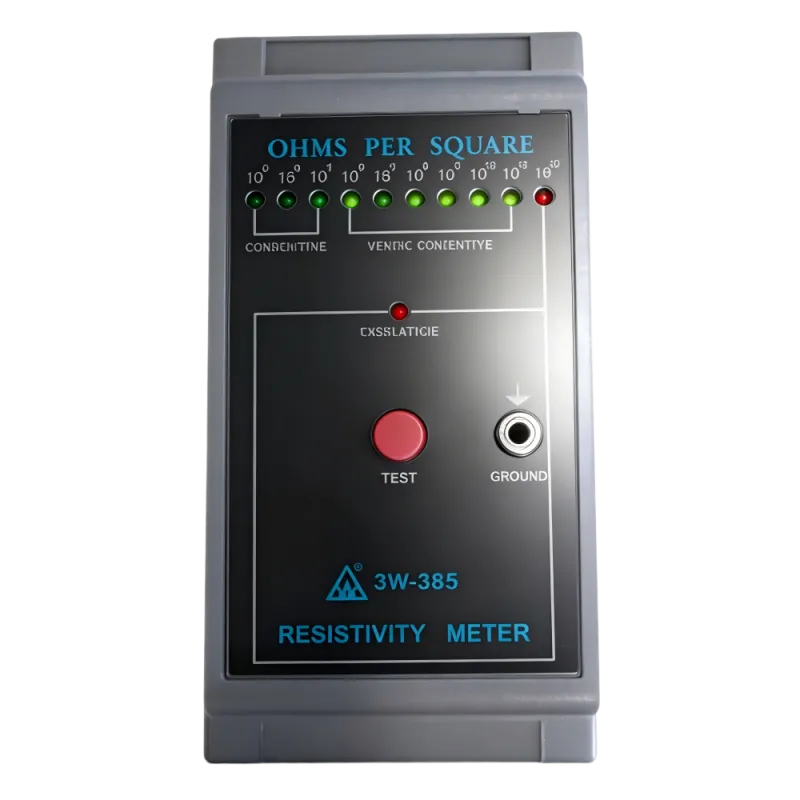
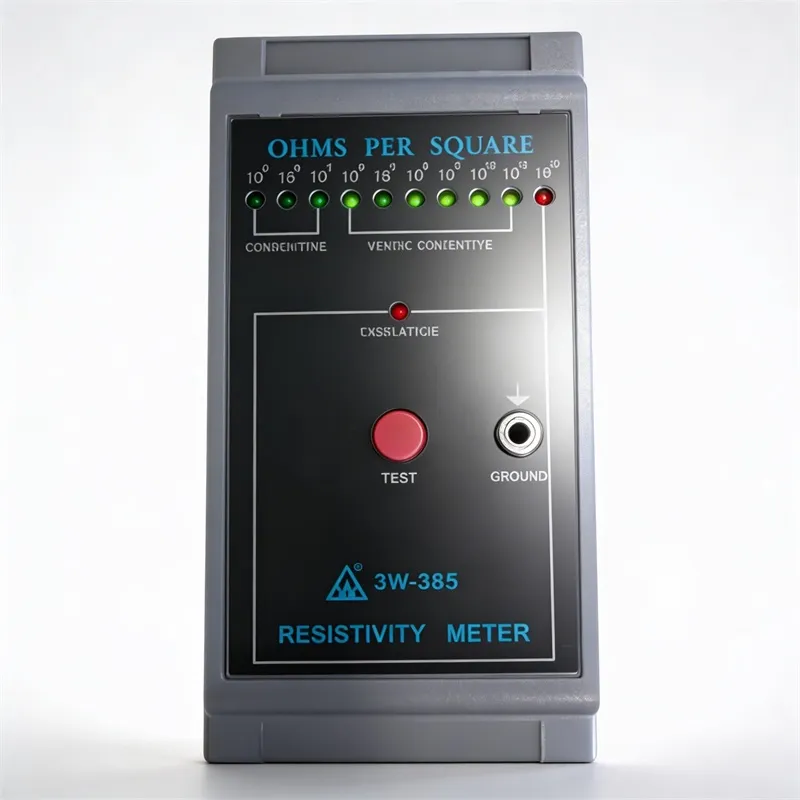
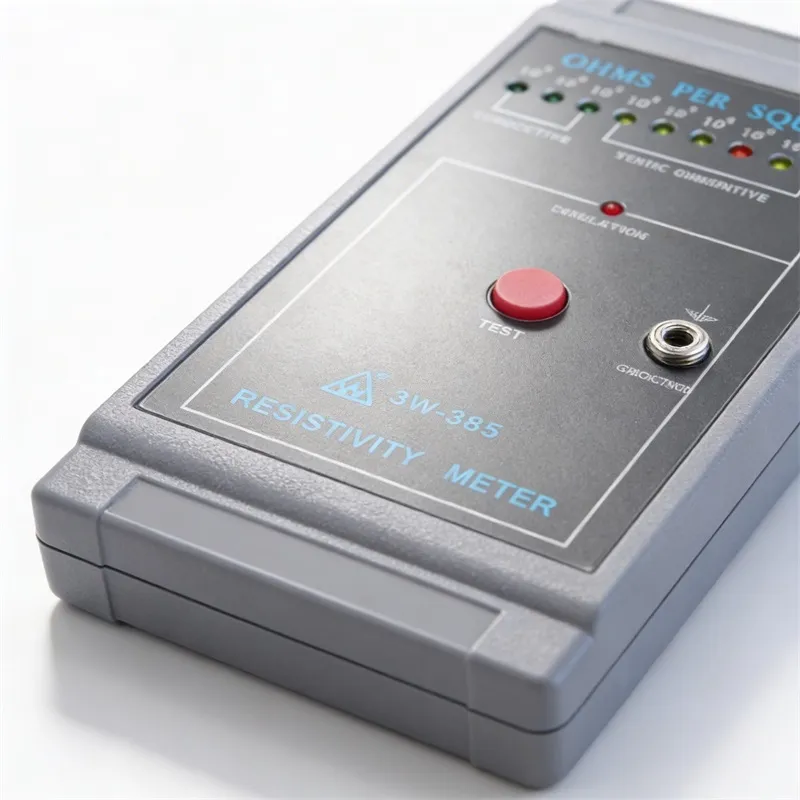
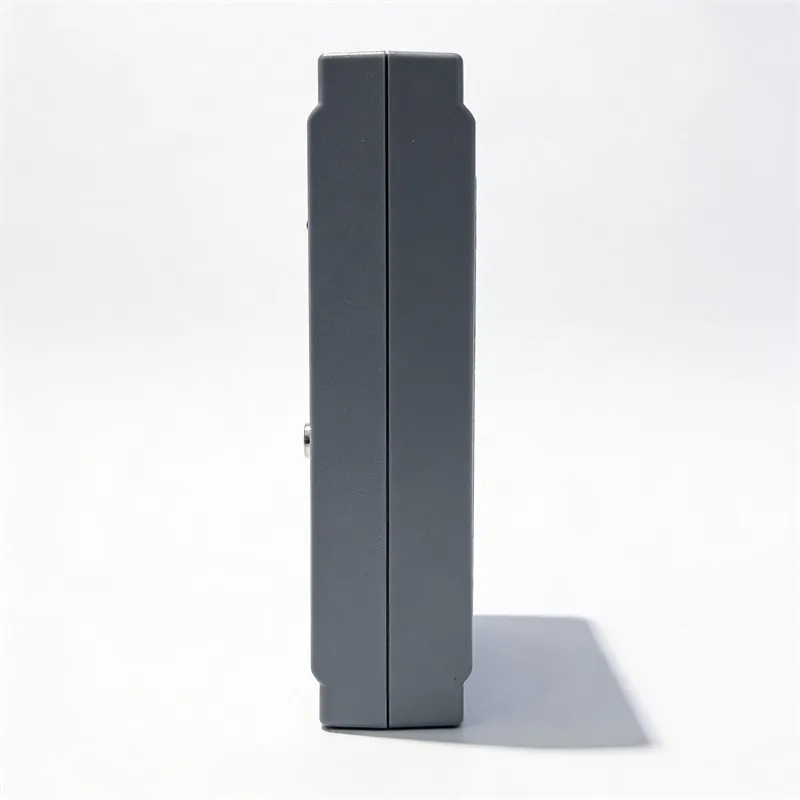
Handmessgerät zur Messung des Oberflächenwiderstands und des spezifischen Oberflächenwiderstands
Übersicht:
Das Oberflächenwiderstandsmessgerät (also referred to as an ESD-Oberflächenwiderstandsmessgerät or surface resistivity tester) is a dedicated measurement instrument designed to accurately determine the surface resistance value of materials, thereby evaluating their conductive properties, static dissipative capability, and insulating characteristics.
Working Principle and Core Technology
The surface resistance tester operates on the principle of DC voltage resistance measurement. It applies a known voltage to the surface of the material under test and measures the resulting current flowing across the surface. The resistance value is then calculated according to Ohm’s law. Most modern instruments offer two test voltages – 10 V and 100 V – with automatic range switching: for example, when the resistance is ≥1×10⁶ Ω, the instrument applies 100 V; when the resistance lies between 1×10⁴ Ω and 1×10⁶ Ω, it uses 10 V. This ensures optimal measurement accuracy across different material types.
Wide Measurement Range and Precision Classification
A high‑quality surface resistance tester typically covers a broad measurement range from 10³ Ω to 10¹² Ω, making it suitable for testing everything from conductive materials to insulators. Different models feature various display methods – some use LED indicators to visually show the resistance range: green for conductive (10³–10⁶ Ω), yellow for static‑dissipative (10⁷–10¹¹ Ω), and red for insulative (≥10¹² Ω). Others employ LCD or OLED digital displays for more precise numeric readings. Measurement accuracy generally reaches ±10 %, with high‑end models achieving up to ±0.5 order of magnitude.
Flexible Test Methods and Electrode Configurations
Das surface resistivity test method complies with multiple international standards, including ASTM D257, IEC 62631‑3‑2, und GB/T 1410. To accommodate diverse testing scenarios, a surface resistance tester is usually equipped with or offers optional electrodes: parallel electrodes for rapid screening, weighted electrodes (2.27 kg or 2.5 kg) for point‑to‑point surface resistance measurement, concentric ring electrodes for surface resistivity testing in accordance with EOS/ESD S11.11, and two‑point electrodes for small‑area measurements. The dimensions, contact pressure, and material of these electrodes are specified by the relevant standards to ensure consistency and repeatability of test results.
Multi‑Scenario Applications and Industry Value
Surface resistivity testing plays an indispensable role across various industries:
-
Electronics manufacturing – inspecting the surface resistance of anti‑static workstations, ESD flooring, and packaging materials to safeguard the production environment.
-
Semiconductor and precision instrumentation – testing wafer carriers, PCB protective coatings, and containers for static‑sensitive devices to prevent electrostatic damage.
-
Laboratories and R&D – studying the static performance of new materials and characterising their surface resistivity.
-
Warehousing and logistics – verifying the resistance of ESD trays, tote boxes, and shipping tubes to avoid electrostatic discharge during storage and transport.
-
Medical and aerospace – measuring the surface resistance of equipment housings and operating tables to ensure user safety and operational reliability.
Portable Design and Smart Features
Modern surface resistance testers are typically designed to be compact and lightweight (often 120–170 g), allowing for easy on‑site testing. Many models also incorporate data logging and transfer capabilities – exporting data via USB, generating comprehensive test reports with companion software, and some advanced versions even storing up to 50,000 measurement records. Built‑in environmental temperature and humidity sensors further enhance traceability, ensuring that every test is performed under documented conditions.
Technische Spezifikationen
| Messbereich | 10³-10¹²Ω |
| Genauigkeit | ±0.5 |
| Size (L×W×H) | 70*27*130mm |
| Gewicht | 0.14G |
| Power Supply | 9V |
Weltklasse-ESD-Fertigungskapazität
Wenn Sie bei Sanwei einkaufen, schließen Sie einen direkten Vertrag mit einem branchenführenden Unternehmen ab. Hersteller von OEM-/ODM-Produkten. Wir verfügen über modernste Produktionsanlagen. 70.000+ m² integrierte Produktion Einrichtung Im Yueqing Central Industrial Park in Zhejiang werden alle Prozesse von Hand bearbeitet. von der proprietären Materialformulierung bis zur endgültigen Formung eines hochpräzisen Produkts.
Integrative Waage
70.000+ m² anspruchsvolle Anlage mit hochbelastbarer Präzisionsspritzung Formmaschinen, die großvolumige Großhandelsaufträge mit stabilen Lieferzeiten bearbeiten können.
Volle Kettensperre
Komplett integrierte interne Kontrolle, die sich über proprietäre Forschung und Entwicklung in Bezug auf statische Materialien erstreckt, Strukturelle Formengestaltung, automatisierte Fertigung und schnelle weltweite Logistiklieferung.
Strenge Inspektion
Strenge Prüfung der Rohstoffe in Verbindung mit der Multi-Point-Oberflächenresistivität Die Messung an der Produktionslinie gewährleistet die 100% Einhaltung der internationalen ESD-Normen.
Antistatisch Produkte und Lösungen
Komplexe elektrostatische Schutzmaßnahmen für Ihren gesamten Produktions- und Betriebszirkel.
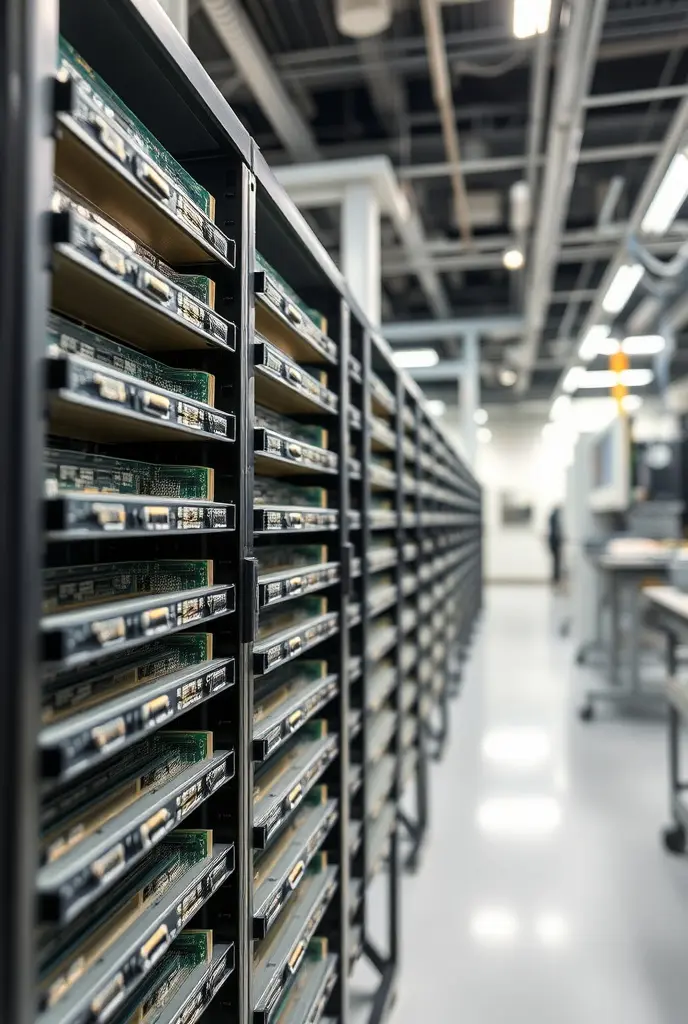
SMT-Ausstattung
Antistatische Sammelbehälter und Regale für automatische Linien.

Speicherung & Logistik
Verkaufswagen, Regale, Schachteln, Tabletts und Behälter für Komponenten.
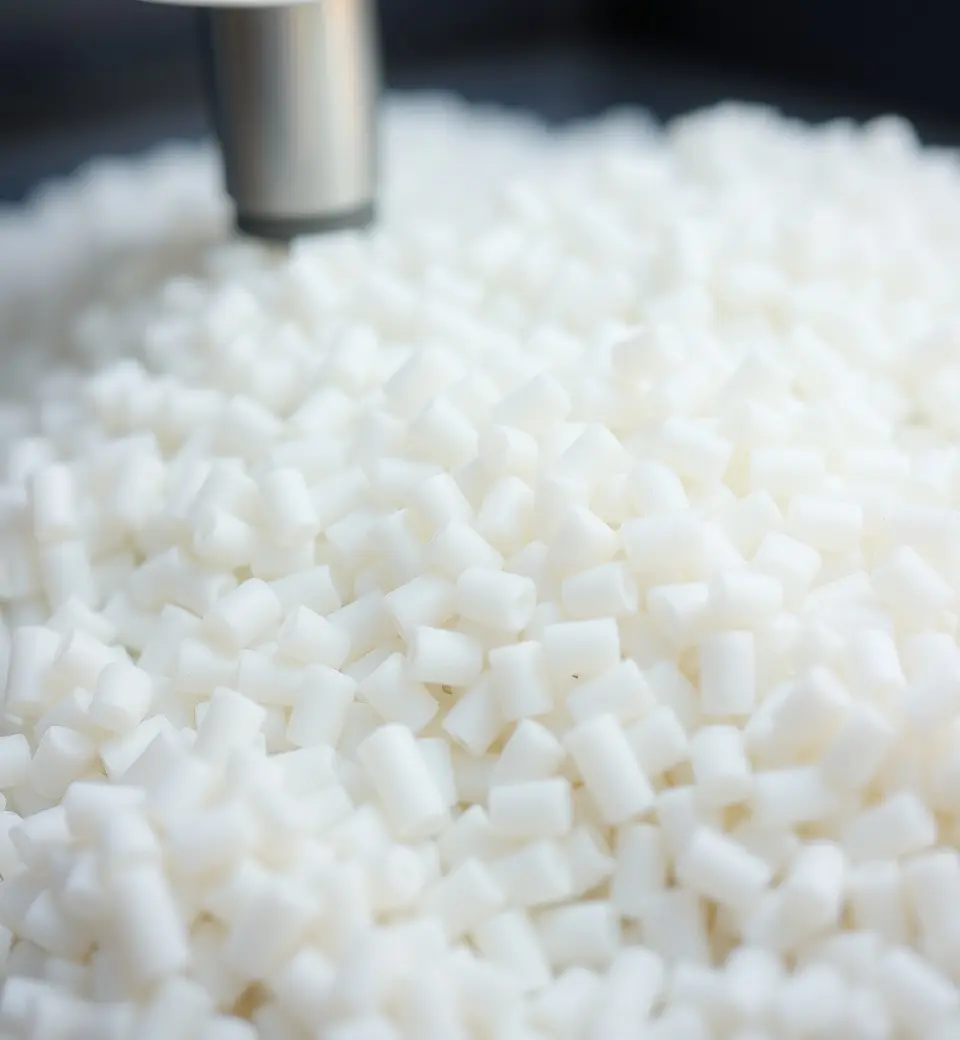
Arbeitsplatz & Schutzausrüstung
Antistatische Stühle, Matte, Handgelenksgurte und persönliche Schutzausrüstung.
Kundenspezifische Entwicklung
Kundenspezifische Formentwicklung und spezielle antistatische Materialien.
UNSERE VORTEILE IN DER OEM-/ODM-ERLEBNIS

Fortgeschrittenes Forschung und Entwicklung sowie Materialinnovationen
In-house entwickelte antistatische Materialien mit nationalen Erfindungspatenten und Hitzebeständigkeit bis zu 200 °C. Wir formen nicht nur Gussformen – wir formulieren auch Compounds.
Volle Produktionskapazität
Anlage mit einer Fläche von 30.000 m², komplett ausgestattet mit Spritzgieß-, Granulier- und Unterstützungsprozesssystemen für Stabile und effiziente Versorgung.

Volle Prozessanpassung
Materialwiderstand, Farbe, Größe, Logo, Verpackung und Zertifizierungen – anpassbar, um den Anforderungen gerecht zu werden IEC61340-5-1, ANSI/ESD S20.20 oder militärische Normen.

Zertifizierte Qualität und globale Compliance
“Sanwei hat erfolgreich kundenspezifische, hochtemperaturbeständige, saubere und natürliche Farbtaschen für uns entwickelt.” Halbleiter-Montagelinie, die importierte Produkte ersetzt und eine hervorragende ESD-Sicherheit gewährleistet sowie den Anforderungen entspricht die hohen Reinheitsanforderungen des Werks.“
VERGÜTET VON GLOBALEN FORTUNE 500 INDUSTRIELEITERN
Unsere proprietären ESD-Lösungen werden in Elite-Produktionsanlagen eingesetzt. weltweit, einschließlich: Intel, Motorola, Siemens, IBM, Panasonic, Nokia und Dell.
Suchen Sie nach maßgeschneiderten Größen oder Großhandelspreisen?
Mit unserem robusten in-house R&D-Team bietet Sanwei komplete OEM-/ODM-Lösungen an. Optionen, die auf Ihre spezifischen SMT-Produktionslinien oder das Lagerlayout zugeschnitten sind. Kontaktieren Sie unsere Spezialisten heute bieten wir maßgefertigte Formen, farbkodierte Verpackungen oder integrierte 5S-Lagerungskonzepte an.
Allgemeine Fragen (FAQ)
1. What is the standard for surface resistivity?
The primary standards for measuring surface resistivity are ASTM D257 und cURL Too many subrequests by single Worker invocation. To configure this limit, refer to https://developers.cloudflare.com/workers/wrangler/configuration/#limits. cURL Too many subrequests by single Worker invocation. To configure this limit, refer to https://developers.cloudflare.com/workers/wrangler/configuration/#limits. cURL Too many subrequests by single Worker invocation. To configure this limit, refer to https://developers.cloudflare.com/workers/wrangler/configuration/#limits.
cURL Too many subrequests by single Worker invocation. To configure this limit, refer to https://developers.cloudflare.com/workers/wrangler/configuration/#limits
cURL Too many subrequests by single Worker invocation. To configure this limit, refer to https://developers.cloudflare.com/workers/wrangler/configuration/#limits cURL Too many subrequests by single Worker invocation. To configure this limit, refer to https://developers.cloudflare.com/workers/wrangler/configuration/#limits. cURL Too many subrequests by single Worker invocation. To configure this limit, refer to https://developers.cloudflare.com/workers/wrangler/configuration/#limits.
cURL Too many subrequests by single Worker invocation. To configure this limit, refer to https://developers.cloudflare.com/workers/wrangler/configuration/#limits
The most common equipment used to test insulation resistance is an insulation resistance tester, often generically called a Megger. These are portable, high-range resistance meters (ohmmeters) with a built-in DC generator that provide direct readings of insulation resistance.
4. What is the surface insulation resistance test?
Das surface insulation resistance test is a method used to measure the resistance across a material’s surface. It’s a non-destructive test often used to evaluate the reliability of electronic assemblies. The test typically involves measuring the resistance between two comb-shaped electrodes on a test board under controlled conditions.
5. What is the surface resistance instrument?
A surface resistance instrument (or tester) is a device used to measure the electrical resistance directly on the surface of a material. It expresses resistance in ohms (Ω) and is commonly used for field audits of ESD workstations, mats, and floors to determine if materials are conductive or static dissipative.