- hanqi
- Blog
The surface resistivity test method is one way for industries that need to implement electrostatic discharge (ESD) controls to understand this important testing technique. Sectors/expertises potentially using this method include electronics manufacturing, semiconductor manufacturing, cleanrooms, aerospace, and advanced packaging. As a quality engineer, lab technician, or procurement professional searching for ESD surface-resistance testers, understanding the measurement process of surface-resistivity will impact product reliability and compliance.
With comprehensive, practical guidance on testing procedures, principles and standards; interpreting results; and applying the information learned from testing in the real world. This guide is meant for laboratory users – as well as potential purchasers who want to know if the surface resistance tester will meet their particular application requirements.
What Is Surface Resistivity?
Surface resistivity refers to the resistive characteristic of a material’s surface when attempting to allow current to flow across it. In contrast to volumetric resistance (which measures conduction throughout the entire thickness of a material), surface resistivity examines the lateral electrical properties present on the outermost layer of a given material. Surface resistivity is also an important measurement for determining if a particular type of material will be either conductive, static-dissipative, or non-conductive when tested according to its surface resistivity measurements.
Subtle changes in surface resistivity in ESD-sensitive environments can have an overwhelming impact on how charge accumulates on surfaces and discharges from them. Because of the need for accurate assessment to determine material safety, engineers continue to depend upon standardized test procedures to measure surface resistivity.
Why Surface Resistivity Testing Is Critical in ESD Control
Microchips, integrated circuits (IC), sensors and precision components can be damaged by electrostatic discharge without any visible damage occurring. If a manufacturing production line has an uncontrolled discharge event occur once, it may cause latent failures, less yield or break down in the field.
The ESD surface resistance tester is used by companies to ensure their work surfaces, packaging materials, flooring systems and tools are in compliance with the required resistance thresholds specified in ANSI/ESD S20.20 and IEC 61340-5-1.
If ESD systems are not tested properly, then they are assumed to work, leaving a larger amount of operational risk.
Surface Resistivity Test Method: Step-by-Step Explanation
Controlled voltage application and current measurements using calibrated electrodes are what make the standardized surface insulation resistances test possible.
To condition the sample properly, it needs to be exposed to a controlled environment, which usually has a temperature of approximately 23°C± 2°C and relative humidity (RH) of 50%±5%. The stability of the environment is important because of the effect of humidity on the surface’s ability to conduct electricity.
Next, a parallel probe or a concentric ring electrode is used to apply a DC voltage (typically 10 or 100V) across the surface of the material being tested for leakage currents. High impedance measurements of the total leakage current can then be made using an electrometer instrument.
Third, this instrument measures resistance (R) using Ohm’s Law and then transforms (or converts) the resistive measurements from R to surface resistivity (Ω/sq) based on the geometry (or configuration) of the electrodes used. Modern digital systems now conduct this transformation automatically to reduce human error.
Automated data storage, multi-point average extraction and compliance reporting in accordance with ISO standards and ESD audits are additional features of advanced surface resistance test systems.
Equipment Used for Surface Resistivity Testing
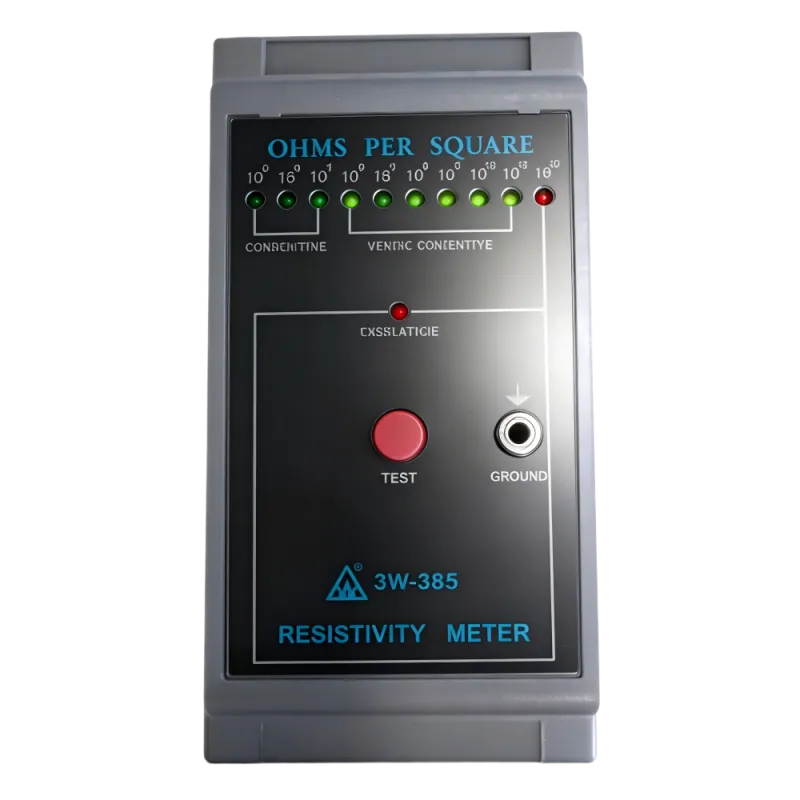
The most important instrument is the ESD surface resistance tester, typically consisting of:
A calibrated electrode system (usually having concentric ring probes) connected to a high voltage DC power supply, through a precise current measuring circuit to a digital display or data acquisition module.
The advanced features of these instruments may consist of various temperature/humidity sensors; as well as automatic range switching, and data exporting via USB/RS232, enabling interfacing with quality management systems.
Understanding Surface Resistivity Range
Surface resistivity is typically categorized into three main ranges:
Low resistive conductive materials allow for quick dissipation of charge. Static-dissipative materials allow for controlled discharge of electrical energy, so the ESD (electrostatic discharge) is minimized and electrical stability is maintained. High resistance insulating materials can accumulate high amounts of static electricity.
In the case of selecting a surface resistance tester for ESD applications, it’s critical that you’re using the right test ranges that are necessary to achieve accurate results, particularly in electronics or semiconductor environments where tolerances can be very tight.
How to Test Surface Resistivity Accurately?
For consistent and repeatable results in surface resistivity testing, good surface preparation is a key factor; the sample should be properly cleaned, dried, and uncontaminated. Even fingerprints or dust can cause a significant variation in test results.
To achieve optimal surface coverage, electrodes should be securely and evenly placed. To account for the effects of local variation, measurements should be conducted in multiple locations throughout the bulk sample.
As an added measure of safety, all results must be recorded with the environmental conditions present during the time of testing to enable traceability during possible quality audits.
Applications of Surface Resistivity Testing
In the electronics manufacturing industry, semiconductor manufacturing, PCB (printed circuit board) assembly, aerospace systems, automotive electronic systems, and within cleanrooms, there is a common testing method known as surface resistivity testing.
Moreover, determining ESD-compatible materials requires careful consideration in assessing anti-static flooring, protective packaging materials (such as ESD bags), work surface surfaces, and ESD garments used in controlled environments.
Choosing the Right Surface Resistance Tester
In selecting a device, engineers need to take into consideration such factors as measurement range, adherence to IEC/ANSI standards, ability to support the calibration process and capability to record data.
Industrial users should look for a dependable ESD Surface Resistance Tester to get consistent, repeatable readings regardless of environmental moisture, as well as long-term calibration stability. Users in industrial settings should also choose ESD testers with durable designs and automated report generation capabilities.
FAQs
What is surface resistivity range?
Normally the surface resistivity ranges will fall into three categories conductive (10³–10⁵ Ω/sq), static dissipative (10⁵–10¹¹ Ω/sq) and insulating (greater than 10¹¹ Ω/sq). Each range classifies how well a material will provide ESD protection.
How to test surface resistivity?
To carry out a surface resistivity test, you will use an electrode system with a known calibration and connect it to the surface resistance tester. You will then apply a DC voltage to the surface, measure the current that flows through that surface, and calculate its resistance based on the dimension of the electrodes.
What is the difference between surface resistance and surface resistivity?
Surface resistance measures how much resistance exists when electricity passes between two points on a surface; surface resistivity takes the same distances of those two points and calculates their resistance using standard surfaces (geometries) defined by standard contacts; therefore, it’s possible to compare the resistivities among various materials.
Why does humidity affect surface resistivity?
The presence of moistening causes the surface of the material (particularly polymer), to become more conductive by creating a small amount of moisture. Because of this, measured resistance will be lower and thus controlled environments are needed.
Can one device measure both resistance and resistivity?
Present-day electrostatic discharge (ESD) surface resistance measuring instruments have the capacity to automatically change between different modes of operation in response to the test setup.
How often should surface resistivity testing be performed?
Typically, material testing occurs in a production environment upon receipt of material, through periodical quality audits, and following any process modifications that will impact material properties.
What standards govern surface resistivity testing?
Common standards include: ANSI/ESD S20-20, IEC 61340-5-1, and ASTM D257. These standards outline the test methods, environmental conditions, and resistive ranges of what is considered acceptable.
What factors can cause inaccurate readings?
Twisted wires (contamination, bad contact, humidity fluctuations, non-calibrated instruments, and uneven surface) can all contribute to erroneous measurement data.
Is surface resistivity testing destructive?
The test being performed here does not involve any physical alteration or damage to the test material; therefore, it can be used for purposes such as quality assurance and product certification.
What industries rely most on surface resistivity testing?
The main utilizers include electronics manufacturing, semiconductor manufacturing, aerospace engineering, automotive electronics, and cleanroom pharmaceutical production.
ESD control systems rely heavily on a surface resistivity testing method as a significant contributor to determining how well materials will perform in the electronic industry environment. With a correctly calibrated ESD/Test Surface Resistance Tester and the application of environmentally controlled standard conditions, along with the knowledge of resistance classifications, manufacturers can successfully mitigate the risk of electrostatic discharge and improve their overall product quality. Accurately measuring surface resistivities is increasingly essential due to the continued reduction in the physical size of electronic devices and the increasing sensitivity to electrostatic damage of those devices.
Leave a Reply