- Turbo
- Blog
SMT reel tray stacking is acceptable only when the exact carrier has a documented stacking arrangement and the proposed loaded configuration has been approved for the actual handling route. A tray that organizes reels is not automatically a stackable container. Ask where the upper carrier bears, how reels are protected from contact, what retains the assembly and how operators retrieve material. If those answers are unavailable, use separately supported storage rather than testing an improvised pile beside production. This guide helps buyers define the evidence needed for stack support, retention and access without inventing a universal stack height or load rating.
Establish whether the carrier is designed to stack
The first purchasing question is simple: does the supplier intend this particular tray to carry another loaded tray? Require the exact model and construction in the answer. Similar external dimensions or the same black color do not establish equivalent support geometry. Feet may support a tray on a shelf without engaging another tray securely. A raised back may locate reels without functioning as an upper-carrier bearing surface. Ask for a drawing or a clear explanation of the intended contact points.
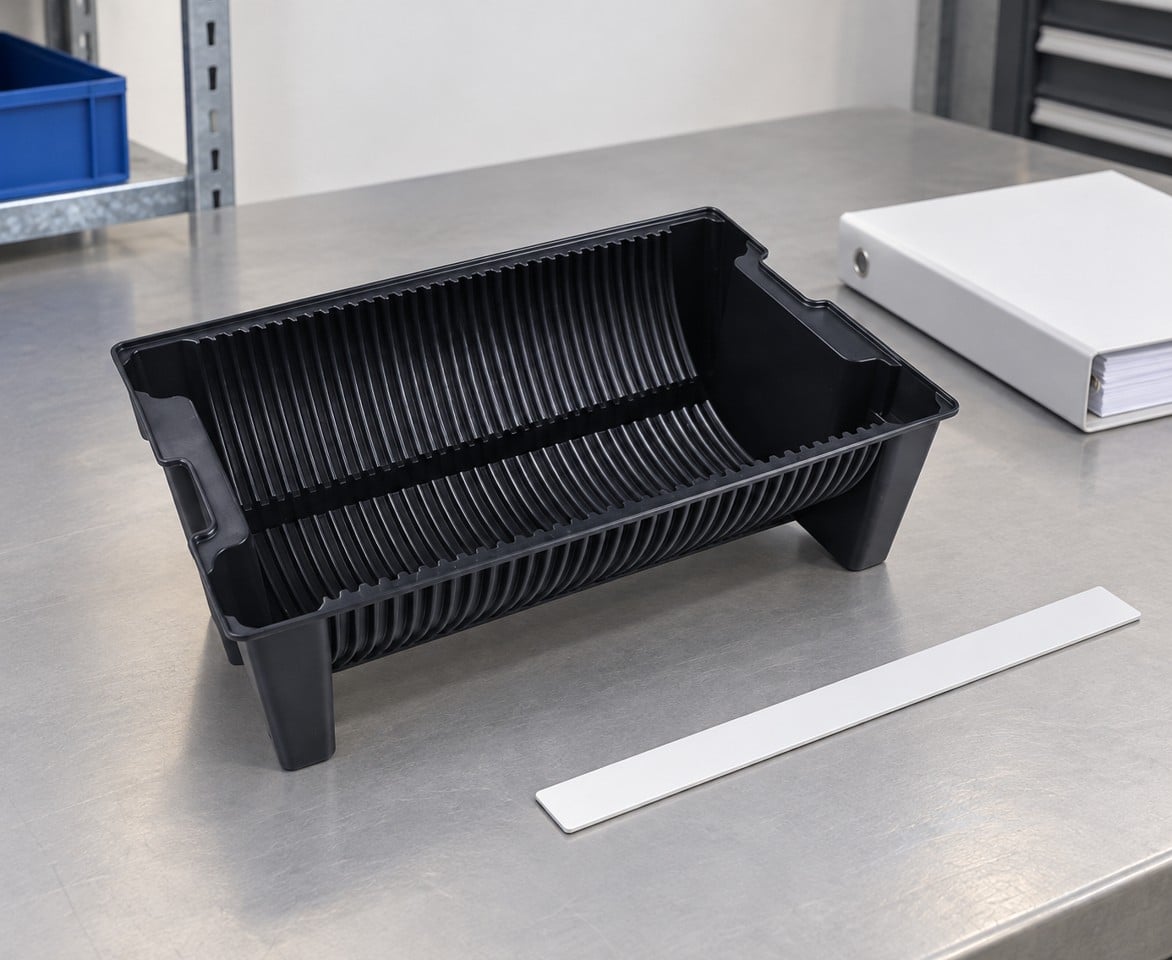
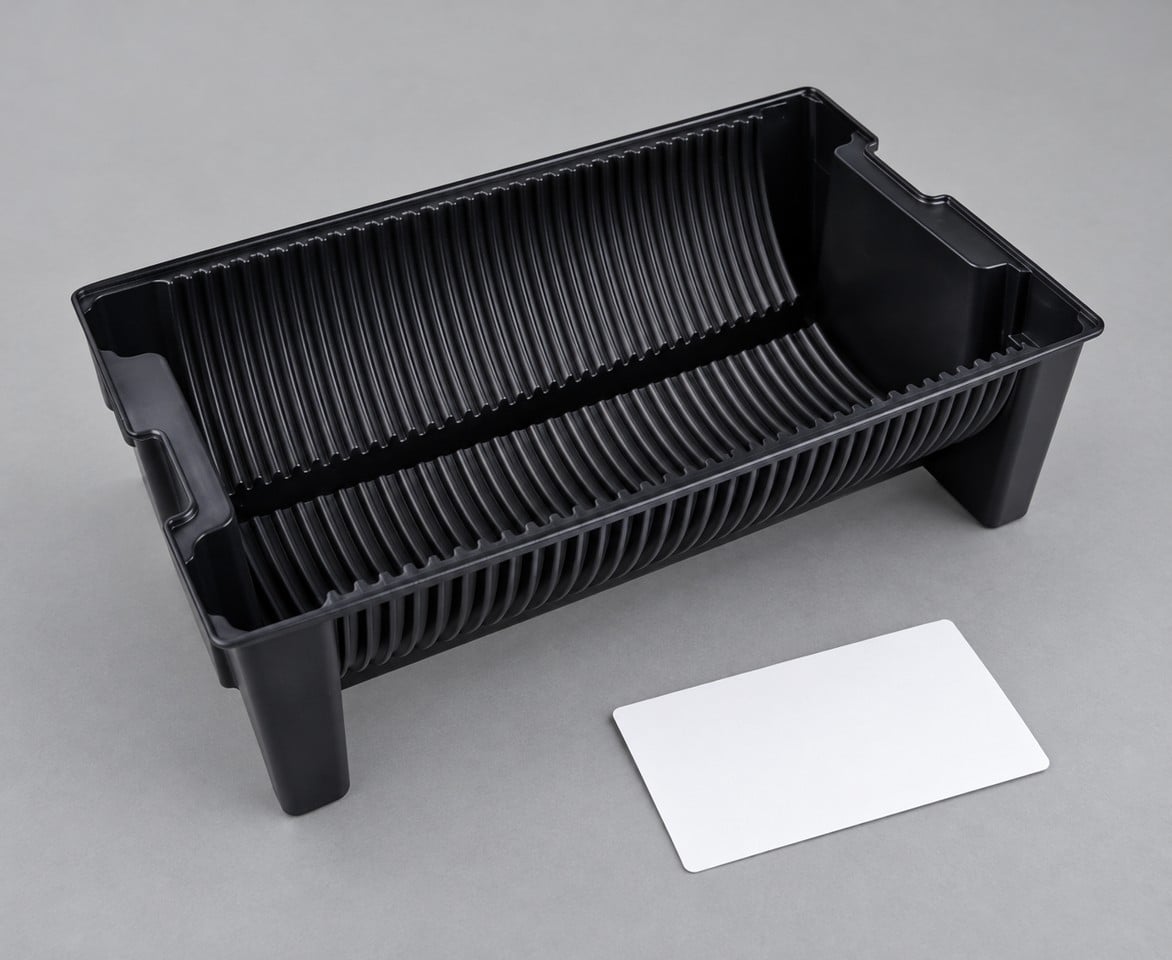
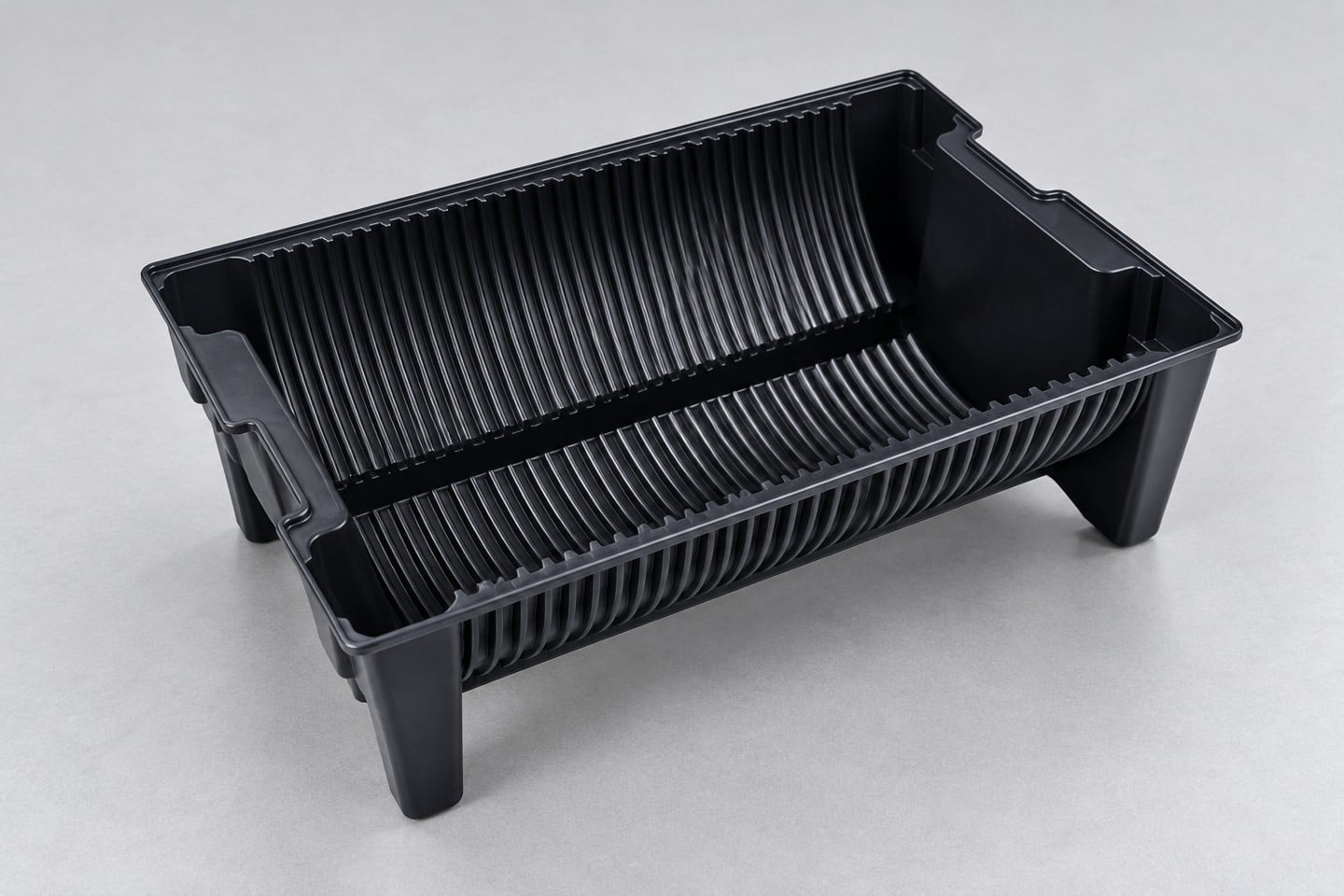
The SWESD SMT reel storage tray is the actual product reference used in this article. The illustration identifies a ribbed open carrier; it does not establish a stacking approval or load capacity. If a supplier does not document stacking for the exact version, make that limitation explicit in the purchase specification. Do not convert a photograph of several carriers near each other into a claim that they can be loaded vertically.
Separate reel fit from stack support
A reel can fit the cradle while still projecting into the space needed by another carrier. Check the complete loaded envelope, including reel flanges, labels, leader material and any approved protective packaging. The SMT reel tray dimensions guide addresses fit measurements. This article adds the separate question of what happens above and below that envelope when another tray is introduced. A nominal tray width alone cannot answer both questions.
Ask whether support remains on the carrier structure throughout placement and removal. Reels, labels and exposed leader tape should not become unintended bearing points. The leader tape protection guide covers that material-handling concern in more detail. Keep the questions distinct in the trial record: one check concerns the physical support path, another concerns reel condition and retention. Passing one does not excuse an unresolved observation in the other.
Describe the actual storage and transport route
Document whether trays remain on a fixed shelf, move on a trolley or travel between storage and a placement line. Identify shelf construction, usable depth, access direction, stopping and turning points and the method used to transfer an assembly. A configuration that remains undisturbed on a level sample bench does not establish suitability for mobile use. Conversely, a proposed transport restraint should not obstruct the storage access that operators need during normal picking.
Record the range of reels and the approved loading pattern. Mixed sizes, partially occupied carriers and asymmetric loading can change the practical handling problem. Do not invent a numerical stability margin from appearance. Ask the responsible engineering or logistics owner to define the relevant trial and acceptance criteria with the supplier. The objective is an agreed configuration that can be repeated on the real route, with clear limits on any variation.
Ask how each level is supported and retained
A useful supplier response identifies the lower support, the carrier-to-carrier contact and any intended retention feature. Ask what prevents lateral movement during the approved operation and what prevents an operator from assembling the wrong orientation. If a separate support frame or restraint is required, include it in the documented system. A removable accessory should have its own identity and inspection requirement. Do not replace a specified item with a convenient band or improvised wedge without approval.
For general workplace context, 29 CFR 1910.176 addresses material handling and secure storage in its applicable jurisdiction. It does not supply a load rating for this tray or a universal stack height. Use the rule as a reason to assess the actual arrangement, access and stability, while relying on supplier documentation and the site’s responsible person for the specific carrier configuration.
| Purchasing question | Evidence | Hold condition |
|---|---|---|
| Designed to stack? | Exact-model supplier statement and drawing | No supported arrangement identified |
| Where is the load carried? | Defined carrier support contact points | Reels or labels become bearing points |
| How is movement controlled? | Specified retention and approved handling trial | Uncontrolled movement during intended use |
| Can operators retrieve reels? | Observed retrieval and temporary placement method | Retrieval destabilizes remaining carriers |
| What limits apply? | Approved configuration and change triggers | Different model, load pattern or support introduced |
Plan an observable trial before production use
Use the proposed production arrangement, a representative shelf or trolley and the actual range of reel envelopes. Define who loads, retrieves and transfers the trays, and record the sequence. Start with the supplier’s supported arrangement and the site’s approved trial controls. Check whether support points are clearly engaged and whether any item changes position during the agreed handling steps. Stop when the arrangement behaves unexpectedly rather than repeatedly adjusting it until one demonstration looks satisfactory.
A record should identify carrier versions, accessories, loading arrangement, support surface, handling steps and observations. If a trial uses substitute objects, explain what they represent and what remains untested. A photograph can show an arrangement, but it cannot establish a rated capacity or ESD qualification. Obtain approval of the documented scope before extending the arrangement to another shelf, another carrier version or a larger reel family. Changes need review rather than silent acceptance.
Make retrieval practical for the operator
Consider how the required reel is selected without destabilizing the remaining assembly. If access to a lower level requires moving every upper level, document a safe, controlled transfer sequence and a suitable temporary support location. Do not expect operators to balance one loaded tray while searching for another reel. A configuration that is theoretically compact can create unnecessary handling, obstruct labels and make errors more likely if its retrieval sequence is difficult to follow.
Ask operators to demonstrate the proposed access method under realistic working conditions. Include normal work clothing and any handling restrictions already required by the site. Record whether labels remain readable and whether the selected reel can be removed without dragging neighboring reels or contacting the upper carrier. The trial should expose awkward steps, not merely prove that an experienced demonstrator can perform one careful movement. Simpler separately supported storage may be the better purchasing choice when frequent retrieval is required.
Keep physical approval separate from ESD control
Stacking changes the physical arrangement, but it does not create a documented grounding path. The EOS/ESD Association’s basic ESD control guidance explains the broader role of controlled handling and materials. Review the tray and storage arrangement within the site’s approved ESD program. Do not infer electrical acceptance from black material, contact between carriers or the presence of a metal trolley underneath them.
Packaging and material status also remain separate. A physical trial should not open moisture-barrier packaging or change a reel’s release status without an authorized process. Keep unopened packages under their own handling requirements, and make clear whether the trial concerns bare carriers, loaded carriers or packaged stock. If the approved configuration depends on a particular packaging method, record it as part of the scope instead of treating packaging as an interchangeable detail.
Inspect changes that can invalidate the arrangement
Before reuse, confirm that support and retention features remain consistent with the approved sample. Cracks, distortion, missing features or uncertain repairs need a disposition under the site’s control plan. The reel tray damage inspection guide addresses those condition decisions. Its visual checks do not establish stacking capacity, but they can identify changes that should prevent a previously approved arrangement from being reused without review.
Watch for substitutions during replenishment. A tray supplied under the same broad description may have a different revision, a different foot or a changed support detail. Ask procurement to preserve the agreed model, drawing revision and relevant accessories in the order. If an alternative is proposed, compare the physical interface and review the trial scope before mixing it with existing stock. Avoid a mixed stack in which each supplier assumes the other component is responsible for support.
Build a quotation request that suppliers can answer
Include reel envelopes, normal loading pattern, desired access, storage support, transport route and whether vertical stacking is actually needed. Ask for the intended support and retention arrangement, documented restrictions, identification method and the evidence the supplier can provide. Request an explicit answer when stacking is unsupported. That answer can prevent wasted trials and help compare a carrier-only option with a separately supported rack or another storage system.
The final approval record should state what configuration may be used, where it may be used and what changes trigger review. Train operators on orientation, retrieval, temporary placement and defect escalation. Maintain a clear boundary between the commercial claim, the observed trial and the engineering acceptance. This lets purchasing compare real system requirements instead of choosing a tray on an unsupported stack-height promise or a photograph that conceals its bearing points.
Educational background: ESD materials within a control program
The EOS/ESD Association video below provides background on electrostatic control. It is not a stack-load demonstration and does not qualify this carrier, a shelf or a trolley. Use the supplier’s documentation and the site’s approved trial for physical stacking decisions, and use the ESD control program for the separate electrical and material-handling requirements.
Frequently asked questions
Are all open SMT reel trays stackable?
No. Require an intended stacking arrangement for the exact model; a carrier shape or photograph does not establish approval.
Can reels carry the tray above them?
Do not use reels as an unintended load path. Confirm documented carrier support points and clearance.
What is the maximum stack height?
This guide gives no universal height. Use the exact supplier documentation and site-approved configuration.
Does stacking create an ESD grounding connection?
Do not assume it does. Electrical control requires separate evidence under the approved site program.
What if no stacking evidence is available?
Use separately supported storage or another documented system rather than an improvised loaded stack.

Leave a Reply