- Turbo
- Blog
SMT reel storage location assignment should link an identified reel or carrier to a controlled physical position and its current stock status. A slot is useful only when the next operator can find the intended material, distinguish it from held stock and record an authorized move. Assign positions around verified reel fit, access and material flow; do not treat an empty groove as permission to mix unidentified reels. The practical goal is a location system that remains accurate when receipts, partial reels, returns and replenishment happen at the same time.
Start with three separate identities
A carrier identity, a shelf address and a reel identity answer different questions. The carrier identifies the handling aid. The shelf address says where it currently belongs. The reel identity identifies the actual component supply, including whatever lot and status information the operation requires. Combining all three into one handwritten label creates ambiguity when the carrier moves or its contents change.
For example, a tray may move from receiving to a released-stock shelf while retaining its carrier identifier. The recorded location changes; the component identity does not. If the operator replaces the contents, the carrier identifier remains while the reel association changes. Document these events separately so an investigation can reconstruct which material occupied the carrier at a particular point in the process.
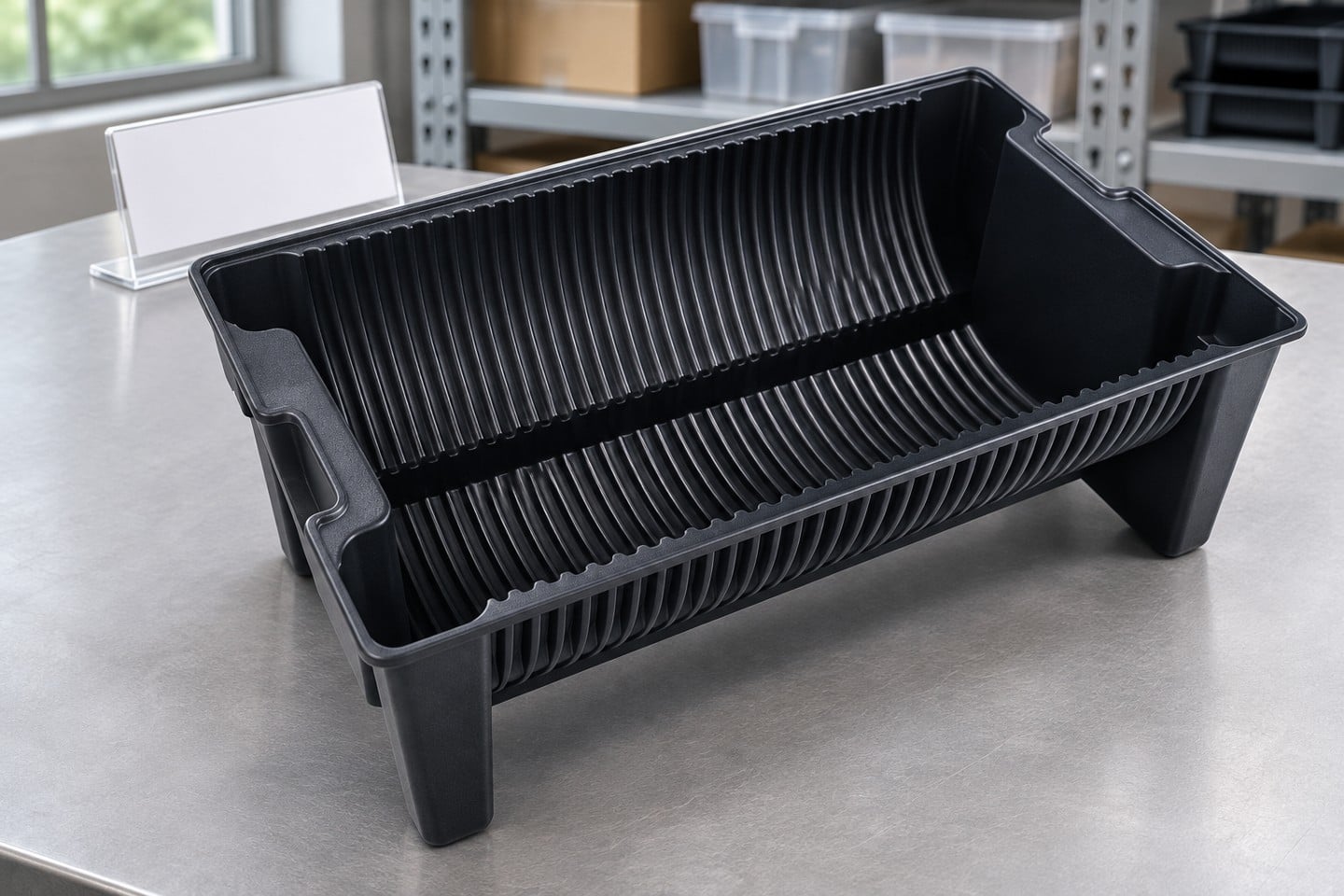
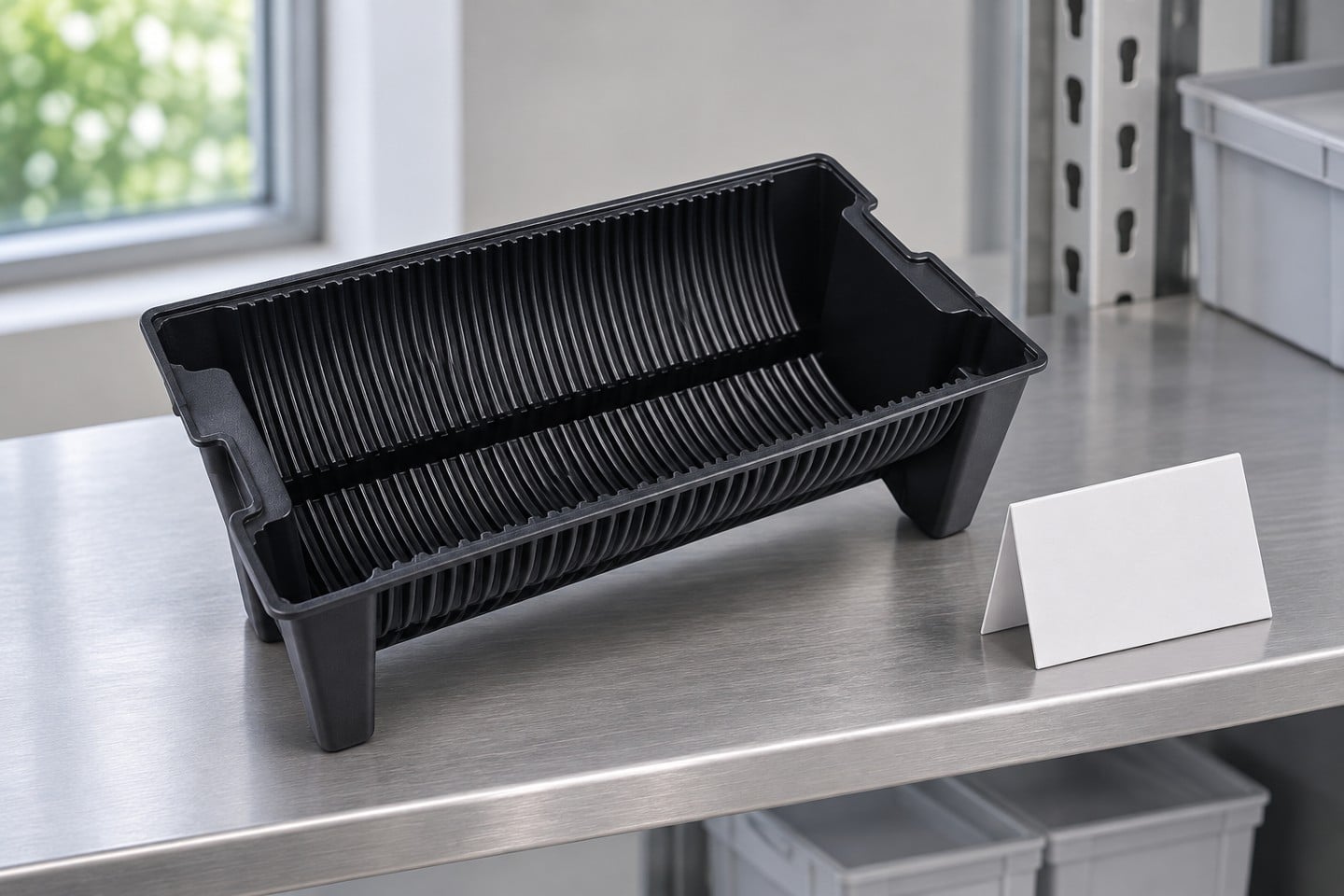
The SWESD SMT reel storage tray provides a physical reference for this workflow. Its visible grooves help separate reels, but the product photograph does not establish usable reel sizes, loading limits or an electronic inventory function. Confirm the actual supplied configuration before designing positions around it.
Define the location hierarchy before numbering slots
Choose a hierarchy that staff can read consistently: building or room, storage zone, shelf, carrier position and, where needed, individual slot. Do not add detail that nobody maintains. A small controlled store may need only shelf and tray addresses, while a busy partial-reel area may require individual slot tracking to prevent repeated picking errors.
Define whether addresses belong to fixed positions or mobile carriers. Fixed addresses remain with the shelf when a tray is removed. Mobile carrier addresses travel with the tray and need an updated shelf association. Either arrangement can work, but a location must not change meaning between shifts. State the convention in the local instruction and demonstrate a real move during training.
Before printing labels, walk the route with stores and production staff. Check whether neighboring addresses look different at normal picking distance, whether the shelf is accessible and whether the proposed code can be entered in the actual system. An address that is technically unique but repeatedly misread is a poor operational choice.
Allocate by release status before convenience
Separate released, held, unidentified and returned material using the site’s approved controls. The relevant distinction is authorization for use, not merely where a reel happens to fit. A held reel should not acquire an apparently released identity because someone places it next to good stock or reuses a familiar carrier.
Physical separation and record status should support each other. If a controlled hold area is used, its address should be recognizable in the inventory record. If different statuses occupy a shared storage fixture, the site needs a justified method that prevents mistaken selection. A colored card alone is weak when its meaning is unclear, the card falls off or a picker cannot see it.
The EOS/ESD Association overview of control procedures and materials explains the broader electrical-control context for handling sensitive items. It does not prescribe a universal warehouse address format or certify that any black carrier is suitable. Location allocation must remain compatible with the actual approved ESD program.
Use a decision table for first assignment
Choose the next action from material identity, stock status and physical suitability together. The following table is a qualitative workflow aid. It contains no universal electrical limits, shelf dimensions or stock-life rules; those must come from the applicable product and site requirements.
| Observed stock condition | Allocation decision | Record to preserve |
|---|---|---|
| Identified released reel and verified fit | Assign the approved released-stock address | Reel identity, carrier association and destination |
| Material awaiting release | Use the approved hold location | Status, hold reference and responsible reviewer |
| Unknown identity or association | Separate for identity resolution | Known observations and unresolved information |
| Partial reel returned from production | Use the approved return review route | Original identity, quantity evidence and handling history |
| Current address unavailable | Use a defined approved alternative | Temporary address, owner and reconciliation action |
Record the reason for exceptions rather than forcing every receipt into the nearest available space. This matters especially when a temporary overflow area becomes a permanent habit. If overflow is allowed, give it an address, an owner and a reconciliation route. An unnamed bench is not an inventory location simply because the material is visible there.
Verify the carrier and reel configuration
Check a representative reel in the proposed carrier and shelf position before assigning routine stock. Confirm support, retrieval clearance, label visibility and the route by which the reel enters and leaves the position. Do not infer compatibility from nominal diameter alone; flange shape, width and handling arrangements may matter to the actual supplied configuration.
Use the existing reel tray dimension guide for the separate task of collecting fit information. The location procedure should reference the approved configuration rather than repeating a new dimension specification. If a different reel format arrives, review suitability before placing it into a previously accepted slot.
Keep loose leader tape and identity labels from becoming hidden between neighboring reels. If a picker must remove several unrelated reels to read the intended one, revise the spacing or association method. Test access with the staff who perform the work, including the actual gloves and handling equipment where these affect retrieval.
Make the first put-away a controlled transaction
At receipt, verify that the material is identified and has reached the status required for the intended destination. Then choose the address, place the item and complete the record in the sequence defined locally. The chosen sequence should avoid a long interval in which the system says the reel is in one place while the reel is somewhere else.
Where scanning is available, test the actual mismatch response. A scan that merely accepts any address may record movement without preventing an incorrect placement. Where records are manual, require a clear entry with the material identity, destination and responsible operator. Do not describe a handwritten process as automatically error-proof; verify it by following a real retrieval request.
Use SMT reel storage barcode labels to address label content and readability. This article owns allocation and relocation decisions. Keeping those purposes separate makes future updates easier: a label redesign should not silently change release rules or overwrite shelf addresses.
Control relocation without creating ghost stock
A move must update both the source and destination associations. Check the source position after removal, particularly where several similar reels share a carrier. An empty slot can remain recorded as occupied, while the moved reel may be counted twice if the destination is added without clearing the original association.
Define who can authorize relocation and how urgent moves are captured. If production needs a reel immediately, the procedure still needs a way to record its actual route. A temporary transfer reference may be appropriate within the site’s approved process, but it must be reconciled. Repeated emergency moves indicate a capacity or workflow problem that deserves investigation.
When a tray moves with multiple reels, distinguish movement of the whole identified group from movement of one reel. Verify the association before transport and again at receipt where required. Do not assume that the list printed last week still describes the current contents. Group movement saves effort only when the underlying identity is dependable.
Keep partial reels and returns visible
Partial reels may need a different allocation decision because remaining quantity, packaging condition and next-use authorization require review. Do not place them in an unopened-stock position merely because their labels look familiar. Keep the original identity linked to any local quantity or return record, and follow the approved release process before reuse.
A returned carrier and its reels can have different statuses. The carrier may be available after an accepted inspection while the material remains on hold. Conversely, released material may need a different carrier if its original one is damaged. Avoid making the carrier location the only source of truth for both decisions.

For a practical example, suppose a returned reel is received at a controlled return position. Staff record the reel identity and known handling history, obtain the required review, and then assign a released-stock destination only after authorization. The position change records the result of release; it does not replace the release decision.
Review accuracy with realistic retrieval tests
Choose a small sample of actual material requests and trace them from the record to the shelf and back. Confirm that operators identify the right reel, recognize its status and complete the move without relying on private knowledge. Include a held reel and a partial reel in the exercise where these occur in normal work.
The reel tray cycle count guide owns stock reconciliation. Use location errors found during counts as feedback for allocation rules: repeated wrong-shelf events may point to confusing address design, while repeated unrecorded tray moves may indicate an impractical transaction sequence.
The EOS/ESD Association training and auditing guidance supports documented training and review in the wider ESD program. Apply that principle to relevant handling behavior without presenting the source as a warehouse software specification. Review exceptions after layout changes, new reel formats or recurring picking problems.
Prepare an RFQ and a release record
For a carrier inquiry, provide actual reel configurations, intended shelf arrangement, access direction and required identification method. Ask SWESD to confirm the supplied tray configuration and available product evidence. Where an electrical function is required, request the applicable evidence for that function rather than relying on appearance or a generic product name.
For local release, retain the accepted configuration, location convention, status separation method and responsibility for moves. A short documented trial is more useful than an elaborate address chart that has never been used. Close outstanding problems before scaling the scheme across the store, and keep obsolete address labels from returning to service.
Electrical-control background for the storage workflow
The following EOS/ESD Association educational video provides background on an ESD control program. It is relevant when assigning storage inside an electrostatic protected workflow, but it is not a reel-location demonstration or proof of this tray’s performance. The written allocation and release procedure remains necessary for the actual operation.
Frequently asked questions
Is an empty tray slot automatically available for any reel?
No. Verify identity, stock status and physical suitability before assigning it.
Should the tray number and shelf address mean the same thing?
Only if that is the explicit maintained convention. Usually carrier identity and current shelf location answer different questions.
Can held and released reels share an address without additional controls?
Use the approved separation method; a shared address must not create ambiguity about authorization for use.
Does a black tray prove ESD suitability?
No. Obtain the applicable product evidence and site review for the intended function.
What must be updated after relocation?
Update the source and destination associations and preserve the material identity and relevant stock status.


Leave a Reply