- Turbo
- Blog
Missing cleanroom garment laundry records should trigger a release-status review whenever those records are required by the site’s garment program. Identify the affected garments, separate them from normal issue and recover the actual service evidence before an authorized decision. A clean appearance, sealed bag or familiar laundry provider does not replace a required record. Equally, a missing document does not by itself prove that the garment was never processed. Treat the problem as an unresolved evidence gap and document what is known, what remains unknown and who can authorize the next step.
Establish what evidence is actually required
Start with the current garment specification and the approved service arrangement. Determine whether the missing information concerns garment identity, service batch, processing date, inspection, repair, test evidence or final release. These are different gaps. A missing delivery note may be recoverable from a dispatch record, while an absent required test result needs a different technical review.
Use the site’s actual requirements rather than assuming every garment needs an identical certificate. Some controls apply at a service-batch level; others depend on an individual garment identity or a defined verification schedule. The reviewer must know which level applies before deciding whether recovered information closes the gap. Do not invent a universal number of wash cycles, record-retention period or cleanliness criterion.
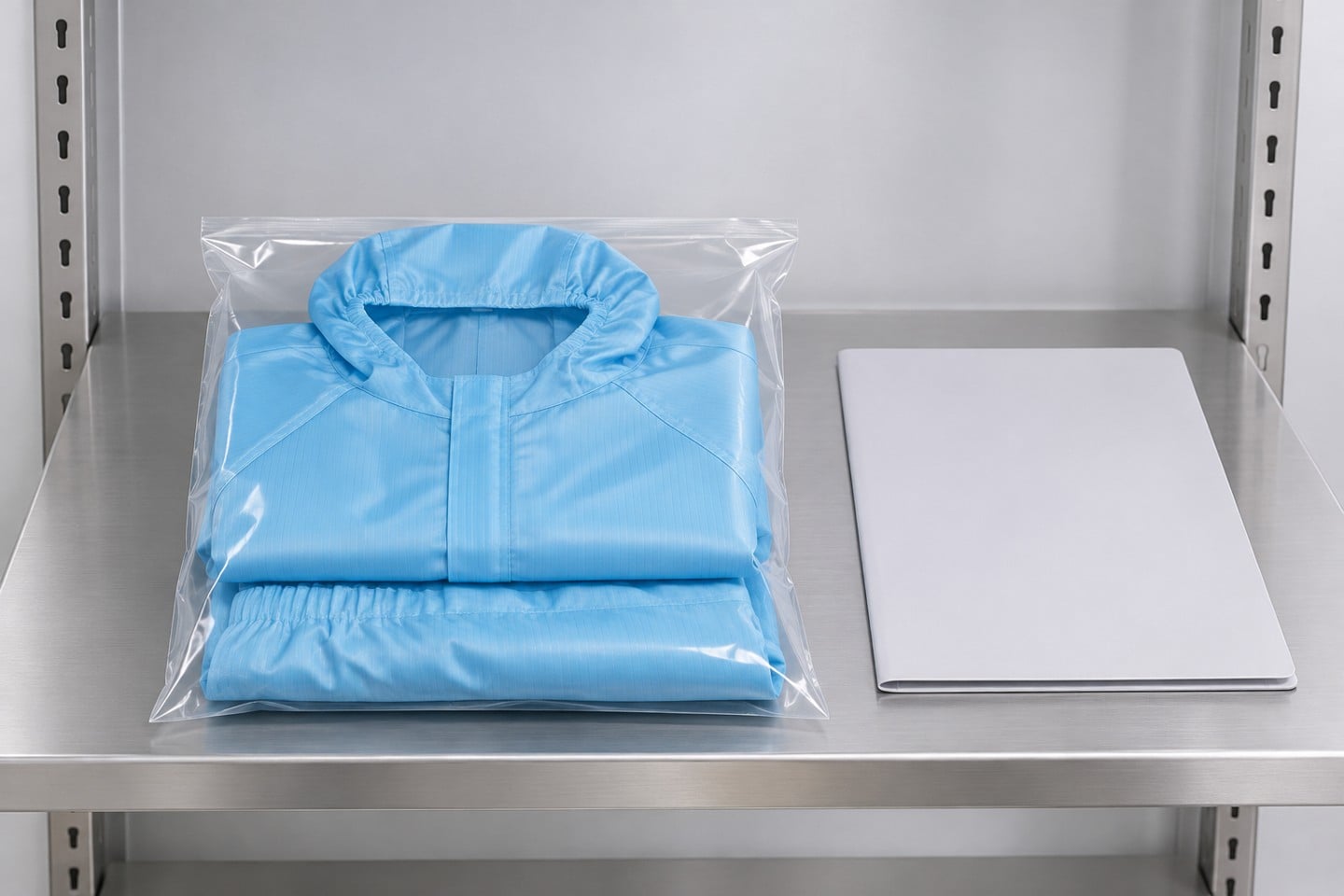
The SWESD two-piece cleanroom suit is a relevant product reference for this workflow. Its published appearance helps identify the garment type, but a product image cannot establish the processing history, electrical performance or suitability of a particular returned garment. Those conclusions need the applicable product and service evidence.
Separate a document gap from a known process failure
Record the reported event in plain language. For example, the delivery arrived with a batch identifier but without the agreed release document. That statement is more useful than writing simply that the laundry failed. It allows the service provider to search for the specific missing record and prevents the investigation from assuming facts that have not been established.
If there is independent evidence of a process deviation, record it separately. A damaged bag, incorrect garment identity or reported processing interruption may require additional review even after the missing paperwork is recovered. Restoring a document does not erase other observations. Conversely, a complete service report does not automatically resolve visible damage found at receipt.
Keep the factual timeline: receipt time, discovery of the gap, material movements and any issue before discovery. Record who observed each fact and preserve the original message or record where appropriate. A later summary should distinguish direct observations from information supplied by another party, particularly when several departments are reconstructing the same delivery.
Identify the affected population without guessing
Use the delivery, garment and service identifiers that actually exist. Start with the smallest population supported by reliable evidence, then expand it when associations are uncertain. If a mixed delivery cannot be separated by service batch, say so. Do not claim that only one garment is affected when the available records cannot support that conclusion.
Check whether garments from the same delivery have already entered issue stock. If so, use the applicable internal escalation route to locate them and assess their status. This does not mean every missing document requires the same operational shutdown; the responsible team decides the response from actual requirements, exposure and evidence. The article does not replace that decision.
The garment identification label guide covers the underlying identity system. In this exception workflow, verify that the identity remains readable and can be linked to the records being requested. Similar size, color or style does not prove that two garments belong to the same processing batch.
Choose the next action from the unresolved gap
Use an exception record that names the missing item and the evidence needed to resolve it. The table below is a qualitative decision aid, not a universal laundry release specification. The approved program determines whether a particular record is required and what evidence is acceptable.
| Missing or uncertain evidence | Immediate review route | Closure evidence |
|---|---|---|
| Service batch link absent | Identify affected garments and request batch association | Verified garment-to-service link |
| Required release document absent | Keep applicable hold pending evidence review | Authentic applicable release record or approved disposition |
| Identifiers disagree | Request an explanation and valid controlled record | Resolved discrepancy with preserved history |
| Packaging damage also observed | Review the physical condition separately | Condition decision as well as document resolution |
| Records cannot be recovered | Escalate for justified alternative disposition | Authorized scope, basis and updated stock status |
Assign one owner to coordinate the request and one authorized reviewer for the release decision, even if several people gather evidence. Without clear responsibility, the laundry may send partial answers to different departments while the garments quietly return to normal issue. Keep the hold reference with the physical stock and the record until the decision is complete.
Preserve packaging and garment associations
Avoid opening or redistributing returned garments solely to make the investigation easier. If an approved inspection requires opening a package, follow the site’s handling procedure and record what changed. A photograph of the original delivery arrangement can preserve useful associations, but photography does not replace the controlled record or prove cleanliness.
Keep the service-batch association intact while material is on hold. Do not combine unidentified garments into an ordinary issue bag or transfer labels between garments. If a temporary local identifier is needed, link it to the original known identifiers and describe the uncertainty. The temporary label must not appear to be an authentic laundry release label.

The post-laundry garment storage guide addresses normal accepted stock. Use a distinct location or status for unresolved returns so that a familiar storage shelf does not imply approval. Storage protects the investigation only when staff can distinguish held supply from garments available for issue.
Ask the service provider targeted questions
Send the relevant identifiers and ask for the specific missing evidence. Useful questions include whether the identified garments were included in a particular service batch, which records support that association and whether any deviation affected that batch. Ask for the original controlled record or an authenticated retrieval under the provider’s process, rather than a casual statement that everything was fine.
Clarify contradictory information before closing the event. If one document lists a different batch or date, do not select whichever version is convenient. Ask the provider to explain the discrepancy and identify the valid record. Retain the superseded version as investigation evidence where the local system requires it, while preventing it from being used as the current release document.
Do not request a replacement certificate with invented dates or retroactive claims. A genuine corrected record should explain what was corrected and preserve the actual processing history. When evidence cannot be reconstructed, the reviewer needs to consider a justified alternative disposition rather than manufacturing a paper trail.
Keep electrical and contamination decisions separate
An electronics garment program may address both contamination and electrostatic control. Evidence that supports one purpose does not necessarily establish the other. A processing confirmation is not automatically an electrical test result, and a resistance result does not establish every cleanliness requirement. Identify the requirements relevant to the actual use before accepting recovered evidence.
The EOS/ESD Association basic control procedures and materials provides background for an ESD control program. It does not establish that a particular laundry batch is acceptable or prescribe a universal garment washing recipe. Use the garment manufacturer’s applicable instructions and the site’s approved verification requirements for those decisions.
The existing ESD garment laundering guide owns qualification of the laundering process. This article addresses missing evidence after a service event. Repeating an unqualified wash to create a new date is not a reliable solution; any reprocessing route needs its own approved instructions and review of the garment’s suitability.
Document an authorized disposition
The final decision should identify the affected garments or batch, the missing evidence, the information recovered and the resulting status. State the authorized scope. A decision releasing one identified batch should not become permission to accept future deliveries without the agreed records. If temporary conditions apply, make them explicit and assign responsibility for closing them.
Possible routes depend on the actual requirements and may include release after adequate evidence recovery, approved reprocessing, further verification or removal from the intended use. Do not present those routes as interchangeable. The responsible reviewer must justify the selected route and ensure that stock records, physical labels and issue instructions reflect it.
If garments were already issued, document the separate review of that use and any required actions. Closing the warehouse hold alone does not explain what happened before discovery. Keep the event record readable enough that a later investigator can understand the sequence without interviewing every person involved.
Prevent repeat gaps at the handoff
Agree in advance which identifiers and records must accompany a return, which information may arrive electronically and how receiving staff verify completeness. Test the arrangement on a real delivery. A document stored in a provider portal is of limited practical use if the receiving team cannot access it when the garments arrive.
Use recurring exceptions to improve the service agreement and receiving checklist. Repeated missing batch links may indicate a weak identity method; repeated late documents may indicate an impractical dispatch sequence. The EOS/ESD Association training and auditing guidance supports training and review in the ESD program, while the site’s actual garment requirements define the acceptance details.
For a new garment inquiry, provide the intended use, identification method, service arrangement and evidence requirements. Ask SWESD to confirm the supplied garment configuration and available product information. Keep those product questions separate from the laundry provider’s obligation to document a particular service event.
ESD program background for garment release
The following EOS/ESD Association educational video explains broader electrostatic-control considerations. It helps explain why garments used in an electronics program need a defined acceptance process. It is not a laundry-record tutorial and cannot release an unidentified or undocumented service batch; the written evidence review remains essential.
Frequently asked questions
Does a missing laundry record prove the garment was not washed?
No. It establishes an evidence gap; investigate the actual service history and required release conditions.
Can a sealed bag replace a required processing record?
No. Packaging condition and service evidence answer different questions.
Must every garment have the same individual certificate?
No. Use the actual program requirements and determine whether evidence applies to an individual garment or an identified batch.
Can stores release the garments after a verbal reassurance?
The authorized reviewer must determine whether the recovered evidence meets the applicable requirements.
Should the original processing date be changed when paperwork is recovered?
No. Preserve the actual history and document the evidence recovery or correction transparently.



Leave a Reply