- Turbo
- Blog
When a wrist strap monitor alarm sounds, stop handling exposed ESD-sensitive devices, place work in the approved protective condition, and investigate the monitored path before resuming. Check the operator’s contact, compatible wristband and cord, monitor connections, and the workstation’s verified grounding arrangement in a controlled sequence. Do not silence the alarm by bypassing a connection or changing a limit until it goes green. An alarm reports the condition detected by that particular instrument; it does not, by itself, identify the failed component. This wrist strap monitor alarm troubleshooting guide explains how to separate causes, document the correction, and decide when maintenance or the ESD coordinator must take over.
Understand what the monitor actually watches
A continuous monitor is part of a personnel-grounding control system. Its operating principle, supported wristband type, monitored channels, alarm behavior, and verification procedure depend on the model. Some instruments monitor resistance through a dual-conductor system; others use a different sensing method with a compatible single-conductor arrangement. Do not assume that a cord which physically fits is electrically suitable, or that a display on one model means the same thing on another.
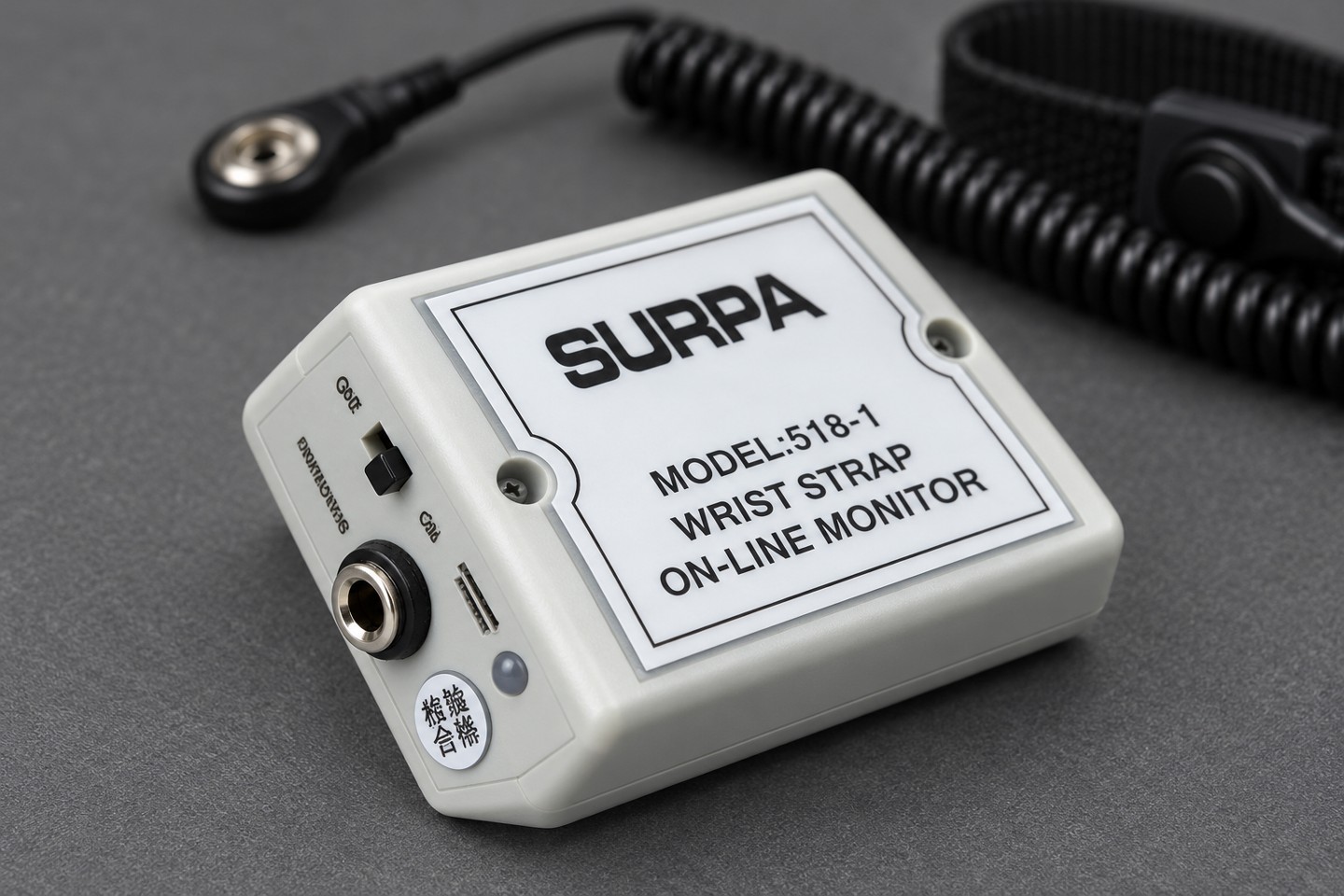
Start with the exact model’s instructions, installation record, and approved workstation configuration. Identify whether the reported alarm belongs to the operator, a monitored work surface, a reference connection, power, or another supported function. If the equipment has no separate channel indication, record that limitation rather than assigning the alarm to a guessed channel. A supplier photograph is useful for identifying a housing and connector, but it cannot establish internal measurement technology or acceptance limits.
The EOS/ESD Association personnel-grounding fundamentals explain why personnel controls work as a system. For an introduction to the equipment category, see our wrist strap online monitor overview. This article addresses corrective investigation after an alarm, rather than repeating installation instructions or prescribing a universal test frequency.
Contain the work before investigating
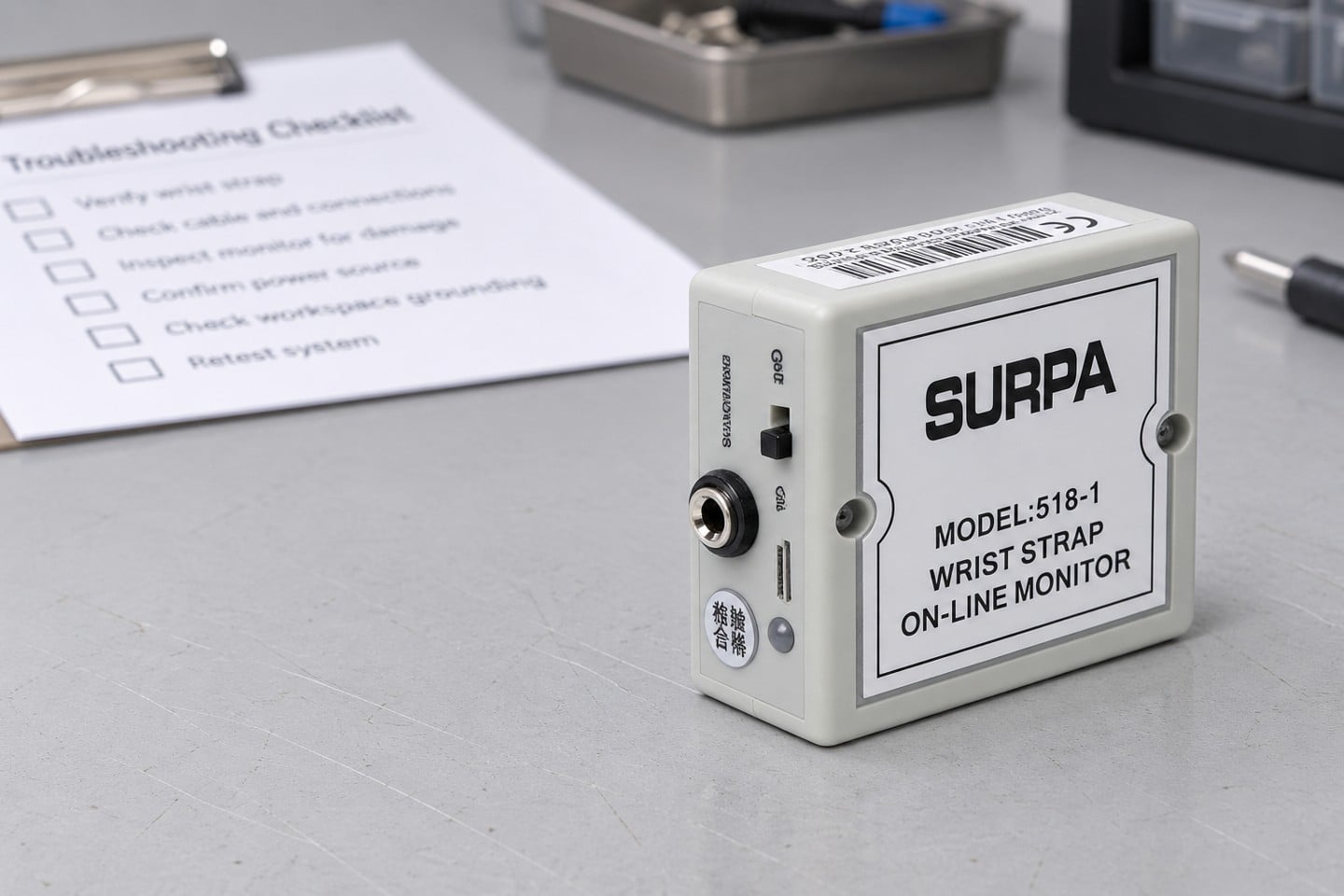
Follow the site’s approved response when the alarm occurs. Keep devices in their qualified protective packaging or on the approved protected work surface as appropriate to the process. Record the last known acceptable check and identify the work handled since then. The ESD coordinator or quality team should decide whether affected material needs a hold, inspection, or further assessment. A subsequent acceptable reading does not prove that earlier handling caused no damage.
Preserve the initial evidence. Note the instrument identity, alarm indication, workstation, operator, time, activity, and whether the alarm was steady or intermittent. Photograph the original arrangement only when company rules permit it. Avoid repeatedly unplugging everything before recording the condition: this can remove the evidence needed to distinguish a loose connector from an operator-contact problem. If electrical safety is uncertain, stop and refer the issue to qualified personnel.
Use a cause-and-check sequence
The table below is a qualitative investigation aid. It supplies no universal electrical limits and cannot replace the instrument manual or the site’s approved verification method. Change one factor at a time, record the response, and perform the required verification after a correction. Do not use an unverified operator or an unidentified spare component as your reference for declaring the workstation acceptable.
| Observed condition | First approved check | Next action and evidence |
|---|---|---|
| Alarm immediately after connecting | Confirm compatible band and cord, intended skin contact and approved monitor connection | Record the initial condition; replace only with a qualified component and verify |
| Alarm during normal movement | Inspect band fit, cord strain relief and accessible connectors | Record the activity; isolate one factor while work remains protected |
| Alarm after bench maintenance | Compare connections and power arrangement with the approved installation record | Refer installation and electrical safety checks to qualified personnel |
| Alarm remains with a qualified replacement | Perform the model-specific monitor verification procedure | Keep the workstation out of service if acceptable response cannot be demonstrated |
| Alarm clears after correction | Verify the complete arrangement and assess affected work through site procedure | Record correction, verification and authorized release; retain unresolved questions |
A successful substitution narrows the investigation but does not establish the root cause alone. For example, a new cord may stop an alarm because the original cord was damaged, because a connector was disturbed during replacement, or because the new combination interacts differently with the instrument. Reproduce the evidence only through an approved method that keeps sensitive work protected. Do not deliberately expose production devices to a suspected grounding failure to make the alarm recur.
Check wristband contact without inventing a remedy
Verify that the wristband is worn as its manufacturer specifies and that the conductive contact has the intended skin contact. A band over a sleeve, a loose fit, contamination, or a damaged contact surface can interrupt the monitored path. Inspect the band while work is protected, then use the approved checking method. An intermittent alarm during ordinary wrist movement may point toward contact or a cord problem, but movement alone cannot identify which part failed.
Do not apply improvised lotions, solvents, or conductive chemicals to force a pass. Skin treatments may be restricted by the device process, contamination controls, personal health considerations, or the wristband manufacturer. If contact remains unreliable, escalate through the approved procedure for a compatible replacement or an authorized alternative personnel-grounding arrangement. Document the decision rather than normalizing recurring alarms as an operator inconvenience.
Also distinguish a legitimate operator disconnect from a fault. A workstation may have a documented parking or standby behavior, but that feature is model-specific. If disconnecting produces an alarm, use the documented operating procedure; do not disable the signal globally. When no clear instruction exists, ask the equipment supplier to explain the expected state and have the ESD coordinator approve the response.
Inspect the cord and connector as a matched assembly
Look for damage at the wristband snap, strain relief, cable, plug, and monitor jack. A cable can appear intact while developing an intermittent internal break near a repeatedly flexed point. Record visible damage and use the manufacturer’s approved verification method. Do not pull, kink, or aggressively flex a cable to produce a test result, and do not dismantle a sealed connector during production troubleshooting.
Replacement cords must match the specified system. Connector size, conductor arrangement, any integrated component, and instrument compatibility matter. Keep approved spares identified and separate from unqualified look-alikes. A component that passes a stand-alone check may still be unsuitable for a particular continuous monitor. Conversely, an acceptable monitor indication is not evidence that every protective component in an unknown cord is correct.
Remove a suspect cord from service and label it with the symptom, workstation, and investigation date. This prevents a discarded component from reappearing in another workstation and creating an apparent new problem. After replacement, check the complete operator-to-workstation arrangement using the authorized method and record the replacement’s identity where the site’s traceability policy requires it.
Verify the workstation reference and power arrangement
Inspect accessible connections against the approved installation record. Check that plugs and terminals are in their documented positions and that no recent bench move, mat replacement, maintenance activity, or cable routing change has altered the arrangement. A monitor’s protective role depends on its intended reference and installation. A connector attached to arbitrary metalwork does not establish an approved grounding point.
Electrical installation and protective-earth questions belong to qualified personnel. Do not remove a safety earth, bridge a protective component, or open powered equipment to troubleshoot an ESD alarm. Apply the relevant electrical-safety requirements, site procedure, and equipment instructions. Have qualified personnel resolve installation and protective-earth questions before releasing the workstation.
Use the correct approved power supply where the instrument requires one. Do not substitute a supply because its connector fits. If the alarm began after a power interruption or equipment move, document that timing and check the installation through the authorized maintenance process. Record what was verified and by whom. A restart may clear a transient indication, but it does not explain or correct an unresolved installation fault.
Separate monitor verification from operator testing
A wrist strap tester and a continuous monitor have related but different roles. A periodic operator check evaluates the personnel-grounding arrangement under its prescribed conditions; verification of the monitor evaluates the instrument’s intended response using its specified procedure and equipment. Neither result should automatically be used as a substitute for the other. Our wrist strap test frequency and records guide covers the separate question of organizing scheduled checks.
Use the monitor manufacturer’s verification fixture or documented method when required. Do not construct a substitute circuit from guessed values or insert a random resistor merely to obtain a preferred indication. The record should state the model, verification method, applicable criteria, equipment identity, result, date, and person performing the check. If the method is unavailable or the instrument cannot be verified, keep it out of the approved production arrangement pending resolution.
The EOS/ESD Association training and auditing overview provides context for maintaining controls through checks and records. It does not establish a single alarm threshold for every instrument. The organization’s approved ESD program and the applicable current standards must define the criteria for the actual installation.
Investigate intermittent alarms with useful records
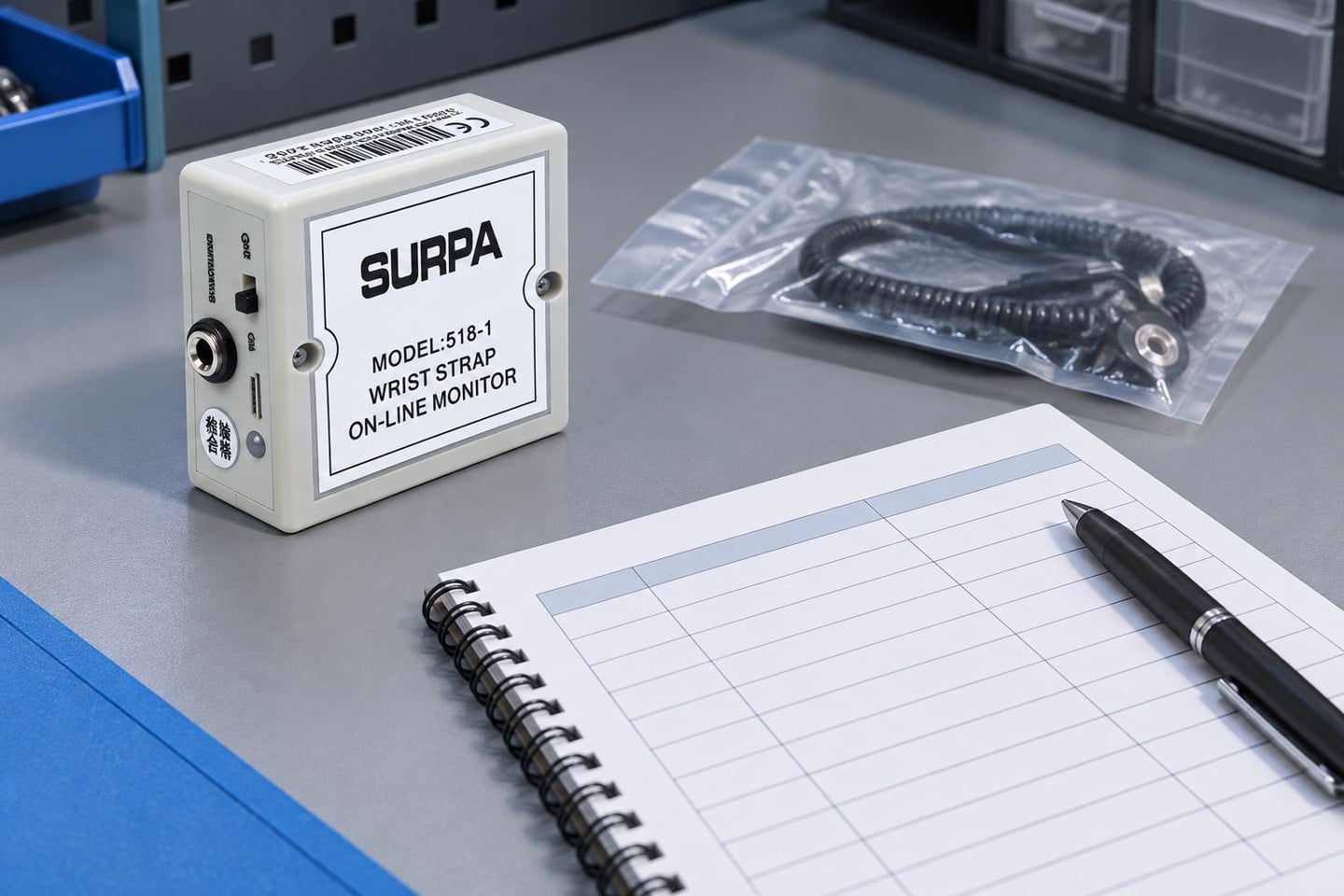
For an intermittent issue, capture the conditions without treating correlation as proof. Record whether alarms occur during normal hand movement, at a particular station, after a particular cleaning activity, or only with a specific cord and band combination. Compare these observations with the installation and maintenance history. A concise log often reveals a repeatable pattern more clearly than a long description of every action taken during the shift.
Change one qualified component or approved condition at a time. State what changed, how the system was checked, whether the symptom returned, and how long it was observed. Avoid declaring permanent success after a momentary green indication. Define the follow-up observation period according to the process and the site’s response procedure, and hand over unresolved findings between shifts so that each team does not start the same investigation again.
If the same symptom affects several stations, investigate shared changes such as replacement components, maintenance, cleaning, or installation work. Do not assume the cause is humidity simply because the weather changed. Environmental conditions can be relevant to the site’s measurements and controls, but they need recorded evidence and the correct method of interpretation. Stop production use of affected arrangements when their acceptable function has not been established.
Release the workstation and prevent recurrence
Before resuming normal handling, verify the corrected arrangement, record the result, and obtain the release required by the site’s procedure. Keep the original symptom, corrective action, affected work assessment, component disposition, and verification evidence together. If the cause remains uncertain, label the conclusion as unresolved and identify the owner of the next investigation. A cleared alarm and a documented root cause are different pieces of evidence.
For procurement, request the exact monitoring method, compatible bands and cords, installation instructions, verification procedure, available fixtures, maintenance guidance, and expected alarm behavior. Ask for written clarification of any unsupported assumption. The SWESD wrist strap online monitor product page is a starting point for an equipment inquiry; obtain documentation for the specific model before committing it to a workstation.
Related controls also need their own checks. Our personnel-grounding entrance checklist helps distinguish entry verification from workstation monitoring. Use compatible records and responsibilities across these processes, while keeping the purpose and acceptance criteria of each check explicit. This produces a practical corrective workflow instead of treating each alarm as an isolated inconvenience.
Further learning
The EOS/ESD Association educational video below supplies background on ESD controls and personnel practices. It is supporting education, not a repair procedure for the pictured monitor. Use the manufacturer’s instructions and the approved site response for the actual alarm. The disconnected product illustrations show visual inspection and recordkeeping situations; they do not demonstrate an electrical test, establish a threshold, or prove protection performance.
Sık sorulan sorular
Does a green indication prove the workstation is fully protected?
No. It reports the condition detected by that monitor. The installation, compatible components and other ESD controls still require their approved checks.
Should an operator keep working while a monitor alarms?
Follow the approved stop-and-protect response. Resume only after the arrangement has been corrected, verified and released according to site procedure.
Can any wrist strap cord be used as a replacement?
No. Use a cord qualified for the monitor and wristband system; physical connector fit alone does not establish compatibility.
Can a wrist strap tester verify the monitor itself?
Not automatically. Operator testing and monitor verification have different purposes and methods; follow the specific instrument documentation.
What should the alarm investigation record contain?
Record the initial symptom, equipment and workstation identity, affected work assessment, checks, changes, verification result, component disposition and release decision.
Son Gönderi
-
 Wrist Strap Monitor Alarm Troubleshooting Guide15 Eki,2026
 -
-
Bir Yorum Bırakın