- Turbo
- Blog
ESD shoe covers need qualification as part of the actual worn footwear arrangement, not approval by color or product name alone. A cover can change the contacts between the wearer, footwear, and floor; a disposable cover with a conductive ribbon also needs the manufacturer’s wearing instructions and evidence for its intended use. Confirm the exact product, fit, route, required tests, and replacement conditions before issue. This guide focuses on disposable shoe-cover approval for electronics work and keeps it separate from reusable heel straps, protective footwear, and electrical-insulating equipment.
Identify why the cover is being introduced
Write down the process problem first. A cover may be proposed for cleanliness control, visitor access, a footwear-control arrangement, or a combination of requirements. Those are different approval questions. If the proposal is only to reduce visible dirt, that does not resolve its effect on an established ESD footwear-flooring system.
Map the intended route from issue through the work area and to removal. Include transitions between floor types, sitting and standing tasks, stairs, and any area where physical footwear protection is required. A cover accepted for a short visitor route should not be extended automatically to an entire production shift or another building. Define who may wear it and what other controls remain required.
Verify the construction and instructions
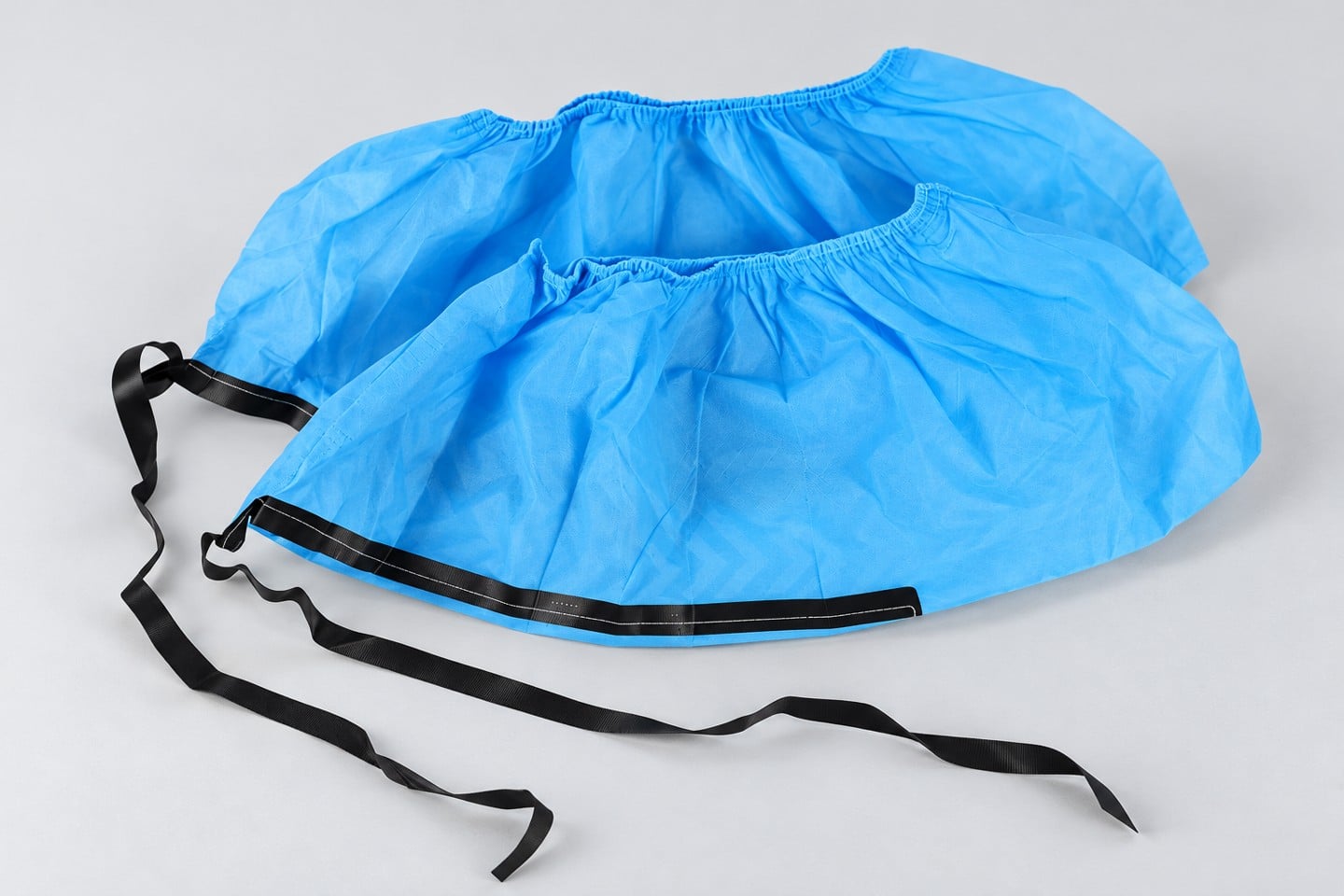
The SWESD disposable shoe cover has a visible blue cover, elastic opening, and black ribbon features. Confirm the exact supplied model and the intended function and positioning of every relevant feature with the manufacturer. Do not invent a ribbon-routing procedure based on the photograph.
Request the current wearing, removal, storage, and disposal instructions. Ask which footwear and floor conditions are covered by the supporting evidence. Confirm whether both feet require the specified arrangement and how the approved process addresses visitors with different underlying shoes. A broad ESD-safe description cannot establish that every combination is acceptable. Keep the sample identity and instructions together during the trial.

Treat the worn arrangement as a system
The EOS/ESD Association overview of control materials discusses personnel grounding and footwear-flooring controls within the overall program. Apply that systems approach: adding a cover can change relevant interfaces, and the complete intended arrangement needs evidence appropriate to its role.
A report for cover material is not automatically a result for the person wearing that cover over a particular shoe on the factory floor. Likewise, an entrance check and a broader qualification exercise can answer different questions. The ESD shoe resistance guide explains the need to identify the measurement path. Use the actual applicable method and approved program requirements rather than copying a universal resistance limit.
Keep physical and electrical safety separate
A disposable cover is not proof of toe protection, puncture protection, slip resistance, or protection against electric shock. It should not be used to conceal unsuitable underlying footwear where protective footwear is required. Review the workplace hazards and the effect of the cover on movement and surface contact.
The Canadian Centre for Occupational Health and Safety footwear guidance explains the importance of selecting footwear for the actual hazards. Use that as safety-selection context, not as an ESD cover specification. If the cover changes how a worker walks or contacts a floor, the responsible safety assessment needs to address that change before routine use.
Build a qualification matrix before the trial
| Keputusan | Define before trial | Evidence to retain |
|---|---|---|
| Identiti | Exact cover, size, construction and instructions | Model and sample lot |
| Arrangement | Permitted footwear, floor and wearer setup | Applicable qualification and verification |
| Pergerakan | Approved route and relevant postures | Fit, retention and condition observations |
| Kebersihan | Supplied state and dispensing method | Process-specific evidence and handling controls |
| Failure response | Rejection, retest and replacement rules | Original result and authorized disposition |
Agree the matrix with the ESD coordinator, process owner, safety owner, and supplier as appropriate. Specify which combinations and routes are inside the proposed approval. A trial that does not identify the underlying shoes or floor cannot support a clear conclusion about the worn arrangement.
Use representative permitted combinations and a controlled procedure. Record the sample lot, size, preparation, instructions, test method, conditions, observations, failures, and decision. Do not mix results from materially different arrangements into a single passed statement. If one combination fails, keep the scope of that finding visible while continuing the evaluation of independent combinations.
Observe fit and ribbon retention during movement
Follow the manufacturer’s instructions to fit the exact cover. Check whether the elastic opening retains it correctly and whether any specified ribbon or contact feature remains positioned during the authorized route. Do not add knots, tape, trimming, or other modifications without approval; these changes can create a different arrangement from the one evaluated.
Observe normal walking, turning, permitted stepping, and the actual work posture under controlled conditions. Record cover movement, exposed areas, damaged seams, snagging, or a feature that repeatedly shifts. A successful stationary check does not demonstrate that the cover stays correctly fitted during the complete route. Use safe trials and stop when an unacceptable condition is identified.

Evaluate cleanliness without assuming sterility
Specify the cleanliness requirement and the condition in which the covers are supplied. A cleanroom-use description does not by itself establish sterility, a particular particle performance, or acceptance for every controlled area. Ask for the exact evidence needed by the process and keep its scope clear.
Include dispensing and donning in the evaluation. A cover can be contaminated while being removed from an unsuitable container or while the user touches the floor during fitting. Define a practical issue arrangement and sequence that the workplace can sustain. Accepted unused stock, opened packages, rejected covers, and waste should have distinguishable routes. Do not reuse rejected items by returning them to the dispenser.
Define test and failure responses
The approved program should identify any required entrance checks, broader verification, records, and failure responses. Train staff to recognize that a failed result cannot be overridden merely because the cover looks new. Check the setup, identity, fit, and instructions through the authorized procedure, while preserving the original observation.
Do not repeatedly alter the arrangement until a favorable result appears without recording the change. If the failure relates to a particular footwear combination or product lot, isolate that scope and investigate it. The ESD test report requirements guide provides a structure for connecting a result to the specimen and conditions that produced it.
Set replacement and visitor-control rules
Request the product’s disposal and reuse restrictions. Do not treat a disposable cover as washable or reusable unless the exact product and route have an approved basis. Define replacement triggers for damage, contamination, loss of fit, displacement of a required feature, uncertain identity, and completion of the permitted route.
Visitor procedures should explain the approved route and the controls that remain necessary. A visitor should not have to interpret a technical certificate at the entrance. Issue staff need a clear list of accepted products and combinations, a demonstration of the correct wearing sequence, and a response when the arrangement cannot be made acceptable. Keep alternate arrangements authorized and identifiable.
Manage supply changes and staff training
Record the construction, supplier, size range, packaging, instructions, and report scope used for approval. Review changes to the cover material, ribbon, elastic opening, seam, underlying footwear, floor, cleaning process, or route before extending the original decision. A familiar blue color does not establish that the new supply is identical.
The heel strap instructions guide concerns a related but different product format; do not substitute its fitting procedure for the shoe-cover instructions. Training should distinguish those products and their permitted uses. Check practical wearing, identification, and rejection behavior during routine observation rather than relying only on an attendance record.
Educational context and purchasing handoff
The following EOS/ESD Association introductory lecture explains the principles behind coordinated personnel and material controls. It does not demonstrate fitting this shoe cover, provide a slip rating, or approve a visitor route. Use the actual manufacturer’s instructions and qualified program evidence for those decisions.

Send procurement a defined scope: exact cover, instructions, permitted footwear and floors, intended route, applicable evidence, issue method, failure response, replacement rules, and change-notification requirements. Where a combination remains unverified, state that limitation. This gives the factory a repeatable approval process instead of assuming that a disposable cover can convert every shoe into suitable ESD footwear.
Soalan Lazim
Does a blue cover make every shoe ESD suitable?
No. Qualify the exact cover, underlying footwear and floor arrangement for the intended use.
Can a cover replace required safety footwear?
No. Physical hazards and protective-footwear requirements remain separate.
Where should the black ribbon be placed?
Use the current instructions for the exact product; do not infer routing from a picture.
Does a material report qualify the worn system?
Not automatically. Match the evidence to the actual arrangement and required measurement path.
Can disposable covers be washed for reuse?
Do not invent reuse instructions. Follow the supplier restrictions and approved route.


Tinggalkan Balasan