- Blog
An injection molding ESD box OEM program needs a controlled design package before a tooling or MOQ discussion can be meaningful. Start by checking whether a published box family and confirmed options fit the job; if they do not, define the geometry, material evidence, quantity assumptions, and sample criteria that a custom-tool quote must address.
This guide is for buyers who need a repeatable ESD turnover box, not an online estimate. It explains the inputs that make an OEM RFQ comparable while keeping MOQ, tooling cost, production timing, and final configuration subject to the supplier’s quotation.
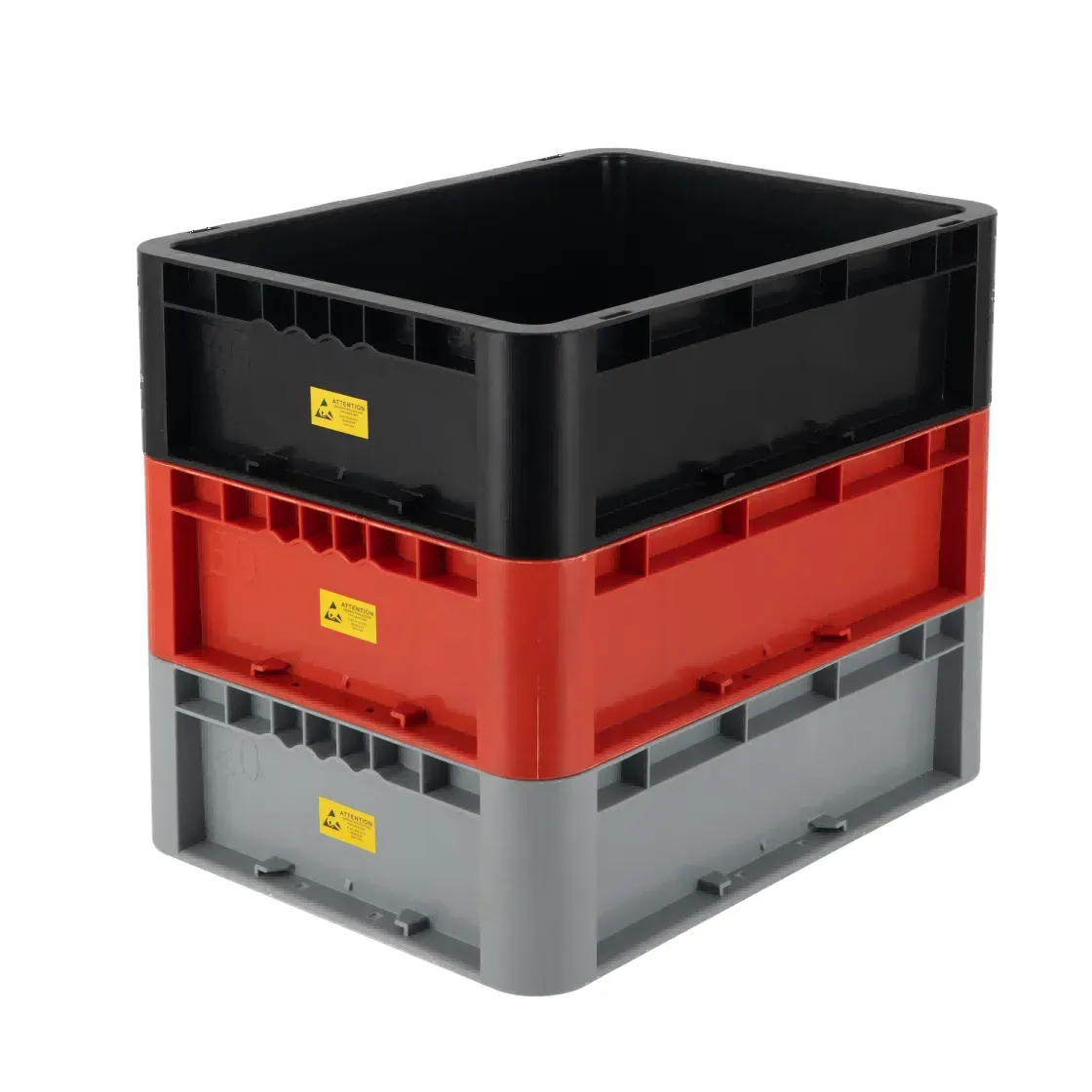
Part 1. Should the program start with a standard ESD box or custom tooling?
The first decision is whether the program has a true geometry or function gap. A published box family may be the lower-risk starting point when its available footprint, depth, cover, partition, label, and handling features can be confirmed against the actual component and process.
Custom tooling becomes a discussion when the required internal layout, exterior interface, identification feature, handling fit, or other controlled requirement cannot be met by a reviewed standard option. It is not a default upgrade for every branded or colored box.
| Starting route | L'acheteur doit fournir | Decision to confirm |
|---|---|---|
| Published box family with options | Component envelope, accessory needs, label information, and handling conditions | Whether a listed configuration fits the selected model |
| Configured box or tray | Drawing of compartments, dividers, cover, or marking requirements | Which features can be supplied together in the quoted configuration |
| New injection-molded part | Controlled CAD or drawing, intended use, material requirement, quantity assumptions, and acceptance plan | Whether new tooling is required and what scope it must cover |
For a component-segregation requirement, the divider-layout RFQ checklist can help define internal cells before any tooling discussion begins. When covered storage and stack orientation are central, also review the lidded-box stacking guide.
Part 2. What belongs in a controlled tooling RFQ?
An accurate quote begins with an unambiguous package, not a brief description such as “custom ESD box.” The bid file should identify the revision that is being quoted and make clear which requirements remain open for supplier recommendation.
| Entrée de demande de devis | What to state | Why the input matters |
|---|---|---|
| Geometry | Controlled CAD and, where needed, a drawing with critical dimensions | Lets the supplier review the actual part rather than infer its shape |
| Intended contents | Maximum item envelope, packing condition, and handling orientation | Connects internal volume and protective features to the use case |
| Material requirement | Required resin family or approved alternatives, color, and ESD evidence request | Avoids comparing quotes built around different material assumptions |
| Functional features | Lid, divider, label, logo, stacking, cart, shelf, or assembly interfaces | Shows which details are part of the mold or an accessory decision |
| Quantity assumptions | First order, annual forecast, and expected order pattern | Gives a basis for discussing the manufacturing approach without asserting MOQ |
| Acceptance plan | Appearance, dimensions, fit, traceability, and electrical evidence to review | Defines what the sample review must demonstrate |
A drawing revision should be identified in the RFQ, on supplier feedback, and on the sample record. If a buyer changes the layout after quotation, the supplier should identify what the change affects before the revision is approved.
Important : An injection-molding proposal is more comparable when drawings, material, production volumes, timing, secondary operations, packaging, and validation requirements are stated rather than assumed. (Crescent Industries RFQ guidance)
Part 3. Which DFM questions should be answered before tool approval?
Before a tool is released, ask for a design-for-manufacturability review that names the features requiring a decision. Draft direction, wall-section transitions, ribs, corners, undercuts, gates, ejection, tolerances, and surface requirements can all influence the proposed tooling concept and the finished part.

The review is not a substitute for the buyer’s drawing revision. It is the point where the buyer and supplier record what must change, what remains a requirement, and which assumptions are acceptable before tool build.
| DFM question | Procurement consequence |
|---|---|
| What is the mold opening direction? | Clarifies draft and ejection assumptions |
| Which walls, ribs, or corners are critical? | Focuses discussion on moldability and part performance |
| Are there undercuts or interfaces? | Identifies possible tooling complexity before approval |
| Which dimensions are critical to fit? | Separates inspection needs from general dimensions |
| What finish, marking, or label area is required? | Prevents cosmetic and identification needs from becoming late additions |
La Fictiv injection molding design guide identifies draft, wall thickness, ribs, tolerances, and material selection as DFM topics. It is general guidance, so the final decision must follow the selected resin, geometry, and supplier review rather than a generic rule of thumb.
Part 4. How should material and ESD evidence be defined?
Use a material requirement that distinguishes the resin decision from the ESD evidence request. The buyer can state the intended ESD-control program, the test method or acceptance criteria required by that program, and whether evidence is needed for the finished box, a sample, or a supplied lot.
Neither an ESD label nor a program-level standard validates every molded container by itself. CEI 61340-5-1 et ANSI/ESD S20.20 provide ESD-control context; the relevant product evidence must still be tied to the quoted material and agreed test conditions.
Material selection also interacts with geometry. A resin change can affect the DFM review, dimensions, surface appearance, and the evidence that must accompany the part. State whether material substitution is allowed and who may approve it.
Sanwei describes ESD box and tray customization topics on its Solution de boîtes et de plateaux ESD. Ask the quotation to identify the proposed configuration and the evidence available for it rather than treating a solution-page description as a universal finished-product claim.
Part 5. Which commercial decisions belong with the tooling request?
Tooling approval is also a control decision. The buyer should know which design revision is being released, which party approves a change, and how ownership, storage, access, maintenance, and end-of-program handling will be documented.
| Commercial topic | Question to resolve in the quotation or agreement |
|---|---|
| Tool ownership | Who owns the tool and what records identify it? |
| Tool storage and access | Where is it stored, and how are access or transfer requests handled? |
| Revision control | Which drawing revision is approved, and who authorizes a change? |
| Tooling scope | Which inserts, accessories, markings, or secondary operations are included or excluded? |
| Sample and production release | What review is required before the part moves beyond sample approval? |
| Packaging and identification | How will parts, revision, lot, and labels be presented for receiving? |
Separate tooling scope from the unit-part discussion. A quotation can be clear only when both describe the same revision, material assumption, configuration, and acceptance plan. This approach also makes it easier to compare a standard-product route with a custom-tooling route without forcing either one to appear universally better.
Part 6. How should MOQ be discussed without assuming a number?
MOQ is a project-specific commercial output, not a technical property of every injection molding ESD box. The requested configuration, resin, tool concept, production setup, packaging, and ordering pattern can affect how a supplier structures the quote.
| Quantity conversation | Entrée de l'acheteur | Réponse du fournisseur à la demande |
|---|---|---|
| First order | Expected first release quantity | State the quoted MOQ basis and any assumptions |
| Annual forecast | Expected total demand and timing pattern | Explain whether it affects the proposed tooling or pricing structure |
| Future variability | Known demand range or uncertainty | Identify which commercial terms would need re-quotation |
| Trial requirement | Whether a sample or limited evaluation is required | State the sample path and what it does not establish |
Provide both the first order and a realistic annual forecast, even if the forecast is a range. Those fields help a supplier evaluate the request, but they do not authorize the buyer to infer a specific minimum, price break, tool life, or production schedule.
For an OEM discussion, contact Sanwei OEM/ODM with the quantity assumptions and ask for a project-specific response. The answer should state the basis of the MOQ and the conditions under which the quoted terms apply.
Part 7. What should be approved on molded samples?
Molded samples should be reviewed against the same controlled requirements used for the RFQ. A visual check alone cannot confirm that the box fits its contents, labels remain usable, interfaces work in handling, and any requested ESD evidence corresponds to the agreed material and part.

Use the sample review to document the result of the following checks:
- Match the sample to the approved drawing revision and requested configuration.
- Check critical dimensions and the fit of contents, covers, partitions, carts, shelves, or labels that matter to the program.
- Inspect visual, marking, and handling requirements under the intended use conditions.
- Review the requested material identification and electrical evidence against the buyer’s stated method and acceptance criteria.
- Record any approved change before releasing a production order.
La Famille de produits de boîtes ESD Sanwei is a useful starting point when published models and options may fit the requirement. For an application that needs custom geometry or other OEM review, use the Sanwei ESD Box & ESD Tray solution as the product recommendation and submit the controlled package through Contacter Sanwei.
Ajuster la limite
| Situation de l'acheteur | Reasonable next step | Éviter |
|---|---|---|
| A published box appears to fit | Confirm the exact model and required options | Assuming every accessory fits every standard box |
| The internal layout or external interface is unique | Submit a controlled RFQ for tooling review | Treating a sketch as a final manufacturing definition |
| The ESD requirement is critical | State the buyer’s evidence and acceptance requirements | Using a standard reference as proof of a finished part |
| Quantity is uncertain | State first-order need and forecast range | Copying an unrelated MOQ into the program |
| A new mold is proposed | Define ownership, revisions, samples, and change approval | Releasing a tool before requirements are recorded |
FAQ
What is an injection molding ESD box OEM program?
It is a project to evaluate or make an ESD box for a defined use case through a controlled design, material, tooling, quotation, and sample-approval process.
When should an OEM buyer consider custom tooling?
Consider it when a reviewed standard box and confirmed options cannot meet the required geometry, interface, handling, identification, or other controlled requirement.
What files should be included in a tooling RFQ?
Include the controlled CAD or drawing revision, material and ESD requirements, intended contents, critical dimensions, functional features, quantity assumptions, packaging needs, and sample-acceptance criteria.
Does a DFM review replace a drawing revision?
No. A DFM review identifies manufacturability questions and proposed changes; the buyer should approve a controlled revision before tooling is released.
What ESD evidence should be requested for a molded box?
Request the material identification, applicable electrical evidence, test method, test conditions, test locations, and traceability that the buyer’s ESD-control program requires.
Who should own and control changes to the tool?
The quotation or agreement should identify tool ownership, storage, access, the approved revision, and which party may authorize design changes.
What determines MOQ for a custom ESD box?
MOQ must be confirmed for the defined project. Ask the supplier to explain the quoted basis using the configuration, material, tooling, production setup, packaging, and ordering assumptions.
What should be accepted on first molded samples?
Check the approved revision, critical fit and dimensions, requested interfaces, visual and marking requirements, handling performance, and the material or ESD evidence specified for the program.

Laisser un commentaire