- Blog
A wrench-adjustable ESD magazine rack is a controlled manual-width buffer, not a universal PCB carrier. For an OEM purchase, define the board envelope, rack envelope, guide and slot geometry, lock method, heat exposure, resistance evidence, and machine interface before asking for a quote.
The checklist below helps buyers separate a stable-format manual rack from a high-mix changeover requirement. Start with the ESD Magazine Rack category for the product family, then keep the chosen model tied to your drawing revision.

Part 1. Define wrench adjustment
Wrench adjustment normally means that a technician loosens, moves, and re-locks side-guide hardware with a hand tool or screw-based fastener. It is a manual setting method, so the useful specification is not the marketing label; it is the adjustable width range, number of locking points, tool size, and confirmation procedure.
Ask the supplier to identify whether both side guides move, how the guides stay parallel, and whether the locked setting has a reference scale. Those details determine whether a setup can be repeated across shifts. Do not infer that a rack described as adjustable has a quick-change mechanism.
Part 2. Decide when manual adjustment fits
Manual adjustment can be a sensible fit when board widths remain stable for long runs and the line can control who changes the setting. It can be less suitable when a shared line changes panel width repeatedly and every reset consumes operator time.
| Operating pattern | Wrench-adjustable fit | Procurement action |
|---|---|---|
| One panel family for long runs | Usually reasonable | Record the locked width and tool requirement |
| Several widths each shift | Confirm changeover time | Compare a faster adjustment family |
| Manual inspection buffer | Possible | Check board edge clearance and guide alignment |
| Automated loader interface | Conditional | Validate outer envelope, ears, and handles on sample |
For a mechanism-focused comparison, use the screw versus belt-screw adjustment guide. It should inform the choice, not replace a sample check.
Part 3. Build the dimensional specification

Record both the PCB range and the outer rack envelope. A rack can hold a board yet still fail at a loader because an ear height, handle, or base width conflicts with the machine.
| Specification field | Record in the RFQ | Why it matters |
|---|---|---|
| PCB length and width | Minimum and maximum finished panel | Sets usable guide travel |
| PCB thickness and edge condition | Drawing revision | Avoids guide interference |
| Outer L × W × H | Maximum assembled rack envelope | Protects loader clearance |
| Slot count and slot pitch | Required capacity and center spacing | Controls buffer quantity |
| Slot depth and width | Board edge engagement | Protects alignment |
| Locking method | Tool, fastener count, witness mark | Makes resets auditable |
| Loaded mass | Full magazine estimate | Checks base and handling practice |
Sanwei’s solution page describes customizable slot pitch for its stated line. Treat that as an invitation to submit a drawing, not as proof that every catalogue rack has the same slot configuration.
Part 4. Qualify ESD and heat evidence
An ESD program needs measured performance rather than a color-based assumption. IEC 61340-5-1 and ANSI/ESD S20.20 provide program context; they do not make an untested rack acceptable by name alone.
Sanwei states a 10^6–10^9 Ω range, 160°C standard material, and an optional 200°C grade for the magazine-rack solution line. Request the test method, test locations, lot identification, and the exact heat duty. A warm queue beside reflow and an in-process carrier duty are not interchangeable conditions.
Part 5. Validate the first article
Before a production release, set the minimum and maximum board width, verify that every lock point is secure, and run the rack through the intended loading motion. Check the guide position after repeated adjustment instead of relying on one static setup.
The receiving record should capture outer dimensions, slot pitch, resistance readings under your test method, and any loader interference. When the process uses frequent width changes, add a documented setup sequence and recheck guide parallelism after maintenance.
Part 6. Choose a rack option
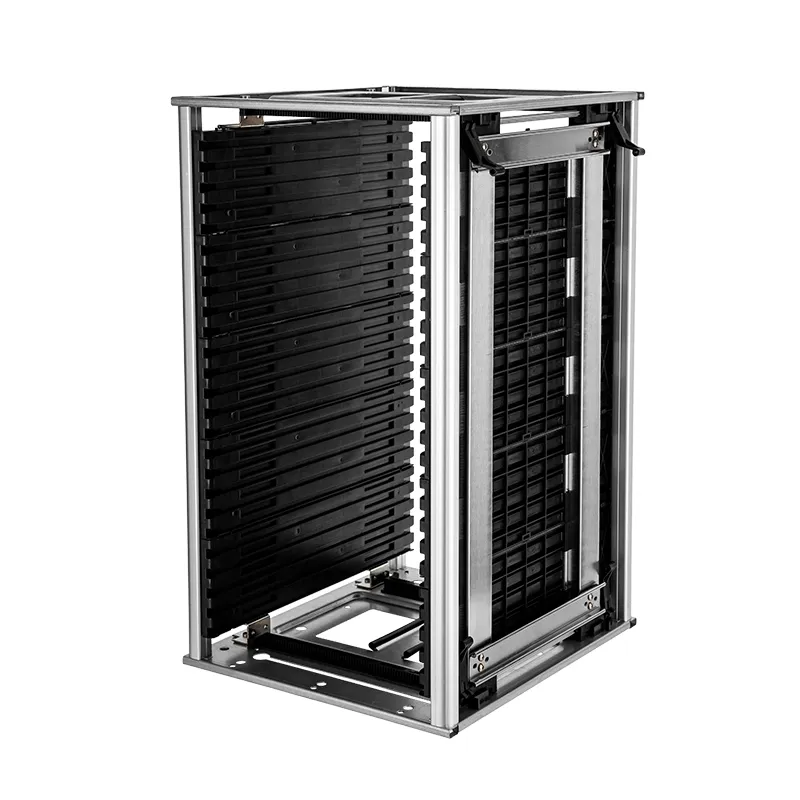
Use Sanwei’s ESD Magazine Rack solution to discuss material and customization requirements. Where the board envelope aligns after drawing review, the 355(L)×320(W)×H mm ESD magazine rack is a practical product-recommendation starting point.
Fit Boundary
| Buyer situation | Suitable path | Do not assume |
|---|---|---|
| Stable board width | Wrench/manual adjustment with controlled work instruction | That it is fastest for every line |
| High-mix line | Compare manual and quick-adjust options | That manual resets meet takt time |
| Reflow-adjacent buffer | Specify actual dwell and heat exposure | That all black racks have the same heat grade |
| Loader or unloader use | Submit machine and board drawings | That outer dimensions alone prove fit |
Send the drawing revision, annual quantity bands, and required documentation through Contact Sanwei for a qualified quotation.
FAQ
How is a wrench-adjustable magazine rack set?
The operator loosens the specified hardware, positions the side guides for the board width, confirms parallel alignment, and re-locks the setting. Request the tool, lock count, and repeatability method for the selected model.
When is manual adjustment suitable?
It is often practical for stable board-width programs with infrequent changes. High-mix lines should compare the documented reset time with their changeover window.
Which dimensions belong in the specification?
Include PCB length and width range, thickness, outer rack L × W × H, slot count, pitch, slot geometry, loaded mass, and automation interface dimensions.
What slot details should an OEM buyer request?
Specify slot count, pitch, guide depth, guide opening, usable board edge engagement, and any component-height restrictions near the supported edge.
How should ESD resistance be verified?
Request a defined test method, probe locations, readings for guides and base, lot identification, and an incoming-inspection plan. Use the supplier’s stated range only within its published scope.
Should a loader sample be checked before purchase?
Yes. Run the first article through the intended loading motion and verify clearance, orientation, locks, and repeatability before approving a production rollout.

Leave a Reply