- hanqi
- Blog
When it comes to electronics manufacturing, repair, assembly and laboratory environments, the smallest parts usually create the greatest handling challenges. Tiny ICs, resistors, capacitors, connectors, sensors and precision parts can easily be misplaced, contaminated or damaged by electrostatic discharge. This is why small ESD trays are an integral part of a well-established ESD protection program.
Small ESD trays are specially designed for the safe holding, organizing, transferring and storing of static-sensitive items within EPA-controlled areas. These trays help decrease the risk of electrostatic discharge while also increasing workflow efficiency, especially when technicians require rapid access to small quantities of components during assembly, inspection, testing or repair.
Small ESD Trays? What Are They?
Small ESD trays are compact tray-like devices made from electrostatic dissipative or conductive materials. Unlike conventional plastic trays, which can generate or hold static charge, an ESD tray is constructed to manage static electricity and prevent damage to sensitive electronic components caused by ESD events.
Small ESD trays are used in many applications, including PCB assembly processes, semiconductor handling, electronics repair operations, clean manufacturing benches, quality control stations and static-sensitive component storage areas. Their compact size makes them an excellent choice for workstations that are space-constrained but still require ESD protection and organization.
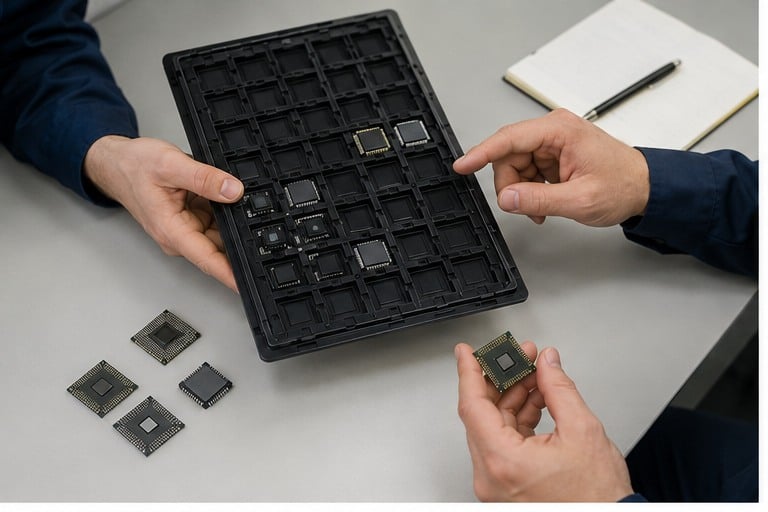
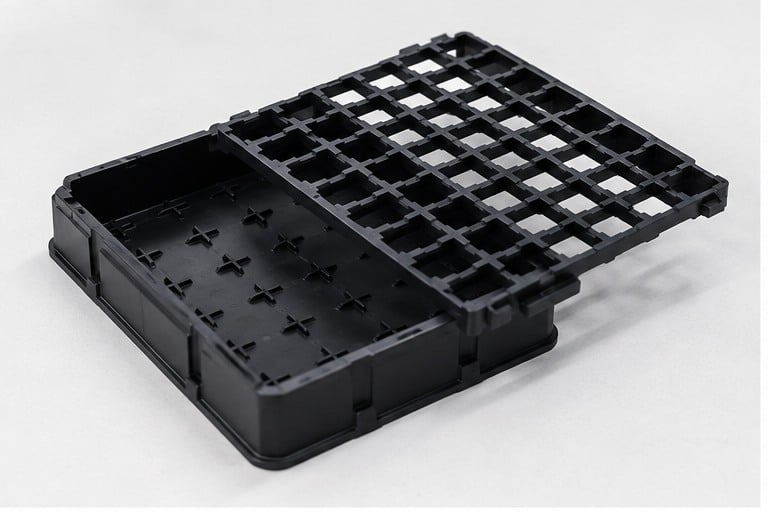
Small ESD trays can have different designs and configurations based on their application. They may have flat surfaces, divided compartments, stackable designs, molded cavities or custom inserts. Depending on their design and use, some trays are suitable for short-term work-in-process handling, while others are designed for longer-term esd tray storage or controlled transport between production areas.
Importance of Small ESD Trays for Electronics
Electrostatic discharge is commonly invisible, and the potential hidden damage to an electronic component may not become evident immediately. A component that has undergone an ESD event may pass visual inspection, but once placed into service in the field, it can fail and lead to warranty claims, returns and reduced confidence in the company’s products. Using the proper tools for handling ESD-sensitive items reduces the risk of these issues becoming quality problems.
Small trays provide an excellent solution for storing and handling small ESD-sensitive components, since many static-sensitive parts are small and easy to mix up when space is limited. By using a small tray configured for ESD-sensitive components, parts are kept separated and easily identifiable. This improves traceability and reduces unnecessary contact, helping minimize both mechanical damage and ESD damage.
For buyers, small trays provide more than a storage solution. The greatest benefit is improved process control, including fewer missing items, cleaner work areas, easier assembly flow and improved protection of sensitive inventory.

Common Uses for Small ESD Trays
Small ESD trays are utilized extensively throughout the electronics industry to ensure components are properly stored and handled. In assembly areas, they are used to hold parts for kitting, staging, soldering, inspection and rework. They are also used in repair centers to organize screws, chips, connectors and replacement parts from disassembly through completion of service.
Small trays are used in warehouse and inventory storage areas as part of a total storage solution for small electronic components. They are often used together with esd safe shelf bins, racks, conductive carts and ESD-safe shelving systems to provide a more complete storage solution. In laboratories, trays designed for an ESD environment help engineers keep prototypes and test samples separated and protected during product development.
They are also useful in areas such as training and maintenance departments, where small electronic component parts are handled regularly but space and organization are limited. By utilizing a compact ESD tray, a cluttered workbench can be changed into a controlled, efficient and safer working surface.
Key Features to Look for When Choosing Small ESD Trays
Not all trays work in every ESD environment. Before purchasing, it is important to review the material, surface resistance, size, shape and compatibility with your process. A tray that works well for loose parts may not be as suitable for populated printed circuit boards, precision sensors or fragile semiconductor packages.
ESD performance should be the first consideration when reviewing ESD trays. Many are made from conductive polypropylene, dissipative plastic, carbon-loaded materials or other engineered compounds. Buyers should review surface resistance values and confirm that the ESD tray is compliant with the requirements of the user’s ESD control program.
Size should also be considered when selecting a small ESD tray. Small trays should be compact enough for bench use, but large enough to prevent overcrowding of components. Overfilled trays make parts harder to identify and can lead to handling mistakes. If the user needs to keep components separated, a divided or compartment tray is usually a better choice than a flat tray.
Durability is another important consideration when selecting a small ESD tray. In an active production environment, ESD trays are often stacked, cleaned, moved and reused several times a day. A durable tray with stable dimensions and excellent wear resistance will usually outperform a less expensive tray that may warp, crack or wear down more quickly.
ESD vs. Plastic Trays
While standard plastic trays may look similar to ESD trays, their performance is quite different. Standard plastic materials can generate static electricity because of friction created when parts are added, removed or moved across the tray surface. If a static charge discharges from a tray into a sensitive electronic component during such activities, the component may be damaged.
ESD trays are designed to minimize the generation of static charge and control the safe, predictable dissipation of static electricity. For environments that work with static-sensitive electronic equipment, replacing standard plastic containers with proper ESD-safe containers is an easy but crucial step toward better quality control.
At first, standard trays may appear less expensive than ESD-safe containers. However, once the hidden costs of damaged components, failed assemblies, rework and quality complaints are considered, the true cost of using standard trays can exceed any initial savings. For companies that care about reliability, ESD-safe handling is not an optional upgrade; it is part of responsible quality management.

Proper Use of ESD Trays
For maximum effectiveness, small ESD trays must be used as part of a complete ESD control system. This includes properly grounded work surfaces, wrist straps, ESD-safe tools, proper packaging and trained personnel. A tray alone cannot compensate for an uncontrolled environment if it is not combined with the other elements of an ESD control system.
When possible, ESD trays should be used on ESD-safe benches or shelves. Operators should avoid mixing sensitive components with non-ESD materials that may generate static electricity. When trays are used for transport, they should be compatible with conductive carts, ESD-safe shelving or controlled storage systems.
It is essential to keep trays clean. Dust, oil, flux residue, adhesive labels and packaging debris can affect cleanliness and handling performance. Clean trays according to manufacturer guidelines, and do not use inappropriate cleaning agents unless the manufacturer confirms they are safe for the tray material.
Storage of ESD Trays: Better Organization and Protection
Good esd tray storage is much more than placing trays on shelves. It includes organizing components to support fast picking, accurate identification and safe handling. Clear labeling, controlled locations and proper separation of component types help reduce errors and improve production flow.
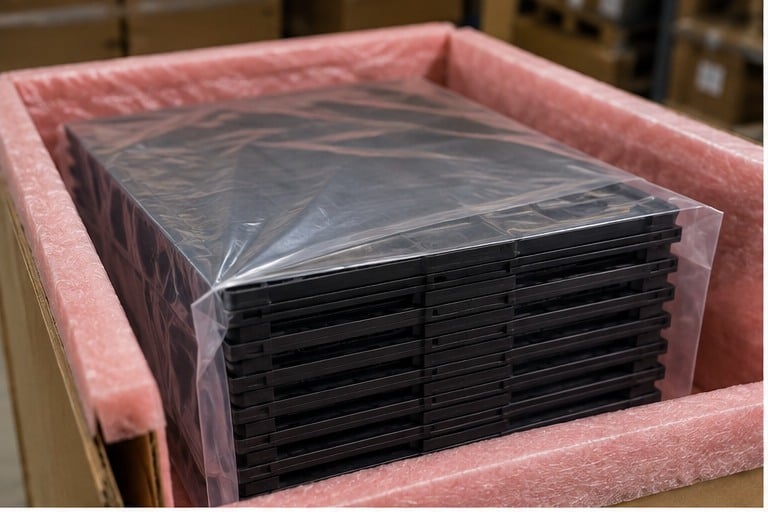
Small parts often require concern regarding storage density. The use of stackable small ESD trays can help conserve space while protecting stored parts. In combination with esd safe shelf bins or ESD storage racks, they create a flexible method of storing and gathering inventory by part number, project, production lot number or inspection status.
Buyers should also consider how trays are transported through the facility. Since ESD trays may be moved among warehouse, assembly, testing and packing locations, standardizing tray sizes often makes handling easier. Consistent ESD tray dimensions can also improve compatibility with carts, shelves, cabinets and workstations.
Industries that Utilize Small ESD Trays
Numerous industries utilize small ESD trays to protect sensitive electronic components. Consumer electronics manufacturers rely on them for connectors, chips, switches, micro motors and printed circuit board assemblies. Automotive electronics suppliers use them to protect sensors, control modules and small precision parts. Medical device manufacturers also use them in highly controlled assembly environments where reliability and cleanliness are essential.
Aerospace, telecommunications, semiconductor manufacturing, LED lighting, battery management systems, robotics and industrial automation companies can also benefit from ESD-safe trays. Any company that handles static-sensitive parts can reduce risk by improving the way components are stored and transported.
How Do You Select a Small ESD Tray That is Right for Your Business?
There are many factors to consider when selecting a small ESD-safe tray for product or application storage. The type and design of the component, the handling procedure used to manage the component and the environment in which the component is stored will dictate the type of tray to use. For loose parts, divided trays may improve sorting and prevent mixing. For fragile parts, custom cavity trays or trays with padding may provide better physical protection. In high-volume production applications, stackable and lightweight trays can increase throughput and optimize limited space.
Before purchasing ESD-safe trays, buyers should consider the following questions:
- What type of component or components will you be storing or transporting?
- Will the components require separation, cushioning or custom cavities?
- Will the trays be used at workstations, on shelving or during transportation?
- Will you require stackable trays to maximize space utilization?
- What ESD performance requirements are mandated for your facility?
- Will the trays need to be cleaned on a regular basis?
Answering these questions will help buyers avoid purchasing ESD-safe trays that do not meet their intended purpose. The right tray should contribute to daily operations rather than merely fulfill a basic storage need.
Custom Small ESD Trays for Specialized Components
In many cases, standard ESD trays will suffice. However, for delicate, irregularly shaped, high-value or easily confused components, custom small ESD trays may provide better protection and enhanced component storage. Custom cavities securely hold each item in one position, minimize movement during transport and help facilitate quicker visual inspections.
Custom trays are frequently utilized in applications where precision electronic components require additional protection against both ESD and mechanical damage, such as molded parts, semiconductor packages, medical electronic parts and assemblies that require physical protection. Custom tooling typically requires more planning upfront, but the payoff can include increased protection, improved handling accuracy and reduced scrap.
Quality and Compliance Considerations
When selecting suppliers, buyers need to look at more than appearance or cost. Reliable ESD products should come with clear material specifications, resistance specifications and consistent quality from batch to batch. If your facility complies with ANSI/ESD S20.20, IEC 61340-5-1 or other internal ESD requirements, make sure the trays you choose meet those compliance requirements.
Consistent quality is important for good repeatability from one production run to the next. A tray that performs well in one batch should perform the same way in the next. Businesses with strict product selection and use procedures should seek knowledgeable suppliers, as they can make product selection easier and reduce the risk of receiving inconsistent materials.
Maintenance Tips for Longer Service Life
Taking care of your ESD trays with proper maintenance will help extend their service life and keep your work area cleaner. Do not expose trays to temperatures outside acceptable ranges, corrosive chemicals or unnecessary shock. Do not drill, saw or modify trays unless you are sure the ESD characteristics of the material will remain acceptable after modification.
Labels used on ESD trays should be selected carefully. Adhesives may leave residue, or the tray surface may perform differently because of adhesive use. If a product requires identification or labeling, use ESD-compatible labels whenever feasible. Routine inspections are also recommended. Any cracked, heavily worn, contaminated or deformed tray should be taken out of service if it is no longer suitable for safe product handling.
Frequently Asked Questions
What Are Small ESD Trays Used For?
Small ESD trays are typically used to store, organize, transport and handle static-sensitive electronic components, including printed circuit boards. Examples of places where small ESD trays are used include assembly lines, repair shops, laboratories, warehouses and quality control areas.
If Components Are Already Packaged In ESD Bags, Is It Still Necessary To Use An ESD Tray?
ESD bags are useful for packaging and transport, but once parts are removed for access, assembly or inspection, they still need a safe handling surface. An ESD tray provides an organized, accessible and controlled means of handling parts during work-in-process operations.
Can I Use A Regular Plastic Tray For Electronic Components?
Regular plastic trays should not be used for storing static-sensitive electronic components because they can generate and retain static charge. An ESD tray helps minimize electrostatic risk and is therefore a much safer product to use in a controlled environment.
What Is The Difference Between Conductive ESD Trays And Dissipative ESD Trays?
A conductive ESD tray allows charges to move quickly, while a dissipative ESD tray allows charges to discharge in a more controlled manner. The right choice depends on the components being used, the process being followed and the ESD control requirements.
Are Small ESD Trays Stackable?
Many small ESD trays are designed to be stackable, creating a space-saving effect in storage areas, production environments and workstations. However, you should always verify the stackable arrangement and maximum load capacity before use.
How Do I Select The Proper Size ESD Tray?
When selecting the proper ESD tray size, base your choice on the dimensions, number of pieces and fragility of your components, as well as how the tray will be used. For small loose items, compartment trays may work better. For larger or fragile products, flat or custom trays may be more suitable.
Small ESD trays provide a practical, space-saving and reliable method to protect sensitive electronic components during storage, handling and transport. By selecting the proper material, size, arrangement and storage system, companies can improve workflow efficiency while reducing ESD-related risk. Manufacturers, repair centers, laboratories and suppliers of electronic components should invest in the right ESD tray solution to enhance quality control and support safer daily operations.
Leave a Reply