- Blog
An anti-static magazine rack stores PCBs vertically in conductive or dissipative slots so SMT lines can buffer panels between machines without flexing assemblies. This guide covers terminology versus measured resistance, slot geometry, base plates, heat ratings, and export RFQ discipline for global buyers. Specify 50 or 60 Hz plant power only where grounding interfaces matter—not for rack material selection.
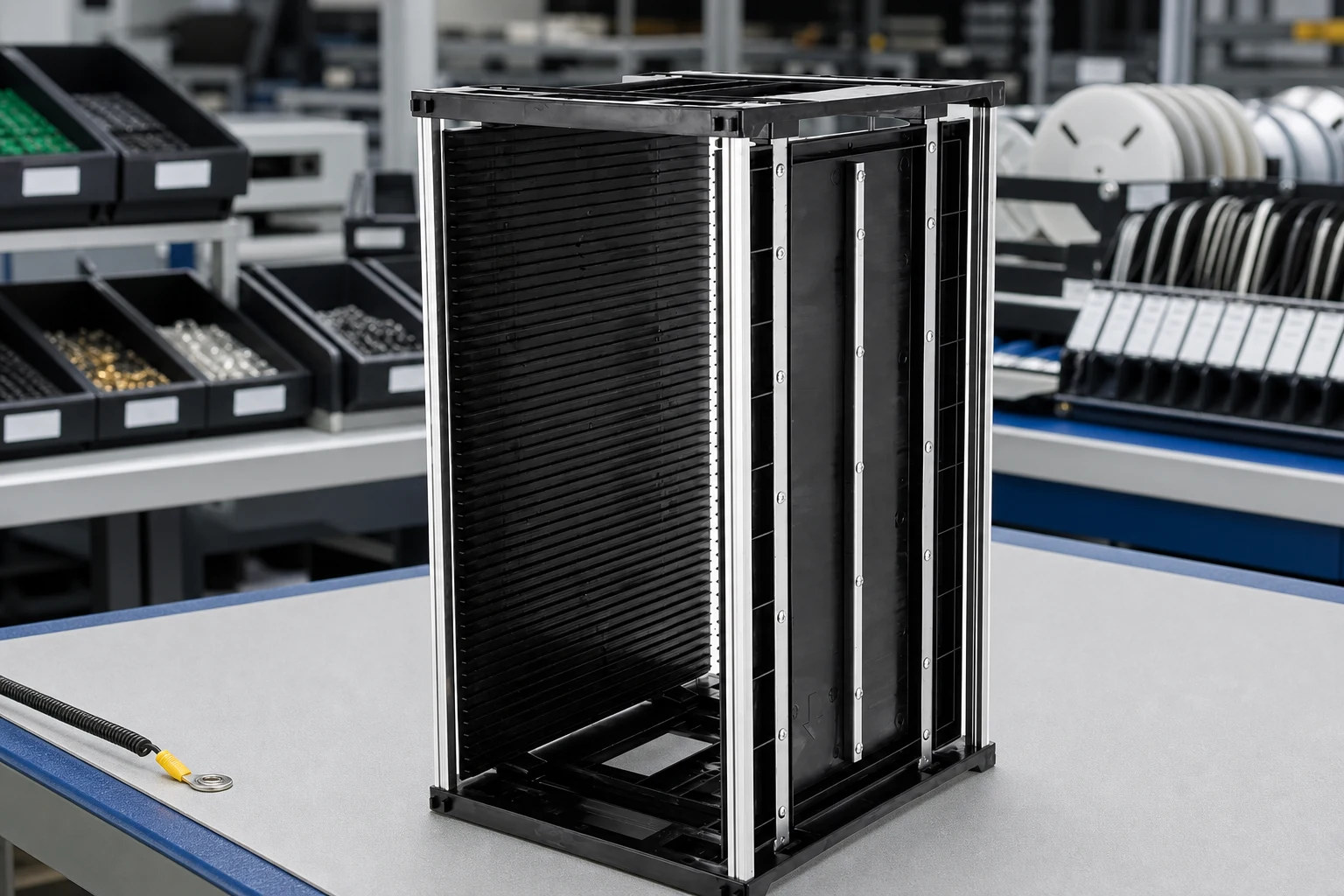
Part 1. What is an anti-static magazine rack?
An anti-static magazine rack—often called a PCB magazine or ESD rack—holds multiple boards vertically in slots for transfer between SMT machines, inspection, and manual stations.
Frames combine conductive or dissipative plastic guides with metal top and bottom plates for rigidity. Anti-static in marketing copy must still map to measured resistance and your program tier.
These racks buffer PCBs, not loose components. Pair them with bins or trays for part kitting upstream of placement.
Cross-site standards prevent regional buyers from ordering incompatible accessories during MRO emergencies.
Returnable loops need damage criteria—cracked surfaces can harbor insulative debris that fails audits.
Programs that skip inbound resistance checks often discover out-of-spec lots only during customer audits—build sampling into receiving SOPs.
Pilot two shifts per line and log mis-picks, grounding misses, and wash time before plant-wide mold standardization.
Naming versus engineering specs
Buyers see anti-static, conductive, and ESD-safe used interchangeably in catalogs. Your RFQ should require Ω readings and test method, not adjectives alone.
| Term | Ask supplier for | Program use |
|---|---|---|
| Anti-static | Resistance logs | Marketing filter only |
| Dissipative | 10⁶–10⁹ Ω typical | Controlled bleed |
| Conductive | 10⁴–10⁶ Ω cited | Fast discharge when grounded |
| ESD rack | Slot pitch + footprint | Automation fit |
Part 2. Magazine racks in SMT and assembly flow
Loaders and unloaders index the same outer magazine repeatedly—consistent width and height matter more than cosmetic color.
Manual lines buffer between printer, P&P, reflow, and AOI. Short moves on grounded racks beat bare boards on insulative carts.
Rework stations use dedicated rack colors so conformal-coated batches do not mix with bare-board lots.
Digital photos of grounded layouts accelerate export desk quoting more than verbal descriptions alone.
Engineering reviews should include EHS, quality, and logistics—not only unit price.
When multiple contractors share one kitting bench, color and label standards matter more than small unit price differences between mold families.
Warehouse humidity swings change resistance readings—log facility RH when comparing supplier certificates across seasons.
Throughput and rack count
If downstream inspection is slow, adding racks without fixing the bottleneck only hides scheduling debt—map dwell time before buying more magazines.
| Step | Rack role | Risk |
|---|---|---|
| Loader feed | Panel buffer | Footprint mismatch |
| Reflow out | Warm queue | Heat class |
| AOI wait | Inspection buffer | Lot mix |
| Rework | Small batches | Label discipline |
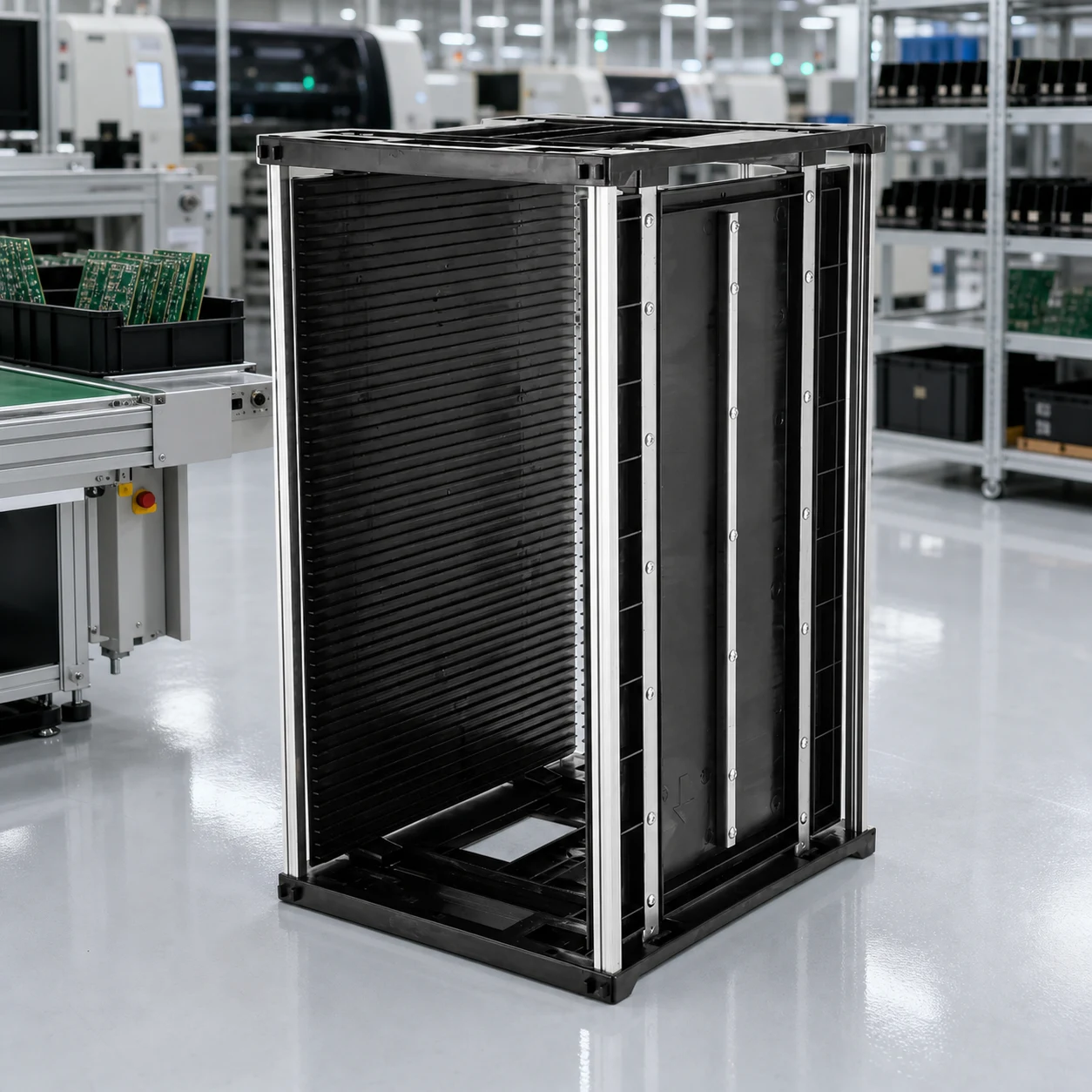
Part 3. Slot pitch, width adjustment, and capacity
Slot pitch near 10 mm is common for many PCB thickness stacks, but tall components may need deeper slots or reduced per-rack capacity.
Screw-adjustable side guides suit stable SKUs; gear-track or belt-screw models speed width changes on mixed lines.
Capacity near fifty boards appears in many industrial listings—validate against your loader rating and panel weight.
Seasonal humidity shifts can change resistance readings—schedule checks before customer audits.
Document carton dimensions early so inbound logistics avoids repallet charges at port.
Export freight models need outer carton L×W×H and gross weight per nested stack—unexpected overhangs trigger repallet fees at hub ports.
Contract EMS sites should freeze mold numbers in customer QA packs to avoid silent substitutions during component shortages.
Automation clearance
Provide outline drawings with ±3 mm discipline early—automation stops on subtle clearance errors.
Part 4. Base plates: metal, galvanized, and plastic
Metal top and bottom plates resist bowing when magazines are fully loaded. Plastic-only frames cost less but may flex on heavy multilayer boards.
Galvanized or coated bases appear in export catalogs for humidity-heavy sites—ask about corrosion if racks sit near wash areas.
Whole-panel conductive bases versus two-sheet designs change rigidity and replacement cost—document spare parts MOQ.
Contract manufacturers should align specs with customer EPA questionnaires before onboarding new SKUs.
Label each storage family to prevent night-shift lot mixing.
Digital work instructions with photos of grounded placement outperform PDF catalogs alone for night-shift onboarding.
Spare parts planning
Side guides, feet, and locking clips wear before metal frames—budget spares before peak season outages.
| Base type | Strength | Trade-off |
|---|---|---|
| Metal top/bottom | High rigidity | Heavier ship weight |
| Galvanized base | Corrosion note | Verify coating |
| Plastic base | Lower cost | Flex on heavy PCBs |
| Whole panel | Stiffness | Higher mold cost |
Part 5. Heat class and material limits
Standard PP guides may cite roughly 60–85 °C continuous service; elevated grades exist for aging-room or warm-queue dwell. Match rating to the hottest zone the rack enters.
Boards exiting reflow need short queues or heat-rated guides—radiant heat can exceed ambient HVAC setpoints near ovens.
Clean slots when solder balls accumulate—contamination can scratch mask and alter resistance on guides.
Video clips of correct grounding reduce training time during contractor rotations.
Inbound inspection should sample resistance on guides and bases, not only shells.
Spare divider and latch MOQ should be negotiated before peak season; stockouts stall kitting faster than shell shortages.
Loader OEM manuals sometimes specify magazine ear height and handle clearance—request third-party adapter drawings before bulk PO.
Night-shift teams benefit from rack color codes tied to MES work orders, not informal sticky notes that wash off during cleaning.
Burn-in rooms may need elevated-temperature guide grades—confirm dwell time at peak, not only continuous service temperature on datasheets.
Magazine handle ergonomics matter on high-mix lines—specify grip clearance for gloved operators in cold warehouses.
Compare quotations on spare side-guide MOQ and lead time, not only frame unit price.
When panels carry heavy connectors, reduce per-rack capacity even if slot pitch still accepts thickness.
Document loader brand and software version—firmware updates have changed magazine indexing on some OEM lines.
Side-guide wear often appears first near slot mouths—inspect for burrs that snag component leads during insertion.
Export programs should list carton nesting count for empty magazines—freight quotes depend on accurate volume per pallet.
Multi-plant standards should include a single adjustment SOP for width changes to avoid night-shift drift between regions.
Request carton photos of metal-reinforced corners before approving first article samples from a new molder.
Log slot pitch in work instructions so contractors do not mix incompatible magazines.
Seasonal floor temperature
Summer aisle temperatures near heat equipment can approach guide limits even when HVAC setpoints look safe—log with a thermometer.
Part 6. Grounding and EPA handling
Racks rest on grounded carts, conveyor segments, or EPA flooring systems. Personnel stay grounded while transferring magazines.
Label racks by product family when many magazines circulate between lines and night shifts.
Edge protectors help when connectors overhang slots—snag events damage leads and slow changeover.
Spare accessory MOQ should be budgeted before peak season—shortages stall kitting during ramp.
Multi-plant rollouts need a controlled BOM for dividers so regions do not substitute incompatible inserts.
Facilities operating both 50 Hz and 60 Hz equipment still specify one ESD material class per program—grounding audits focus on discharge paths.
Audit sampling
Sample resistance on guides after cleaning cycles; flux residue can shift readings over time.
Part 7. RFQ and procurement checklist
State PCB length, adjustable width range, thickness stack-up, maximum component height, and loader OEM if automation must index the magazine.
Request overall dimensions, weight, and carton packing for freight modeling on export programs.
Compare quotations on Incoterms, included spares, and adjustment mechanism—not rack price alone.
Facilities running 50 or 60 Hz lines still specify the same ESD material class; audits focus on resistance paths.
Compare total cost of ownership: wash labor and spare lids often exceed unit price deltas.
Returnable container loops require crack and chip criteria—damaged ribs can trap insulative debris that fails visual EPA walks.
Common failures
Underspecified slot depth for tall parts causes snags; overspecified heat class adds cost without benefit if racks never enter warm zones.
| Field | Example | Owner |
|---|---|---|
| PCB size | 350×(50–250) mm | Process |
| Pitch | 10 mm | PE |
| Heat class | Aging 120 °C | Quality |
| Frame | Metal reinforced | Automation |
Part 8. Specifying anti-static magazine racks for your line
When magazines must mate with loaders or manual carts, buyers shortlist one frame family and standardize width adjustment hardware across plants.
Send PCB dimensions, slot pitch needs, and automation notes early—export engineering can match magazine footprints and packing data.
Inquiry package
Include panel photos, loader brand, annual quantity bands, and destination country for logistics and compliance quotes.
Send PCB dimensions, slot pitch, and loader interface notes to Sanwei export engineering via Contact Us for anti-static magazine rack matching and documentation.
FAQ
What surface resistance should ESD storage meet?
Programs commonly cite 10⁴–10¹⁰ Ω depending on tier. Confirm supplier test method and inner/outer readings per IEC 61340-5-1.
How do you ground ESD containers in an EPA?
Place on grounded mats or carts, or use approved cords. Conductive material alone does not guarantee discharge without a known path.
What should export buyers include in an RFQ?
Part types, quantity bands, stacking height, grounding method, labeling, and layout photos reduce sizing errors.
Are black plastic containers automatically ESD-safe?
No. Verify material certificates and resistance logs for the exact SKU and molder lot.
How often should ESD storage be cleaned?
Wipe when flux residue or oils accumulate; dirty surfaces can shift resistance readings.
Can the same container family serve warehouse and line-side?
Often yes, but define separate color/label rules so quarantine lots never share cells with released material.
Do lids need to match the base material class?
Yes. Mixed dissipative bases with insulative covers break enclosure integrity.
When should buyers request samples?
Before bulk orders—confirm footprint, divider fit, and resistance at your facility RH band.
References


Leave a Reply