- مدونة
A branded ESD box program works when the logo request is controlled as carefully as the box configuration. Start with the selected SKU, artwork revision, placement, traceability needs, proof, and sample acceptance—not an assumed print process or visual result.
This guide helps distributors and OEM buyers prepare a branding request for صناديق ESD. It focuses on how a permanent brand mark can coexist with barcode, lot, status, and handling information. For related box configuration work, see the divider RFQ checklist and the lidded-box stacking guide.
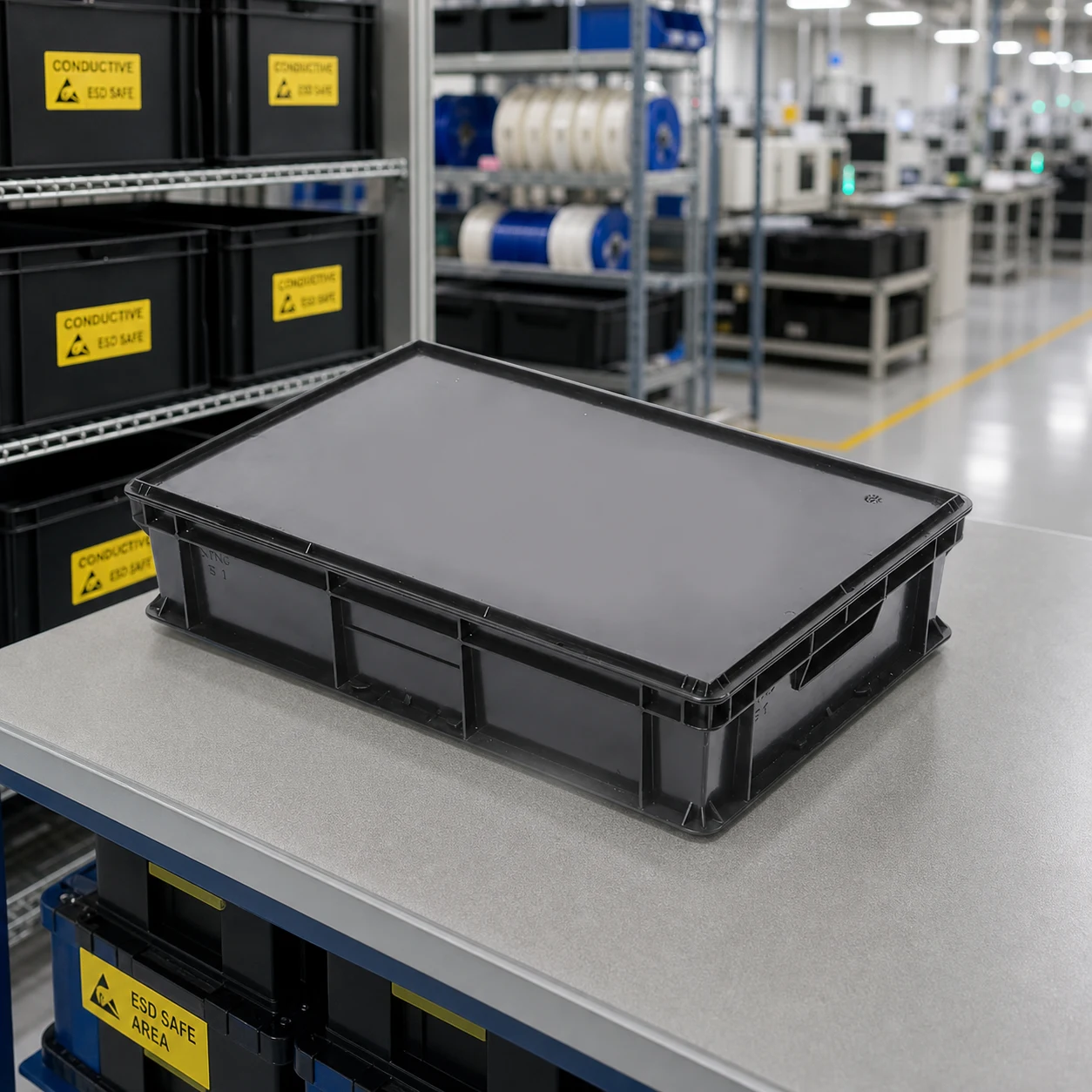
Part 1. What distribution job should branding support?
A distributor logo can help identify an approved product program, but it should not carry the operational burden of a part number, lot, or inspection status. Begin by defining the job the box performs after it enters stock, a customer warehouse, or an electronics line.
| Distribution situation | Branding objective | Control to add |
|---|---|---|
| Private-label catalogue program | Associate the box with the distributor’s approved line | Record the logo artwork and selected configuration together |
| Customer-specific kitting | Distinguish a managed program from general stock | Keep customer identity separate from variable lot data |
| Multi-location replenishment | Help teams recognize the intended product family | Use a controlled item reference for every release |
| Electronics material storage | Support identification without obscuring handling information | Reserve clear space for barcode, status, and required warnings |
Treat the box as an operating item first and a branded surface second. A visible mark that blocks scanning, receiving labels, or safe handling instructions can create more confusion than value.
Part 2. How should permanent branding and traceability be separated?
Permanent branding identifies the commercial program. Traceability identifies the individual transaction, lot, location, or status. The two should be planned together but controlled as different layers of information.
| Information layer | Typical purpose | Approval owner |
|---|---|---|
| Brand mark | Distributor or program identity | Brand owner |
| Box model reference | Ties the item to the quoted configuration | Sourcing or product manager |
| Barcode or RFID field | Scanning and system lookup | Warehouse or IT process owner |
| Lot, date, or status label | Variable receiving and quality information | Operations or quality owner |
| Handling or ESD notice | Process instruction | ESD-program owner |
Keep the fixed logo clear of a field that must change during normal operations. If a barcode or RFID-related area is needed, define its location and required clear zone in the drawing rather than relying on a verbal description.
Sanwei lists logo marking, barcode label areas, and RFID-related options on its ESD Box & ESD Tray solution page. That is a customization starting point, not confirmation that every box model has the same usable surface or identification feature.
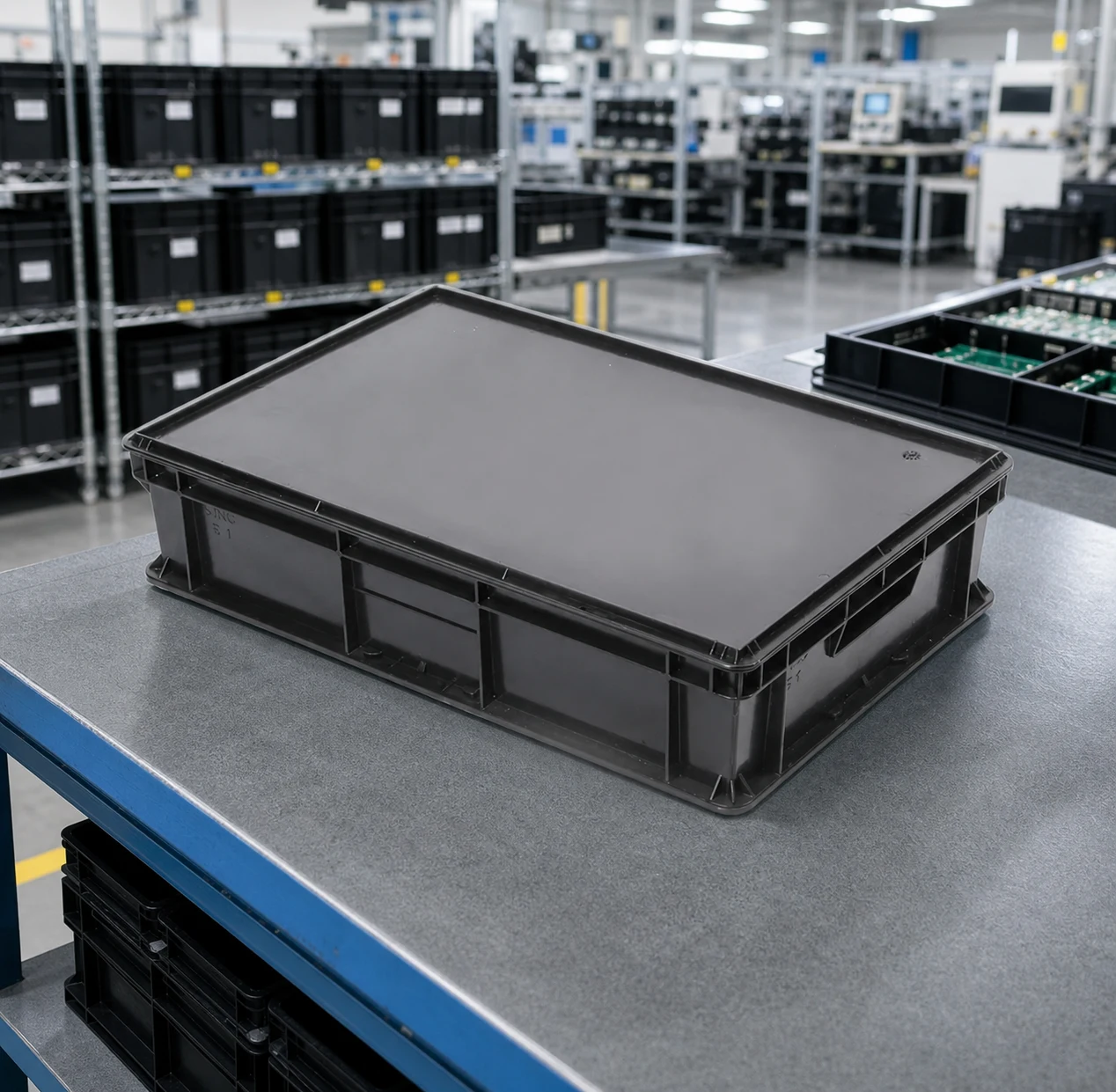
Part 3. What belongs in the SKU, artwork, and placement brief?
The request should allow a supplier to identify one box configuration and one visual instruction set. “Add our logo to an ESD box” leaves the selected model, printable surface, scale, orientation, and acceptance target open to interpretation.
| RFQ field | Buyer input |
|---|---|
| Selected SKU or candidate footprint | Product reference, outer dimensions, and intended contents |
| Artwork revision | Controlled file name, revision code, and approving owner |
| Logo geometry | Width, height, orientation, and protected clear space |
| Proposed placement | Marked face, distance from edges, and relation to lid, handles, ribs, or labels |
| Traceability plan | Barcode, RFID, lot, status, and customer-label locations |
| Visual acceptance reference | Approved digital proof, marked drawing, or sample standard |
| Handling conditions | Storage, transport, cleaning, and contact conditions to review |
| Quantity assumptions | First order and forecast for quotation discussion, not a presumed MOQ |
Provide vector artwork when the supplier requests it, along with a controlled PDF showing its intended placement on the chosen box view. Ask the quotation to identify any changes needed because of the actual surface, geometry, material, or selected branding route.
For an early configuration conversation, the Sanwei ESD Box product family is useful for narrowing the box type. The final request still needs Sanwei to confirm that the chosen model and accessories match the branded layout.
Part 4. How should visual requirements be specified without assumptions?
Color names, online swatches, and an artwork preview are not interchangeable specifications. If a logo color matters to the program, state the brand reference, the viewing conditions that matter, and the visual acceptance method; then ask whether the selected configuration can support the request.
| Visual item | Better request | Avoid |
|---|---|---|
| Brand color | Controlled color reference and approval method | Assuming any color is available on every box |
| Logo edge quality | Approved proof or sample comparison | Calling an artwork preview a production guarantee |
| Location | Dimensioned placement on a box view | “Put it on the front” without naming the front |
| Readability | Viewing distance and orientation for the use case | Promising permanent visibility in every environment |
| Marking life | Required handling and cleaning conditions for review | Claiming an exact durability period without validation |
The same caution applies to the phrase “silkscreen-ready.” Use it as a buying intent, not as a product claim, until the supplier confirms the selected-SKU decoration route. Material, texture, curvature, print area, visual target, and use conditions can affect what is practical to quote.
Part 5. What should a proof and sample approval control?
A proof is the buyer’s checkpoint for the intended artwork and placement. A sample is the checkpoint for the agreed configuration and observable appearance. Neither should silently replace the controlled RFQ revision.
Use a staged approval record:
- Freeze the box candidate and artwork revision.
- Approve the marked placement drawing or digital proof.
- Review the supplied sample against the agreed visual reference.
- Check that variable labels, scanning zones, lid operation, and handling access remain usable.
- Record approved deviations, if any, before the release decision.
Acceptance criteria should be written in the buyer’s own terms. For example, describe the approved placement, legibility expectation, and inspection reference instead of asserting that a logo will have a specific service life.
When the project needs broader configuration review, use Sanwei OEM/ODM to start a quote-confirmed discussion about the box, identification needs, and sample process.
Part 6. How should ESD evidence be handled for a branded box?
Branding does not prove ESD performance, and an ESD-program reference does not approve a finished decorated product. The buyer should identify the electrical requirement, test method, relevant locations, conditioning, and traceability needed for the supplied configuration.
| Evidence request | What it helps establish | Boundary |
|---|---|---|
| Exact quoted configuration | Which box, accessories, and requested marking were reviewed | Do not rely on a generic product image |
| Material identification | The material selection named in the quotation | Do not infer material from visual color |
| Applicable electrical record | Measured evidence under a stated method and condition | Confirm relevance to the buyer’s program |
| Test locations | Areas the buyer needs assessed | Define whether decoration affects the evaluation plan |
| Sample or lot traceability | Connection between evidence and supplied goods | Retain it with receiving records |
IEC 61340-5-1 و ANSI/ESD S20.20 provide program-level context. They do not replace model-specific and configuration-specific evidence requested by the buyer.
Part 7. What should be controlled for repeat distribution orders?
Repeat orders should point back to an approved configuration record, not only to a logo file. That record reduces the chance that the box, artwork, placement, traceability layout, or visual acceptance reference changes without review.
| Control item | Record for replenishment |
|---|---|
| Product definition | Selected SKU, accessory set, and approved configuration reference |
| Artwork | File name, revision, and approving owner |
| Placement | Approved drawing or sample reference |
| Traceability layout | Barcode, RFID, lot, status, and clear-zone requirements |
| Acceptance | Visual inspection reference and approved deviations |
| Commercial review | Quantity assumptions and quote-confirmed terms for the current order |
| Change control | Who must approve a model, artwork, placement, or process change |
Product recommendation
Use the Sanwei ESD Box & ESD Tray solution as the starting page when the distributor has a controlled brief and needs confirmation of available branding and identification options. Do not default to a logo-only request when the selected SKU, label space, artwork placement, ESD evidence, or commercial terms are still unknown.
Fit Boundary
| Buyer situation | Reasonable path | Avoid |
|---|---|---|
| Defined private-label ESD-box program | Controlled artwork and selected-SKU RFQ | Treating a generic logo option as an approved specification |
| Barcode-heavy warehouse workflow | Separate permanent branding from scan and lot areas | Covering a variable label field with a logo |
| New visual requirement | Proof and sample approval before release | Promising a color or durability result without confirmation |
| New mold or major geometry change | OEM review with controlled design inputs | Assuming decoration alone avoids a tooling decision |
Send the selected-SKU candidate, artwork revision, placement drawing, traceability requirements, sample criteria, and quantity assumptions through Contact Sanwei for configuration and quotation confirmation.
أسئلة متكررة
What is a silkscreen-ready ESD box for a distribution program?
It is a buyer-intent description for an ESD box program that may need a controlled brand mark. The final branding route, selected SKU, placement, and visual acceptance criteria require supplier confirmation.
Can every ESD box receive the same logo marking?
No. The usable surface, material, geometry, selected model, and requested branding method can differ. Confirm the option for the chosen configuration instead of transferring one layout to another box.
What artwork should be sent for an ESD box logo request?
Send the controlled artwork revision, the approving owner, and a placement drawing or PDF that shows size, orientation, and clear zones. Provide the requested source format when the supplier asks for it.
Should a logo share space with a barcode or lot label?
Usually no. Permanent brand information and variable traceability information should have separate planned areas so scanning, receiving, and status control remain usable.
Can a buyer specify an exact logo color without confirmation?
The buyer can state a controlled color reference and acceptance method, but availability and the final result must be confirmed for the selected configuration. Do not treat a screen preview as a production promise.
How should a branded ESD-box sample be approved?
Compare the sample with the controlled artwork, placement drawing, visual reference, selected box configuration, and required label or scan zones. Record any approved deviation before release.
Does logo marking prove ESD performance?
No. Request applicable evidence for the supplied configuration under the buyer’s ESD-control program. A logo and a program standard are not proof of finished-box performance.
What should be locked for a repeat distribution order?
Lock the selected configuration, artwork revision, placement reference, traceability layout, acceptance record, and change-approval path. Request current commercial terms for each quote rather than assuming them from an earlier order.
المراجع
أحدث مشاركة
-
-
-
 IC Tray Inserts: Pocket Design, Fit Checks and RFQ Guide06 سبتمبر,2026
اترك ردًا