- توربو
- مدونة
ESD wipes described as “laundered” and “nonwoven” are not two mutually exclusive grades. Nonwoven describes how a wiping material is constructed; laundering describes a cleaning process applied to a material. A buyer must compare the actual construction, post-processing, cleanliness evidence, chemical compatibility and electrostatic behavior of each finished product. Choose the wipe that passes your defined cleaning operation, rather than assuming that either label guarantees lower contamination or better ESD control. This guide focuses on that comparison and the approval record needed to purchase consistently; it does not assign a cleanroom class or electrical rating to an untested sample.
Separate construction from processing before comparing quotations
Start by asking each supplier what the material actually is. Record fiber composition, knitted or nonwoven construction, edge treatment, dimensions, packaging configuration and any cleaning or treatment applied after manufacture. A short catalog description can compress several independent attributes into one phrase. Two quotations may therefore appear to describe competing categories when one specifies a construction and the other only a processing step.
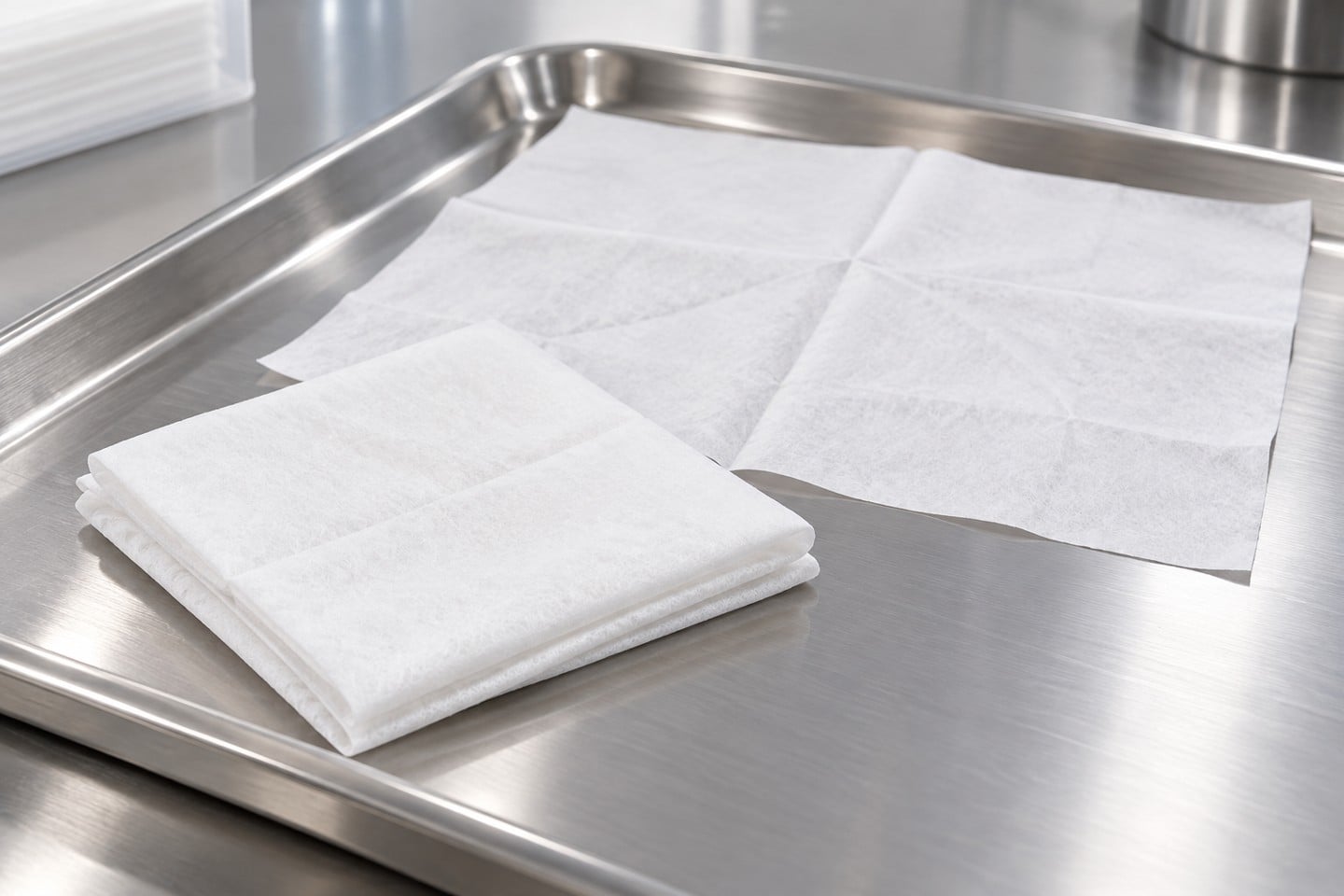
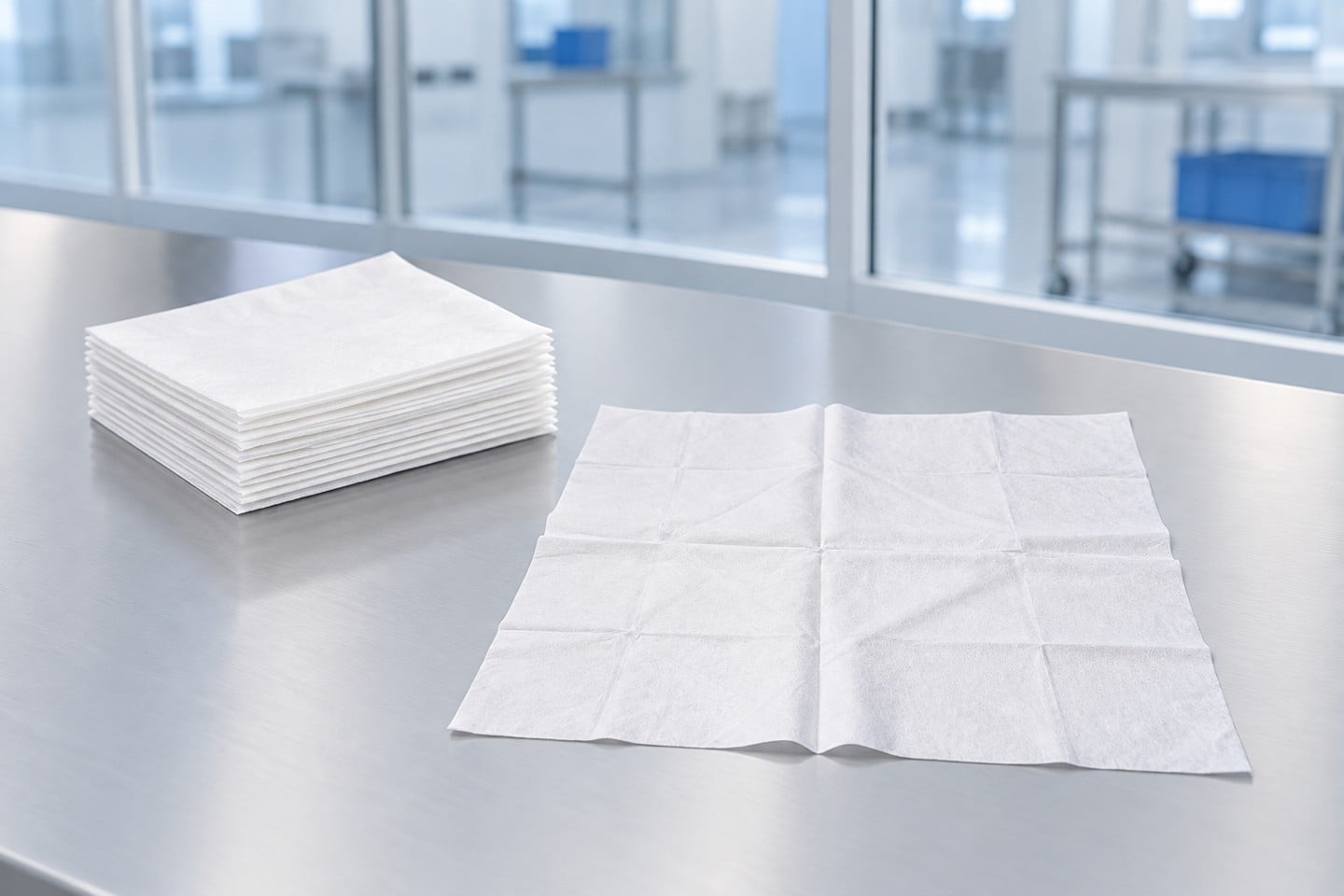
Do not assume a visible white square identifies a polymer, a laundering method or a controlled-environment suitability claim. The SWESD precision wipe product is a starting point for a sample request. Ask for the finished product specification and applicable evidence before assigning it to a sensitive operation. The illustrations here show the referenced product form, not a microscopic material identification or an approval result.
Define the comparison in full sentences. For example, candidate A might be a specified knitted material with documented cleaning and edge processing, while candidate B might be a specified nonwoven material delivered in controlled packaging. Both still need evaluation against the same task. If information is missing, leave the corresponding field unapproved rather than filling it with an assumption based on the trade name.
Begin with the residue and the surface you need to clean
A wipe used to collect loose particles from a tool enclosure faces a different task from one removing process residue from a precision fixture. Describe the soil, surface finish, access restrictions, allowable solvent and intended contact pressure. Identify whether the wipe contacts a device, only equipment, or a surface near exposed sensitive components. That location determines who should review the proposed change.
Record what success looks like before receiving samples. The process owner may need a visibly clean surface, an approved particle result, acceptable residue performance, or an inspection outcome specified elsewhere in the quality system. These are examples of decision categories, not interchangeable acceptance tests. A visually clean surface alone cannot establish the absence of invisible contamination.
Use the existing cleanroom wipe selection guide to define the overall operation, then use this comparison to resolve the construction and processing choice. If the task is an automated printer cleaning cycle, refer instead to the stencil wiper selection guide; a hand wipe is not automatically a suitable machine web.
Compare evidence in a single approval matrix
Use one comparison sheet for the finished candidates, including their delivered packaging state. The following matrix deliberately avoids generic numerical limits. Your approved process, customer requirements and applicable methods must supply any required limits and conditions.
| Decision field | أدلة للطلب | Approval question |
|---|---|---|
| Material identity | Fiber composition, construction and finished product code | Are the candidates described on the same basis? |
| Post-processing | Cleaning, edge processing and packaging specification | What was done after the base material was made? |
| النظافة | Applicable method, conditions, units and lot evidence | Does the result address the contamination concern? |
| Fluid compatibility | Approved fluid identity and controlled process trial | Does the complete operation meet requirements? |
| Electrostatic suitability | ESD owner review and relevant test evidence | Is the intended dry or wet configuration covered? |
| Use and cost | Consumption, handling observations and task outcome | Which approved option fits the operation consistently? |
ال IEST guidance on evaluating wiping materials provides a recognized framework for investigating wiper cleanliness and function. Obtain the applicable controlled method when conducting a formal evaluation. Do not compare numbers from different extraction procedures, sample preparation, reporting units or particle-size ranges as though they came from the same test.
Add a column for unresolved questions and assign an owner. A candidate with incomplete documentation is not necessarily unsuitable, but its approval is incomplete. Keep that distinction visible so purchasing does not interpret a request for clarification as a released material specification. Equally, a polished certificate should not override a failed process trial.
Run a comparison that reflects normal use
Prepare representative surfaces or approved test articles and describe their starting condition. Keep the cleaning fluid, amount applied, wipe size, folding method, contact area and inspection sequence consistent where those factors are intended to be controlled. If a candidate requires a different procedure, document that difference instead of quietly adapting the trial until it appears equivalent.
Set aside unused samples from each lot and identify every trial sample. Record who performed the operation, the sequence of candidates and any departure from the written method. When practical, use neutral sample codes for assessment so the reviewer is not influenced by a premium product description. Do not introduce customer devices into an unapproved experiment simply to make the test seem realistic.
Observe handling as well as the final surface. Note snagging, edge damage, visible fiber release, excessive saturation, difficulty folding, or transfer of material to the surface. These observations help explain results, but they are not a replacement for the measurement your process requires. Record an observation as an observation and a measured result with its method and units.
Evaluate electrostatic behavior separately from cleanliness
Neither laundering nor nonwoven construction establishes that a wipe is suitable around every electrostatic-sensitive item. The relevant question is how the complete wiping operation behaves in the intended ESD control environment. Material treatment, wetting, handling, the surface being cleaned and the surrounding process can affect the assessment. Ask the ESD coordinator to define the required evidence rather than applying a generic catalog threshold.
ال EOS/ESD Association principles of ESD control explain the roles of reducing charge generation, grounding suitable materials and managing necessary insulators. Use that context to examine the cleaning operation. A resistance result answers a different question from particle release, extractable residue or charge generated during contact and separation.
If a supplier offers an “ESD” claim, request the method, specimen, conditioning, reported result and intended use behind it. Check whether the evidence covers a dry wipe, a wet wipe, the packaging, or a particular treatment. Avoid transferring a statement about one tested configuration to every fluid, surface or production condition. Revisit the assessment when a proposed change alters those conditions.
The EOS/ESD Association lecture above provides background on electrostatic risks and control principles. It supports understanding of the separate ESD review; it is not a wipe comparison test or evidence that either candidate has passed your application.
Treat chemical compatibility as a controlled process question
Confirm that the proposed cleaning fluid is allowed for the surface, process and facility. Review its supplier instructions and safety information through the responsible site personnel. A wipe absorbing a fluid without immediately tearing does not prove acceptable residue, cleanliness, product compatibility or safe use. Do not use an informal solvent experiment as a substitute for the site’s chemical approval process.
Ask what changes after wetting and during the expected contact time. The trial should capture operational issues such as loss of handling strength, uneven fluid release or a need to change wiping technique. If a candidate performs well only with a different fluid, evaluate that as a combined process change with its own review, rather than calling it a direct material substitution.
Preserve the identity of both fluid and wipe lots in the trial record. This makes a later deviation easier to investigate. A report that merely says “alcohol wipe passed” leaves too much ambiguity about concentration, formulation, packaging and material. Write the identifiers needed for another qualified person to repeat the approved operation.
Include packaging and operator access in the comparison
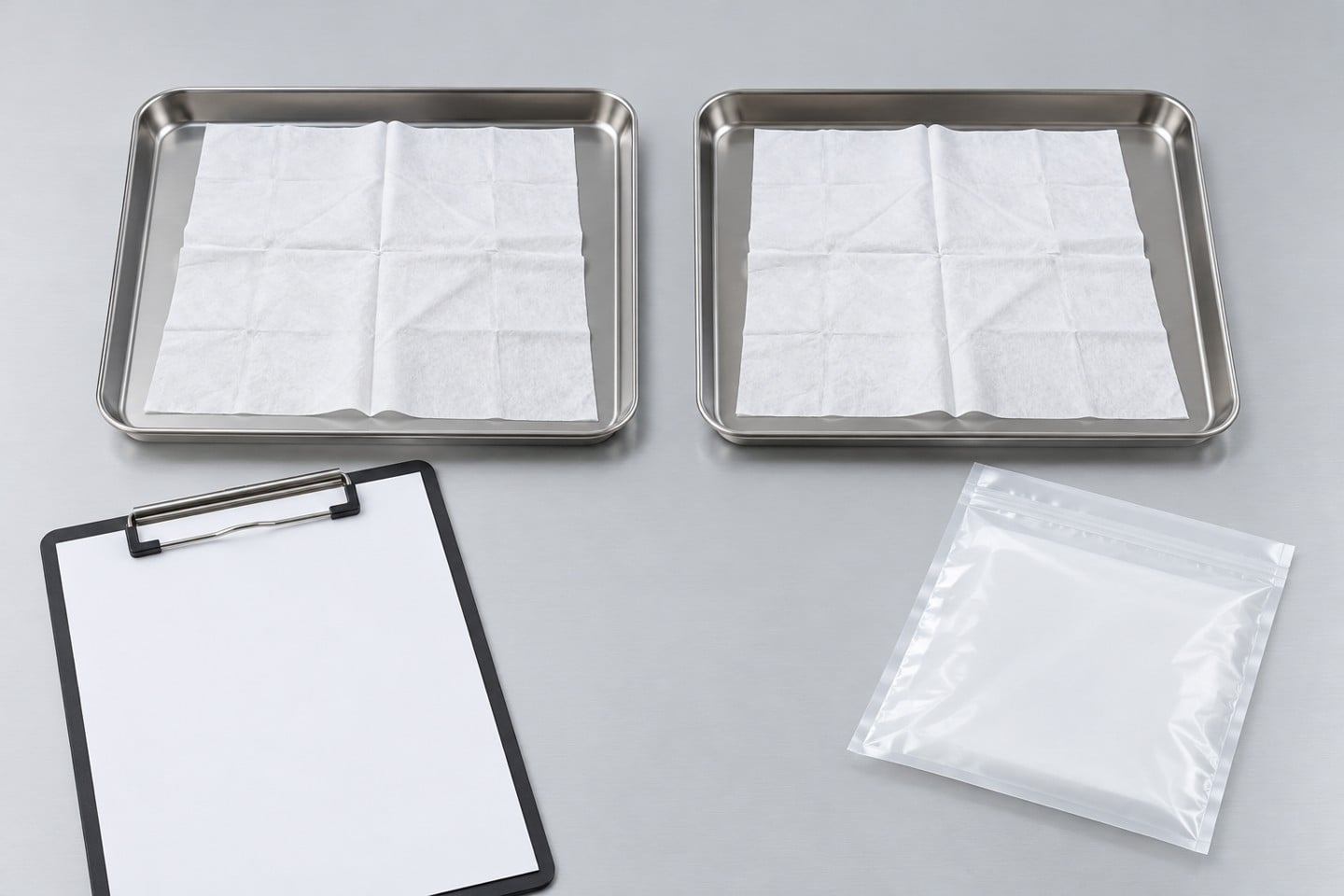
A clean material can be compromised by an unsuitable opening or dispensing routine. Observe how operators open the inner package, remove a wipe and protect the remaining stock. Specify the approved storage location, package handling and disposition of exposed material. Do not invent an open-package lifetime; have the process owner establish a justified rule for the application.
Compare usable supply at the workstation, not simply the number of pieces in a carton. A larger package may reduce purchasing cost yet make controlled dispensing harder. A smaller pack may fit the operation better but increase replenishment activity. Record the actual workflow and the waste observed during the trial before deciding which commercial format is preferable.
Keep unused approved wipes separate from trial material and used wipes. Staff should be able to identify which stock is released without guessing from its appearance. This is particularly useful when two white materials look alike but have different approval status. Use controlled container or package identification; avoid applying an unapproved adhesive label directly to a wiping surface.
Calculate cost using the approved cleaning outcome
Price per wipe is only one input. Compare how many wipes the defined task consumes, the time required, rejected or repeated cleaning, packaging waste and any additional inspection. Use measured trial quantities and your purchasing prices. A simple worksheet can calculate task cost as consumed wipe cost plus the other recorded process costs, with assumptions clearly identified.
Do not assume that a laundered material always reduces rework or that a nonwoven material always lowers total cost. Either conclusion needs evidence from the application. Where sample size or trial duration is limited, label the estimate as preliminary and specify what production observation will confirm it. Avoid presenting a small trial as a proven annual saving.
For a purchase request, state the approved product identity, packaging, relevant evidence, trial reference and change-notification requirements. Ask suppliers to identify changes to construction, treatment, cleaning, packaging or manufacturing location that require review. The goal is to purchase the approved configuration consistently, rather than repeatedly choosing the cheapest quotation under a vague description.
Release the decision and retain its limits
The final record should explain why the selected candidate suits the named process, what was tested and what remains outside the approval. Link the source reports and retained sample identifiers. Quality, process engineering and the ESD owner should approve the parts within their responsibilities, with purchasing receiving a clear released specification.
Keep the particle testing and acceptance guide as the related measurement reference; this article’s role is choosing between differently described material candidates. Review the decision after an adverse observation, a relevant supplier change or a process change. A documented comparison is useful because its conditions can be checked and updated, not because it turns a product label into a universal guarantee.
الأسئلة الشائعة
Are laundered and nonwoven wipes opposite categories?
No. Laundering describes processing, while nonwoven describes material construction. Request both attributes for each finished product.
Does a white wipe photograph identify its material?
No. Appearance cannot confirm fiber composition, cleanliness, laundering history or electrical behavior. Use the product specification and evidence.
Does low particle release prove ESD suitability?
No. Contamination and electrostatic behavior require separate assessment against the intended cleaning operation.
Can two suppliers particle counts be compared directly?
Only after confirming that methods, sample preparation, reporting units and relevant conditions are comparable.
What should trigger a new review?
Relevant changes in construction, treatment, cleaning, packaging, approved fluid, process conditions or adverse production observations should be assessed by the responsible owners.
أحدث مشاركة
-
 ESD Wipe Laundered vs Nonwoven: Which Fits the Process?17 أكتوبر,2026
 -
 ESD Packaging Failure Analysis After Shipping Damage16 أكتوبر,2026
 -
 ESD Gloves Resistance Testing and Replacement Criteria16 أكتوبر,2026
اترك ردًا