- Turbo
- Blog
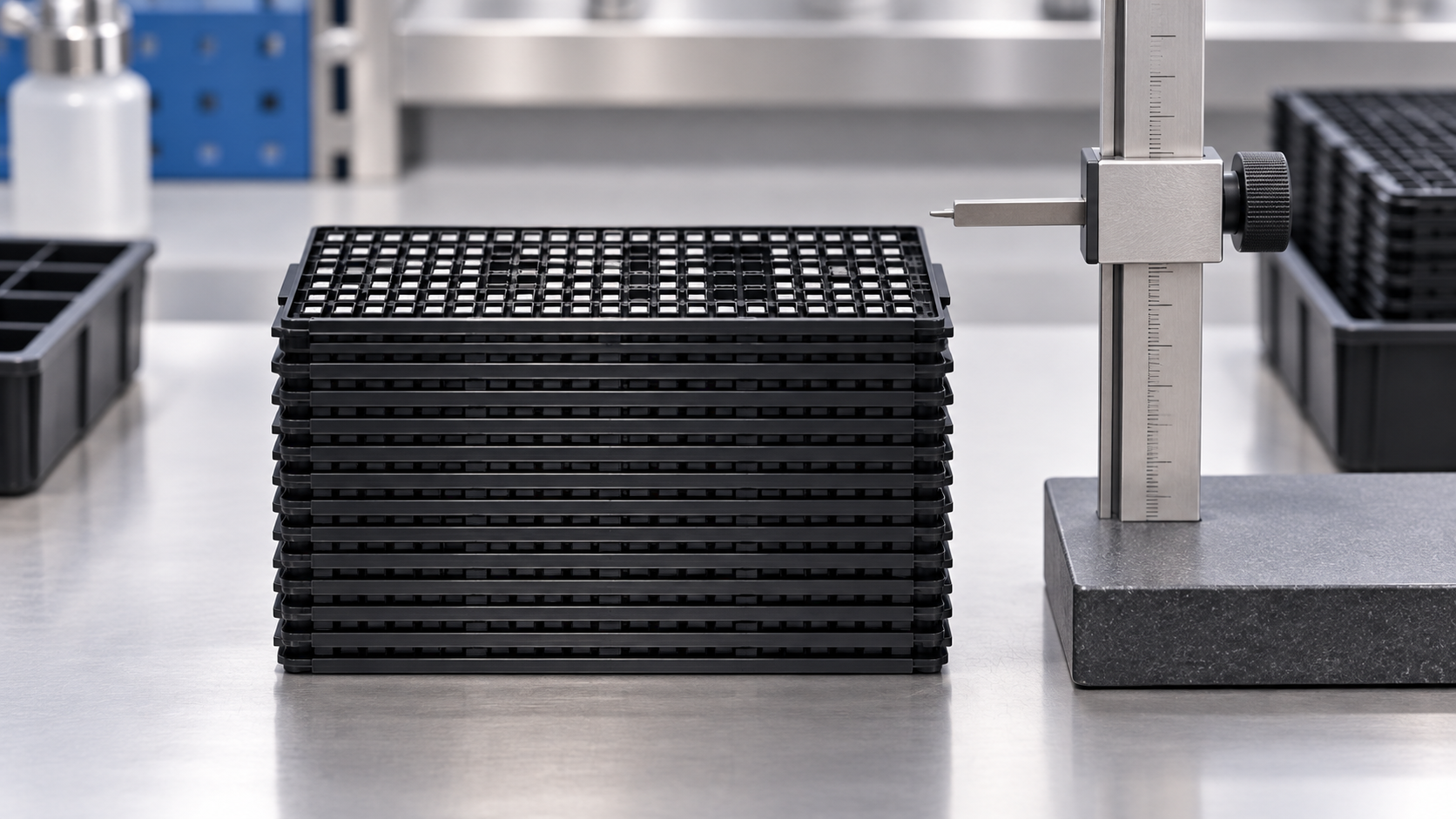
JEDEC Tray Stack Height and Shipping Carton Planning is a purchasing and validation problem: the aim is to control accumulated tray-stack height so covers, straps, cartons and automated handlers fit consistently. A reliable decision starts with the protected device and its complete route, then converts the search term into measurable drawing, sample and receiving requirements. There is no universal material, tolerance, reuse count or test value that safely fits every program.
Decision Summary for jedec tray stack height
| Decision area | Define before quotation | Evidence to request |
|---|---|---|
| Single-tray pitch | Seated height added by one tray | Measure nested trays, not loose edges |
| Stack quantity | Normal and maximum trays per stack | Include covers and separators |
| Accumulated tolerance | Worst-case build across the full stack | Check multiple production lots |
| Handling interface | Carton, rack, elevator or loader clearance | Run a full-height trial |
Use the table as an RFQ discussion guide, not as a substitute for controlled values. Final limits should come from current device drawings, equipment interfaces, the facility ESD program, supplier documentation and qualified trials. When a number is not yet known, state the functional risk and agree a prototype test instead of copying a limit from an unrelated tray.
1. Single-tray pitch: Turn the Requirement into Evidence
For jedec tray stack height, the buyer must define seated height added by one tray. This point controls whether the tray can control accumulated tray-stack height so covers, straps, cartons and automated handlers fit consistently. Write the requirement against the actual device, route and equipment rather than a generic tray description. Name the responsible drawing or work instruction, the condition in which the characteristic applies, and who approves an exception.
The practical verification is to measure nested trays, not loose edges. Begin with identified samples from the proposed production material and tooling. Record sample quantity, lot or cavity, conditioning, equipment, method and result. Include both normal and credible worst-case conditions. A pass on one convenient sample is useful for development, but it is not evidence that production variation is controlled.
Ask the supplier to explain which input variables can change this result. Depending on the characteristic, these may include resin or sheet lot, additive level, molding or forming settings, cooling, trimming, storage, cleaning and previous use. Convert important variables into incoming evidence, periodic checks or formal change notification. This makes the requirement auditable and prevents a catalog promise from becoming the only acceptance basis.
2. Stack quantity: Turn the Requirement into Evidence
For jedec tray stack height, the buyer must define normal and maximum trays per stack. This point controls whether the tray can control accumulated tray-stack height so covers, straps, cartons and automated handlers fit consistently. Write the requirement against the actual device, route and equipment rather than a generic tray description. Name the responsible drawing or work instruction, the condition in which the characteristic applies, and who approves an exception.
The practical verification is to include covers and separators. Begin with identified samples from the proposed production material and tooling. Record sample quantity, lot or cavity, conditioning, equipment, method and result. Include both normal and credible worst-case conditions. A pass on one convenient sample is useful for development, but it is not evidence that production variation is controlled.
Ask the supplier to explain which input variables can change this result. Depending on the characteristic, these may include resin or sheet lot, additive level, molding or forming settings, cooling, trimming, storage, cleaning and previous use. Convert important variables into incoming evidence, periodic checks or formal change notification. This makes the requirement auditable and prevents a catalog promise from becoming the only acceptance basis.
3. Accumulated tolerance: Turn the Requirement into Evidence
For jedec tray stack height, the buyer must define worst-case build across the full stack. This point controls whether the tray can control accumulated tray-stack height so covers, straps, cartons and automated handlers fit consistently. Write the requirement against the actual device, route and equipment rather than a generic tray description. Name the responsible drawing or work instruction, the condition in which the characteristic applies, and who approves an exception.
The practical verification is to check multiple production lots. Begin with identified samples from the proposed production material and tooling. Record sample quantity, lot or cavity, conditioning, equipment, method and result. Include both normal and credible worst-case conditions. A pass on one convenient sample is useful for development, but it is not evidence that production variation is controlled.
Ask the supplier to explain which input variables can change this result. Depending on the characteristic, these may include resin or sheet lot, additive level, molding or forming settings, cooling, trimming, storage, cleaning and previous use. Convert important variables into incoming evidence, periodic checks or formal change notification. This makes the requirement auditable and prevents a catalog promise from becoming the only acceptance basis.
4. Handling interface: Turn the Requirement into Evidence
For jedec tray stack height, the buyer must define carton, rack, elevator or loader clearance. This point controls whether the tray can control accumulated tray-stack height so covers, straps, cartons and automated handlers fit consistently. Write the requirement against the actual device, route and equipment rather than a generic tray description. Name the responsible drawing or work instruction, the condition in which the characteristic applies, and who approves an exception.
The practical verification is to run a full-height trial. Begin with identified samples from the proposed production material and tooling. Record sample quantity, lot or cavity, conditioning, equipment, method and result. Include both normal and credible worst-case conditions. A pass on one convenient sample is useful for development, but it is not evidence that production variation is controlled.
Ask the supplier to explain which input variables can change this result. Depending on the characteristic, these may include resin or sheet lot, additive level, molding or forming settings, cooling, trimming, storage, cleaning and previous use. Convert important variables into incoming evidence, periodic checks or formal change notification. This makes the requirement auditable and prevents a catalog promise from becoming the only acceptance basis.
Prototype and Production Approval
Approve the proposal in gates. First review the device revision, orientation, allowed contact, route, equipment and packaging stack. Next inspect identified first articles and verify the four decision areas above. Then load representative minimum and maximum devices, build the real stack, apply covers or restraints, and run the normal handling sequence. Include cleaning, heat, labels, storage and shipment only where they belong to the actual route.
Keep the approved drawing, material or construction identity, sample lot, photographs, raw results, deviations and sign-off together. Receiving inspection should check identity before sampling, separate lots, inspect critical features with the approved datum and method, and quarantine failures before they mix with accepted inventory. Sampling depth follows risk and supplier history; it should not be invented in a blog or purchase note.
Failures That the Control Plan Must Prevent
Failure 1: Multiplying one tray height without considering nesting
This shortcut can release trays that look acceptable but fail during handling. Contain the affected lot, identify where the assumption entered the specification, and compare the tray with the controlled device and process requirements. Repeat the relevant dimensional, functional or electrical check under documented conditions. Record the disposition so the same issue can be recognized at receiving and during reuse.
Failure 2: Measuring a short stack and ignoring accumulated variation
This shortcut can release trays that look acceptable but fail during handling. Contain the affected lot, identify where the assumption entered the specification, and compare the tray with the controlled device and process requirements. Repeat the relevant dimensional, functional or electrical check under documented conditions. Record the disposition so the same issue can be recognized at receiving and during reuse.
Failure 3: Forgetting the top and bottom cover contribution
This shortcut can release trays that look acceptable but fail during handling. Contain the affected lot, identify where the assumption entered the specification, and compare the tray with the controlled device and process requirements. Repeat the relevant dimensional, functional or electrical check under documented conditions. Record the disposition so the same issue can be recognized at receiving and during reuse.
RFQ and Supplier Checklist
- Controlled device drawing, samples, orientation and surfaces that may contact the pocket.
- Tray quantity, stack quantity, cover, restraint, outer packaging and equipment interfaces.
- The four topic-specific decision areas and the exact evidence expected for each.
- Material or construction identity, restricted substances, cleaning and environmental exposure.
- First-article quantity, production-lot traceability, inspection method and retention records.
- Change notification for material, additive, coating, tool, cavity, site, process or subcontractor.
- Reuse inspection, obsolete-label control, cleaning instructions and retirement criteria where applicable.
Start the commercial discussion from SWESD’s IC tray product page. For adjacent decisions, consult the JEDEC tray dimensions guide, custom IC tray RFQ guide and semiconductor shipping tray guide. These pages support planning; the controlled project documents remain decisive.
Educational Video: ESD Context
This neutral manufacturer video explains electrostatic-discharge fundamentals. It is supplementary and does not set project-specific tray limits.
Frequently Asked Questions
Is stack pitch the same as tray height?
Not necessarily; stack pitch is the increment when trays are correctly seated. The approved answer should identify the applicable device, tray revision, route and evidence so that purchasing and production use the same rule.
Why does stack height vary?
Molding variation, warpage, debris and incomplete seating can accumulate. The approved answer should identify the applicable device, tray revision, route and evidence so that purchasing and production use the same rule.
How many trays should be tested?
Test the actual planned stack quantity and relevant worst case. The approved answer should identify the applicable device, tray revision, route and evidence so that purchasing and production use the same rule.
Should straps compress the stack?
They should restrain without distorting trays or loading devices. The approved answer should identify the applicable device, tray revision, route and evidence so that purchasing and production use the same rule.
What belongs in the RFQ?
State stack quantity, covers, maximum envelope, measurement condition and interface clearance. The approved answer should identify the applicable device, tray revision, route and evidence so that purchasing and production use the same rule.
Authoritative References
- EOS/ESD Association: packaging and material-handling fundamentals
- NASA-STD-8739.6B: Electrostatic Discharge Control
- JEDEC JEP95: registered and standard mechanical outlines
Application boundary: Final dimensions, electrical limits, temperature exposure, inspection frequency and disposition rules must follow current controlled drawings, standards, manufacturer information and the facility quality and ESD systems.

Leave a Reply