- wp_kexun
- Blog
When a sourcing engineer in Munich replaced a black conductive tray with a lighter “anti-static” tray from a sample catalog, the parts fit and the unit price improved. A week later, the ESD team rejected the handoff because the buyer had treated three electrical behaviors as interchangeable colors. The product was not necessarily poor; the material category did not match the control function.
Tóm tắt: Anti-static, static dissipative, and conductive describe different charge-control behaviors. Buyers should specify the required resistance range, charge-generation risk, grounding path, and test method for each application. IEC 61340-5-1 and ANSI/ESD S20.20 focus on controlled systems; no color, resin name, or “ESD” label is sufficient evidence by itself.
What anti-static means in an SMT supply specification
Anti-static usually describes a material that tends to generate less charge during contact and separation. It is useful language for handling risk, but it does not by itself define resistance-to-ground, point-to-point resistance, decay time, or shielding. A buyer should never accept “anti-static” as the only electrical requirement.
In an SMT ESD program, a low-charging surface may still need a deliberate ground path. Packaging may also require shielding rather than only low charge generation. The intended process decides which property matters.
How static dissipative materials behave
Static dissipative materials move charge at a controlled rate rather than holding it indefinitely or releasing it abruptly. In practice, the specified range depends on the item and test method; buyers commonly encounter surface-resistance values between 1 × 10^6 and less than 1 × 10^9 ohms for dissipative work surfaces and handling products, but the purchase requirement must cite the applicable standard and method.
Dissipative trays, mats, and Vật tư chống tĩnh điện are often chosen where a controlled path matters more than maximum conductivity. Grounding hardware, humidity, contamination, and geometry can change the system result.
When conductive materials are appropriate
Conductive materials generally provide a lower-resistance path, often below 1 × 10^4 ohms in common product classifications. They can equalize charge quickly, but that does not make them universally safer. Exposed conductive surfaces can create electrical shorting or energy-transfer risks if the application is poorly defined.
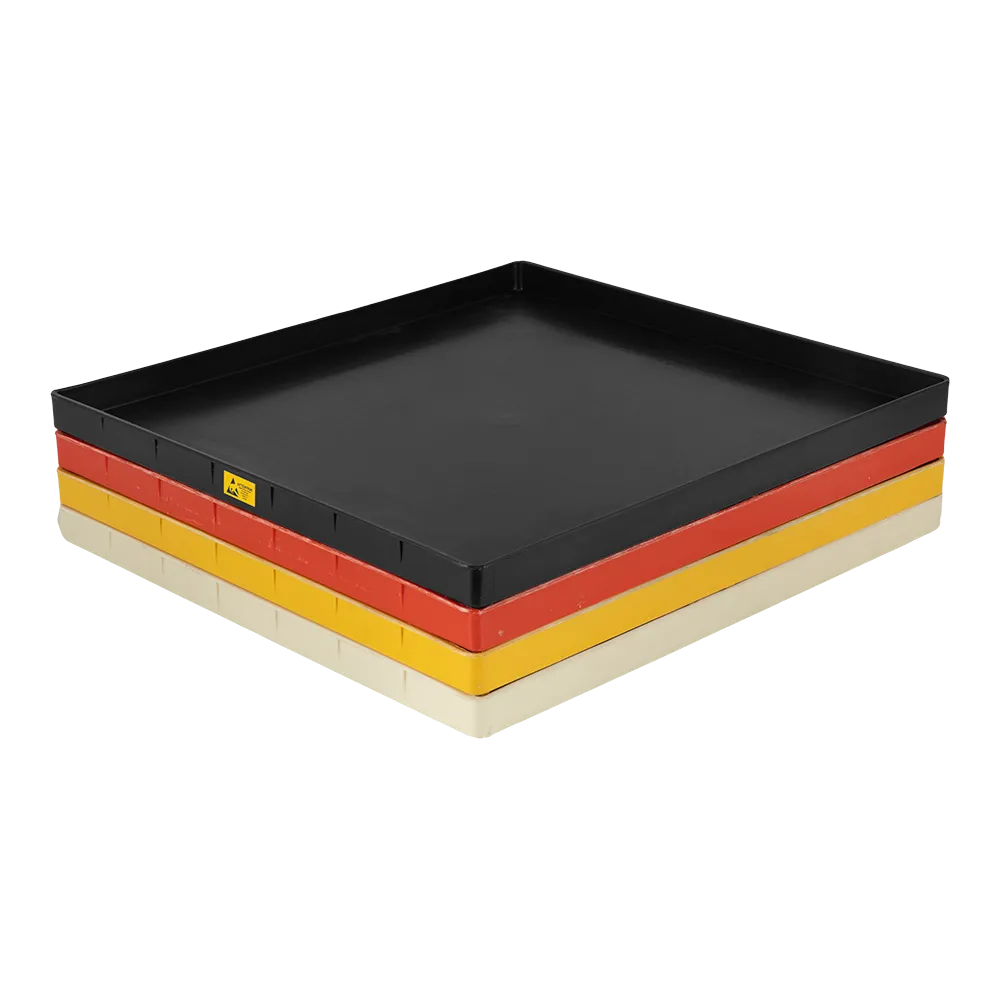
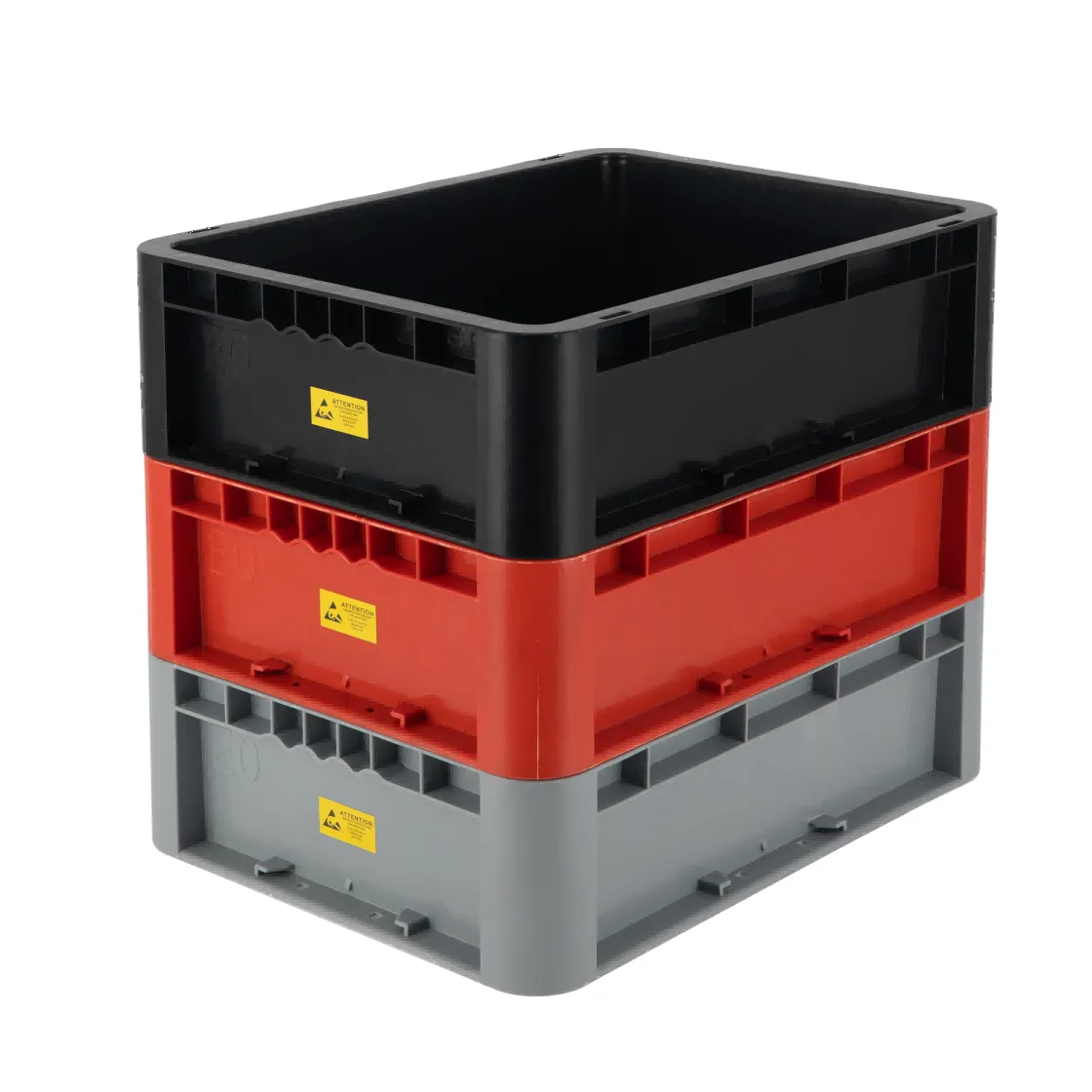
Conductive bins and trays are useful in closed handling systems with a verified ground path. They should be assessed as a system with operators, shelving, trolleys, and packaging—not as isolated black plastic products.
Why color and appearance are unreliable
Carbon-filled products are often black, yet modern compounds can produce colored or clean white dissipative materials. Conversely, black pigments do not prove ESD performance. The buyer should request a material specification, lot evidence, and representative test results.
This is especially important when Băng dính chống tĩnh điện, esd wipes, and trays share a workstation. Their functions differ: tape may identify an area, wipes may control contamination, and the tray may provide the electrical path.
Anti-static vs. Static Dissipative vs. Conductive at a Glance
| Material description | Typical electrical behavior | Best-fit SMT use |
|---|---|---|
| Anti-static / low charging | Reduces triboelectric charging; resistance may vary | Bags, handling layers, selected cleanroom consumables |
| Static dissipative | Controlled charge movement; commonly specified in a defined mid-range | Work surfaces, trays, bins, garments |
| Conductive | Low-resistance charge equalization | Grounded bins, racks, carts, selected shielding structures |
| Insulative | Holds charge and lacks an intentional path | Avoid near ESDS items unless controlled by distance or ionization |
Which Material Class Fits Each SMT Application
| Application | Preferred decision factor | Common mistake |
|---|---|---|
| PCB tray | Resistance, dimensions, grounding route | Buying by color |
| Workstation mat | Resistance-to-ground and installation | Testing the roll but not the installed mat |
| Protective packaging | Low charging plus shielding where required | Equating dissipative with shielding |
| Cleanroom wipe | Particle and chemistry control plus ESD suitability | Assuming every cleanroom wipe is an ESD Wiper |
How Standards Define ESD Material Classification
IEC 61340-5-1 and ANSI/ESD S20.20 require the organization to identify technical elements and verify them. IEC 61340-2-3 and ANSI/ESD test methods are often used for resistance measurements. The test voltage, electrodes, conditioning, and geometry must be recorded because an unqualified resistance number is not reproducible.
How to Specify ESD Material Performance
- Start with the hazard and control function, not the material color.
- Specify the exact measurement and resistance range.
- Test the installed system, including its ground path.
- Separate low charging, dissipation, conduction, and shielding requirements.
- Requalify when resin, additive, thickness, or supplier changes.
Sanwei cung cấp các vật liệu chống tĩnh điện (ESD) và sản phẩm xử lý đạt chứng nhận ISO 9001, ISO 14001:2015, tài liệu RoHS/SGS, và hỗ trợ cho các chương trình tuân thủ tiêu chuẩn IEC 61340-5-1 và ANSI/ESD S20.20.
Câu hỏi thường gặp
Is anti-static the same as static dissipative?
No. Anti-static commonly refers to reduced charge generation, while static dissipative refers to controlled charge movement within a specified resistance or decay behavior.
Is conductive always better for ESD protection?
No. Conductive materials can equalize charge quickly, but the correct choice depends on grounding, short-circuit risk, product sensitivity, and process geometry.
What resistance is static dissipative?
Many specifications use a mid-range such as 1 × 10^6 to below 1 × 10^9 ohms for particular products, but the governing standard, item type, and test method control the acceptable range.
Can colored plastic be ESD safe?
Yes. Performance comes from the compound and construction, not color; buyers should verify representative test evidence.
How are SMT supplies verified?
Use the specified resistance, charge-generation, decay, or shielding test and record equipment, voltage, environment, result, and acceptance limit.
Tài liệu tham khảo
Sự khác biệt không chỉ nằm ở nhãn sản phẩm—mà ở các quyết định có thể kiểm chứng giúp mọi khâu bàn giao đều nằm trong kế hoạch kiểm soát. Sanwei chế tạo các sản phẩm chống tĩnh điện (ESD) và giải pháp xử lý vật liệu cho thời điểm đó; liên hệ với nhóm Sanwei để xem xét đơn đăng ký, bằng chứng và các yêu cầu tùy chỉnh.
Bài đăng gần đây
-
 Kiểm tra độ lệch của hộp ESD: Đo kích thước phù hợp trước khi phát hành22 tháng 10 năm 2026
 -
 Kiểm tra điện trở bề mặt khay JEDEC: Hình dạng, tiếp xúc và báo cáo22 tháng 10 năm 2026
 -

Để lại phản hồi