- Tăng áp
- Blog
ESD shipping boxes for inter-facility transport must protect electronics through more than one risk: electrostatic discharge, movement and impact, contamination, identity loss, and uncontrolled handoffs. A rigid lidded tote can be a useful reusable carrier, but a dark color or ESD label does not prove the complete package provides discharge shielding outside an ESD protected area (EPA). Define the route and device sensitivity, qualify the inner and outer packaging combination, and trial the actual loading and transport process. This guide is for buyers, quality engineers and logistics teams building that specification; it does not certify any particular SWESD box for a route without test evidence.
Map the complete journey before selecting a box
Start at the point where the device or assembly is exposed in the sending EPA. Follow it through packing, staging, loading, vehicle transfer, receipt, quarantine and unpacking at the destination. Note every step outside a controlled area and every place a box may be opened. Inter-facility movement differs from a short internal tote transfer: there may be more handlers, different floors, longer dwell time, weather exposure, palletization and inconsistent receiving practices.
For each leg, specify whether the contents are bare, in a low-charging contact package, in a qualified shielding package, or inside a verified rigid shielding container. The EOS/ESD Association’s packaging guidance explains that material-handling containers outside an EPA need discharge-shielding protection in addition to suitable contact properties. Do not infer that every lidded tote provides it. A verified shield bag or other qualified layer may be part of the approved system, but the process owner must determine the right configuration for the device and route.
Separate electrical protection from physical protection
ESD protection concerns how the package limits charge generation and discharge exposure. Physical protection concerns shocks, vibration, compression, abrasion and crushing. One material property does not substitute for the other. A rigid box may resist handling damage while allowing unacceptable ESD exposure; a shielding bag may address electrostatic risk yet leave a heavy PCB assembly free to move and break a connector. Define acceptance criteria for each hazard and test the complete loaded pack, not only an empty box or raw material coupon.
The EOS/ESD Association’s control principles describe packaging as one part of a broader ESD program. They also distinguish dissipative/conductive behavior from shielding needed for movement beyond an EPA. Therefore, a supplier’s surface-resistance number alone is not evidence that a particular closed box shields the contents from direct discharge. Ask which standard and method were used, on what configuration, and whether the result covers the lid, inserts and closures actually purchased.
Choose a layered packaging architecture
A practical architecture may include an approved contact layer, a shielding layer where required, a shaped support, a rigid reusable carrier and an outer freight unit. Not every shipment needs all layers, and adding unqualified materials can introduce new risks. The contact layer should not damage or contaminate the part. The support should keep components from rubbing against a hard wall. A shielding layer must remain closed and intact through the uncontrolled portion of the route. The rigid carrier must fit the payload and handling system without forcing deformation.
Do not use ordinary foam, plastic film or paper as an ESD-control layer merely because it is convenient. Their charging behavior and compatibility vary. If humidity or moisture sensitivity matters, treat dry-pack and storage requirements as a separate process with its own evidence; a lidded ESD box is not automatically a moisture barrier. Likewise, do not equate an ESD warning label with package qualification. A label communicates handling requirements after the package has been designed; it does not create protection.
Compare packaging choices by route
| Transport situation | Packaging question | Evidence required before approval |
|---|---|---|
| Within one EPA | Will exposed items contact a qualified low-charging surface? | Local ESD plan and material qualification |
| Between two EPAs through uncontrolled space | Is discharge shielding maintained for the whole crossing? | Approved package configuration and closure method |
| Road transfer between facilities | Can the loaded pack survive handling, movement and dwell? | Route-specific mechanical trial and ESD package evidence |
| Returnable tote pool | Does reused packaging remain intact and traceable? | Inspection, cleaning, replacement and ownership records |
| Unknown or mixed sensitivity | Is the packaging choice based on the most vulnerable item? | Product owner disposition or separated shipments |
This qualitative table deliberately avoids made-up numeric limits. The shipment owner’s approved ESD program, customer contract and transport qualification determine pass criteria. The ANSI/ESD S20.20 overview provides the program context; it does not certify a specific box by name or color.
Fit and secure the payload without compromising protection
Measure the payload in its protective inner package and the usable box interior. Leave controlled clearance for placement and removal, but avoid a cavity so large that contents can slide or overturn. Protect connectors, board edges and fragile protrusions with approved supports. Ensure dividers cannot shed particles or abrade the contents. Verify that the lid closes fully with the highest expected payload and does not press on a component.
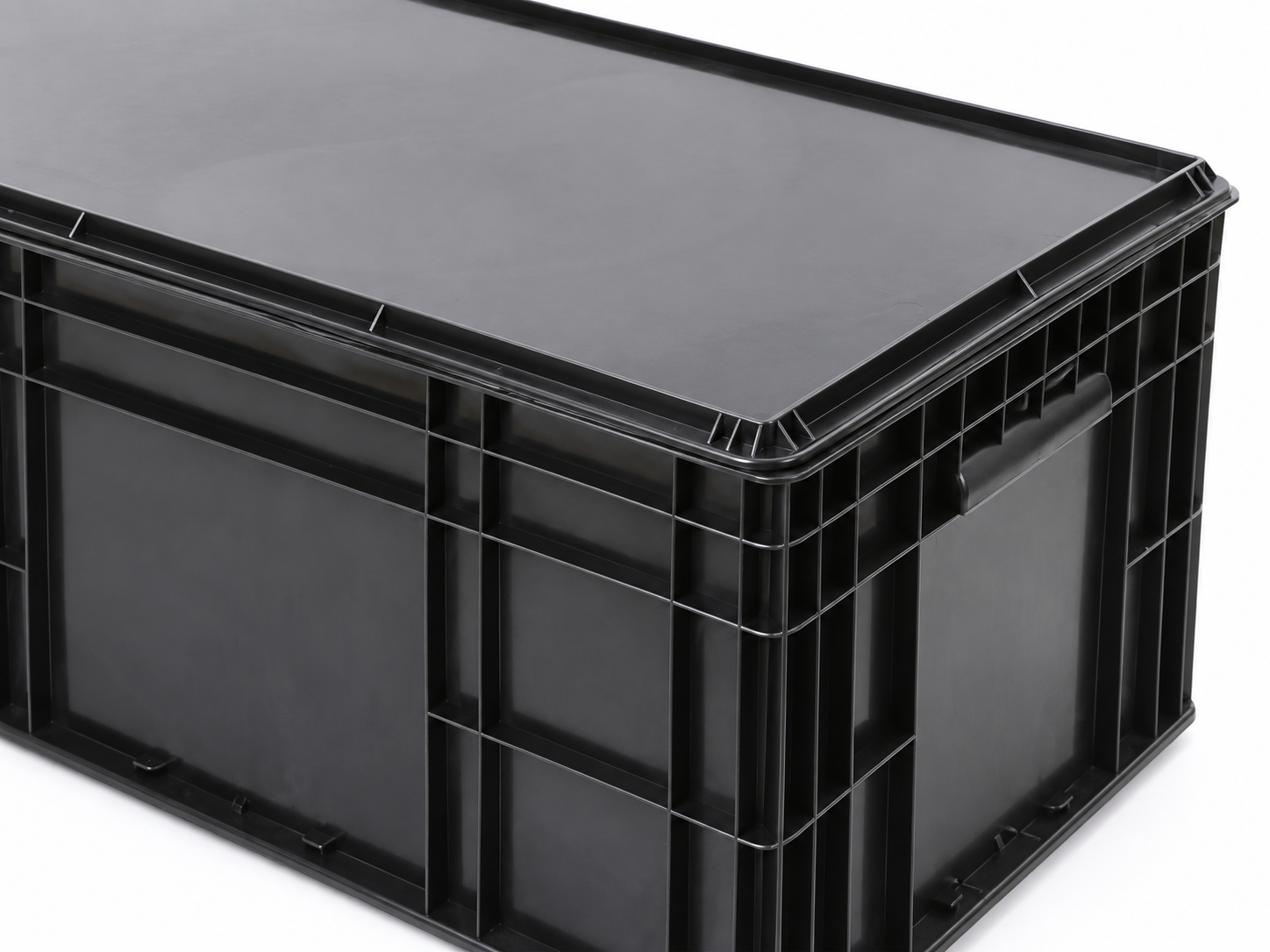
When a shipment contains multiple assemblies, test the maximum count and a partial-load condition. The partial load may move more than the full box. Check how the pack is lifted, pushed onto a cart, stacked or transferred to a pallet. The illustrated lidded ESD box product shows a reusable rigid format; its particular load rating, electrical properties and transport suitability must be confirmed from project-specific supplier documents and a validated trial.
Inspect the reusable box at every cycle
Before loading, inspect base, corners, handles, ribs, lid, labels and any closure feature. Remove boxes with cracks, warping or loose parts from service. Clean only by the approved method and confirm that cleaning materials do not leave residue or change the package’s required performance. A previously qualified design can become unsuitable when the actual reusable unit is damaged or contaminated. The related ESD bin cleaning guide addresses maintenance, while the lid and stacking guide covers closed-bin handling. Neither turns an unverified tote into a shielding package.
Set a documented retirement rule. Operators should know which damage triggers immediate quarantine and which condition can be reviewed by quality. Do not improvise repair with tape or an unrelated replacement lid. A mixed returnable pool also needs control over who removes old labels and how different part numbers or suppliers are separated. Otherwise, a mechanically sound box can cause a traceability error that is hard to discover at receipt.
Control labels and chain of custody
Record sender, destination, part number, revision, lot or serial range, quantity, pack ID, protection configuration and seal status. Keep labels readable without placing them over a structural feature, closure or critical ESD mark. Scan the physical pack at each transfer point when the operation requires traceability. A warehouse scan is only useful when the box’s contents match the system record; reconcile a sample during audits and after any exception.
Define what the receiving team does with a damaged or unsealed package. The correct response may be quarantine, product-owner review, inspection or repackaging within an EPA. It should not be an automatic transfer to usable stock. If the destination lacks an EPA, plan how the contents stay protected until they reach one. The related PCB handling and circulation overview provides the broader movement context; this article concentrates on inter-facility package decisions.
Run a route-equivalent validation trial
Build a trial pack with representative parts or dimensionally faithful dummies, the approved inner protection and the intended reusable box. Record the exact configuration, revision and loading pattern. Move it through the route or a controlled simulation that reflects handling, stacking, vehicle transfer and receipt. Inspect the physical package and contents before and after. Where a formal distribution test is required, choose an appropriate recognized method through the quality team rather than declaring one generic drop height sufficient for every product.
Verify ESD properties using the site’s approved standard and test method for the complete configuration. Test closure and lid behavior after the mechanical trial; a lid that loosens in transit may invalidate assumptions about protection. Repeat the trial when the box design, insert, bag, seal, route or payload changes materially. The objective is a documented, reproducible package system, not a one-time demonstration with an unrepresentative empty sample.

Send a precise RFQ, not a vague ESD request
Include device or assembly type, sensitivity information available to the supplier, shipment route, EPA boundaries, payload dimensions and mass, pack count, inner protection, required shielding evidence, reusable-cycle expectation, handling equipment, cleaning method, labels and return process. State which claims require test reports and which will be validated in your facility. Request a controlled drawing and sample so the team can compare fit, handling and protection. If the supplier cannot support a specific shielding claim, do not fill the gap with a marketing phrase; specify another qualified layer or choose another system.
For small service-part shipments, the PCB assembly bin checklist helps define the geometry and contact risks. For repeated facility-to-facility transfers, include cleaning, retrieval and reverse logistics in total cost, not merely unit price. A returnable box may reduce disposable packaging, but only if the tracking, inspection and repair or retirement process actually works.
Further learning: why ESD packaging matters
The EOS/ESD Association’s introductory lecture explains the underlying discharge risk. Use the written packaging guidance above for route-specific qualification decisions.
Các câu hỏi thường gặp
Is every black ESD box suitable for shipping outside an EPA?
No. Confirm that the approved complete package provides the required protection, including discharge shielding outside an EPA where applicable.
Does a lid alone provide discharge shielding?
No. Lid fit matters mechanically, but shielding is a property to verify for the complete qualified configuration.
Can shielding packaging replace a rigid carrier?
It may address ESD exposure, but the payload still needs mechanical protection appropriate to the route and handling risks.
What changes require requalification?
Review material changes, new lids or inserts, changed closures, different payloads and materially different transport routes.
What should a receiver do with a damaged pack?
Follow the approved containment and quality-disposition process; do not assume the contents remain protected or put them straight into usable stock.
Bài đăng gần đây
-
 ESD Shipping Boxes for Inter-Facility Transport01 Th10,2026
 -
-
 How to Audit an ESD Storage Area01 Th10,2026
Để lại phản hồi