- Tăng áp
- Blog
An ESD storage audit checks whether sensitive electronic parts remain protected throughout receiving, shelving, picking and transfer—not merely whether bins have an ESD label. Start with the site’s approved ESD control plan, trace a real part through the storage area, inspect the containers and shelves it touches, and compare records with actual practice. Verify packaging suitability for each boundary crossed, especially movement outside an ESD protected area (EPA). This guide gives a warehouse lead or ESD coordinator a practical, evidence-based audit route. It does not replace the site’s written limits, test methods or customer-specific requirements.
Define the audit boundary before walking the floor
Mark where the EPA starts and ends. Include receiving, quarantine, racks, issue counters, kitting benches, return shelves and the route to production. A storage room can contain both controlled and uncontrolled spaces; a marked doorway does not make everything behind it automatically safe. List the material families being stored, whether devices are bare or packaged, and who owns each handoff. Then choose representative high-risk transactions, such as a newly received reel, an opened PCB assembly box, and a partial lot returned from production.
The EOS/ESD Association’s auditing guidance treats compliance verification as a comparison with a written control plan and its defined limits. Therefore, an auditor should not invent a universal pass mark on the spot. Obtain the local packaging plan, product qualification records, verification schedule, training evidence and escalation procedure first. If those documents are missing or inconsistent, record that as a program finding rather than assigning a made-up electrical value to a container.
Walk one item from receipt to issue
Select a part number and lot from the inventory record, then find it physically. Check that the outer package identifies the item, lot, quantity and protection status; that the inner container matches the approved route; and that a picker can retrieve it without setting a bare device on an uncontrolled surface. Observe the actual sequence instead of asking only what the procedure says. A well-marked box can still fail in practice if its lid is left off after a partial pick or a protective bag is discarded before a part leaves the EPA.
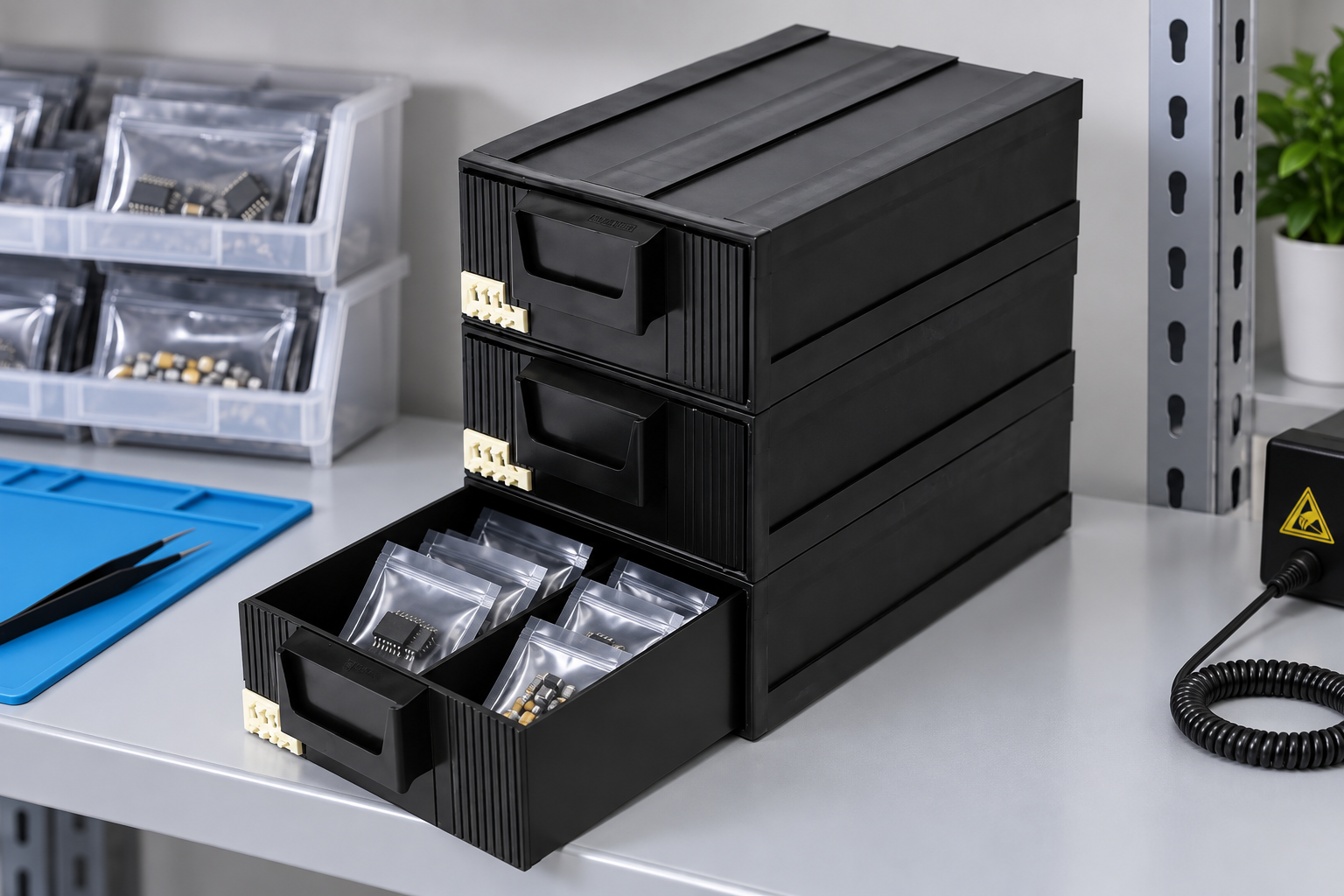
At each handoff, ask four questions: Is the item exposed? Is the surrounding area an EPA? What surfaces can touch it? What protective package is required before it enters an uncontrolled area? The EOS/ESD Association’s packaging overview distinguishes low-charging and conductive/dissipative behavior inside an EPA from the additional discharge-shielding need outside it. A black plastic tote, including the illustrated lidded ESD storage box, should be qualified for its intended use; appearance or color alone cannot prove shielding.
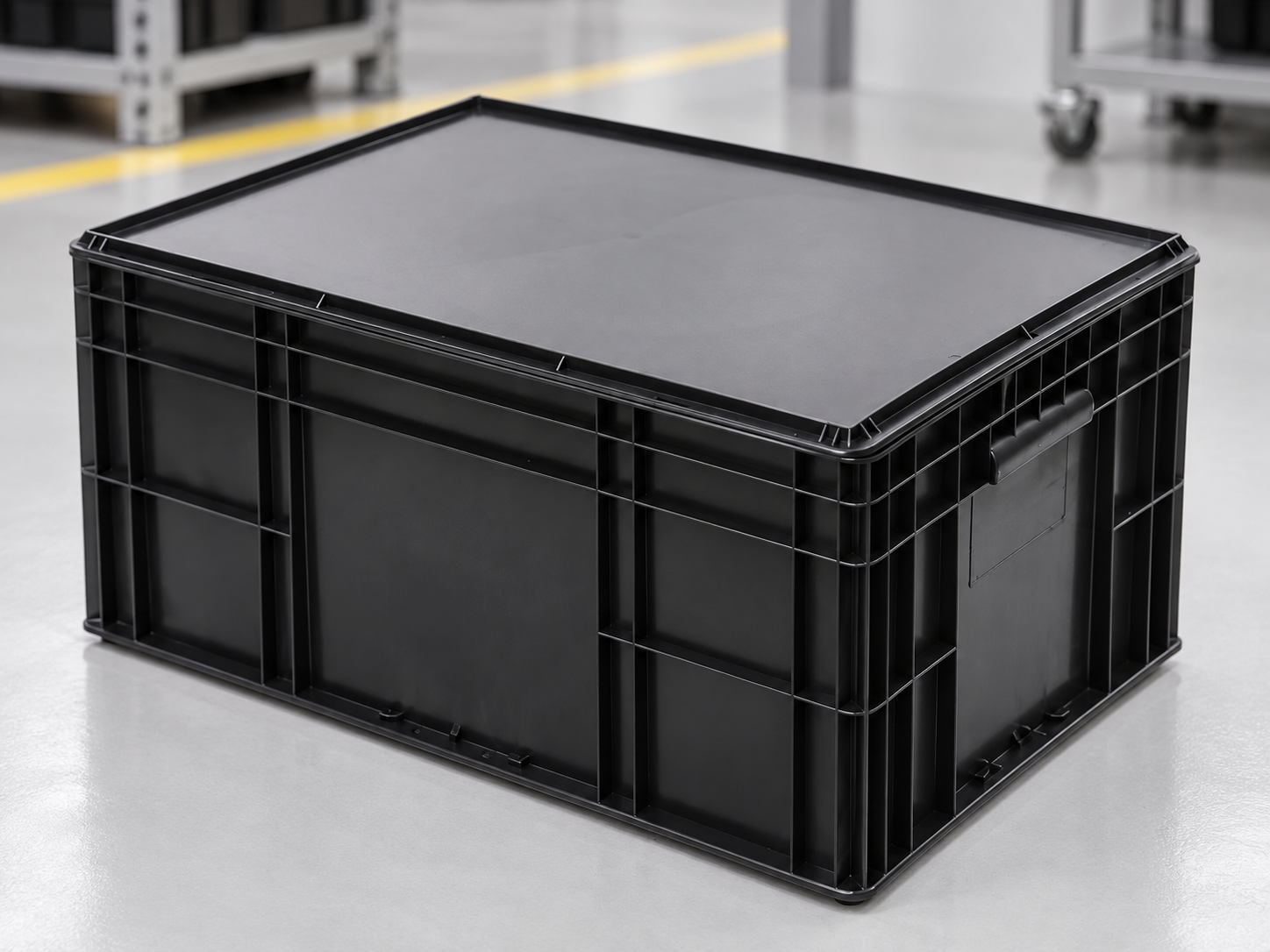
Check container condition and identification
Inspect a sample of empty and loaded bins. Look for cracked corners, warped walls, broken rims, missing lids, exposed fasteners, excessive soil, adhesive residue, unapproved repairs and labels that hide damage. Check whether a lid closes as intended and whether an insert or divider actually prevents parts from touching. Do not assume a repaired container retains its original electrical or mechanical characteristics. Remove questionable units from service until the responsible owner evaluates them against the approved method.
Confirm that part number and lot labels remain readable throughout the workflow. If a reusable container changes owners, define who removes the old label and who applies the new one. An ESD symbol is not a substitute for traceability. Likewise, a scan in the warehouse system does not prove the physical box contains the scanned lot. Open a controlled sample and reconcile its contents with the record without compromising the item’s protection. For detailed storage-location rules, use the site’s electronic component warehouse storage guide; this audit focuses on verifying that rules are actually followed.
Inspect shelves, aisles and environmental controls
Check that shelving is stable, in good condition and within its rated load, and that aisles are clear for the equipment used. Put heavier loads at appropriate levels and keep containers secure against sliding or falling. These are worker and product-safety controls, not optional ESD extras. OSHA’s warehousing guidance specifically addresses rack condition, load capacity and orderly storage; the applicable local law and site design still govern the facility.
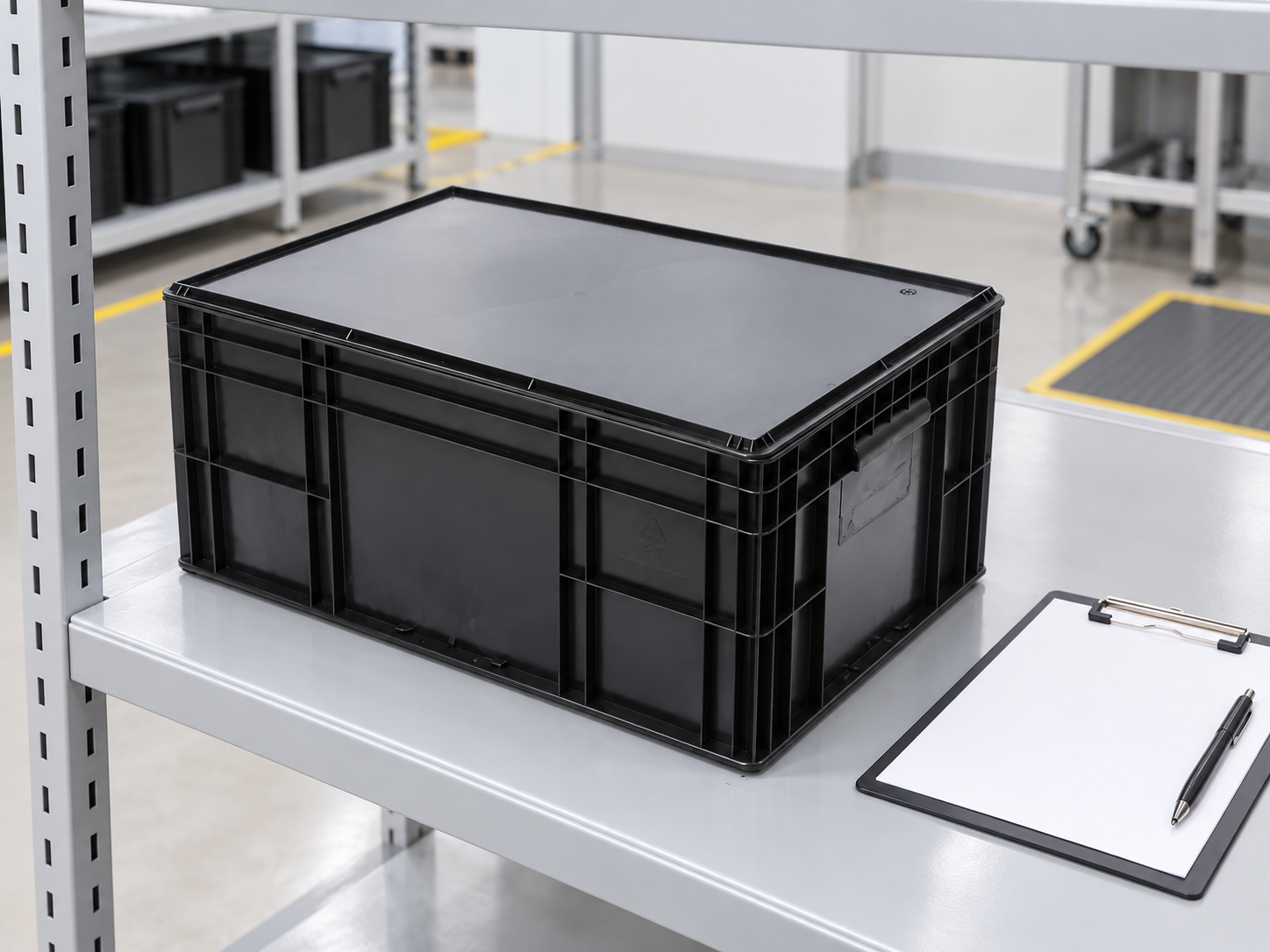
Check whether unpackaged sensitive items ever rest on an ordinary shelf or cart, even briefly. If shelves, carts or work surfaces are part of the EPA control system, verify that they are included in the local qualification and compliance-verification plan. Do not infer that a metal shelf is safe merely because it looks conductive: isolated conductors and uncontrolled contact paths can create their own risks. Also inspect dust, moisture, chemical exposure, sunlight and traffic routes according to the item’s own storage instructions. Record observations rather than claiming that a fixed humidity number is universally required for ESD protection.
Use a decision table that separates evidence from assumptions
| Audit point | Evidence to collect | Action when evidence is missing or fails |
|---|---|---|
| EPA boundary and transfer route | Floor marking, process map, observed movement | Trace an actual part and stop uncontrolled exposure |
| Container suitability | Approved item list, qualification and verification record | Hold the container for ESD coordinator review |
| Physical condition | Sampled lid, wall, rim and handle observations | Segregate damaged units; do not repair informally |
| Identity and lot | Box label, system location, physical contents | Quarantine ambiguous or mixed material |
| Shelf and aisle safety | Rack rating, condition, loading and clearances | Remove unsafe loads and escalate to facility owner |
| Return from production | Return record, protective package and opened-lot status | Reconcile and repackage before re-shelving |
This table is a practical audit aid, not a substitute for the site-approved measurement limits. Use the program’s specified instruments, method and frequency where an electrical measurement is required. The ANSI/ESD S20.20 program description identifies both administrative and technical requirements; local documents must show how those requirements apply to this particular storage operation.
Sample normal work, exceptions and rework paths
A tidy shelf during a scheduled audit is weak evidence if the busy-hour workflow is different. Watch a routine receipt, a partial pick and a replenishment. Then test an exception: an item that arrived in damaged packaging, a wrong-location scan, a box with a missing lid, or a component returned without its original label. Ask operators what they do next and compare the answer with the written process. The audit should identify whether the process makes the correct action easy under time pressure.
Do not treat an operator mistake as the only root cause. A confusing location code, inaccessible approved packaging, mixed ESD and non-ESD containers, or a gap between warehouse and production ownership can make recurrence likely. Review the high-mix component storage workflow và ESD bin cleaning procedure as distinct controls: one addresses location and identity, the other contamination and container maintenance. Neither replaces the electrical qualification of the package.
Record findings so they can be closed
For every finding, record the exact location, item or container ID, observed condition, affected material, immediate containment, owner, due date and evidence required for closure. Keep an observation separate from an assumption. For example, “lid absent on tote at rack B4” is evidence; “all lots on this shelf are unprotected” is a hypothesis until checked. If product may have been exposed, follow the site’s quality disposition process rather than silently returning it to stock.
Classify findings by operational consequence: exposed sensitive item outside control, uncertain qualification, traceability mismatch, physical damage, housekeeping or documentation gap. Prioritize containment of potential product exposure and worker hazards first. Assign corrective action to the process owner, not just the person who discovered it. Recheck the real transaction after the fix; a signed form without a successful repeat observation is not strong closure evidence.
Set a repeatable verification rhythm
Use the site’s approved compliance-verification frequency, then add targeted checks when the operation changes: new container type, new shelf layout, changed receiving supplier, new transport route or repeated damage. Keep short, consistent records that reveal trends in failed lids, mix-ups or location errors. A monthly visual walk may be useful locally, but it is not a substitute for whatever instrument checks or intervals the written program requires.
Train receivers and pickers on the decision points they actually control: which package to preserve, when a tote can be opened, where an exposed item may be set down, how to record a partial lot, and whom to call for damage. Use realistic examples from the area rather than a generic awareness slide alone. The EOS/ESD Association’s training and auditing discussion links ongoing verification with process performance, which is why this audit should test behavior as well as documents.
What to request when selecting storage containers
Before an RFQ, state whether use is entirely within an EPA, across a boundary, or in external transport. Provide the product dimensions and vulnerability, contact requirements, expected load, rack or cart envelope, lid need, handling method, cleaning method and identification scheme. Request material and ESD qualification information appropriate to the approved plan, plus samples for a real workflow trial. Do not accept “ESD safe” as a complete specification. For bins used to organize smaller parts, compare the drawer-cabinet storage approach with lidded totes; these solve different access and protection problems.
A trial should include full and partly filled containers, operator handling, stacking or shelving, label durability, lid fit, damage inspection and cleaning. Verify any electrical claims with the site’s specified method. Keep the accepted sample and approval record linked to a stable part number so a later material or tooling change triggers review. The goal is a container that works within the complete system, not simply a box with an ESD icon.
Further learning: ESD principles
The EOS/ESD Association’s educational lecture provides background on why controlled handling and packaging matter. It is not a substitute for a site audit plan.
Các câu hỏi thường gặp
Does an ESD logo on a tote prove it is suitable?
No. Confirm the specific container’s qualification and intended use against the site’s written plan, including whether it crosses an EPA boundary.
Should every audit measure every bin electrically?
Follow the sampling, method and frequency in the approved compliance-verification plan; do not invent a universal audit frequency or limit.
Can a lidded tote replace shielding packaging outside an EPA?
Only if the complete packaging configuration has been qualified for that use. A lid and dark color alone do not prove discharge shielding.
What is the first action for a damaged storage box?
Segregate it and protect any affected parts, then let the responsible owner decide on disposition under the approved process.
What is the best audit sample?
Trace a real item and lot through receiving, storage, picking and transfer, including a partial-pick or return path.
Bài đăng gần đây
-
 How to Audit an ESD Storage Area01 Th10,2026
 -
 ESD Drawer Cabinets for Small Electronic Parts30 Th9,2026
 -
Để lại phản hồi