- Tăng áp
- Blog
ESD storage bins for ASRS and automated warehouses must be selected against the exact machine interface and the component protection plan. A bin advertised as ESD suitable is not automatically compatible with a shuttle, lift, robot, conveyor, or named ASRS platform. Confirm its outside envelope, loaded mass, base support, lid retention, machine-readable identity, and electrical requirement, then test production-intent samples through the real storage and retrieval route. The bin can organize protected component packages, but it does not automatically replace a shielding bag, moisture barrier, or approved EPA procedure.
Start with the system integrator’s bin specification
Ask for the permitted bin footprint, height, weight, center-of-mass range, bottom support, side-wall clearance, and tolerances. Document whether the machine grips the lid, wall, base, or an outer carrier. Some systems accept only a proprietary bin geometry. In that case, a site may need a validated ESD insert or inner container rather than substituting a different outer bin. Never infer compatibility from a catalog photograph or approximate dimensions.
NIST’s manufacturing automation overview describes mobile material handling and machine vision as common automation uses. The practical bin choice depends on how those devices interact at every handoff.
| Interface | Required input | Trial to run | Failure to watch |
|---|---|---|---|
| Storage cell | Full outer envelope and loaded height | Insert and retrieve worst-case sample | Collision or stuck lid |
| Conveyor or shuttle | Base footprint and support span | Start, stop and transfer under load | Rocking or bridging gaps |
| Robot or lift | Grip point and center of mass | Repeated pickup across variation | Slip or wall deformation |
| Reader | Label or RFID location | Read at speed and orientation extremes | No-read or wrong-bin association |
| ESD control | Device sensitivity and handling route | Material and packaging verification | Assuming color proves performance |
Set the numerical limits from the actual ASRS vendor and component requirements. The table is a validation framework, not a claim that any SWESD bin fits a particular machine.
Separate outer automation geometry from inner protection
The outer bin must move reliably. The inner package must protect the component. A sealed pouch, tray, liner, divider, or dry package may be required depending on the part and route. The EOS/ESD Association’s ESD control principles describe how handling inside and outside an EPA affects packaging needs. The selected bin material should be evaluated against that plan, not treated as the whole plan.
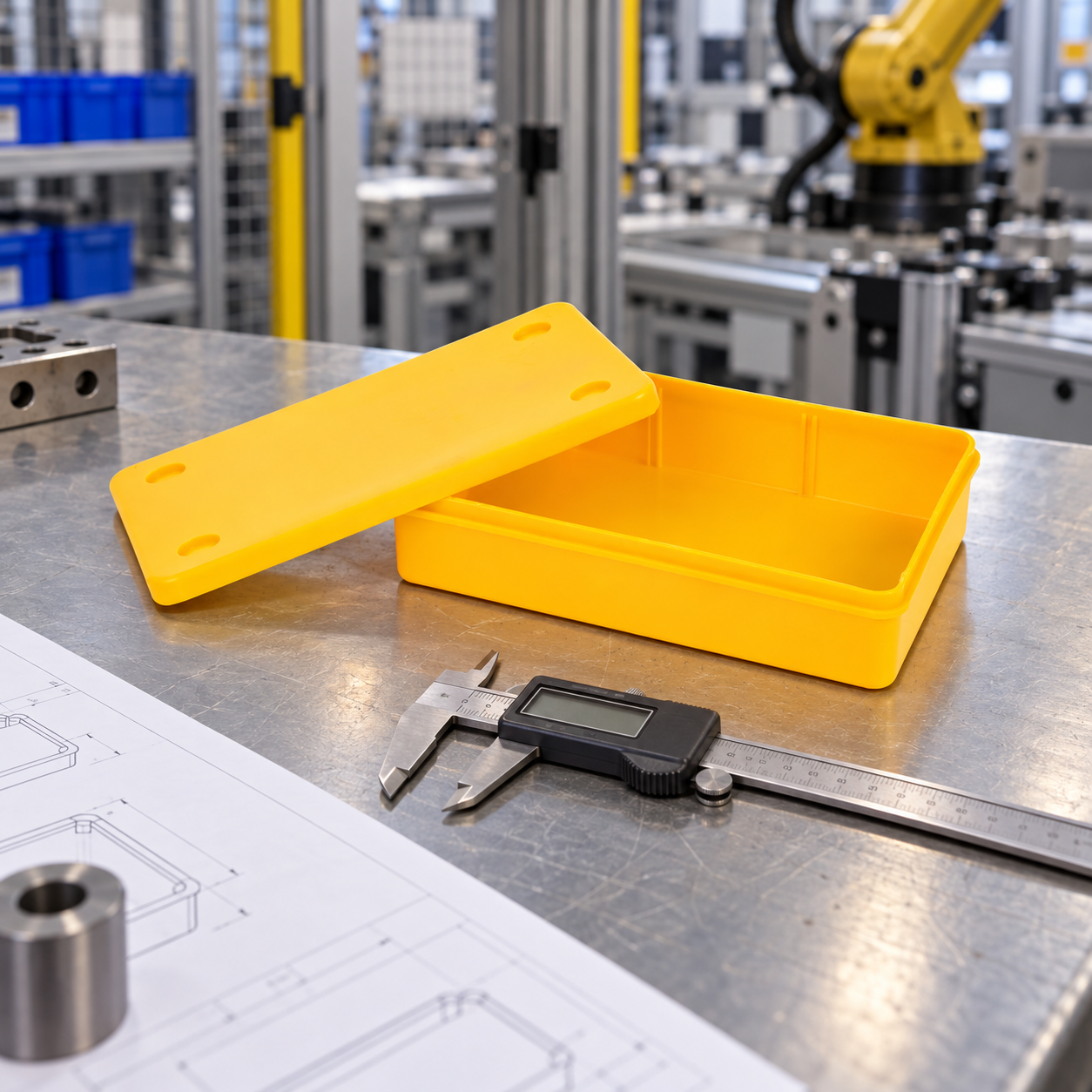
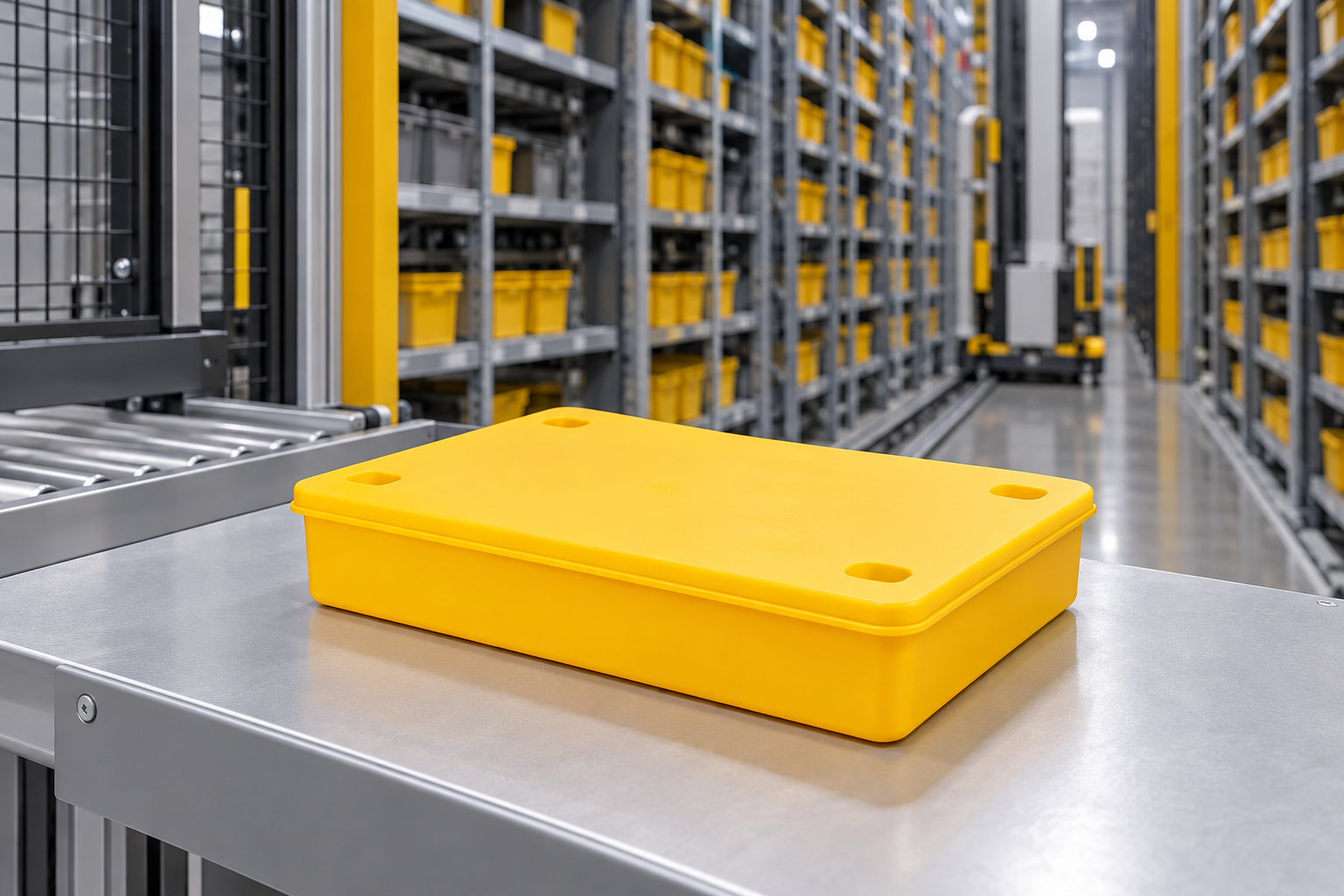
Sử dụng SWESD lidded ESD component bin as a physical example for preliminary discussion. Its exact dimensions and material must be checked with the supplier and integrator. The featured image is illustrative; it is not evidence of compatibility with any ASRS brand.
Validate the loaded center of mass
Measure or estimate the heaviest approved load and its worst credible distribution. A bin full of identical small pouches behaves differently from a bin with one heavy assembly in a corner. Test acceleration, deceleration, transfer gaps, and emergency-stop recovery. Observe any shifting that could raise the lid or place a part against the wall. Define an approved loading layout if the machine requires a narrow center-of-mass range.
Do not rely on an empty-bin trial. Empty geometry can pass while the loaded base bows or the lid lifts. Use representative production material or approved surrogates, and record the sample ID and load arrangement for repeatability.
Check lid, label and stack interfaces
A removable lid must stay seated through the intended route if the process requires it. Check whether the machine contacts the lid or assumes a fixed height. A label holder may extend beyond the outer envelope or scrape a neighboring bin. Put identifiers in an approved zone that remains visible to the reader but clear of the grip and support surfaces.
If the bin is stacked before entering the ASRS, validate that stack separately. A lidded container is not automatically a stackable automation carrier. Review the bin-to-bin load path and loaded height. The tray stacking guide offers related mechanical checks, though a bin must be assessed against its own geometry.
Choose identification that survives the route
Separate bin asset ID from part, lot, quantity and status. The bin can be reused for another material unit after cleaning; the old material record must not follow it. GS1 US explains the role of standard identifiers in its inventory management overview. A facility can use internal IDs, provided they are unique, readable and linked to reliable transactions.
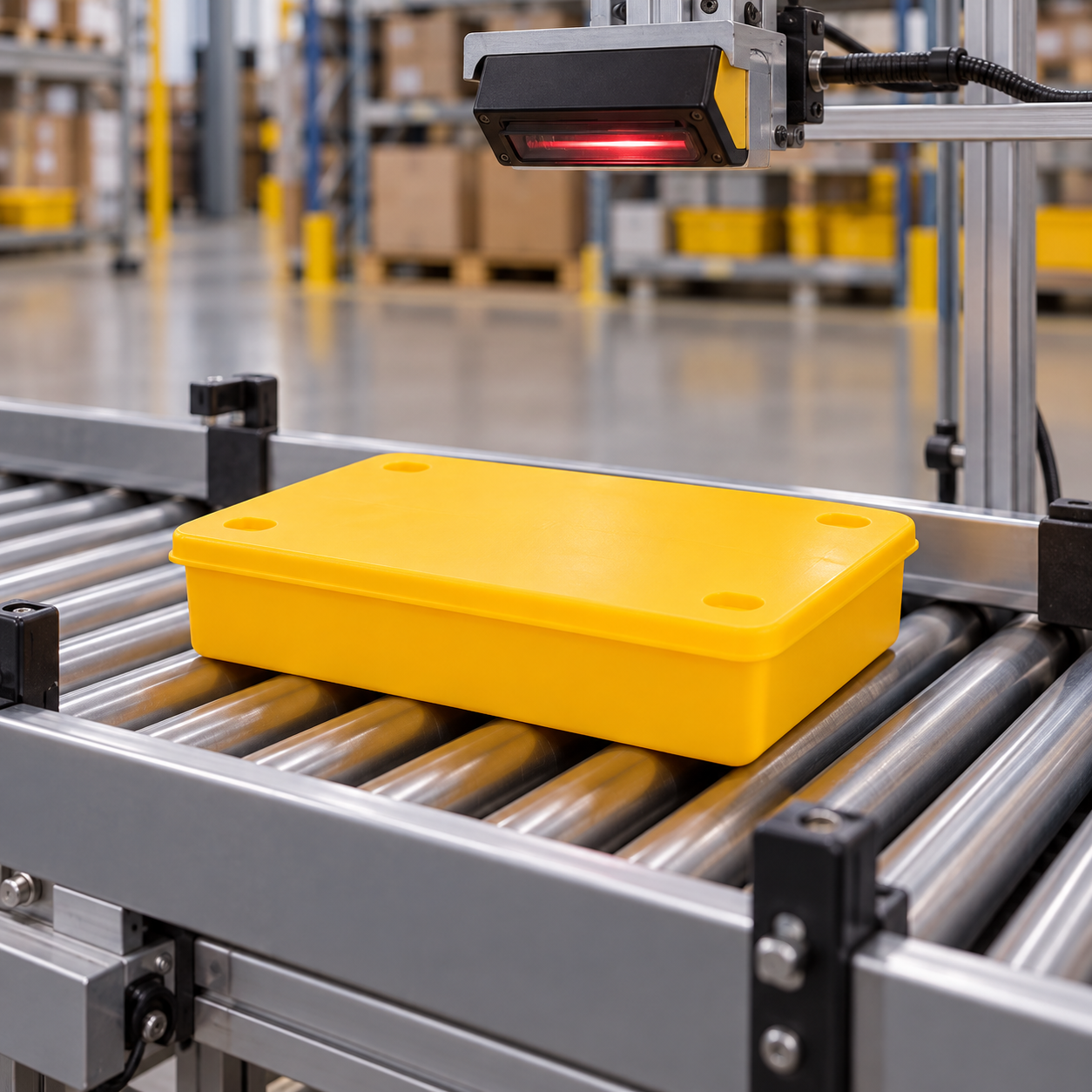
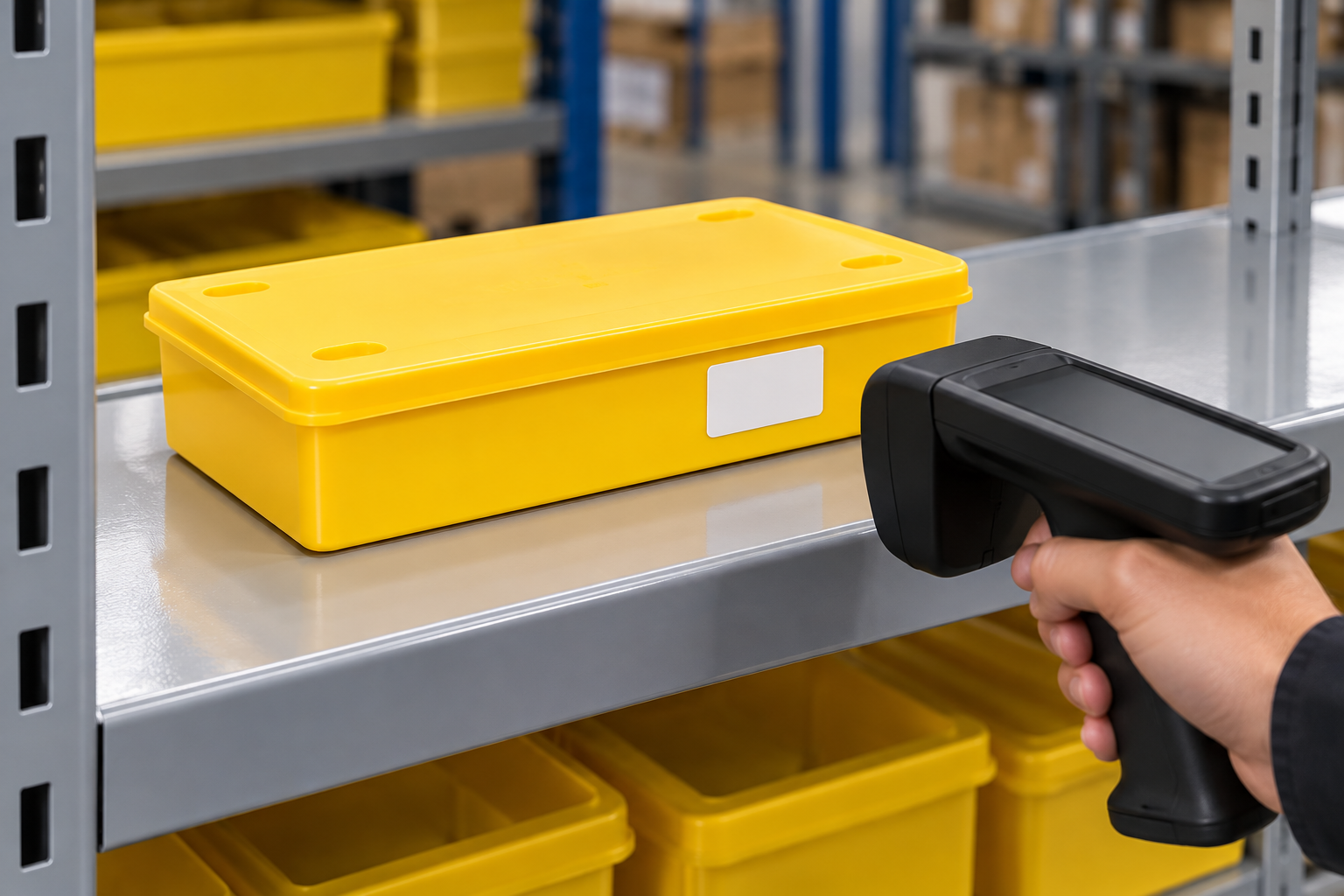
Test readers with a dirty label, several orientations, a full bin, and the fastest intended movement. A no-read should stop or route the bin for controlled exception handling. Do not let the software infer identity from the previous bin in the lane. For RFID, evaluate the tag and bin material together; the labeling and MES workflow guide describes complementary identity controls.
Run a production-intent acceptance trial
Test several bins from the intended manufacturing process, not only a single prototype. Include maximum and minimum loads, different lot samples, empty returns, stop and restart, and repeated storage cycles. Record jams, no-reads, lid movement, wear, contamination and physical damage. Reinspect the bin after the trial and define a replacement criterion.
NIST’s material handling architecture report describes interacting tray tables, storage, guided vehicles, controllers and support services. Equipment has changed since that research, but validating the integrated route remains a useful engineering principle.
Measure clearance with real variation
Do not compare only nominal dimensions. Measure several bins from the intended tool, including the lid seated and the most protruding approved label. Record the largest outside dimension in each direction and compare it with the integrator’s allowed envelope. If the clearance is small, account for guide adjustment, thermal change, wear and any loaded wall deflection. The acceptance margin belongs in the joint mechanical specification, where both supplier and integrator can review it.
Check the bin after cleaning and repeated use. A polymer container can change shape or a label holder can loosen. Inspect the exact contact points that touch shuttles, guides and lifts. A crack in a non-contact corner may have a different consequence from a distorted support rail; the disposition rule should explain both rather than treating every visual defect alike.
Commission the information flow with the mechanics
Give every bin a permanent asset identity and every material unit a separate identity. At insertion, the system should verify bin, contents, location and status. At retrieval, it should confirm that the requested bin is the one delivered. Deliberately test a duplicate ID, missing label, held lot and empty return. The machine must not complete a move in the WMS if the physical transfer failed, or leave a physical bin in a cell while the database says it was issued.
Plan recovery after power loss or emergency stop. Operators need a safe way to reconcile bins in transit, including the bin in a lift, one at a conveyor transfer, and one held by a robot. Record the state before restarting automatic movement. This recovery process should be rehearsed with non-sensitive test material before live component inventory is loaded.
When a pilot shows a failure, identify the exact interface instead of redesigning the bin immediately. A no-read might be a reader angle, while a jam might be a raised label edge, wrong lid placement or guide setting. Correct the cause and repeat the affected route. Keep a record of the change so later production samples can be compared with the accepted configuration.
Control exceptions and change
Specify what happens after a jam, damaged lid, wrong part, missing bin ID, overloaded unit or ESD hold. The bin should move to a known exception location with its asset and contents still identified. Do not return it to active storage because the operator can push it back into the cell manually.
Any change to resin, bin geometry, lid, label, liner, maximum load, conveyor speed or machine recipe can affect the approved interface. Keep a change record and repeat the relevant acceptance cases. A supplier material substitution that preserves color may still change stiffness or electrical behavior.
RFQ checklist
- ASRS vendor and exact permitted bin envelope.
- Maximum loaded mass and distribution.
- Base, lid, grip, guide and reader interfaces.
- Component package and ESD control requirements.
- Label or RFID zone and error handling.
- Cleaning, wear inspection and replacement rule.
- Production-intent samples and acceptance trial plan.
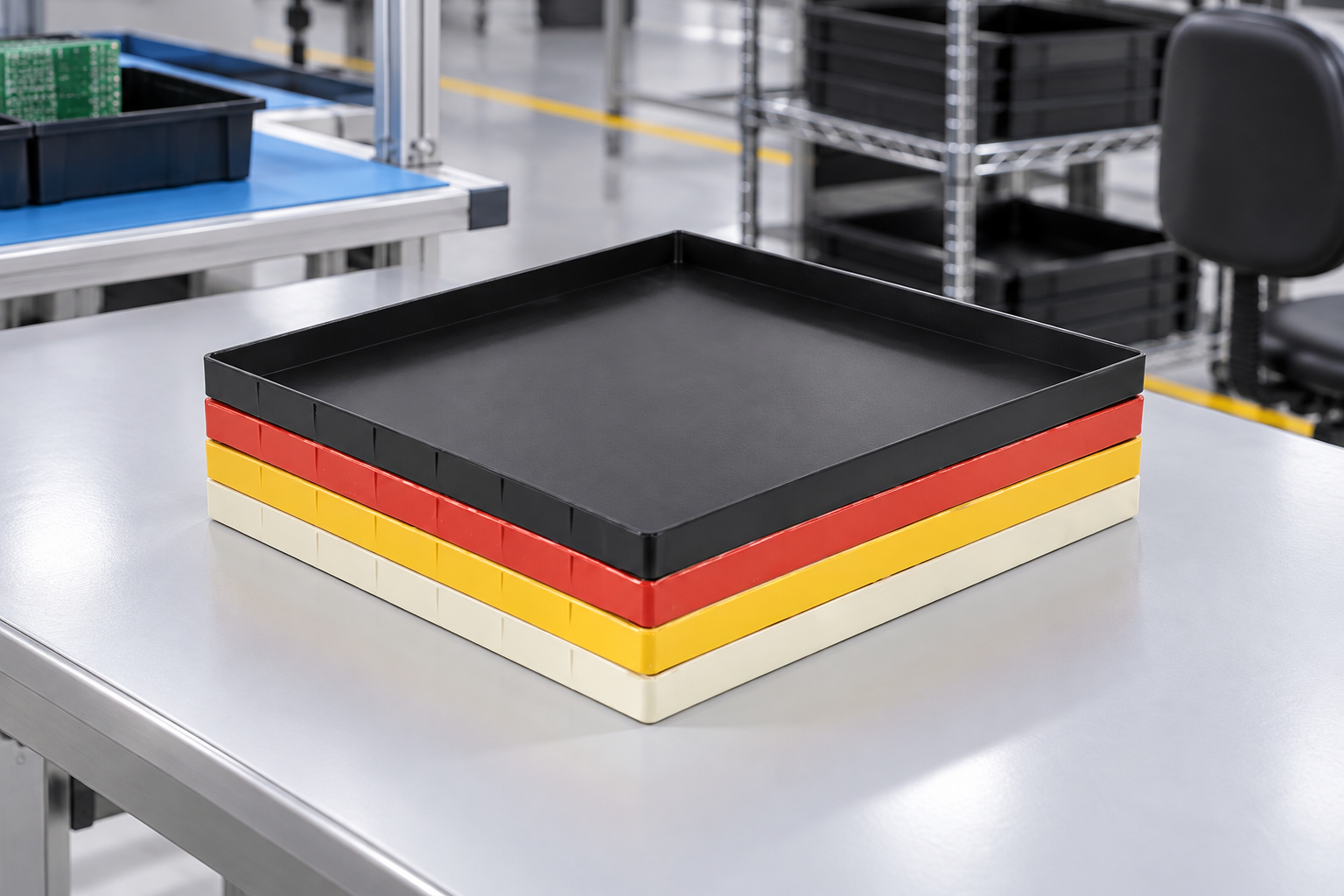
The ESD warehouse storage guide covers location and status control; high-mix component storage covers many small lots; and automated ESD tray handling addresses a related but different carrier format.
Further learning: ESD handling context
This EOS/ESD Association lecture provides the ESD background; the ASRS interface must still be validated with the integrator.
Các câu hỏi thường gặp
Will any ESD bin fit an ASRS?
No. Confirm the exact machine specification and test production-intent bins under load.
Does a lid make the bin moisture proof?
No such property should be assumed. Use the approved moisture package or dry-storage method for the component.
Can the same bin carry different lots over time?
Yes, if its asset ID remains separate from material identity and every change is recorded.
What should happen on a no-read?
Route the bin to a controlled exception process and verify its identity before further movement.
Which change requires retesting?
Any change that affects geometry, material, load, lid, label, liner or machine handling logic should trigger relevant checks.
Để lại phản hồi