- Turbo
- Blog
Stacking ESD trays safely requires more than placing one tray on another. A stable stack depends on a compatible rim-and-base interface, flat trays, controlled load distribution, a defined maximum stack height, and handling rules that keep the stack aligned from storage through transport. Nesting is different: empty trays fit partly inside one another to save return-storage space, but loaded trays normally need a positive stacking interface that protects the parts below. Buyers should validate the complete loaded stack, not infer performance from tray color or surface resistance alone.
Stacking, nesting and simple piling are different
A stackable tray transfers load through intended contact points around its rim, corners or molded rails. A nestable tray rotates or changes orientation so empty units occupy less vertical space. A tray that merely has a flat base may sit on another tray, but that does not prove it is a controlled stack. The distinction matters because an unsupported base can bow into the parts below, while a poorly located rim can slide during cart movement.
Start the specification by naming the operating mode: loaded stacking, empty nesting, or both. If both are required, document the orientation that changes the mode and add a visible poka-yoke feature or work instruction. Operators should not need to guess whether a tray must be rotated 180 degrees.
| Mode | Main purpose | Interface to verify | Typical risk |
|---|---|---|---|
| Loaded stacking | Protect parts while using vertical space | Rim, corner and base engagement | Bow, slip or excessive load on lower trays |
| Empty nesting | Reduce return and storage volume | Taper, stops and release clearance | Jamming or surface abrasion |
| Simple piling | Temporary placement only | No defined positive interface | Uncontrolled movement and contact |
Begin with the real product and process envelope
Record the tray outside dimensions, usable inside dimensions, empty mass, material, temperature range, and the condition in which electrical performance is specified. Then record the part mass, quantity per tray, center of gravity, protrusion above the rim, and any lid, liner or separator. A stack that is stable when empty can behave differently when the load is high, off-center or concentrated in a few cavities.
Also measure the environment: shelf depth, cart deck, conveyor guides, lift clearance, aisle turns and packaging carton. The nominal tray footprint alone is not enough. A raised label holder, bowed wall or overhanging liner can change the effective envelope and catch on adjacent equipment.
Check rim alignment and support paths
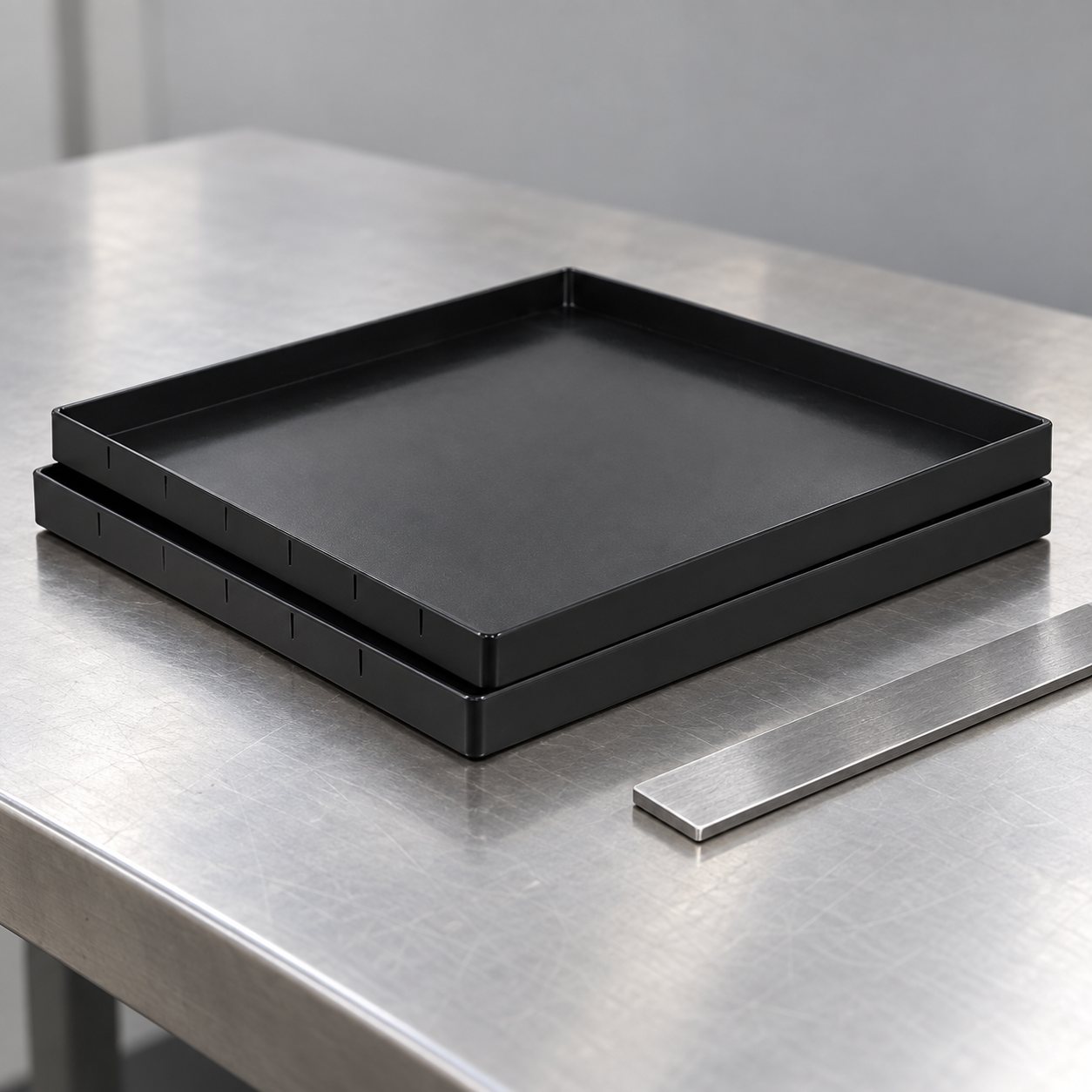
Place representative trays on a verified flat surface. Check all four corners and the long sides for rocking, gaps, burrs, warpage or local damage. Then stack two empty units and apply light horizontal pressure in each direction. The upper tray should locate consistently without riding on a label, liner or component. Repeat with production-representative loads because the support path may change as the base deflects.
Do not use one successful pair as evidence for a production batch. Sample trays from different cavities, lots and ages. Include cleaned trays and units that have completed realistic handling cycles. If a supplier uses several tools for one size, record the tool or cavity identity where practical.
Set stack height from evidence, not convenience
There is no universal safe number of ESD trays in a stack. The limit depends on tray geometry, resin system, temperature, load pattern, dwell time, surface condition, cart acceleration and the consequences of failure. Define a temporary engineering limit, test it, and reduce it when the handling route introduces greater shock, vibration or human reach risk.
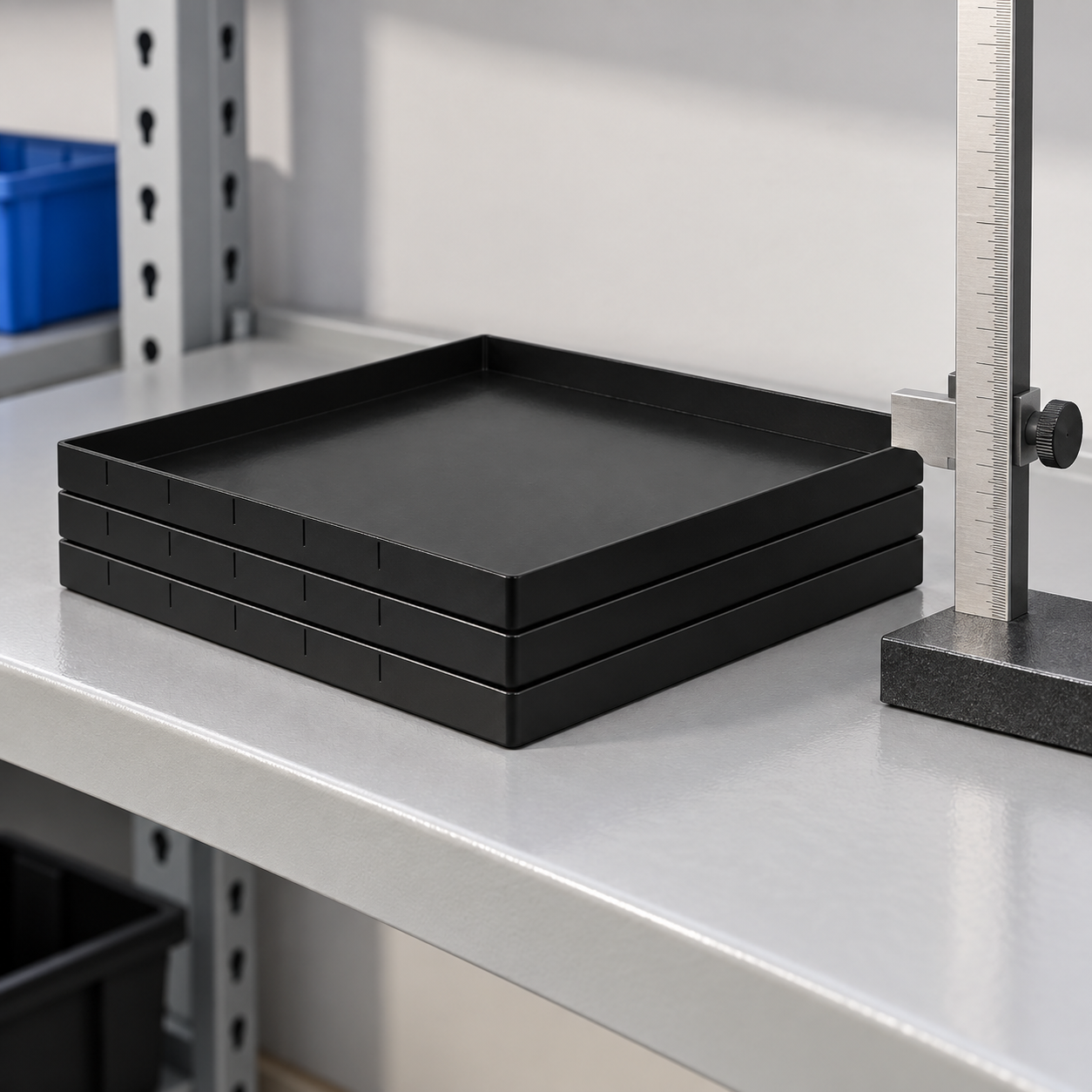
A practical validation uses at least three conditions: normal load, foreseeable worst-case load distribution, and an intentionally small alignment error. Observe leaning, permanent set, rim damage, contact with parts below and release after dwell. Test the loaded stack on the actual shelf or cart, then repeat after movement. Shipping validation should follow the selected distribution test plan rather than a workshop-only demonstration; the International Safe Transit Association test-procedure overview explains how distribution hazards are organized.
Separate mechanical suitability from ESD protection
Mechanical stability does not establish electrostatic performance. A tray can stack perfectly and still be unsuitable for the item or protection zone. Conversely, a material described as static dissipative does not automatically have enough stiffness or creep resistance for a tall loaded stack. Treat electrical classification, physical protection and contamination control as separate verification items.
The EOS/ESD Association explains the system context for protecting susceptible items in its ESD fundamentals. Its ANSI/ESD S541 genel bakış describes packaging materials used to protect ESD-sensitive items. Use the applicable current standard, customer requirements and measured material data when approving a tray.
Design the workflow around the approved stack
Mark the maximum loaded stack quantity on the traveler, shelf standard or reusable label rather than relying on memory. Define whether mixed part numbers are prohibited, whether the top tray requires a cover, and where incomplete stacks wait. A stack should have one identity at the handling-unit level while retaining traceability to the trays or lots inside.
cURL Too many subrequests by single Worker invocation. To configure this limit, refer to https://developers.cloudflare.com/workers/wrangler/configuration/#limits.
cURL Too many subrequests by single Worker invocation. To configure this limit, refer to https://developers.cloudflare.com/workers/wrangler/configuration/#limits
cURL Too many subrequests by single Worker invocation. To configure this limit, refer to https://developers.cloudflare.com/workers/wrangler/configuration/#limits.
cURL Too many subrequests by single Worker invocation. To configure this limit, refer to https://developers.cloudflare.com/workers/wrangler/configuration/#limits.
cURL Too many subrequests by single Worker invocation. To configure this limit, refer to https://developers.cloudflare.com/workers/wrangler/configuration/#limits
- cURL Too many subrequests by single Worker invocation. To configure this limit, refer to https://developers.cloudflare.com/workers/wrangler/configuration/#limits.
- cURL Too many subrequests by single Worker invocation. To configure this limit, refer to https://developers.cloudflare.com/workers/wrangler/configuration/#limits.
- cURL Too many subrequests by single Worker invocation. To configure this limit, refer to https://developers.cloudflare.com/workers/wrangler/configuration/#limits.
- cURL Too many subrequests by single Worker invocation. To configure this limit, refer to https://developers.cloudflare.com/workers/wrangler/configuration/#limits.
- Run the approved movement, dwell and distribution tests.
- Quarantine cracked, bowed, contaminated or poorly locating trays.
- Revalidate after a material, tool, geometry, liner or cleaning-process change.
For purchasing, request drawings and samples before production approval. Include load distribution, stack quantity, dwell time, storage temperature, cart or conveyor interface, label zone, cleaning method and electrical requirements in the RFQ. The NASA workmanship standard portal for NASA-STD-8739.6 is also a useful example of why packaging and handling controls need documented workmanship requirements rather than assumptions.
Turn the validation into a controlled specification
A useful approval record states exactly what was tested. Photograph the tray orientation, load pattern, shelf or cart and any cover or liner. Record the sample quantity, conditioning time, observation points and acceptance criteria. Useful criteria include no tray-to-part contact, no disengaged corner, no permanent lean, no visible crack, no label interference and no unacceptable permanent set after unloading. Avoid a vague result such as “stack test passed,” because another team cannot reproduce it.
Give the approved configuration a revision and link it to the purchasing drawing and work instruction. If two tray revisions fit together but have different stack pitches, identify whether mixed-revision stacks are allowed. During a pilot run, ask operators to record difficult separation, rocking and unexpected contact. Those observations often reveal practical problems that a short bench check misses.
How this connects to SWESD tray selection
Kullan SWESD ESD tepsi aralığı as the product starting point, then provide the actual part, load and process envelope for confirmation. The broader anti-statik bileşen tepsi kılavuzu explains tray roles. Review ESD tray material selection, tray load-capacity validation, ve liner fit and contamination control as separate decisions. This prevents a mechanically convenient stack from hiding an electrical, dimensional or cleanliness mismatch.
Further learning: why ESD controls must work as a system
This EOS/ESD Association lecture gives neutral background on electrostatic-discharge controls. It supports the system context; the article’s mechanical stacking checks remain necessary.
Sık sorulan sorular
Kaç tane ESD tepsisi istiflenebilir?
There is no universal number. Set the limit from the specific tray, loaded weight and distribution, dwell time, temperature, handling route and validation results.
Bir yuvalı tepsi yüklendiğinde otomatik olarak istiflenebilir mi?
Hayır. Yerleştirme genellikle boş tepsiler için alan tasarrufu modudur. Yüklenmiş istifleme, doğrulanmış destek ve konumlandırma arayüzü gerektirir.
Tepsi rengi ESD performansını kanıtlayabilir mi?
No. Color can support visual management, but electrical behavior requires the applicable material specification and verification.
Etiketler istiflenmiş tepsilerin arasında mı durmalı?
Hiçbir etiket veya tutucu onaylanmış yük yolunu kesmemeli veya rafların hizasını bozacak şekilde dışarı çıkarmamalıdır. Etiket bölgesini bağlantı arayüzü dışında ayırın.
When should stack validation be repeated?
Malzeme, takım, geometri, yük, liner, etiket, temizlik işlemi, taşıma ekipmanı veya dağıtım rotasında yapılan değişikliklerden sonra tekrar edin.
Bir Yorum Bırakın