- Turbo
- Blog
An SMT reel tray inventory cycle count should reconcile the reels physically present with their recorded identities, quantities, locations and stock status. Counting the slots in a carrier is not enough: an empty position is not missing stock unless a record says material should be there, and a reel count is not a component count. Define the count unit, control movements during the check, record discrepancies without silently editing balances, and release corrections through an authorized review. This guide focuses on manual carrier-based counts and the handoffs between warehouse, production and inventory control.
Separate carriers, reels and component quantities
Three quantities often become confused. A carrier count describes reusable handling assets. A reel count describes identified material packages. A component quantity describes parts remaining on those packages. Keep these units separate in the count form and system. Three partially used reels are three reels, but their component balance requires an approved measurement or transaction method; it cannot be inferred from the number of occupied tray positions.
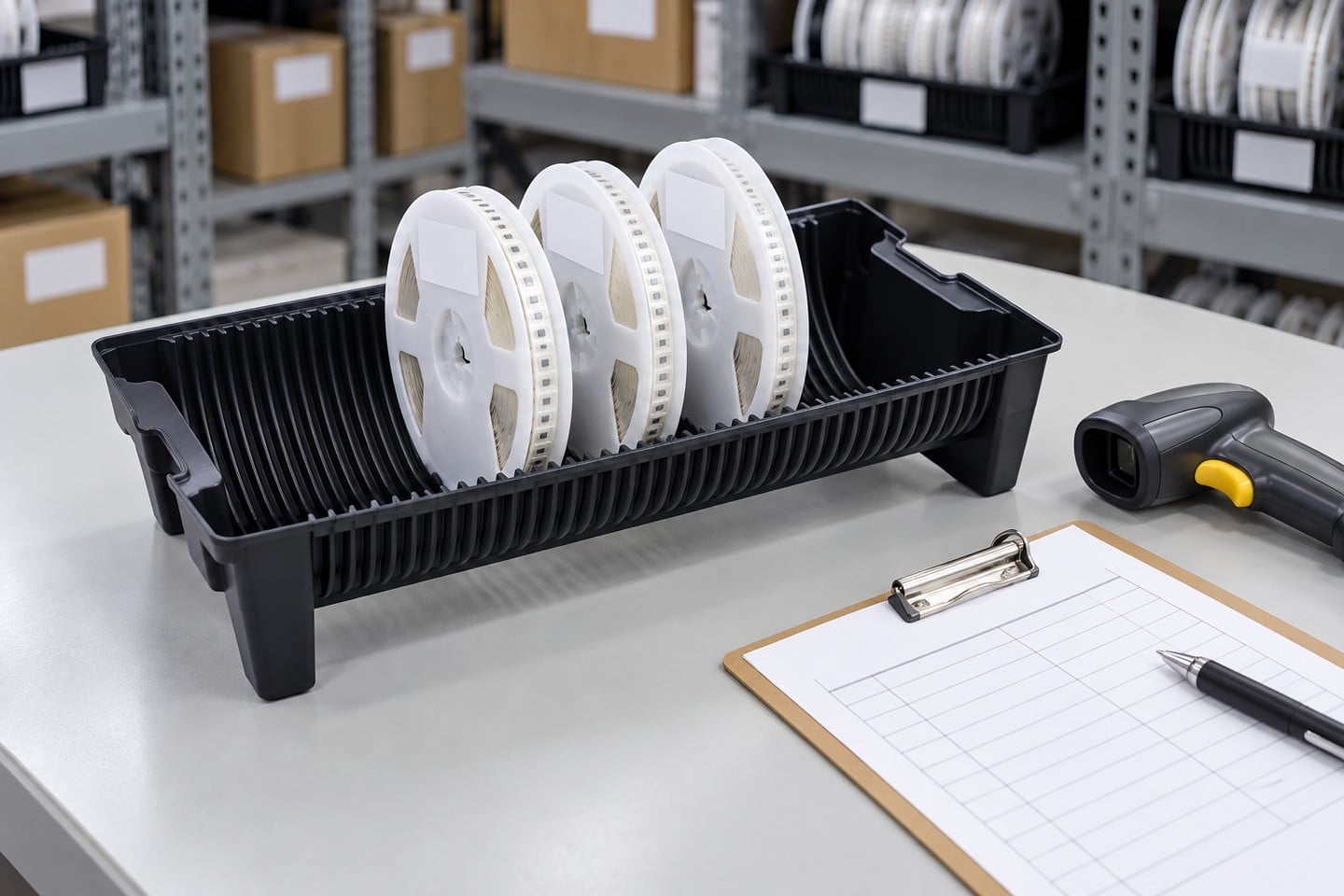
The SWESD SMT reel storage tray provides physical slots for organizing reels. The passive tray does not itself read identifiers, update stock or resolve discrepancies. If your facility combines it with scanners or software, document those separate functions. Do not assume that a tray product includes RFID, automatic counting or integration simply because similar terms appear in searches for intelligent storage systems.
Define the scope before the first count
Select the locations, material statuses and count unit covered by the exercise. Include a rule for work-in-progress, material temporarily staged for a line, quarantine and unidentified stock. A shelf may appear accurate while its staged reels remain outside the count boundary. State whether the check is a blind count, a record-to-floor check or a targeted investigation, because the information shown to the counter changes the evidence produced.
Choose a responsible owner for the count and another authorized person for balance corrections where the site requires separation of duties. Give the team a location map and a route. Explain how to flag an unreadable identifier, an unexpected reel and a movement that occurs during counting. Those instructions prevent staff from inventing their own workarounds when a routine check encounters a real production exception.
Preserve the snapshot while material continues moving
A count compares physical stock with records at a defined point or within a controlled interval. The simplest approach may be a temporary location hold, but a live production area may require a transaction log instead. Record the snapshot time, the movement cutoff and the procedure for material that must leave or arrive. The method must be approved locally; this article does not prescribe a universal shutdown rule.
If a reel moves after the physical count but before reconciliation, retain both the count observation and the movement record. Do not change the count to match the latest display without explaining the transaction. When movements cannot be reconstructed reliably, recount the affected scope at a new controlled cutoff. Repeatedly adjusting numbers until two screens agree produces an apparently clean result while destroying the evidence needed to find the cause.
Read identity before recording occupancy
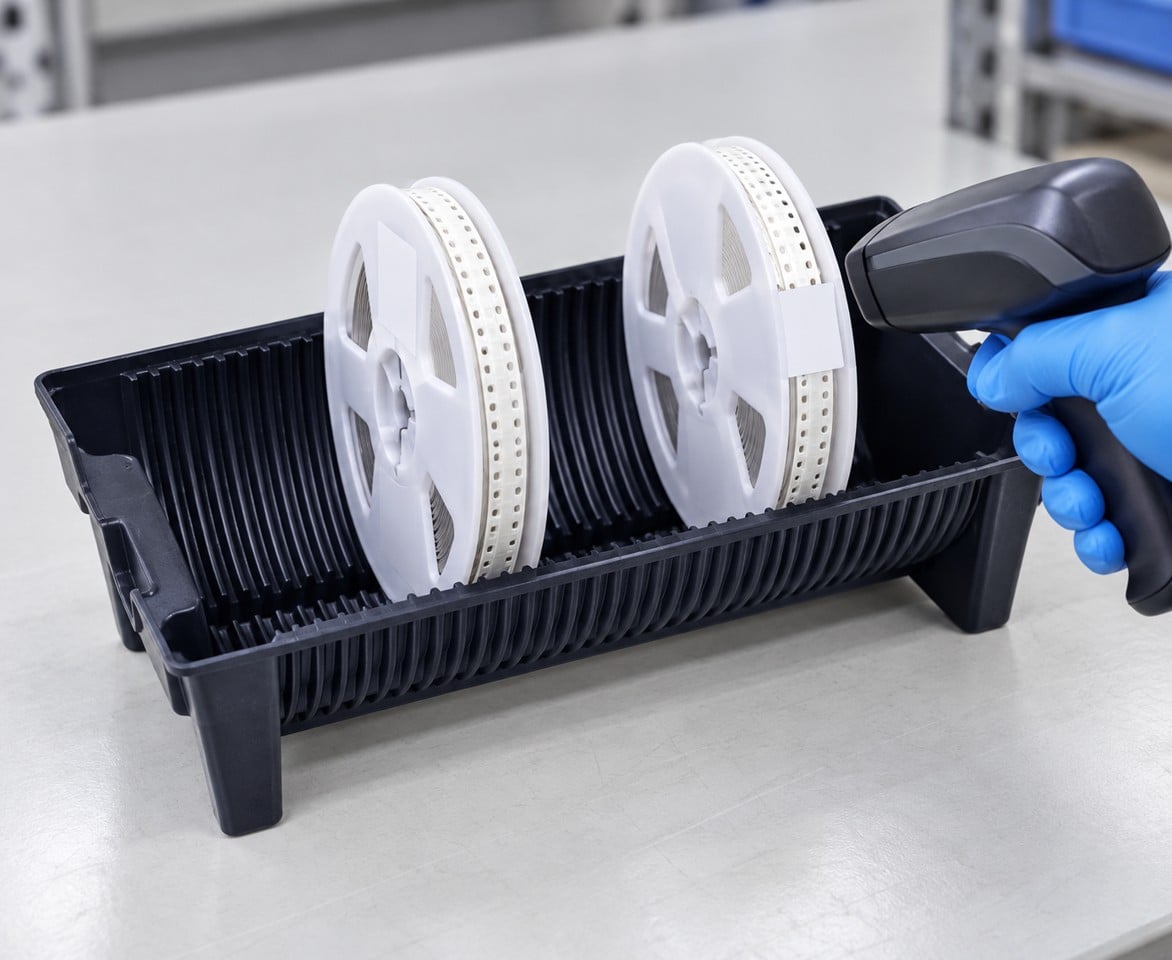
Verify the location label first, then the carrier identifier where one is used, then each reel identifier. Keep the original material label associated with the reel. Do not replace a hard-to-read label with an improvised number that breaks the record link. An unreadable reel should follow the site’s identity-hold process rather than being guessed from nearby material, reel color or a familiar part description.
The barcode visibility guide for reel storage explains how to keep identifiers accessible. It is an input to cycle counting, not a replacement for reconciliation. Readability also does not establish uniqueness: two packages with the same printed part number may be legitimate separate reels. Where individual package identity matters, verify the identifier defined by your inventory system rather than treating every repeated part number as a duplicate.
Use a count sheet that distinguishes exceptions
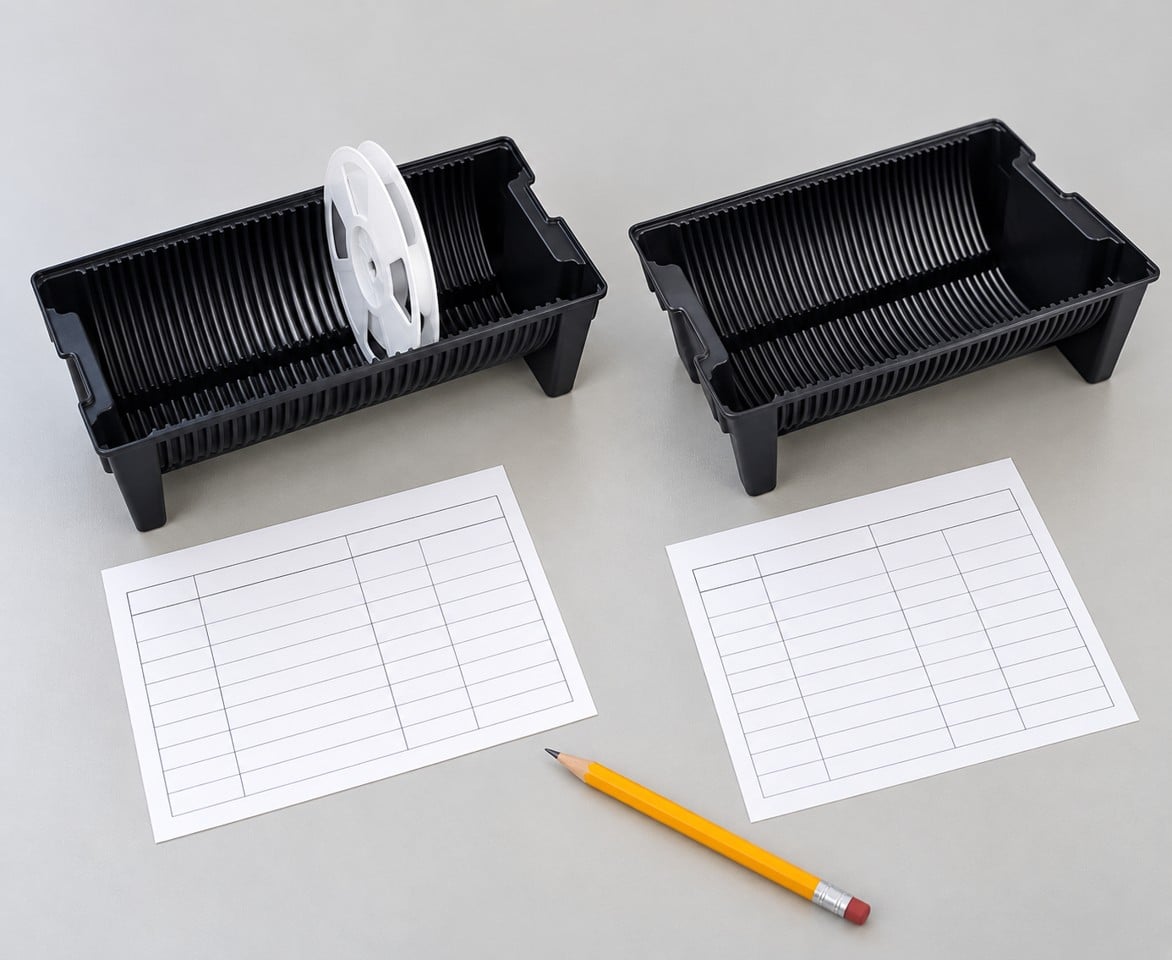
A useful count sheet records expected location, observed location, material identifier, count unit, observed status, time and the counter. The table below shows qualitative decision rules. It does not establish any product accuracy, inventory tolerance or acceptable loss threshold; those belong to your approved inventory policy.
| Count observation | Record separately | Next action |
|---|---|---|
| Expected reel absent | Identifier, location and cutoff time | Check authorized movements and recount affected scope |
| Unexpected reel present | Actual identifier and observed location | Investigate ownership and status before any correction |
| Unreadable identifier | Physical presence and identity uncertainty | Hold through approved identity-review process |
| Partial reel quantity uncertain | Reel presence distinct from component balance | Use approved quantity method and document limitations |
| Movement during count | Time, item and transaction reference | Reconcile to cutoff or recount at controlled snapshot |
| Carrier count differs | Reusable asset unit, not component stock | Reconcile asset register independently of reel inventory |
Leave space for evidence references and the result of a recount. Avoid a single ‘adjusted’ checkbox that hides whether an item was moved, misidentified, counted twice or genuinely absent. If the system supports reason codes, define them clearly and retain a free-text field for unusual cases. A reason code selected only to make a transaction save is not a root-cause investigation.
Recount discrepancies without copying the first answer
For an unexpected difference, verify the location and count unit before expanding the search. A carrier may have been moved to the next shelf, or a balance may refer to components while the counter recorded reels. Where practical, have the recount performed without showing the first observed quantity. Record the second result independently, then compare both with the transaction trail and the physical identities.
Do not search only for a missing quantity. An overage elsewhere can be the other side of a location error, but it is not automatically the same material. Match the actual identifiers and approved records before transferring a balance. If a difference persists, isolate the affected scope and assign an owner. The production need for material should not turn an unverified assumption into an authorized stock correction.
Treat partial reels as a separate measurement problem
A visual estimate of reel fullness is not a reliable universal component count. Package pitch, reel construction, leader and trailer material, splices and prior issues can affect any inference. Use the site’s approved counting equipment or transaction method and its documented limitations. Record the method and relevant equipment identity where required. Do not present a precise remaining quantity when the method only supports an estimate.
If a partial reel is outside the measurement capability available during the cycle count, record its physical presence and identity while escalating the component balance. This preserves useful evidence without fabricating precision. Define how the inventory record will show the unresolved quantity and who may release the material. Physical presence, usable status and exact remaining quantity are separate statements, each requiring its own support.
Protect material while inspecting the carrier
Counting should not create handling damage or unnecessary exposure. Keep reels in the approved carrier and packaging arrangement, moving only what is needed to read identity safely. Do not pull exposed tape to estimate the balance or rest a reel against an unsuitable surface. The leader tape protection guide covers a distinct handling issue that can arise when material is repeatedly picked up during a count.
Follow local controls for sensitive devices and any packaging restrictions that apply. The EOS/ESD Association explanation of basic procedures and materials provides background on maintaining an ESD control program during handling. A count is not an electrical verification activity, and a correct stock balance does not establish that component packaging or handling conditions have remained acceptable.
The following EOS/ESD Association educational video explains electrostatic-control background for personnel handling sensitive materials. It does not show this tray counting reels or demonstrate inventory software.
Reconcile records through an authorized decision
Prepare a discrepancy packet containing the count observations, recount, material identities, location history and relevant transactions. Distinguish a correction of location from a correction of quantity or status. Have the designated owner approve the appropriate transaction, and retain the reference to the original discrepancy. Do not rewrite the first observation after approval; the difference between observation and correction explains what actually happened.
Where the cause remains unknown, say so. A correction may be necessary to restore a usable record, but it does not prove that the underlying process is fixed. Track repeated exceptions by route, location or transaction type without blaming individuals from incomplete evidence. The objective is a trustworthy inventory record and fewer interruptions, supported by a history that another reviewer can follow.
Review trends and improve the physical route
Look for recurring unreadable labels, unrecorded transfers, mixed status locations and material staged outside defined boundaries. Resolve the route or work instruction that produces repeated errors. Moving labels into view may reduce handling; clarifying a staging boundary may reduce location disputes. Test the improvement on a small controlled scope and compare actual exceptions rather than promising an unsupported percentage improvement.
The EOS/ESD Association training and auditing discussion is useful background for assigning responsibilities and checking that documented practices are followed. Apply that management principle carefully to the count workflow: train staff on the exact units and exception rules, observe the work, and revise instructions when real evidence shows an ambiguity. The reference does not prescribe an inventory accuracy target or count frequency.
Ask for the right storage and process information
When enquiring about carriers, provide the reel range, identification access, storage arrangement, handling route and expected cleaning process. Ask for confirmed fit and any restrictions on the offered tray. Review the reel tray dimensions guide if diameter, width or flange support is uncertain. A carrier should fit the material and count workflow without forcing operators to obscure labels or lift every reel unnecessarily.
For a software or scanner enquiry, separately describe identifier structure, transaction rules, exception handling and the interfaces your organization actually needs. Validate those functions with the relevant system supplier. Keep physical tray acceptance and system acceptance separate in the purchase record. This prevents a simple storage product from being credited with automation functions that have never been specified, supplied or demonstrated.
Sık sorulan sorular
Is counting occupied tray slots a component count?
No. Slot occupancy, identified reel count and remaining component quantity are different units and must be recorded separately.
Does a passive SMT tray update inventory automatically?
No. A passive carrier organizes material. Scanning, stock transactions and software integration require separate specified systems and validated workflows.
Must production stop for every cycle count?
Use an approved method to preserve the count snapshot. This may be a location hold or a controlled movement log; the appropriate method depends on the site.
Can partial reel quantities be estimated from appearance?
Appearance is not a universal precise method. Use the approved equipment or transaction method and disclose any uncertainty or limitation.
When should an inventory adjustment be posted?
After the discrepancy has been reviewed and the designated owner approves the appropriate location, quantity or status correction with its supporting record.

Bir Yorum Bırakın