- Turbo
- Blog
A PCB magazine trolley for high-mix production should help keep board families, process status and changeover settings controlled while moving compatible magazines or supported boards between approved locations. Start with the workflow and the exact board configurations, then confirm physical fit, mechanical handling and the required ESD behavior. A trolley that holds one sample is not automatically ready for every job in the schedule. Define which combinations are permitted, how settings are identified, who releases a changeover and what happens to partially completed lots. This guide focuses on mixed-job control and changeover evidence, rather than treating cart capacity alone as the purchasing decision.
Map the jobs and their process states
List the board families that will use the trolley, including relevant panel dimensions, thickness, populated features and handling restrictions. Identify the stages where transfer is permitted and where waiting or movement requires separate approval. A board after printing may have different restrictions from a completed assembly. Do not assume that all process states can share the same route or support arrangement. Ask the process owner to identify constraints that are not visible in a board outline, such as clearance around components or restrictions on contact with a particular surface.
For each job, record the source station, destination, receiving owner and intended buffer location. Distinguish a planned transfer from temporary storage while a downstream operation is unavailable. If a trolley serves both purposes, define the permitted limits and how its current role is shown. Mixed production becomes difficult to control when the same cart can mean ready, waiting, rejected or completed without a clear status record. The equipment choice should support a visible, auditable workflow rather than relying on operators to recognize jobs from the board appearance.
Define the permitted loading combinations
Specify whether the trolley carries one job at a time or approved combinations of jobs. If mixed loading is permitted, define how identities and physical positions remain unambiguous. Do not assume that a handwritten note lying on a shelf will stay with the correct material during movement. Use the site’s accepted identification system and preserve lot, job and process-state information. The rule should cover partial lots, engineering samples and material awaiting disposition, because these are common sources of confusion during frequent changeovers.
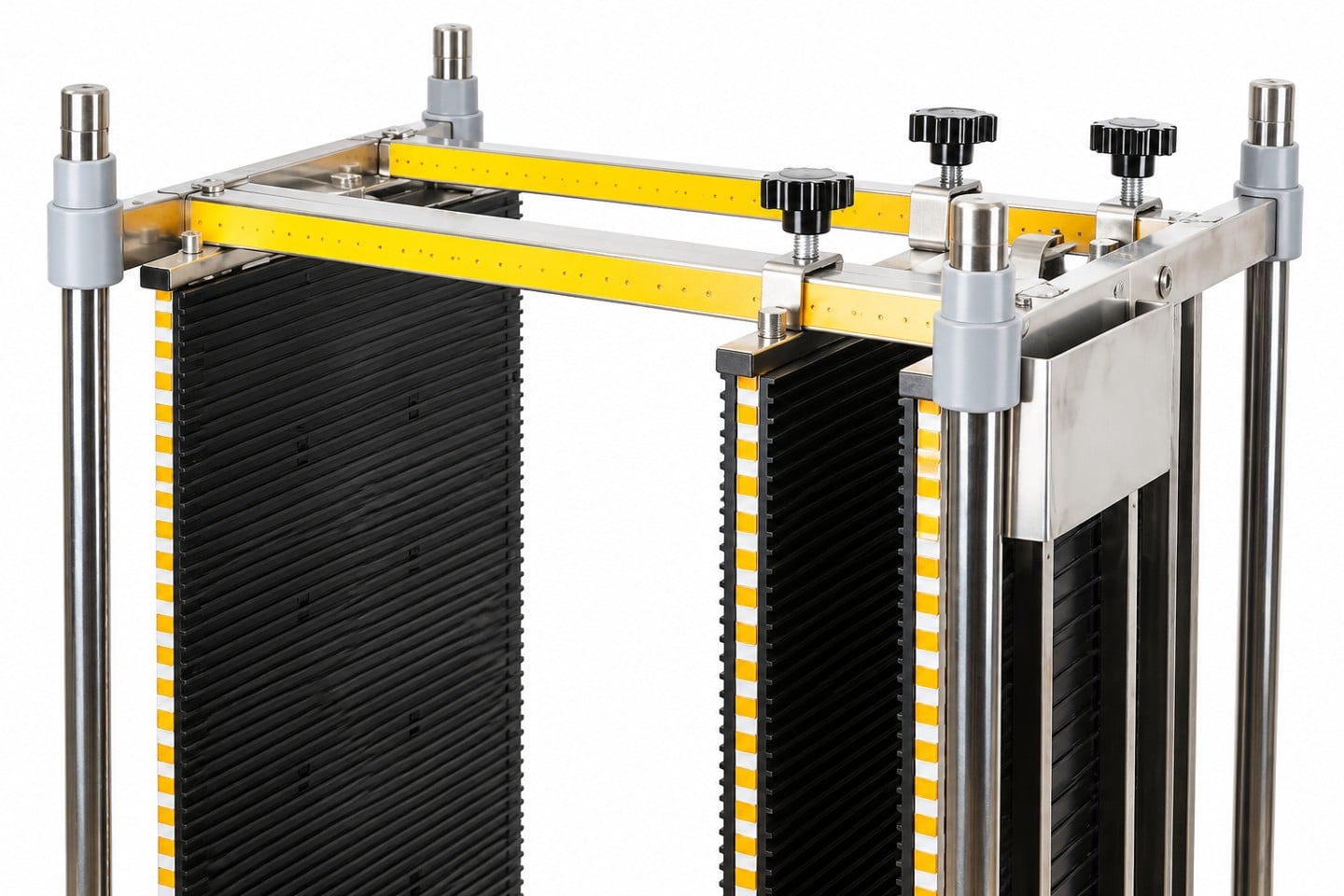
Create a configuration record for each approved board family or magazine type. Include the actual support arrangement, width setting where relevant, orientation, permitted slot use and exclusions. Identify how the configuration was accepted and what changes require another review. A photograph can supplement the record but cannot replace a dimensioned requirement or handling restriction. If the trolley must be reset between families, specify the release check rather than assuming that matching a scale mark proves the board is supported safely.
Verify fit using representative assemblies
Use representative boards or approved samples that cover the relevant size and feature envelope. Check support at the intended contact locations and clearance along the full loading and unloading path. Populated assemblies may have components, connectors or protrusions that are absent from an unpopulated panel sample. Confirm that adjacent slots and nearby trolley structure do not contact those features. Do not load boards into a generated illustration as proof of fit; the actual configuration and trial provide that evidence.
Review tolerance and variation with the supplier and technical owner. The widest nominal board is not necessarily the most difficult specimen if another family has more restrictive clearance or an irregular edge. Define the sample selection and record which configurations remain untested. Where a magazine rather than loose boards is transported, verify the magazine interface and how movement is restrained under the approved arrangement. Do not invent straps, dividers or retainers that the supplied trolley does not include or that have not been accepted for the process.
Make changeover a controlled task
A changeover begins with clearing or disposing of the previous job according to the site procedure. Confirm that no board, loose accessory or label remains in an unintended position. Inspect the equipment condition, then apply the accepted settings for the next job. If adjustment features are present, use their instructions and confirm locking or securing requirements. A scale can make settings easier to communicate, but it does not establish load capacity or prove that the adjustment is complete. Verify the relevant physical checks before material is loaded.
Assign responsibility for the setting and its release. For a simple approved configuration, one trained operator may complete the defined check; higher-consequence uses may need another form of verification under the site’s rules. Record the actual job and configuration so a later investigation can reconstruct the change. Avoid a procedure that only says adjust to suit. That instruction hides the critical support and clearance decisions and makes it difficult to distinguish a supplier issue from an uncontrolled setup change.
Use a high-mix acceptance checklist
| Stage | Evidence to retain | Release question |
|---|---|---|
| Job definition | Board family, process state and restrictions | Is this configuration within the accepted scope? |
| Physical fit | Representative specimens and contact/clearance checks | Are loading and unloading paths acceptable? |
| Changeover | Previous-job clearance and accepted setting record | Is the new configuration ready for material? |
| Handover | Lot identity, destination and receiving owner | Can the next shift determine the correct status? |
| Assembly verification | Mechanical and relevant electrical evidence | Has the actual supplied configuration been accepted? |
The checklist should connect to the approved job records, not become a generic form completed without inspection. Define what constitutes acceptable evidence for each stage. Keep unresolved restrictions visible and prevent an unapproved board family from entering normal use. If the purchase trial covers only a subset of planned jobs, state that boundary in the acceptance record. This prevents the equipment from gradually being used for configurations that were never checked simply because the overall trolley category appears suitable.
Control status during movement and buffering
Before movement, confirm that the receiving location is prepared and the route is allowed. Preserve job identity and process state during handover. Record exceptions such as a changed destination or an interrupted transfer. A trolley parked outside a station can otherwise become an uncontrolled queue with no clear owner. Assign responsibility for partially completed lots and specify how a temporary hold is communicated. The rule should make it possible for a different shift to understand what the material is and whether it may proceed.
Kullan PCB magazine buffer-point guide for the relationship between buffering and line flow, while treating this article’s mixed-job changeover record as a separate control. The box and magazine-rack trolley layout discussion addresses physical layout choices. Do not treat either topic as proof that a particular cart is compatible with a conveyor. Where a transfer interfaces with automated equipment, use the conveyor compatibility checks and the actual equipment documentation.
Check mechanical handling under the real route
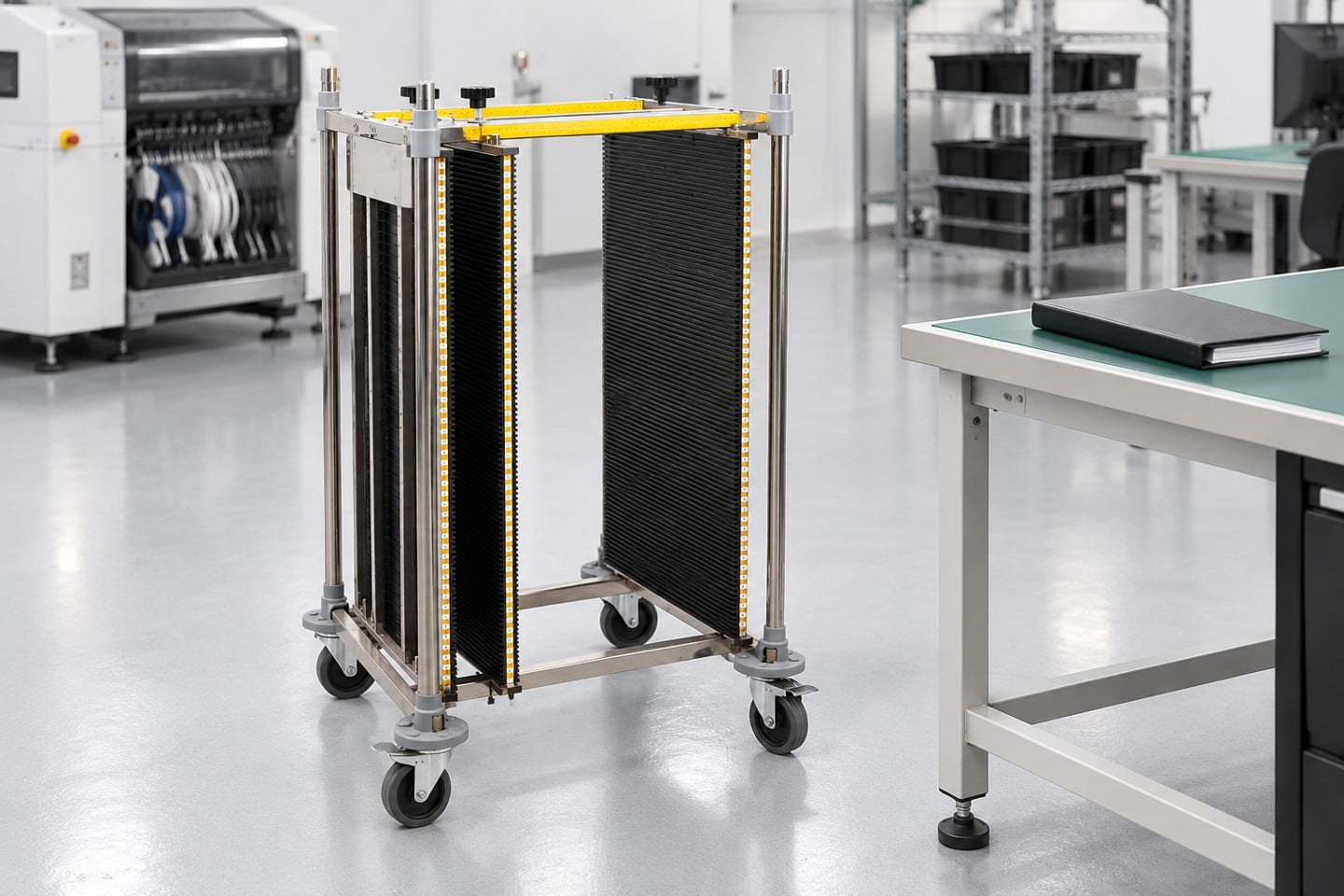
Request the manufacturer’s loading and operating instructions for the exact configuration. Confirm ratings, restrictions and the evidence that supports them; do not infer these from caster diameter or the appearance of chrome tubing. Review the route, floor transitions, stopping locations and access around stations. Loading can affect stability and handling, so the accepted trial should reflect the intended arrangement without exceeding the equipment instructions. Do not use an informal push test to replace a qualified assessment where the site’s handling requirements call for one.
The material-handling provisions in 29 CFR 1910.176 provide a general United States reference for clear passageways and safe storage practices. They do not certify an individual SWESD trolley or prescribe the configuration for your board family. Apply the relevant local requirements and site assessment. A commercially attractive cart still needs a route and storage arrangement that the actual operation can accept, particularly where frequent movement and short production runs create more handovers.
Verify ESD behavior as an assembly
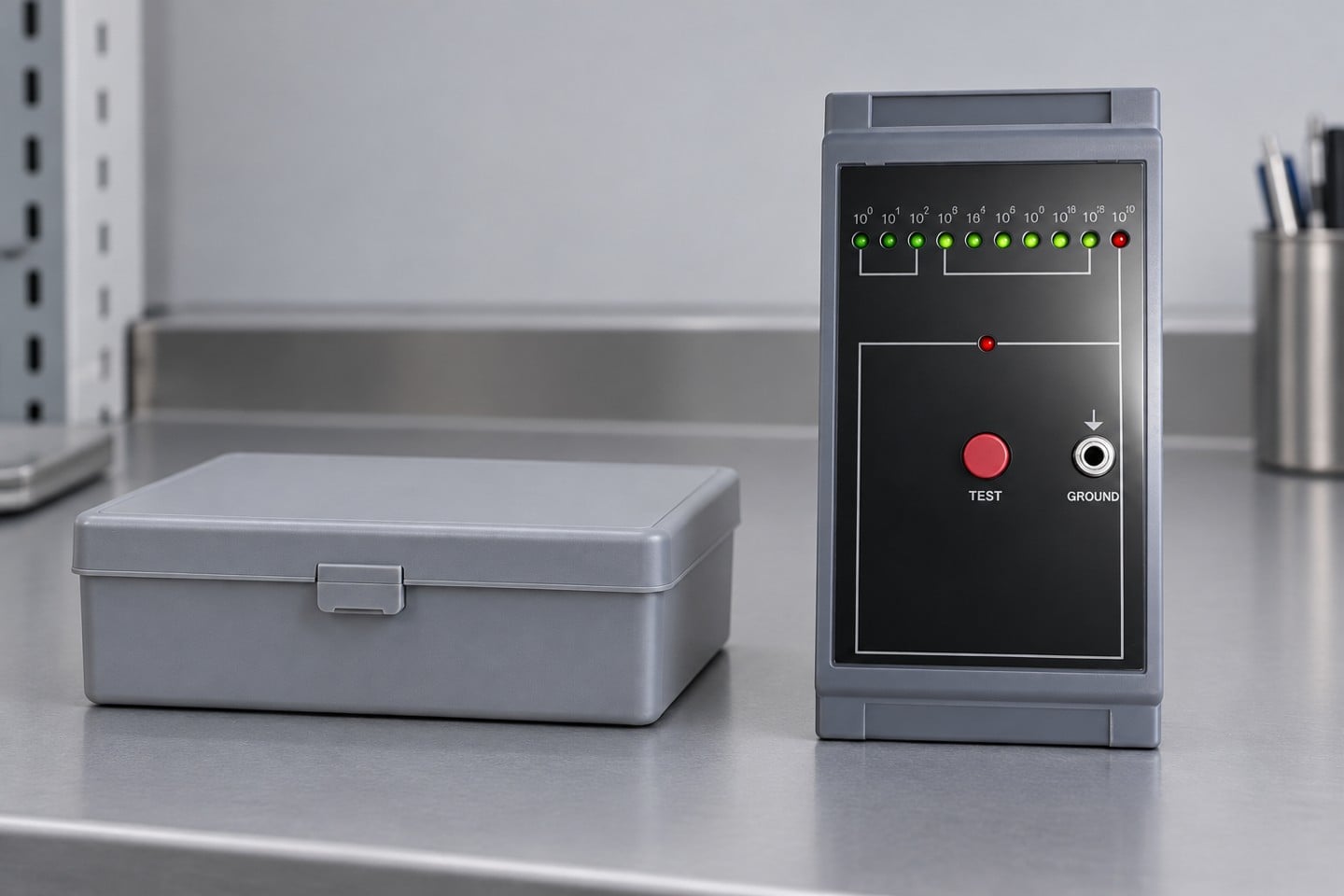
Define the relevant electrical requirements for the equipment and its use within the site’s ESD control program. Request evidence for the supplied assembly and the intended conditions. A material description for one panel or wheel does not establish the behavior of every contact path in the complete trolley. Changes to accessories, coatings or replacement wheels may require review. Keep the accepted configuration and verification evidence linked so maintenance does not unknowingly create a different electrical arrangement while preserving a similar appearance.
The ESD Association’s principles of ESD control explain the broader need for controlled handling of sensitive items. They do not eliminate the need for product-specific checks. State what the trolley must do at each transfer point and who owns the corresponding verification. Do not assume that electrical continuity alone establishes every required ESD property or that a conductive-looking finish is sufficient. Use the approved site method and document the complete arrangement examined.
Ask suppliers for evidence that matches the mix
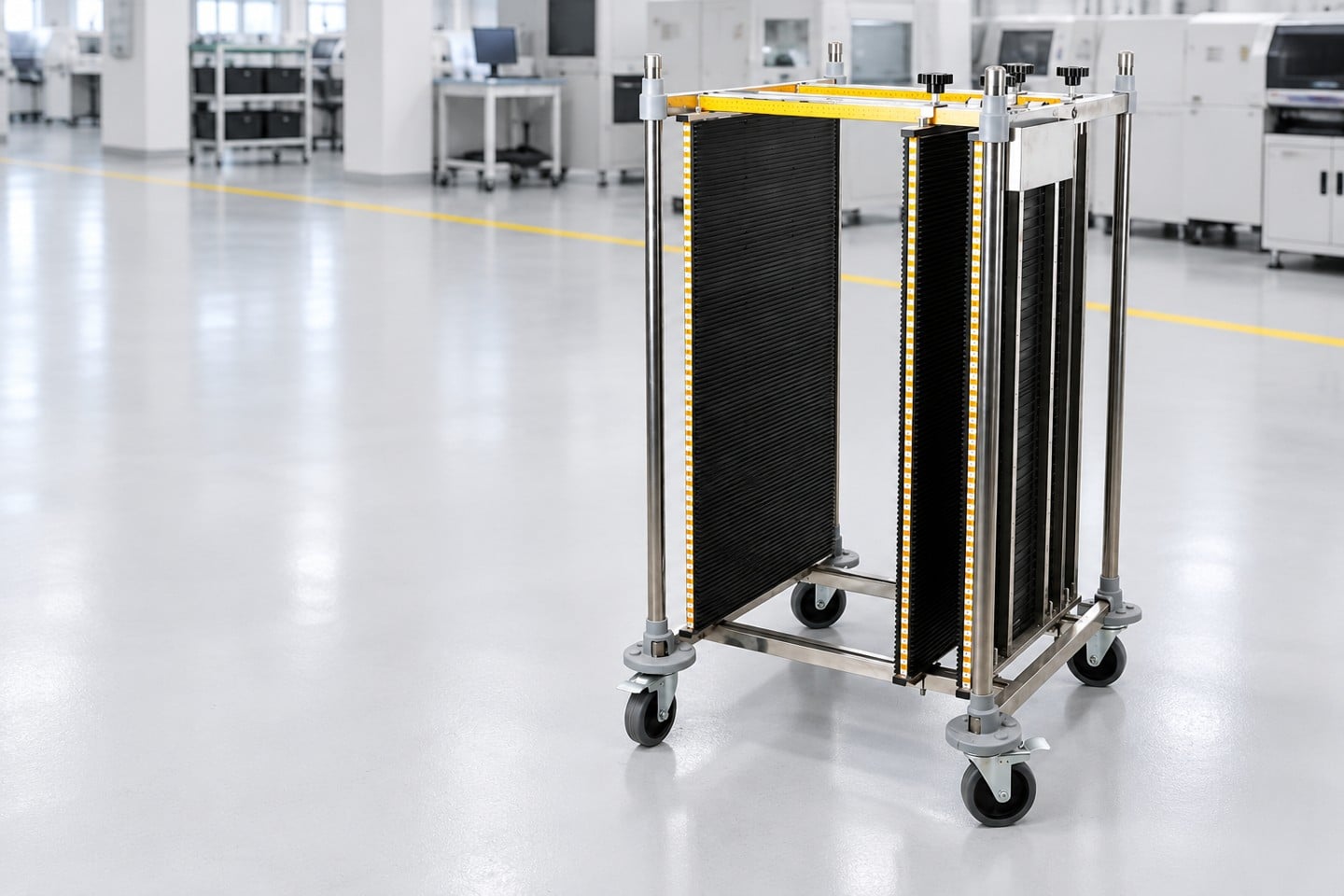
For the SWESD PCB magazine trolley product reference, provide the job matrix, representative board or magazine drawings, handling restrictions and route description. Ask for the actual supplied configuration, available adjustment range, instructions, ratings and verification evidence. Confirm what accessories are included and which combinations need a trial. The article images preserve the real trolley structure but do not establish dimensions, load capability or board compatibility. Those purchasing decisions need documentation and representative evaluation.
Request a proposed acceptance plan before ordering a production quantity. It should distinguish mechanical fit, handling, job identification and electrical checks, with clear owners and outcomes. Review replacement parts and maintenance requirements as part of the same evidence file. For frequent changeovers, also evaluate the practical time and repeatability of the approved setup sequence. Do not promise a productivity improvement from the cart alone: the benefit depends on how reliably the operation controls loading, status, transfer and receiving readiness.
Maintain the approved configuration over time
Keep the job matrix current when new board families enter production. Review whether a new job fits an existing accepted configuration or needs another trial. Record changes to the trolley, its accessories and the process route. Inspect condition and adjustment features according to the approved instructions, and separate mechanical repair from release for production use. An apparently minor replacement can affect support, handling or electrical behavior. Preserve the evidence needed to decide whether the changed assembly remains within the acceptance boundary.
Educational background
The following educational video introduces electrostatic behavior as context for why sensitive boards need controlled handling. It does not demonstrate the capacity, adjustment method or safe route for a particular trolley. Follow the actual equipment instructions and approved site procedures for those decisions, and use the job matrix to keep high-mix loading and changeovers traceable.
Sık sorulan sorular
Can different PCB jobs share one trolley?
Only under an approved arrangement that preserves physical suitability, identity and process status. Define permitted combinations and exclusions.
Does a scale mark prove correct adjustment?
No. Confirm the required support, clearance and securing checks for the actual job configuration.
Can an unpopulated panel prove fit for every populated board?
No. Representative evaluation must cover relevant components, connectors, protrusions and handling restrictions.
Do the article images establish trolley capacity?
No. Obtain ratings and supporting documentation for the actual supplied configuration and evaluate the intended route.
What should changeover records show?
Identify the cleared previous job, new job, accepted configuration, completed checks, responsible operator and any required release.

Bir Yorum Bırakın