- Turbo
- Blog
SMT reel returns to stock need a controlled handoff that preserves material identity, quantity basis and release status while separating the reel from the reusable carrier’s own condition and ownership. A reel found in a returned tray is not automatically available inventory. Record where it came from, which order or line used it, what quantity information is reliable and who may release it. Route unresolved material through the site’s review process instead of placing it among accepted stock. This guide focuses on the return transaction and responsibility between production and stores, rather than repeating carrier cleaning, damage inspection or cycle counting instructions.
Separate the material transaction from the empty-carrier return
A carrier and its contents represent different objects in the process. The reel has a part identity, lot association, quantity basis and material status. The reusable tray has an asset identity or pool association and a condition or cleaning status. Returning one does not automatically close the other. Define whether the handoff arrives as a loaded carrier, a packaged reel or an empty carrier, and give the receiving person an explicit route for each case.
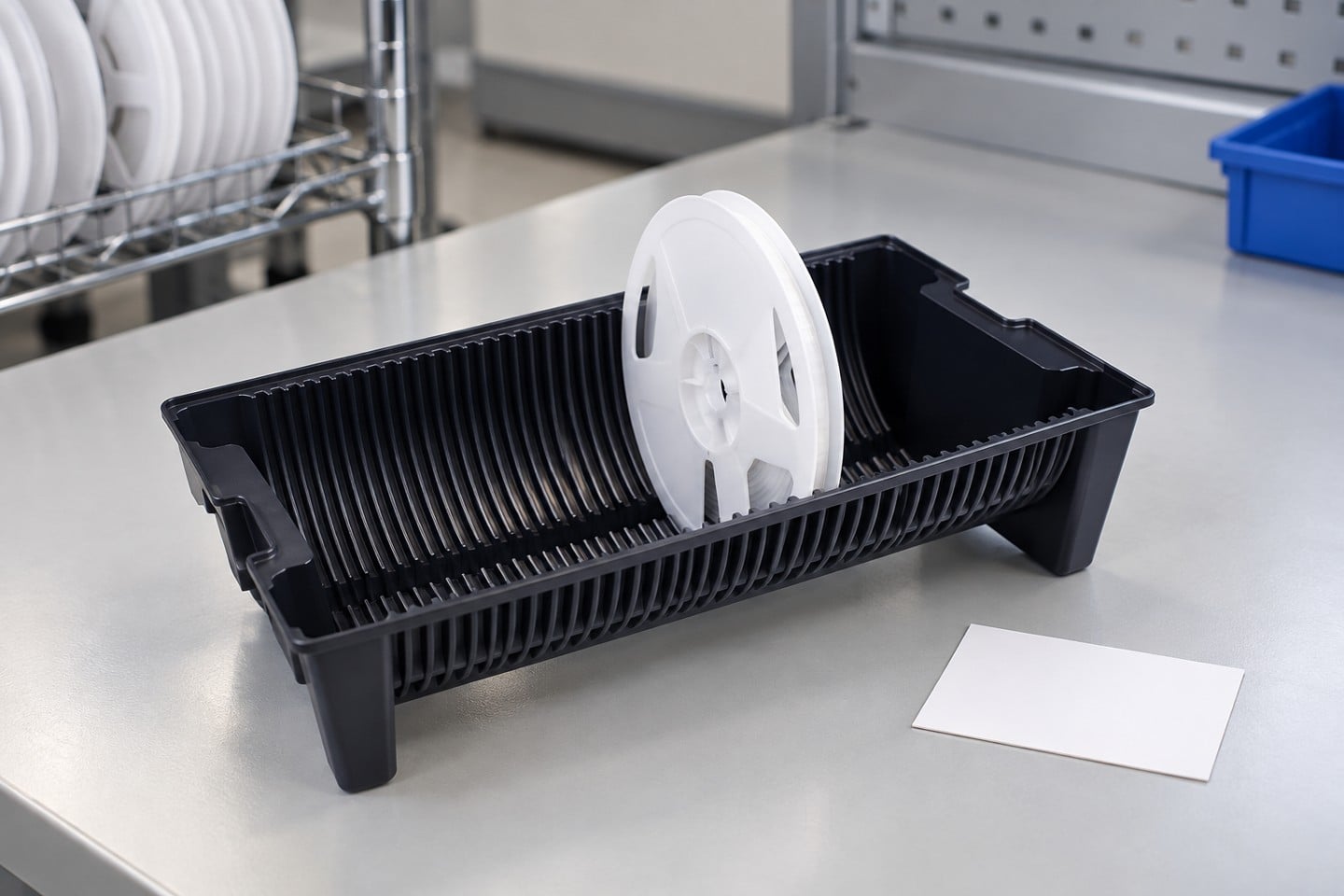
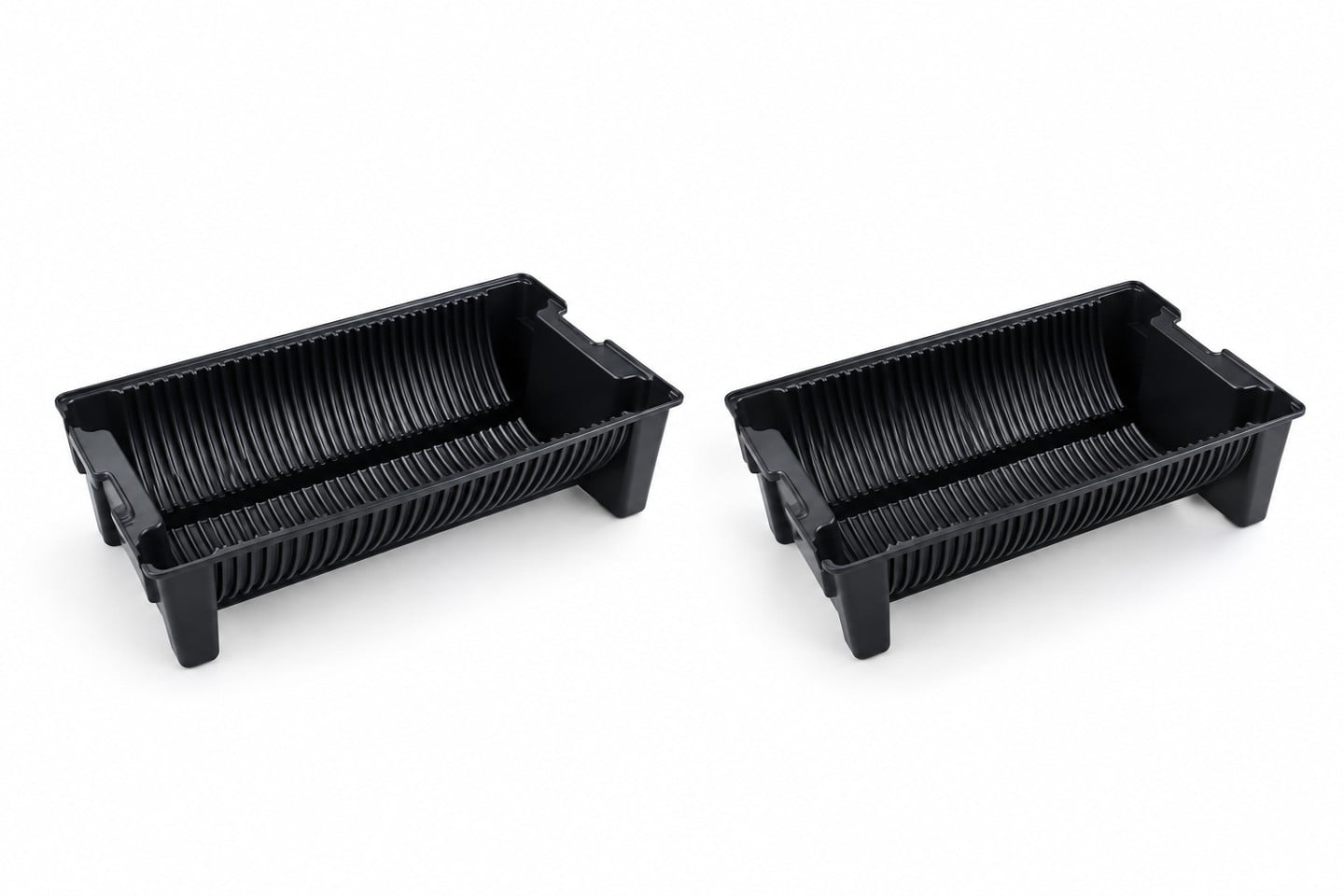
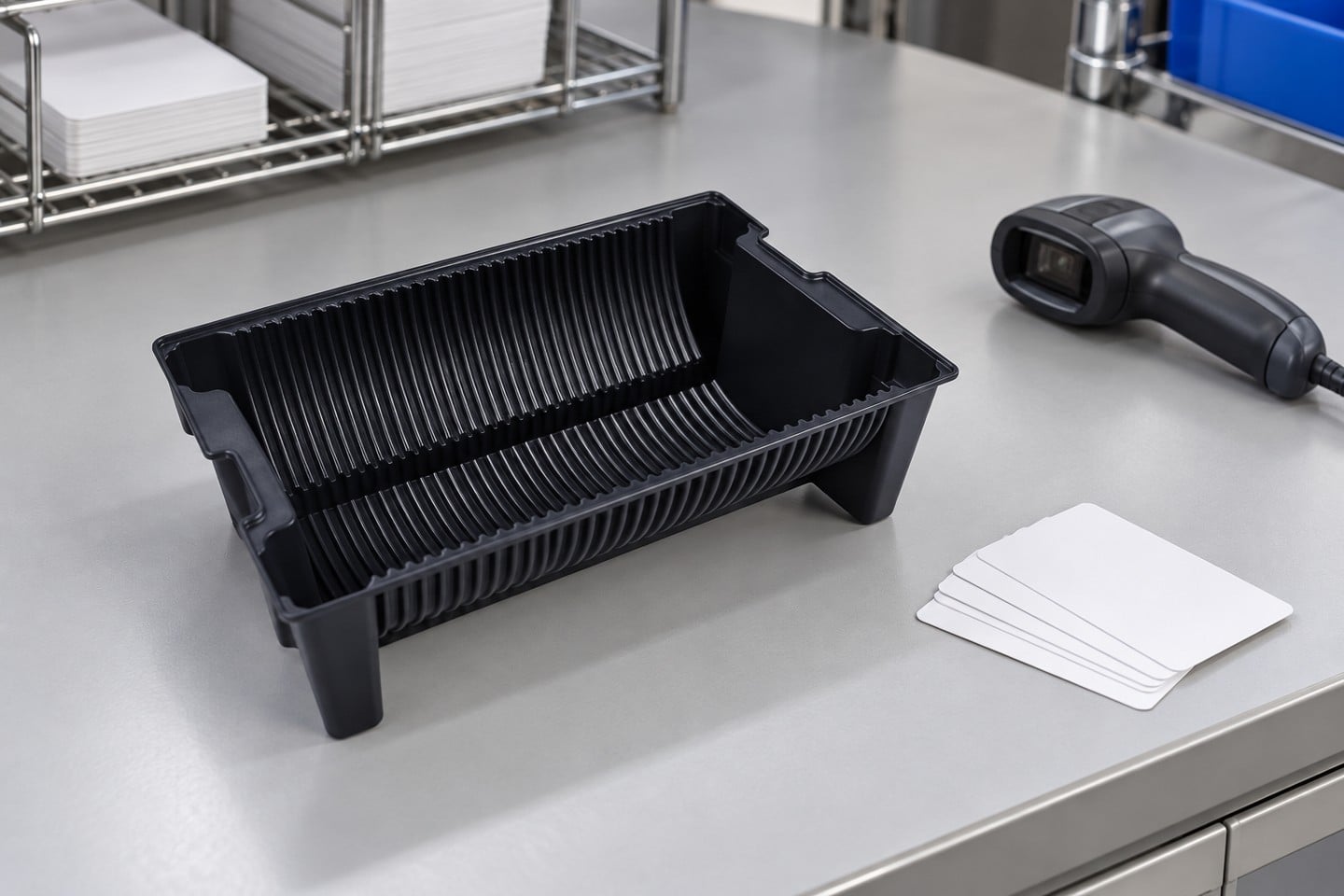
The SWESD SMT reel storage tray is the actual carrier reference used in the illustrations. It organizes reels physically; it does not itself update inventory, preserve moisture history or authorize release. The reel storage barcode label guide explains the separate identification link. A scanner in an illustration represents a possible workflow tool, not an included electronic feature or a validated software integration.
Agree what production must hand over
Define the minimum return information before the first reel leaves the line. Include the material identifier, source line or work order, return date and time, responsible person and the reason for return. Identify whether the item was unused, partially used, involved in a stoppage or held for another question. Those descriptions should point to controlled statuses rather than informal assumptions such as “looks fine” or “probably spare.” Stores should not need to reconstruct the event from the carrier’s location.
Quantity information needs a named basis. A machine transaction, approved counting method or another site-defined source may support the balance, but reel appearance alone is not a precise component count. Preserve uncertainty where the amount is unresolved. Do not round an unknown balance into available inventory merely to complete the form. If a reconciliation is needed, assign it to the appropriate owner while keeping the physical material identifiable and segregated through the approved process.
Preserve identity when changing carriers or packaging
Sometimes production returns several reels in a shared carrier and stores needs to separate them. Define how each reel retains its identity during that transfer. Work on one controlled item or another approved arrangement that prevents labels and records from being mixed. A tray-location label cannot replace the reel’s own required identity. If a label becomes detached or unreadable, stop the ordinary restocking path and route the item for identity review.
The reel tray dimensions guide addresses physical fit when a different carrier is used. A better-fitting tray does not resolve a missing material identity or a disputed lot. Likewise, transferring a reel to a clean carrier cannot restore a missing packaging or service record. Record what changed during the handoff so a later reviewer can distinguish the original return condition from the receiving team’s handling actions.
Review packaging and exposure records separately
Where a material has controlled packaging or exposure requirements, use its applicable supplier documentation and the site’s approved process. Record whether the returned package is intact, opened, resealed or otherwise changed, without inventing a universal permissible exposure time. A carrier protects organization and handling only within its documented role. It should not be described as a moisture barrier or as evidence that an opened sensitive component is acceptable for return to general stock.
The Texas Instruments moisture-sensitive device guidance provides semiconductor handling context, but it does not qualify every returned component or authorize a generic reset of exposure history. Check the exact component and packaging requirements. If the relevant history is missing, preserve that fact and ask the designated material owner for disposition. Do not replace the missing record with a new bag date that implies the earlier history no longer matters.
| Return condition | Preserve | Güzergâh |
|---|---|---|
| Identified reel with complete accepted records | Part, lot, quantity basis and transaction references | Approved receipt and release workflow |
| Unreadable or disputed identity | Physical item and original labels or evidence | Identity review rather than ordinary restock |
| Quantity uncertain | Known presence and stated limitation | Approved reconciliation before available-balance correction |
| Packaging history incomplete | Actual condition and known event times | Designated material review without invented reset |
| Quality or handling concern | Affected identity and event description | Appropriate controlled hold and disposition |
| Empty returned carrier | Asset identity and carrier condition | Separate inspection, cleaning or pool-return route |
Use a receiving hold that cannot be mistaken for available stock
A receiving area should make unresolved returns visibly and administratively distinct from released inventory. Follow the site’s approved location and status controls. Record who owns the next action, what evidence is missing and how the item will be kept identifiable while awaiting review. A paper note is insufficient if the system still offers the quantity for picking. Conversely, a system hold is not enough if the physical reel can be selected from an accepted-stock shelf without warning.
Avoid broad status names that conceal different questions. Identity uncertainty, quantity reconciliation, packaging review and a quality investigation can require different owners and evidence. The return record can remain simple while identifying the actual issue. Do not use “quarantine” as a decorative label for any item that is inconvenient to process. Define what prevents use and what documented decision will permit the next movement. That makes a hold actionable instead of a permanent storage category.
Control the receiving transaction and its timing
Choose the point at which the physical receipt is acknowledged and the point at which inventory becomes available. They may be different events. Recording that stores has received custody should not imply that quality review or quantity verification has finished. Keep the transaction timestamps and responsible people clear enough to explain where the reel was while a discrepancy was investigated. A delayed system entry can otherwise create the appearance that material vanished between the line and stores.
The reel tray cycle count guide addresses later reconciliation of physical stock and records. A cycle count can discover a return error, but it is not a substitute for a correct handoff. If a return occurs during a count, preserve the movement reference and follow the approved cutoff method. Do not add the same reel to both a line balance and a stores balance because each team assumed the other had already posted its transaction.
Route the empty carrier through its own controls
Once material has been transferred or released, identify what happens to the tray. An empty tray may need inspection, cleaning, return to a specific pool or another process before reuse. Keep that path distinct from component stock. The reel tray cleaning guide covers compatibility and cleaning release, while damage inspection belongs to its own procedure. Neither condition should be inferred merely because the tray came from an accepted production line.
Prevent an empty-carrier status card from becoming a material-status label during the next use. Remove or retire obsolete identifiers through the site’s approved method, preserving any asset marking that should remain. Check that the carrier does not retain loose labels, fragments or another reel hidden among returns. The important handoff outcome is clear ownership: the carrier is ready for its next approved route, and each material item has a separate traceable destination and status.
Keep ESD precautions through the handoff
A return route still handles potentially sensitive material. The EOS/ESD Association’s basic control guidance provides context for coordinated handling precautions and materials. Follow the approved packaging, personnel and work-area controls during the physical exchange. Do not assume that a black tray makes any receiving bench suitable or that a short transfer outside the normal route needs no review.
If a return involves uncertainty about handling conditions, record the actual event rather than changing the item status by intuition. A suspected excursion needs the designated review; this article does not define a universal acceptance threshold. Preserve enough information for the reviewer to identify the affected material and the period or movement involved. Keeping the carrier and reel records separate helps prevent an inspection of the empty tray from being mistaken for release of the component.
Build an exception path people will actually use
Ask production and stores to walk through an ordinary partial-reel return and several realistic exceptions. Include an unreadable label, uncertain quantity, missing packaging history and an empty tray with an obsolete card. The procedure should tell the receiving person what to record, where the item goes and who decides next. If the only instruction is “contact quality,” name the required information and the method of maintaining custody while that review occurs.
Review recurring exceptions by cause and handoff stage. If missing work-order references are common, fix the production return record. If quantity balances are disputed, review the approved quantity method and transaction timing. If empty trays accumulate without ownership, define the carrier-pool process. Do not write a longer form simply to compensate for unclear responsibilities. A small number of reliable fields and explicit decisions can support a more usable process than a checklist nobody completes accurately.
What a buyer or process owner should specify
For carrier procurement, provide the reel envelope, handling route, cleaning requirements and identification approach. For the return workflow, specify custody acknowledgment, material identity, quantity basis, status review and final storage transaction. Ask suppliers for evidence related to the carrier’s actual role without attributing inventory or packaging capabilities it does not have. Keep the approved trial and operating instruction aligned with the supplied carrier version.
Retain a complete example of a closed return, including any exception and its disposition. The final record should show that the reel reached an authorized location with an appropriate status, the inventory transaction matched the accepted quantity basis and the empty carrier entered its own route. That is a meaningful completion criterion. A reel physically back in the warehouse, an empty tray on a shelf or a draft system entry alone is not enough to establish a controlled return to stock.
Educational background: controlled ESD handling
The following EOS/ESD Association video provides electrostatic-control background for the handoff. It does not validate an inventory system, restore packaging history or release a returned reel. Use it to explain why handling controls continue during a return, and use the exact material requirements and site’s approved workflow for the operational decisions.
Sık sorulan sorular
Is a reel in a returned tray available stock?
Not automatically. Preserve identity and required records and complete the approved release and inventory process.
Can a new bag reset missing exposure history?
Do not assume that it can. Follow exact material requirements and obtain the designated disposition for missing history.
Does the tray update inventory automatically?
No. Transactions, scanning and software require separate specified systems and approved workflows.
Can reel quantity be judged from appearance?
Appearance is not a universal precise count. Use the approved quantity basis and retain uncertainty when unresolved.
Does cleaning the empty carrier release its former contents?
No. Carrier condition and material release are separate records and decisions.


Bir Yorum Bırakın