- wp_kexun
- Блог
When a procurement manager in Austin, Texas, accepted a low-cost quote for a new surface-mount line, the first shipment looked perfect: reels were labeled, feeder kits were complete, and the supplier promised a quick ramp. Two weeks later, first-pass yield fell below 96%, component traceability broke at the line-side handoff, and an ESD audit held the lot. The products were not necessarily defective; the supplier-selection assumptions were. The practical question is: how should a buyer evaluate an SMT supplier before the contract becomes a production constraint?
Резюме: A reliable SMT supplier is more than a component catalog or an assembly price. The buyer should verify process capability against IPC workmanship criteria, confirm an ANSI/ESD S20.20 or IEC 61340-5-1-aligned control plan, and score traceability, capacity, quality response, and total cost together. A useful gate is 100% lot-level traceability, a documented sample-approval route, a measurable response time, and a line-side material flow that protects components from receipt through rework. We recommend a staged RFQ: specification review, controlled sample, pilot lot, and quarterly scorecard.
What a trusted SMT supplier must control
“SMT supplier” can mean a component distributor, a contract manufacturer, or an integrated partner that supplies materials, assembly, inspection, and logistics. Those are different risk profiles. Start by defining the boundary of responsibility:
- Components: approved manufacturer list, date/lot codes, moisture sensitivity level, and counterfeit controls.
- Process: stencil, placement, reflow, inspection, repair, and change control; ask for the applicable IPC class and acceptance criteria.
- ESD: personnel grounding, workstations, packaging, storage, and verification records aligned to ANSI/ESD S20.20 and IEC 61340-5-1.
- Evidence: certificates, calibration records, first-article results, nonconformance reports, and corrective-action timing.
IPC-A-610 and J-STD-001 are commonly used reference points for assembly workmanship and soldering processes; the exact class and revision should be written into the purchase specification, not left to a sales quotation. For a high-mix line, the supplier should also explain how engineering changes are locked, released, and traced.
How to test capability before volume production
The lowest-risk path is a four-stage qualification flow. Each stage should have an acceptance record and an owner.
- Specification review (2–5 business days): check the BOM, approved alternates, package mix, board dimensions, MSL handling, inspection coverage, and ESD requirements.
- Controlled sample (5–10 business days): run a representative board or panel; record placement accuracy, solder-paste inspection findings, reflow profile, and defect categories.
- Pilot lot: compare first-pass yield, rework minutes per board, and traceability completeness against agreed gates. A practical internal gate is at least 98% first-pass yield for a mature product, with every exception documented.
- Ramp and review: release volume only after the supplier closes open actions; then review quality, delivery, engineering response, and cost every quarter.
Ask for numbers rather than adjectives. “High capacity” should become available shifts per week, feeder count, line changeover time, and a realistic monthly board or placement capacity. “Fast response” should become a named escalation path and a maximum first-response time, such as one business day.
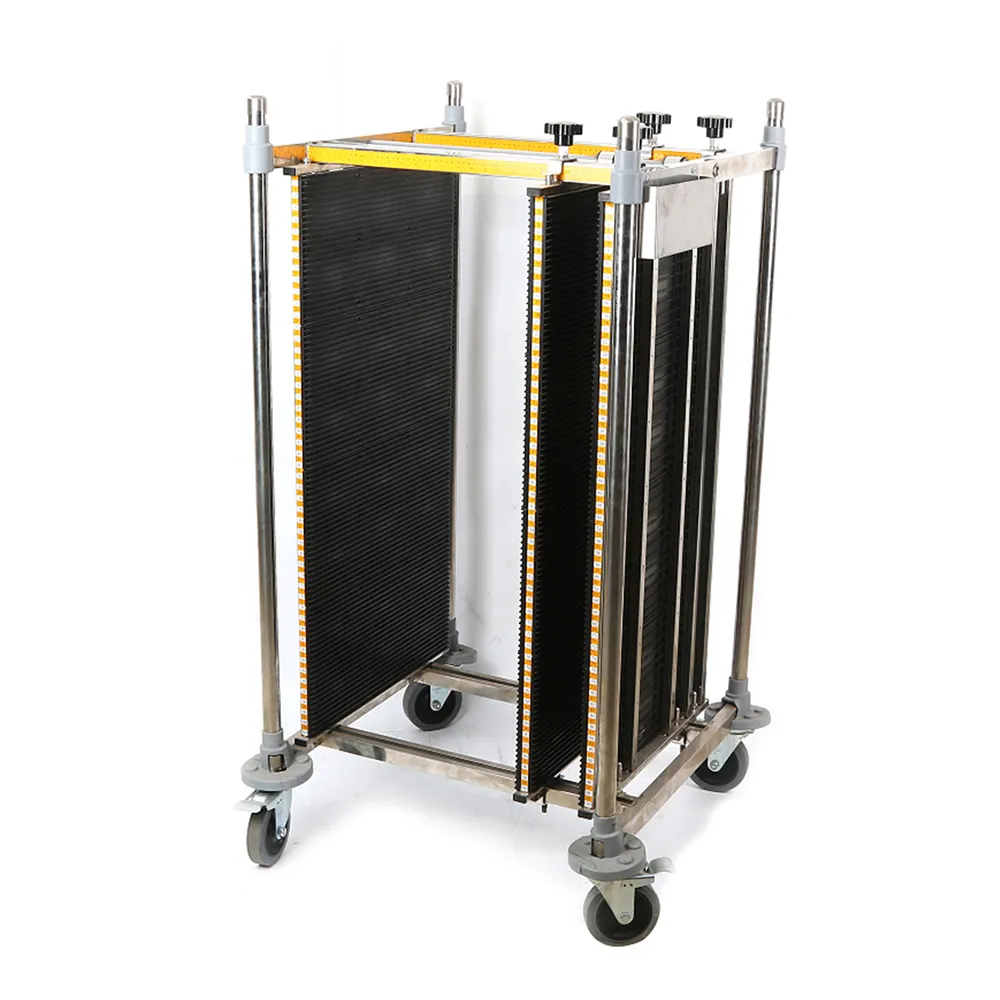
ESD and material flow are part of supplier quality
An SMT supplier can meet placement tolerances and still create latent failures through poor handling. The buyer should map the material route from incoming inspection to kitting, line-side staging, rework, and finished-goods shipment. At each handoff, specify:
- conductive or static-dissipative packaging for sensitive assemblies;
- a defined shelf, rack, tray, or trolley location;
- status labels for waiting, released, hold, and ready;
- a verification interval for wrist straps, footwear, mats, and monitors;
- a quarantine rule when an ESD or traceability check fails.
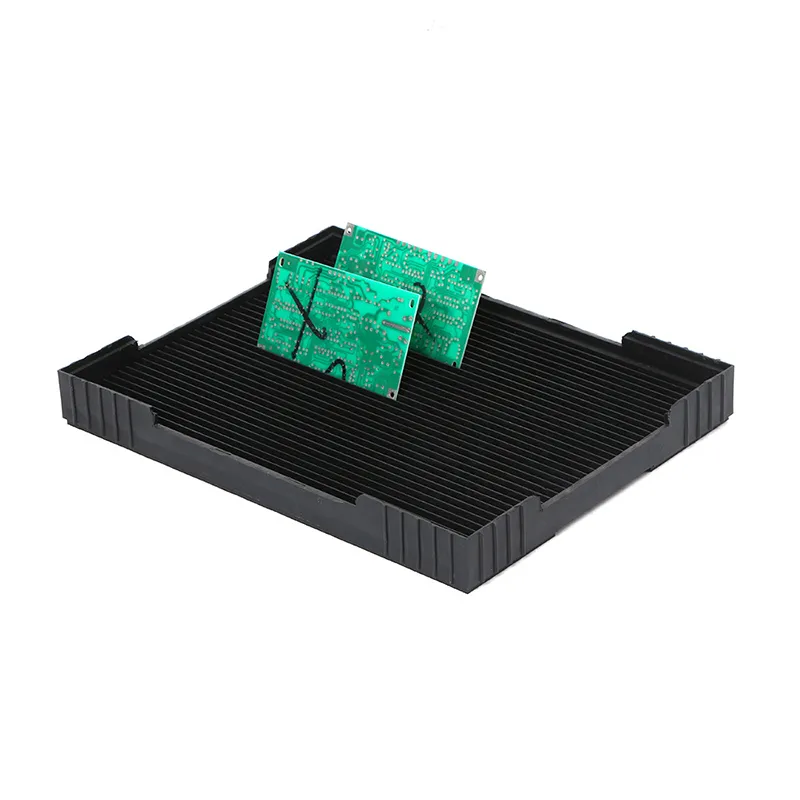
For repeatable line-side movement, a buyer can link the RFQ to an ESD магазин полка, ESD-лоток, или ESD тележка specification. The link is useful only when the application, dimensions, and verification method are written beside it; an image alone is not a control plan.
Supplier comparison: performance, risk, and total cost
| Dimension | Minimum evidence to request | Why it changes total cost |
|---|---|---|
| Process capability | IPC class, placement/reflow limits, inspection plan | Fewer escapes and less rework |
| Прослеживаемость | 100% lot/serial linkage from BOM to shipment | Faster containment and recalls |
| ESD control | ANSI/ESD S20.20 or IEC 61340-5-1-aligned program | Lower latent-failure and audit risk |
| Capacity | Named lines, shifts, changeover time, surge plan | Less expediting and line stoppage |
| Quality response | 8D owner, first-response target, closure date | Shorter disruption window |
| Commercial fit | Tooling, NRE, freight, scrap, and warranty terms | Prevents a low quote becoming a high TCO |
The honest answer is that unit price is only one variable. A supplier that is 4% cheaper but adds two days of changeover, 3% rework, or repeated freight premiums may be the more expensive option over a quarter. We recommend calculating landed cost per accepted board, then adding the expected cost of escapes and schedule risk.
Regional and application checks
| Ситуация покупателя | Extra check | Useful evidence |
|---|---|---|
| North American medical or aerospace | Contract review, configuration control, audit access | Approved supplier list, revision history |
| European electronics | RoHS/REACH declarations and CE-related product files where applicable | Material declarations, test reports |
| Defense or high-reliability | GJB requirements and controlled records | National/military standard scope, secure traceability |
| High-mix prototyping | Changeover and NPI engineering bandwidth | Pilot schedule, ECO turnaround data |
| High-volume consumer production | OEE, yield trend, and contingency capacity | Monthly scorecards, backup line plan |
These checks do not replace the customer’s regulatory assessment. They create a common RFQ language so that suppliers are compared on evidence rather than presentation quality.
Standards and compliance: what can go wrong
ANSI/ESD S20.20 describes the elements of an ESD control program; IEC 61340-5-1 provides an international framework for protecting electronic devices from electrostatic phenomena. IPC-A-610 and J-STD-001 address assembly acceptability and soldering-process requirements. ISO 9001 supports a quality-management system, while RoHS controls restricted substances in applicable products.
Non-compliance can mean more than a failed audit. It can trigger customer containment, rework, delayed shipment, warranty exposure, or a disqualification from an approved-vendor list. Request the certificate scope, issuing body, expiry date, and the process area covered; a logo without scope is not evidence.
RFQ checklist: five questions that expose hidden risk
- Which process steps are in scope—component sourcing, assembly, inspection, repair, packaging, and freight?
- Which IPC class, revision, and acceptance examples will govern the build?
- How are lot codes, MSL controls, ESD checks, and engineering changes recorded?
- What are the sample, pilot, and ramp gates, and who can stop shipment?
- Which costs sit outside the unit price: NRE, tooling, programming, rework, scrap, expedited freight, or warranty?
Sanwei provides ESD bins, boxes, trays, magazine racks, and trolleys with IEC 61340-5-1, ANSI/ESD S20.20-aligned practices, ISO 9001, ISO 14001:2015, RoHS/SGS documentation, and experience supporting electronics, semiconductor, aerospace, and defense programs. Use the ESD box for electronics manufacturing when the material-flow review shows a need for protected, repeatable handoffs.
Часто задаваемые вопросы
What are SMT products?
SMT products include surface-mount components, printed circuit boards, assembled modules, and the process materials and handling equipment used to place, solder, inspect, and protect them.
What is SMT in manufacturing?
Surface mount technology places components directly on a PCB surface; the process typically combines printing, pick-and-place, reflow, inspection, and controlled material handling.
What should a buyer ask an SMT components supplier?
Ask for approved-source controls, date/lot traceability, MSL handling, counterfeit prevention, change notification, and a clear nonconformance response path.
How do ESD supplies affect SMT yield?
They reduce exposure during storage and movement, but only when the packaging, grounding, verification, and operator procedures are part of a documented ESD control program.
Is the cheapest SMT supplier the best choice?
Not usually. Compare cost per accepted board, response time, rework, traceability, capacity, and compliance; the lowest unit price can produce the highest total cost.
Ссылки
- ESD Association — ANSI/ESD S20.20 program information
- IEC 61340-5-1 electrostatics standard
- IPC standards and certification
- ISO 9001 quality management overview
The difference is not just in the quoted placement price—it is in the evidence, controls, and decisions that keep a board moving after the purchase order. Sanwei builds the ESD handling layer around that moment; связаться с командой Sanwei to review your SMT material flow, qualification gates, and custom requirements.



Оставить ответ