- Турбо
- Блог
An ESD shoe resistance test must identify what is being measured: a footwear specimen, a person wearing footwear, or a person-footwear-flooring system. These measurements answer different questions and need different procedures. Acceptance limits must come from the applicable current standard, the approved ESD control program, and the method used for the specific application; there is no universal shoe-sole number that proves every wearer is protected on every floor. Before approving a supplier report, verify the specimen, conditions, fixture, equipment, measurement path, and decision rule. This guide explains how buyers can request and interpret meaningful footwear evidence without improvising an electrical test.
Distinguish a sole material from complete footwear
A sample of sole material is not a complete shoe. The footwear construction can include an insole, lining, adhesive interfaces, and other components affecting the intended path. A material report may be useful during development, but it must not be presented as proof that the assembled footwear performs the same way. Identify exactly what the laboratory tested and whether it matches the item being ordered.
Record the product model, size, construction revision, production lot, and supplied state. If a report concerns another size or a different insole, ask the supplier to explain the basis for applying it to the proposed order. The answer may require additional evaluation. An ESD marking or a familiar outsole color cannot resolve that question, and a product photograph cannot demonstrate electrical properties.
Земля EOS/ESD Association industry-document list distinguishes footwear and footwear-flooring-system documents. Use it to identify the document family, then obtain the current applicable document rather than relying on historical listings for edition or numerical requirements. Our introduction to ESD shoes explains the broader product category; the focus here is test scope and report acceptance.
Define the measurement path before commissioning a test
A footwear-specimen evaluation addresses the item under the selected standard’s prescribed arrangement. An operator check assesses the worn arrangement under that check’s procedure. A person-footwear-flooring assessment includes additional interfaces and conditions. The resulting numbers cannot be substituted simply because all are reported in ohms. Ask the laboratory to describe the path and method in the report.
The EOS/ESD Association lists ANSI/ESD STM9.1 footwear testing among its endorsed laboratory standards. This establishes the relevant footwear method family, not an approval of any pictured SWESD product. The public laboratory listing does not provide the full fixture design, conditioning procedure, or acceptance criteria. Obtain the applicable full method and use competent personnel for its execution.
Do not replace a prescribed fixture with a probe held against the outside of a sole, or use an ordinary multimeter because a display shows a resistance value. Contact configuration, measurement voltage, timing, and conditioning are part of the method. An improvised reading may describe a different path and have no defensible relationship to the requested result. Avoid publishing it as a qualification test or using it to release footwear to production.
Write the test request in terms the laboratory can act on
State the purchasing decision and the intended process. Identify whether the objective is initial product qualification, comparison of constructions, investigation of a returned pair, or routine compliance verification. These objectives can require different samples and evidence. Include the applicable document and edition selected by the ESD coordinator, and specify the criteria and treatment of uncertainty before testing begins.
Ask the laboratory to confirm sample preparation, conditioning, equipment, fixture, and reporting requirements. Supply samples with traceable labels and record how they were selected and stored. If the footwear is to be evaluated after approved cleaning or wear, define that state explicitly and preserve an untreated comparison when the plan requires it. Do not condition only the candidate expected to fail or clean away suspected contamination before documenting it.
Provide the intended socks, floor system, cleaning policy, and other relevant application details when the scope includes a worn system. The footwear manufacturer should confirm any restrictions or necessary compatible components. If those inputs are unknown, the report should disclose the limitation. A laboratory cannot qualify an unspecified production arrangement from a pair of shoes alone.
Review the report with a scope-and-evidence table
The following qualitative table helps separate evidence types. It contains no numerical acceptance limits because those must be tied to the authorized method and application. Keep the report’s units, method designation, specimen identity, and conditions together. A pass statement without that context is not enough for procurement approval.
| Evidence scope | Question it can address | What it does not establish |
|---|---|---|
| Sole-material specimen | Behavior of the sampled material under its defined method | Performance of the complete footwear or every wearer |
| Complete footwear specimen | The identified item under the applicable footwear test arrangement | A person-flooring system or every service condition |
| Operator check with worn footwear | The worn arrangement under the entrance or verification procedure | An independent footwear laboratory qualification or walking-voltage result |
| Person-footwear-flooring evaluation | The defined combined system under its prescribed conditions | Compatibility with another floor, cleaning state or clothing arrangement |
| Used-footwear investigation | Condition of identified returned items under recorded preparation | The condition of every earlier shipment or the cause of all device failures |
| Supplier pass statement | A decision only when identity, method and criteria are documented | A universal safe sole-resistance range or safety certification |
Request individual results when they are needed to understand variation; a batch average can hide a failing or unusual sample. Ask how the report handles readings outside the measurement range, unstable readings, or incomplete tests. These conditions should not be silently converted into convenient numbers. Preserve the original report and any clarification so that another reviewer can reconstruct the decision.
Treat conditioning and cleaning as controlled inputs
Electrical behavior can depend on environmental and surface conditions. Record the conditioning specified by the method, not merely the weather on the test day. The sample’s storage and handling also matter: contaminants introduced before testing can change the result or complicate interpretation. Use the required preparation and record departures rather than modifying the procedure until a result falls within the preferred range.
Cleaning must follow the footwear manufacturer’s instructions and the site’s process requirements. An unapproved detergent, coating, disinfectant, or insole substitution can change the arrangement under evaluation. Do not claim that a cleaning treatment improves grounding without evidence from the approved method. For used footwear, retain the as-received observations and separate any subsequent authorized cleaning evaluation in the records.
Земля EOS/ESD Association basic control-procedures guidance describes personnel grounding and flooring-footwear controls in their wider context. It supports evaluating the system rather than only the appearance of a shoe. Current standards and the approved program determine the actual criteria; this general background should not be converted into a universal footwear limit.
Evaluate the actual worn arrangement where required
Qualification of the footwear item is only one part of an application decision. A person wearing the footwear on the facility’s flooring introduces contact and interface conditions that a separate specimen test does not capture. Plan the required system evaluation and operator checks with the ESD coordinator. Include realistic approved clothing and socks, the actual floor finish, and the process’s cleaning state where these belong to the method.
Do not assume footwear can replace a wrist strap in every operation. Standing, walking, seated work, the handling process, and the grounding control selected by the program affect the decision. The personnel-grounding arrangement must be explicitly approved. Our EPA entrance personnel-check guide covers the entry workflow, while wrist strap testing frequency and records addresses the separate workstation-control schedule.
An entry-check result should identify the worn arrangement and the check performed. It does not automatically establish a walking body-voltage result or prove continued acceptable contact throughout a shift. Keep these evidence types separate in the control plan. If an operator fails an approved check, follow the documented response and protect work rather than instructing the person to bypass the test or repeatedly retry without investigation.
Investigate failed or inconsistent results carefully
Start with specimen identity and the test setup. Confirm that the equipment and fixture were suitable and that the method was followed. Review conditioning, sample state, damage, contamination, and any changes to the insole or footwear construction. A failed result should remain in the record even when an authorized retest is later performed. Document why the retest was justified and what changed.
For an operator-check problem, investigate the actual worn arrangement through the approved procedure. Do not automatically blame the sole material because that is the part touching the floor. Fit, socks, contact, floor condition, and compatibility can all be relevant. Use qualified substitutions or additional approved evaluations to isolate the issue; do not create a risky makeshift electrical experiment using a person as a test fixture.
Quarantine suspect items when the procedure requires it and identify the owner of the investigation. Define whether affected devices or work need assessment through the quality process. A later acceptable reading does not demonstrate that all earlier handling was safe. Record the corrective action and release decision separately from the test result.
Set replacement rules from the process evidence
Footwear replacement should address damage, contamination, wear, changes to construction, and failure of the applicable checks. A fixed age limit may be part of a manufacturer’s instruction or a site policy, but no universal interval applies to all footwear and conditions. Inspect the item and maintain the required checks. Keep rejected footwear separate so that it is not returned to service by another shift.
Track recurring failure patterns by model, lot, area, and use condition where practical. This may reveal a construction change, a cleaning incompatibility, or a floor-maintenance issue. Review that evidence before making a broad supplier decision. Equally, do not continue buying an item solely because its original qualification report once passed; the item and application can change.
Ask suppliers to notify you of relevant material, sole, insole, construction, and manufacturing changes. Define when a revised product needs fresh qualification. Link the approved item specification and the production purchase order to the accepted evidence. This makes a change visible before it becomes an unexplained failure at an entrance checker.
Keep electrical safety and product claims separate
An ESD footwear designation does not establish protection against electric shock, impact, compression, chemicals, slipping, or every other workplace hazard. The site’s safety assessment must specify the required protective footwear and evidence. Never infer protective-toe certification from a closed toe or an attractive product image. Similarly, do not use ESD footwear as a reason to approach an electrical hazard without the required safety controls.
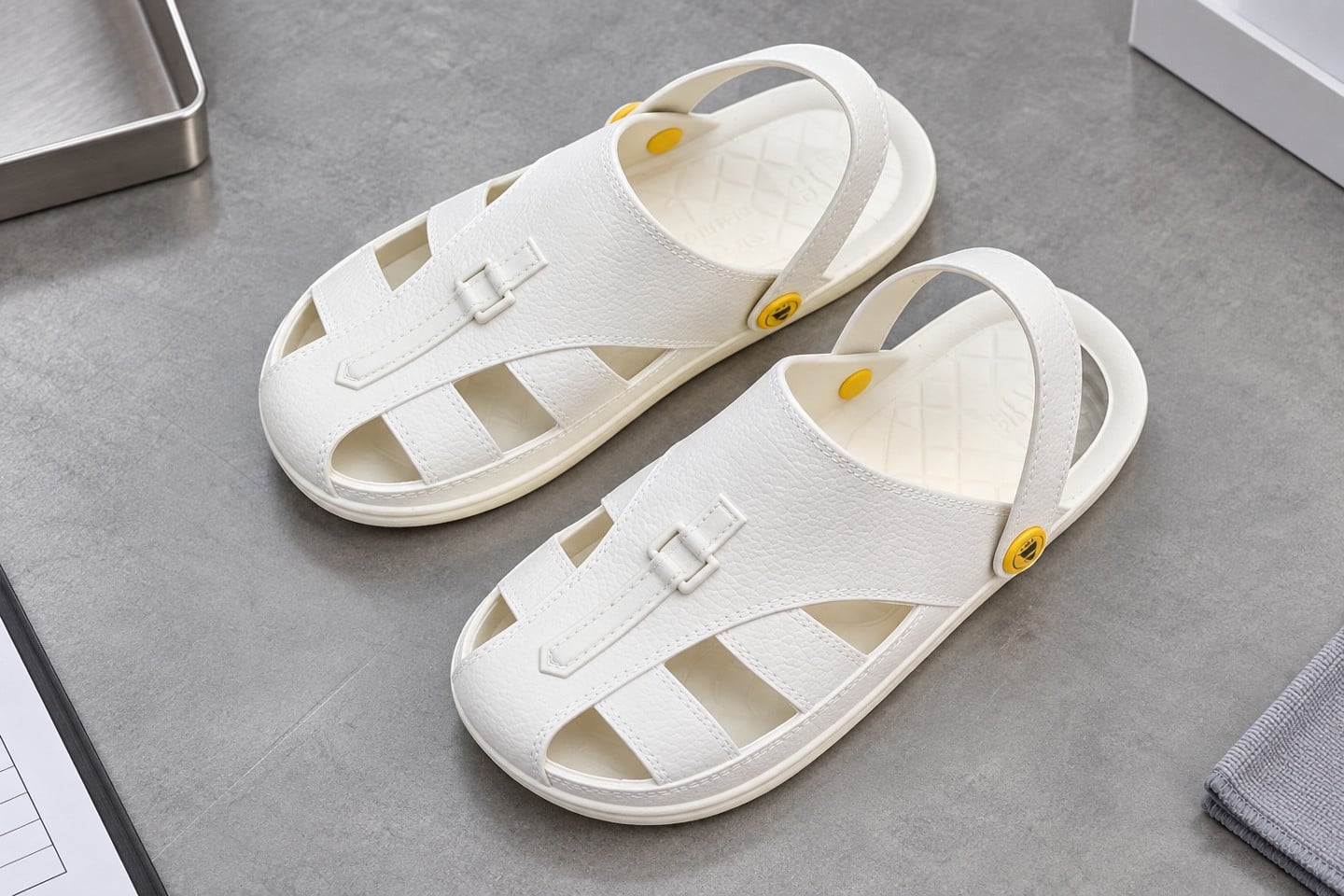
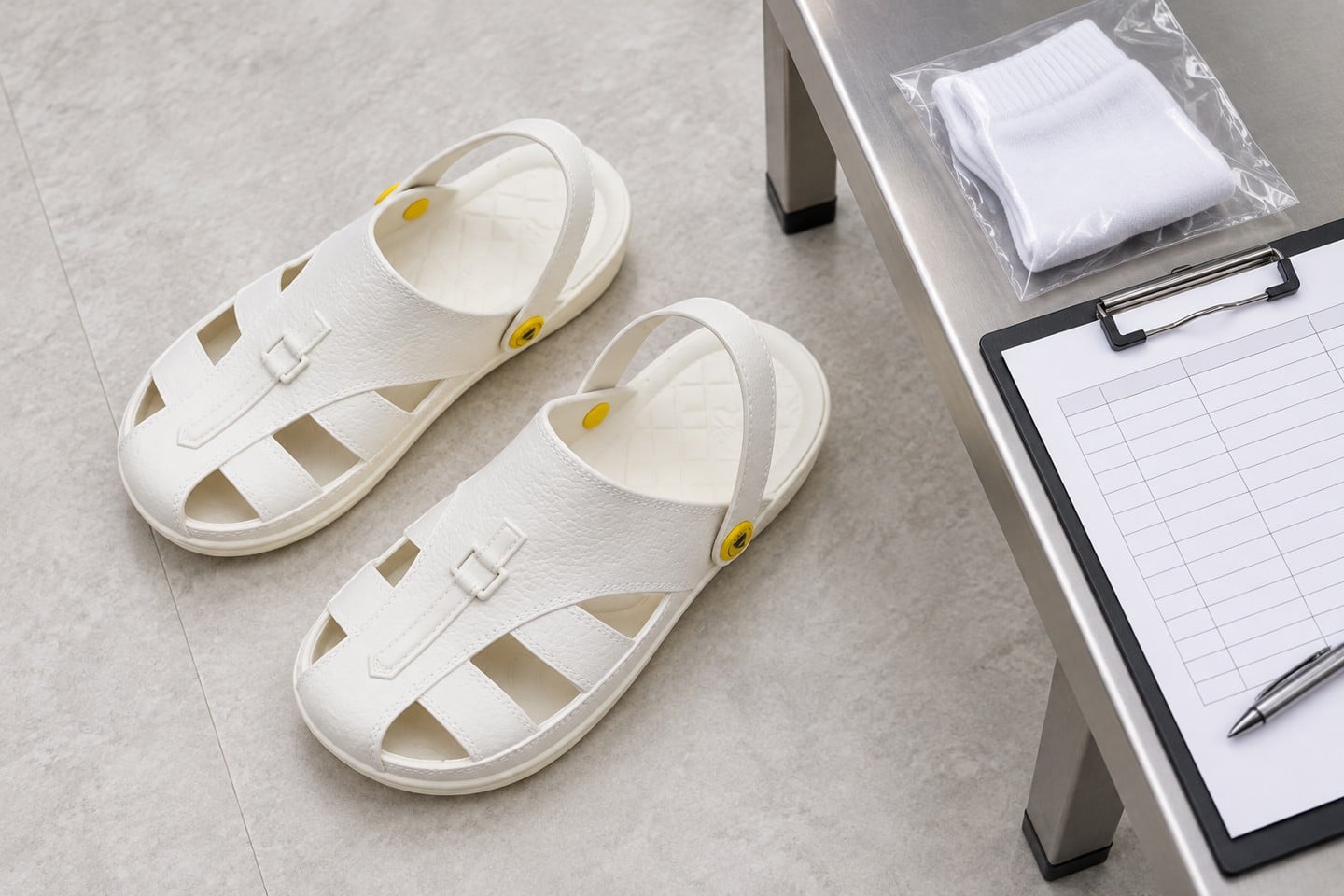
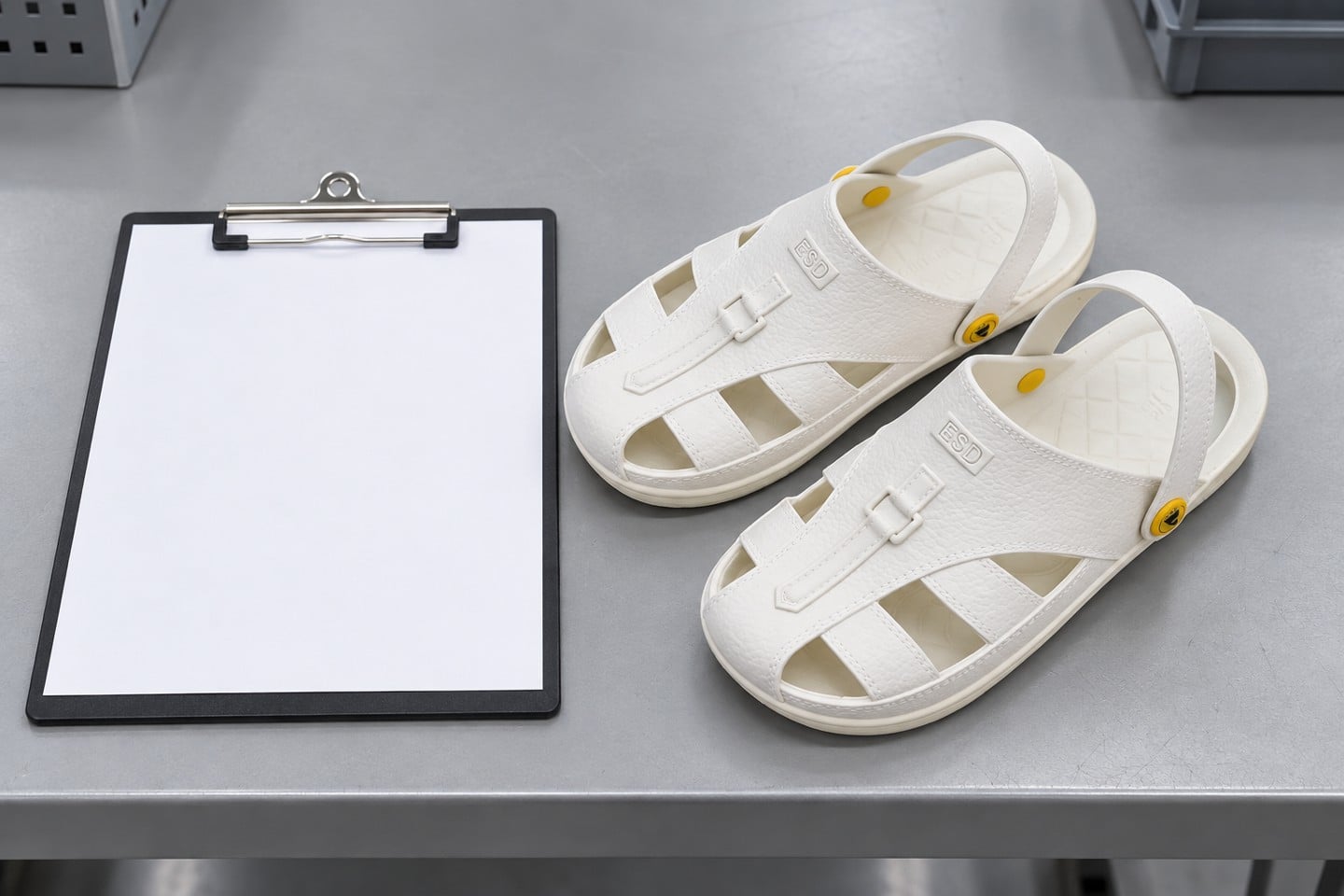
For a supplier inquiry, the SWESD footwear product page provides a product starting point. Request documentation for the exact construction and application, along with the required test report. The illustrations in this article depict the real product reference for identification and visual inspection; they do not show an electrical fixture, establish test results, or imply safety certification.
Further learning and a practical purchasing decision
The EOS/ESD Association educational video below introduces why charge control and personnel practices matter. It supports the system context of footwear evaluation, but it is not the footwear test procedure. Use the full applicable method, manufacturer instructions, and approved site program for testing and acceptance.
Approve the purchase only when the footwear evidence matches the supplied item and the intended control arrangement. Record unresolved limits and the checks still needed at the facility. A good report makes its scope clear, preserves the actual observations, and supports a specific decision. It does not turn one resistance number into a claim that every wearer, floor, and process will be protected.
Часто задаваемые вопросы
Is a sole-material resistance result enough to qualify an ESD shoe?
No. A material sample is not the assembled footwear, and it does not establish performance of the worn footwear-flooring system.
What is the universal acceptable resistance for ESD shoe soles?
There is no universal sole value for every application. Use the applicable current method and the criteria in the approved ESD program.
Can an ordinary multimeter replace the specified footwear test fixture?
No. The fixture, contact path, voltage, timing and conditioning belong to the method and cannot be replaced by an improvised reading.
Does a footwear entrance-check pass prove the whole shift was protected?
No. It records the arrangement and check at that time; other required verification and operating controls still apply.
When should footwear be replaced?
Follow manufacturer instructions and the site rules for damage, contamination, wear, construction changes and failed applicable checks, with recorded release decisions.
Оставить ответ