- Блог
Dissipative vs conductive storage is not a choice that can be made from color or a generic product name. The correct role depends on what is being handled, where the container sits, how the workstation is controlled, and whether the load leaves the protected area. For an SMT buyer, the useful question is not which word sounds safer, but which evidence and handling boundary belong with the tray or bin.
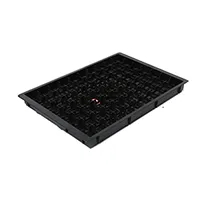
Part 1. What is the practical difference between dissipative and conductive storage?
Conductive and dissipative describe different electrical-behavior categories, but neither word is a complete handling instruction. Their practical relevance appears only when the container is matched to the item, the contact path, the work area, and the operating procedure.
In a purchasing discussion, avoid treating either term as a quality ranking. A buyer should first define whether the item is an exposed board, an assembly, a component package, or a non-sensitive line-side supply. That definition determines which evidence the local ESD program needs before it approves the container.
| Пункт обзора | Dissipative-storage question | Conductive-storage question |
|---|---|---|
| Intended item | What item and contact surface will rest in the container? | What item and contact surface will rest in the container? |
| Work-area context | Is the handling step inside a defined EPA? | Is the handling step inside a defined EPA? |
| Доказательство | Which current material or test record is required by the local program? | Which current material or test record is required by the local program? |
| Route | Does the load stay at a controlled station? | Does the load stay at a controlled station? |
Земля ESD Association principles of control place material selection inside a wider control system. That is why a material label cannot replace an approved handling method.
Part 2. Why is a container only one part of ESD control?
A tray or bin holds the item, but it does not define personnel grounding, work-surface condition, process ownership, cleaning practice, or the rule for a failed check. Those controls have to work together at the station where the load is opened, staged, assembled, inspected, or reworked.
For example, two otherwise similar trays can occupy very different roles. One may sit at a verified line-side station and be returned through a defined route.
Another may be placed on an uncontrolled cart, moved through a doorway, and opened again without a receiving check. The second case changes the question from tray selection to control-plan design.
Важно: Do not approve a storage material from an image, color, or a historic quotation alone. Confirm the current product evidence and the local handling program before release. ESDA procedures and materials guidance explains why controls change when the environment is not controlled.
Part 3. Which storage role fits a tray, bin, or carrier?
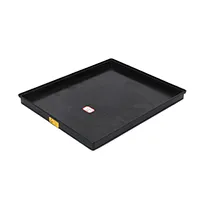
Start with the physical job. A shallow tray often supports orientation, separation, or short line-side staging. A bin can support point-of-use identification and replenishment.
A carrier or closed package may be needed when the item moves beyond the assumptions of the work area.
| Handling step | Primary decision | Evidence to review | Not decided by this article |
|---|---|---|---|
| Line-side staging | Board or component envelope, contact areas, identification | Drawing, item interface, program requirement | A model-specific electrical value |
| Point-of-use storage | Picking access, label position, replenishment route | Container geometry and handling procedure | Whether any bin is suitable for every component |
| Inter-area transfer | Exposure outside the controlled area | Route and protective-packaging plan | Whether an open tray is a shielding enclosure |
| Incoming or outbound packaging | Protection during the complete route | Packaging standard and shipment conditions | A blanket material recommendation |
This role-first approach prevents a common mismatch: buying a tray for a transport problem or buying a large bin when only line-side orientation is needed. It also leaves room for a process engineer to set the evidence requirements rather than inferring them from a category label.
Part 4. When does a line need more than an open tray or bin?
An open container is not automatically a protective package. If a load leaves a defined EPA, waits in an uncontrolled location, goes through maintenance, or enters an outbound route, the project team should apply the approved packaging procedure for that transition.
Земля ESD Association procedures guidance is useful here because it separates controlled-area practices from protective packaging. The exact decision must come from the buyer’s program and the route conditions, not from a generic article.
This is the fit boundary: this comparison cannot determine suitability when the item sensitivity, work-area controls, package route, or required verification method is unknown. In that case, pause the material choice and document the missing inputs.
Part 5. How should buyers compare options without relying on color?
Color can support visual management, but it is not proof of electrical behavior. The review should instead connect the product drawing, the intended component interface, any required verification record, and the process that will use the container.
Ask the supplier to identify the exact product configuration, then compare the evidence against the operating use. This separates a useful RFQ from a request that merely says “black ESD tray” or “conductive bin.” It also keeps product claims within the evidence available for the quoted model.
The related ESD-safe material selection article can help a buyer frame material questions. It should not be read as a substitute for model-level records or the buyer’s own control plan.
Part 6. What should go into an RFQ and approval review?
Provide operational inputs together with the requested container type. The supplier can then confirm which published family or configuration should be reviewed, while the buyer’s ESD owner can decide what evidence is necessary for release.
| RFQ or approval input | Почему это важно | Send with the request |
|---|---|---|
| Item type and dimensions | Defines the required usable area and contact arrangement | Drawing, board envelope, or sample detail |
| Handling step | Separates line-side staging from transport or shipment | Process map and receiving point |
| EPA and route conditions | Identifies where the control assumptions apply | Route description and exceptions |
| Требуемые доказательства | Prevents unsupported model claims | Current test, program, or customer requirement |
| Quantity and packing need | Allows configuration discussion without promising MOQ or lead time | Forecast and destination |
The approval review should also name the person who owns the decision after the sample or quotation is received. A container can be physically suitable yet still require a different handling method for the planned route.
Part 7. Which Sanwei product family is the right starting point?
For line-side orientation and component staging, start with the published Sanwei ESD Tray family. For point-of-use storage and replenishment discussions, start with the Sanwei ESD Bin family. These category links identify product families, not a universal material or compliance claim.
Send Санвэй the item envelope, intended storage step, route outside the EPA if any, required evidence, label or divider need, target quantity, and destination. Do not select an ESD trolley from this comparison alone: mobile equipment requires separate information about the carrier, route, load, floor, and handoff process.
Часто задаваемые вопросы
Is conductive storage always the better option?
No. The right option is the one supported by the item, work-area controls, route, and documented requirements. A material label alone does not establish suitability.
Can a black tray be assumed to be conductive?
No. Color is not a substitute for the current product evidence required by the buyer’s ESD program.
Does an open ESD tray protect a board during shipment?
Not by itself. Shipping and movement outside a controlled environment require an approved protective-packaging plan.
Каковы первые исходные данные для запроса коммерческого предложения (RFQ)?
Provide the item type and envelope, then describe the exact handling step and route. Those facts determine which product family and evidence should be reviewed.
Should bins and trays use the same approval method?
They can share some evidence requirements, but their physical roles may differ. Review the item interface and process use for each configuration.
Can this article confirm a Sanwei product’s electrical value?
No. Request the current model-specific evidence required for the proposed application.



Оставить ответ