- Блог
Ан ESD rack for SMT is a magazine-style holder that buffers printed circuit boards between pick-and-place, reflow, inspection, and manual stations while keeping assemblies in a controlled electrostatic environment. This article compares rack types, slot geometry, heat ratings, and buyer specifications for automated and manual SMT lines. Written for global electronics manufacturing and EPA teams—specify 50 or 60 Hz plant power only where electrical grounding interfaces matter, not for material selection.

Part 1. What is an ESD rack for SMT?
SMT magazine racks—often called PCB racks or ESD racks—store multiple boards vertically in slots so operators and loaders can transfer batches without flexing assemblies. Frames combine conductive plastic side guides with metal top and bottom plates for rigidity.
Standard industrial units frequently store about 50 boards with 10 mm slot pitch, but width adjustment mechanisms differ: screw-type, gear-track, or fixed-width models each fit different PCB size mixes.
These racks are not component bins. They move bare or assembled PCBs, so edge support and slot depth matter as much as surface resistance.
Cross-site programs benefit from a single drawing register for storage hardware so MRO orders do not drift across regions.
Facilities running both 50 Hz and 60 Hz equipment should still specify the same ESD material class; grounding audits focus on resistance paths, not mains frequency.
Cross-site programs benefit from a single drawing register for storage hardware so MRO orders do not drift across regions.
Facilities running both 50 Hz and 60 Hz equipment should still specify the same ESD material class; grounding audits focus on resistance paths, not mains frequency.
Field evaluation notes
Document who owns ESD audits versus procurement sign-off—misaligned approvals delay standardization across plants.
Capture photos of existing layouts before RFQ; dimensions inferred from memory often underestimate clearance for drawer pull or rack handles.
| Attribute | Typical range | Verify in RFQ |
|---|---|---|
| Capacity | ~50 PCBs | Loader compatibility |
| Шаг паза | 10 mm common | Board thickness stack-ups |
| PCB width | 50–250 mm adjustable | Panelized width |
| Surface resistance | указано 10⁴–10⁶ Ом | Test method |
Part 2. Where racks sit in the SMT workflow
Loader and unloader interfaces use racks as the physical buffer when line automation cannot pause. Consistent outer dimensions let conveyors or robots index the same magazine repeatedly.
Manual lines place racks between printer, P&P, reflow, AOI, and rework benches. Short moves with grounded racks reduce bare-board handling on insulative carts.
Post-wave or selective solder areas may need higher heat-rated racks if boards enter warm holding zones—standard PP guides can soften if temperature limits are ignored.
When contractors rotate frequently, label standards and color codes matter more than marginal cost differences between models.
When contractors rotate frequently, label standards and color codes matter more than marginal cost differences between models.
Integration with EPA programs
Map each storage zone to ANSI/ESD S20.20 and IEC 61340-5-1 control items applicable to your program tier.
Training beats hardware alone: operators must know when to ground personnel and when to move assemblies in shielding bags for warehouse transits.
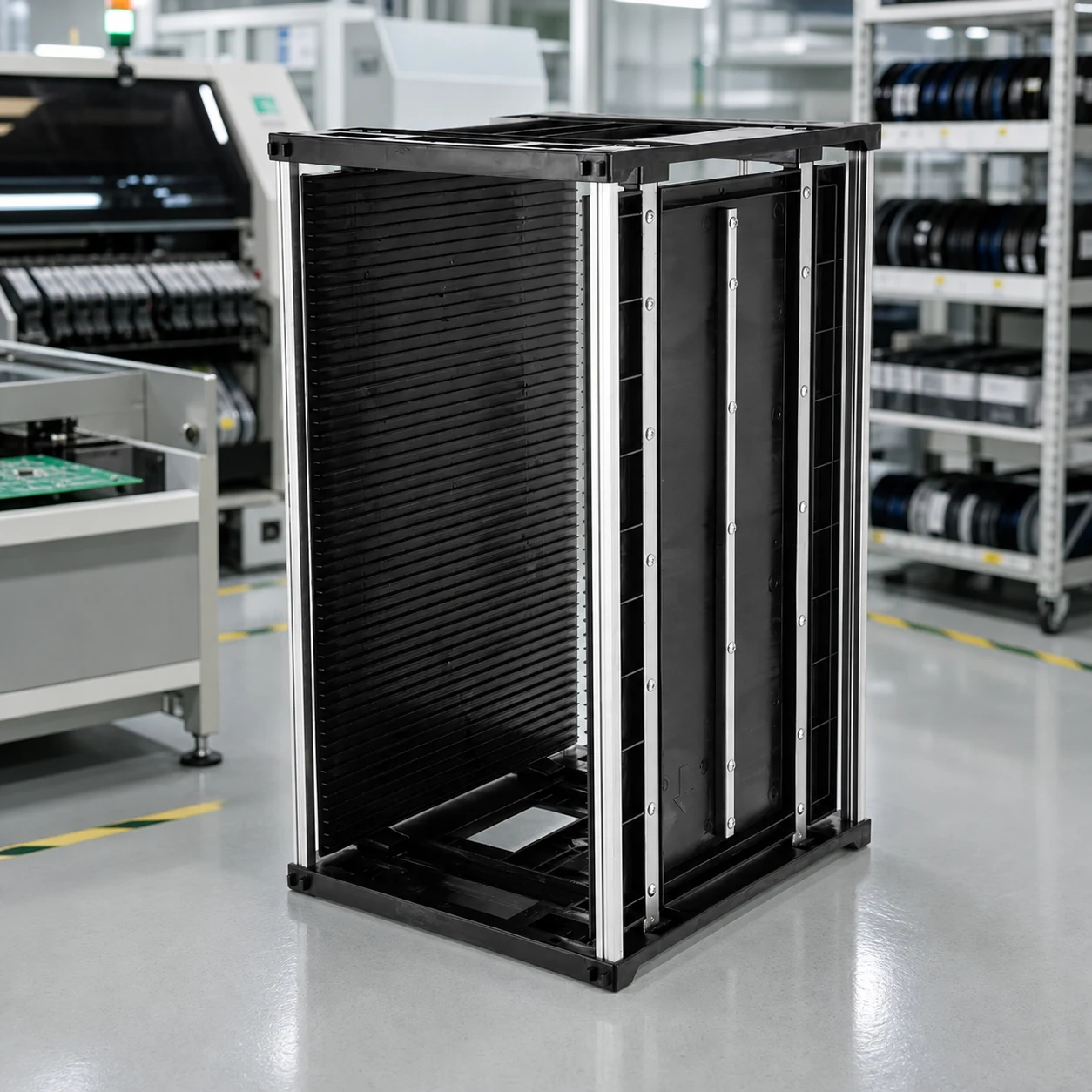
Part 3. Heat resistance and material choices
Suppliers often list standard grades near 60–85 °C continuous service and heat-resistant variants from 120 °C up to 200 °C or higher for aging-room use. Match the rating to the hottest zone the rack enters, including summer floor temperatures near ovens.
Metal-reinforced frames resist bowing when fully loaded. Plastic-only guides cost less but may flex with heavy high-layer-count boards.
If boards exit reflow and queue for inspection, confirm whether radiant heat requires a heat-resistant rack or simply a shorter queue time on a standard model.
Export shipments should list carton L×W×H and gross weight per stack so freight forwarders avoid repacking that breaks interlocks.
Facilities running both 50 Hz and 60 Hz equipment should still specify the same ESD material class; grounding audits focus on resistance paths, not mains frequency.
Export shipments should list carton L×W×H and gross weight per stack so freight forwarders avoid repacking that breaks interlocks.
Facilities running both 50 Hz and 60 Hz equipment should still specify the same ESD material class; grounding audits focus on resistance paths, not mains frequency.
Field evaluation notes
Document who owns ESD audits versus procurement sign-off—misaligned approvals delay standardization across plants.
Capture photos of existing layouts before RFQ; dimensions inferred from memory often underestimate clearance for drawer pull or rack handles.
Measurement and record keeping
Log resistance checks after cleaning cycles; flux and oils can shift readings over weeks of production.
Store supplier certificates with lot numbers so audits trace back to the mold run—not a generic material family.
Part 4. Adjustability, slot geometry, and automation fit
Screw-adjustable side guides suit low-changeover shops that run one board width for months. Gear-track models speed width changes when multiple products share a line.
Slot depth and lip design protect component leads and connectors from snagging during insertion. Assemblies with tall parts may need deeper slots or reduced per-rack capacity.
When integrating with OEM loaders, provide the rack outline drawing early—3 mm clearance errors stop automation.
Digital work instructions with photos of correct grounding beat verbal handoffs during overtime shifts.
Digital work instructions with photos of correct grounding beat verbal handoffs during overtime shifts.
Integration with EPA programs
Map each storage zone to ANSI/ESD S20.20 and IEC 61340-5-1 control items applicable to your program tier.
Training beats hardware alone: operators must know when to ground personnel and when to move assemblies in shielding bags for warehouse transits.
| Adjustment type | Лучший для | Компромисс |
|---|---|---|
| Винт | Fixed SKU lines | Slower width changes |
| Gear track | Mixed widths | Moving parts to maintain |
| Fixed width | Dedicated automation | Less flexible |
Part 5. Grounding and EPA handling
Racks should rest on grounded carts, conveyor segments, or EPA flooring systems. Personnel must remain grounded while transferring magazines.
Clean slots when solder balls or flux residue accumulate—contamination can scratch solder mask or alter resistance readings on guides.
Label racks by product family when multiple magazines circulate to prevent mixing conformal-coated batches with bare-board lots.
If your MES tracks lot numbers, align label placement on drawers or rack faces so scans do not block ESD contacts.
Facilities running both 50 Hz and 60 Hz equipment should still specify the same ESD material class; grounding audits focus on resistance paths, not mains frequency.
Contract manufacturers should align storage specs with customer EPA audits before onboarding new SKUs—surprise findings delay shipments.
Third-party logistics hubs need the same grounding instructions as internal lines; otherwise bins arrive compliant but sit on insulative pallets.
When migrating from cardboard to conductive PP, update waste handling and recycling contracts—carbon-filled scrap streams differ from OCC.
Document maximum cleaning chemical exposure; aggressive solvents can craze conductive PP and change surface resistance over time.
Engineering reviews should include EHS, quality, and logistics—not only unit price—before locking a global standard.
For multi-plant rollouts, issue a controlled BOM for storage accessories so regional buyers do not substitute incompatible dividers.
Video clips of correct drawer pull and rack insertion reduce training time more than PDF catalogs alone.
Reserve sample units for destructive stack tests when safety policy exceeds supplier marketing stack photos.
If your MES tracks lot numbers, align label placement on drawers or rack faces so scans do not block ESD contacts.
Facilities running both 50 Hz and 60 Hz equipment should still specify the same ESD material class; grounding audits focus on resistance paths, not mains frequency.
Field evaluation notes
Document who owns ESD audits versus procurement sign-off—misaligned approvals delay standardization across plants.
Capture photos of existing layouts before RFQ; dimensions inferred from memory often underestimate clearance for drawer pull or rack handles.
Part 6. How to specify ESD racks in procurement documents
State PCB length, width range, thickness, maximum component height, and whether panels are routed or singulated. Include automation brand and model if racks must mate with factory loaders.
Request overall dimensions (for example 355 × 320 × 563 mm class sizes), weight, and carton packing for freight.
For export programs, ask for stackability of empty racks during warehouse storage to reduce inbound logistics cost.
Seasonal humidity swings can change resistance readings—schedule checks before customer audits, not only after failures.
Seasonal humidity swings can change resistance readings—schedule checks before customer audits, not only after failures.
Integration with EPA programs
Map each storage zone to ANSI/ESD S20.20 and IEC 61340-5-1 control items applicable to your program tier.
Training beats hardware alone: operators must know when to ground personnel and when to move assemblies in shielding bags for warehouse transits.
| Spec field | Example detail | Цель |
|---|---|---|
| Размер печатной платы | 350 × (50–250) mm | Guide adjustment |
| Класс нагревостойкости | 120 °C aging room | Material grade |
| ESD resistance | 10⁴–10⁶ Ω | Program compliance |
| Capacity | 50 boards | Buffer sizing |
| Рамка | Металлический верх/низ | Rigidity |
Part 7. Rack vs bin: choosing the right storage
Use magazine racks when the unit of flow is a PCB panel or assembly moving between machines. Use drawer or hopper bins when the unit of flow is components, fasteners, or kitting quantities.
Hybrid lines often standardize rack color for WIP boards and bin color for parts to reduce cognitive errors during night shifts.
If buffer queues grow because downstream inspection is slow, fix the bottleneck before buying more racks—extra magazines only hide scheduling problems temporarily.
Spare parts strategy should cover latches, dividers, and replacement feet before the first peak season after go-live.
Facilities running both 50 Hz and 60 Hz equipment should still specify the same ESD material class; grounding audits focus on resistance paths, not mains frequency.
Spare parts strategy should cover latches, dividers, and replacement feet before the first peak season after go-live.
Facilities running both 50 Hz and 60 Hz equipment should still specify the same ESD material class; grounding audits focus on resistance paths, not mains frequency.
Field evaluation notes
Document who owns ESD audits versus procurement sign-off—misaligned approvals delay standardization across plants.
Capture photos of existing layouts before RFQ; dimensions inferred from memory often underestimate clearance for drawer pull or rack handles.
Part 8. Specifying ESD magazine racks for SMT buffering
Magazine racks bridge pick-and-place, reflow, and inspection when automation expects a repeatable outer footprint. Width adjustment range and slot pitch matter more than catalog photos.
For lines that mix manual and automated transfers, confirm heat class if racks dwell near warm zones—standard PP guides differ from elevated-temperature grades.
Compare total cost of ownership: accessory compatibility, spare MOQ, and cleaning labor often exceed unit price deltas.
Request carton photos and pallet patterns for inbound logistics—unexpected overhangs drive repallet charges at port.
Compare total cost of ownership: accessory compatibility, spare MOQ, and cleaning labor often exceed unit price deltas.
Request carton photos and pallet patterns for inbound logistics—unexpected overhangs drive repallet charges at port.
Loader compatibility checks
Provide PCB length, panel width range, and loader OEM model early. Three-millimeter clearance errors stop indexing.
If you run multiple board widths per shift, gear-track adjustment often beats screw-type guides for changeover minutes.
Pairing racks with component storage
Racks move PCBs; drawer or hopper bins stage components. Hybrid programs color-code magazines for WIP boards and bins for kitting to reduce cognitive load.
Send PCB dimensions, slot pitch needs, and automation interface notes to Sanwei export engineering via Contact Us for magazine rack matching and packing data.

Часто задаваемые вопросы
What surface resistance should ESD storage bins meet?
Most buyers specify dissipative or conductive ranges commonly cited as 10⁴–10⁹ Ω, aligned with IEC 61340-5-1 and ANSI/ESD S20.20 program requirements. Confirm the supplier test method and whether resistance is measured on inner and outer surfaces.
Can stackable ESD bins replace magazine racks?
They solve different problems. Drawer and stackable bins organize components, reels, and kits at the bench. Magazine racks buffer PCBs between SMT machines. Many lines use both in sequence.
How should buyers document ESD storage in an RFQ?
Include part types, temperature exposure, stacking height, grounding method, color or labeling needs, and target quantities. Photos of the workstation layout reduce sizing errors.
Are heat-resistant ESD boxes suitable for reflow ovens?
Standard conductive PP boxes are for handling and staging, not inside reflow or wave solder processes. Specify peak temperature and dwell time so the supplier can quote the correct grade.
What is the minimum order quantity for custom colors?
MOQ varies by mold and pigment load. For export programs, buyers often standardize on black conductive PP first, then add color variants after pilot runs.
How often should ESD storage be cleaned in production?
Wipe down bins when flux residue, oils, or particulates accumulate—dirty surfaces can raise resistance readings. Follow your EPA audit checklist and the supplier care instructions.
Should ESD racks be conductive or dissipative?
PCB magazine racks typically use conductive or static-dissipative materials with metal frames. Verify slot pitch, PCB width range, and whether the unit must enter a burn-in or aging room.
Where can I request samples before a bulk order?
Request samples through the supplier export desk with model numbers, quantities, and destination country so logistics and compliance documents can be quoted together.
Ссылки



Оставить ответ