- Turbo
- Blog
Cleanroom sticky mat final layer replenishment needs an agreed handoff before the usable sheets run out. Identify the actual installed mat, confirm how its layer indicator works, make an approved replacement available, and assign who can close the entrance during the change. Do not assume a printed number alone proves remaining stock or that a replacement pad can be fitted immediately. This guide focuses on preventing a gap between the last usable layer and the next accepted installation. It complements routine peeling, used-sheet disposal and floor preparation rather than replacing those instructions.
Define what counts as an available replacement
A replacement is available when the correct approved item is identifiable, accessible and in acceptable condition for installation. A carton somewhere in a warehouse is not necessarily a usable reserve at the entrance. It might contain a different size, be allocated to another area, have damaged protection or require authorization before opening. The handoff should distinguish stock recorded in the purchasing system from a replacement that the responsible operator can actually obtain.
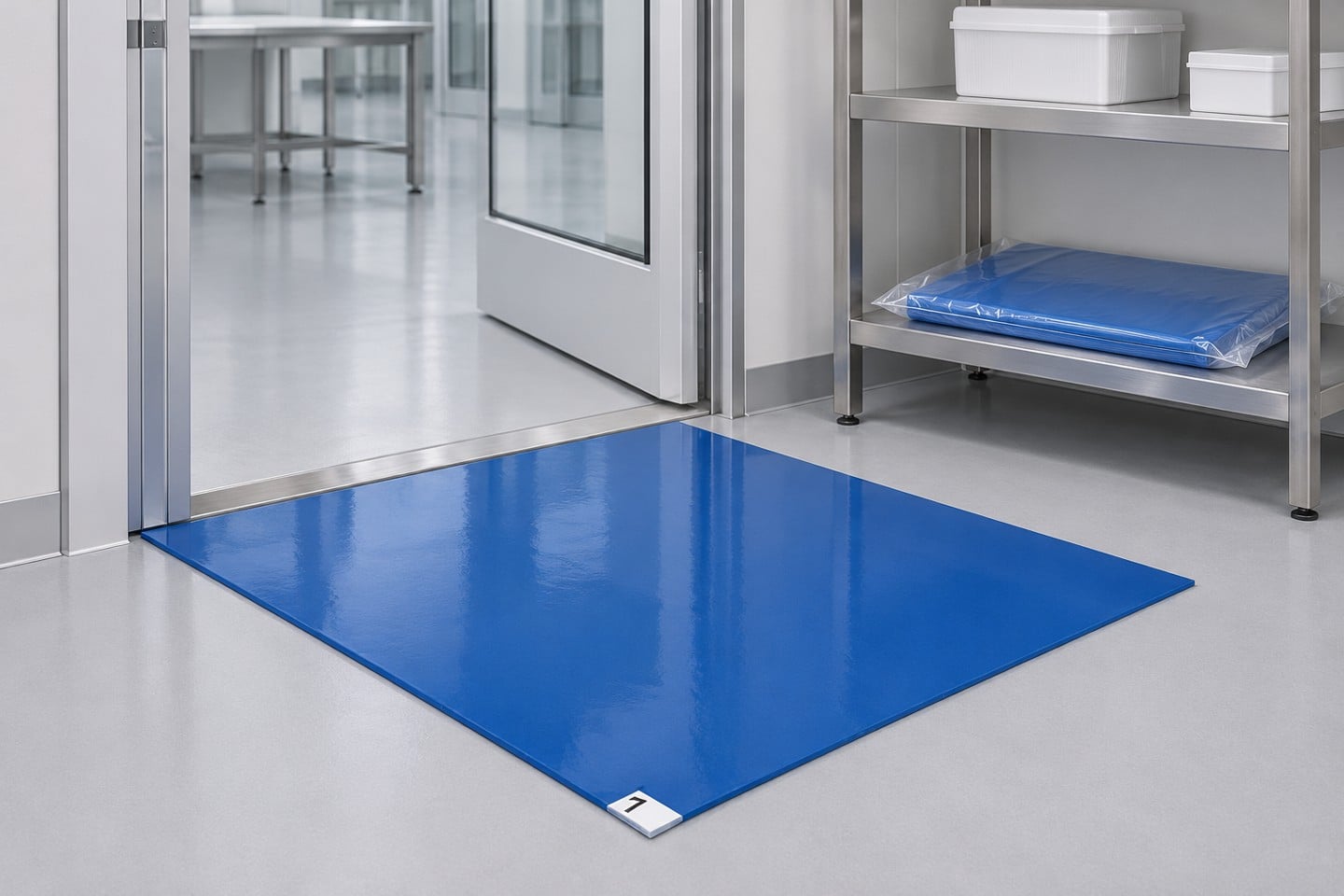
Zacznij od Produkt maty klejącej do czystych pomieszczeń SWESD and the specification selected for the facility. Confirm the delivered item and instructions rather than inferring layer count, adhesive suitability or storage life from a photograph. The blue mat shown in this article is a product-reference illustration. Shelf arrangement and protective wrapping are illustrative; they are not a statement that these accessories are included with the product.
Connect replenishment to the entrance procedure
A mat is part of the facility’s contamination-control arrangement. Replacing it can temporarily change the route, walking surface and cleaning sequence. The IEST cleanroom housekeeping recommended-practice overview describes the subject within a wider housekeeping program. The public overview does not prescribe a universal replenishment threshold. Set local actions using the applicable instructions, traffic pattern and approved entrance procedure.
Keep a clear distinction between a sheet that needs changing and a whole pad that needs replacing. A dirty exposed layer may still have usable layers underneath; a pad at its end needs a different action. Damage, poor attachment or an unsuitable floor condition can also require attention before the layers are exhausted. The final-layer process must not encourage staff to keep a compromised mat in service simply because a planned replacement date has not arrived.

Verify the layer indicator before setting a trigger
Numbered tabs are helpful only if operators know what the numbering means for the actual product. Confirm whether the visible number represents the current sheet, a counting direction or another supplier convention. Do not write an instruction that assumes every mat counts down the same way. Use the supplier instructions and a real approved sample to explain how staff recognize the replenishment stage and the final usable layer.
When a tab is missing or unreadable, use the agreed exception route. A guess based on how thick the pad feels may be unreliable, particularly when dirt, compression or viewing angle changes the impression. The peel-tab condition guide addresses damaged indicators. Replenishment planning should recognize this uncertainty and provide a way to request help without requiring the operator to state an invented remaining-sheet count.
Use a handoff record with clear ownership
A useful replenishment record answers who noticed the approaching end, who confirmed the replacement, who performs the change and who accepts the entrance afterward. These roles may be combined in a small facility, but the responsibilities still need to be explicit. The following table is a suggested operational checklist. It is not a standard-mandated form and does not establish universal replacement intervals or layer limits.
| Handoff point | Evidence to confirm | Owner decision |
|---|---|---|
| Approaching end | Actual layer indicator and entrance identity | Request replacement through the agreed route |
| Reserve confirmation | Correct item, protection and accessible location | Accept stock as ready or flag uncertainty |
| Change preparation | Approved entrance restriction or alternative route | Authorize the time and traffic arrangement |
| Instalacja | Actual floor and mat condition | Resolve defects before normal use |
| Completion | Accepted installation and remaining reserve status | Close the handoff and renew the stock request |
Define what the receiving person must acknowledge. A message saying “mat nearly finished” can be overlooked because it lacks a location, condition and requested action. A better handoff identifies the entrance, installed item, actual indicator observation, replacement location and the person responsible for the next step. If acknowledgment does not arrive, the operator should know the escalation route instead of assuming someone else will notice the same mat later.
Choose a replenishment trigger from real use
The trigger should leave enough practical time to obtain and fit an approved replacement under the facility’s conditions. Consider the time needed for stock release, travel, route control, old-pad removal, floor preparation and acceptance. Traffic can vary across shifts and production events, so a fixed number of remaining layers may not provide the same margin everywhere. Record the reason for the chosen trigger and review it when the use pattern changes.
Do not turn this planning exercise into an unsupported universal formula. Start with observations from the actual entrance and improve the instruction as evidence accumulates. If no reliable use history exists, use a conservative locally approved arrangement and record that the initial threshold is provisional. Buying more pads may help a supply problem, but it does not correct unclear responsibility or a replacement stored in a location that operators cannot access.
Keep reserve pads protected and traceable
Preserve the replacement in the condition required by the supplier and the site’s cleanroom entry procedure. Do not expose an unused adhesive surface simply to prove that stock exists. Keep the item identity visible while maintaining suitable protection. The cURL Too many subrequests by single Worker invocation. To configure this limit, refer to https://developers.cloudflare.com/workers/wrangler/configuration/#limits explains the earlier stock-control stage; the replenishment handoff should connect to those records without creating a separate conflicting description.
cURL Too many subrequests by single Worker invocation. To configure this limit, refer to https://developers.cloudflare.com/workers/wrangler/configuration/#limits.

cURL Too many subrequests by single Worker invocation. To configure this limit, refer to https://developers.cloudflare.com/workers/wrangler/configuration/#limits
cURL Too many subrequests by single Worker invocation. To configure this limit, refer to https://developers.cloudflare.com/workers/wrangler/configuration/#limits Przewodnik dotyczący porządku w miejscu pracy CCOHS cURL Too many subrequests by single Worker invocation. To configure this limit, refer to https://developers.cloudflare.com/workers/wrangler/configuration/#limits.
cURL Too many subrequests by single Worker invocation. To configure this limit, refer to https://developers.cloudflare.com/workers/wrangler/configuration/#limits.
cURL Too many subrequests by single Worker invocation. To configure this limit, refer to https://developers.cloudflare.com/workers/wrangler/configuration/#limits
cURL Too many subrequests by single Worker invocation. To configure this limit, refer to https://developers.cloudflare.com/workers/wrangler/configuration/#limits.
cURL Too many subrequests by single Worker invocation. To configure this limit, refer to https://developers.cloudflare.com/workers/wrangler/configuration/#limits Przewodnik wyboru i umieszczania mat klejących provides the broader context. A replenishment record supports continuity of the approved arrangement; it is not a substitute for environmental monitoring or a validated contamination-control process.
Recover a missed handoff without hiding the gap
If the last usable layer has already been removed and no accepted replacement is ready, record the actual condition and notify the authorized owner. Use the approved entrance restriction or alternative route. Do not describe an uncovered position as protected, and do not install an unrelated mat solely to make the station appear complete. If traffic has continued, document the period of uncertainty and let the responsible process owner decide whether further review is necessary.
Once the immediate issue is controlled, find the failed handoff. Was the trigger misunderstood, the replacement unavailable, the message unacknowledged or the work deferred without ownership? Correct the specific failure. Adding a daily checkbox will not help if the purchasing record counts a different product as stock. Retain the event as useful operating evidence so future triggers reflect the real time and resources needed to complete the change.
Review continuity with a short practical exercise
Walk through a final-layer scenario with the people who actually use the entrance. Ask them to identify the installed product, locate the replacement, explain the traffic control and show how completion is accepted. Include the less convenient cases: an unreadable tab, a replacement pack with damaged protection and a change needed during a busy shift. Resolve uncertainty in the instruction before a real shortage exposes it.
Review the arrangement after supplier changes, traffic changes or repeated emergency requests. Keep only records that support decisions and make ownership visible. The aim is a dependable transition from one accepted mat installation to the next, with honest handling of any interruption. A clear final-layer handoff can reduce avoidable disruption while preserving the distinction between stock availability, installation acceptance and demonstrated contamination-control performance.
Podstawy edukacyjne i zakres
The following IEST educational video explains cleanroom floor cleaning and disinfection, providing context for the controlled floor preparation stage of a whole-pad change. It is not permission to wash a disposable adhesive layer or to use a cleaner without checking compatibility. Follow the actual mat instructions and the facility’s approved floor procedure.

Często zadawane pytania
Does every mat count layers in the same direction?
No. Confirm the indicator convention for the actual approved product.
Is a carton in stores automatically a ready replacement?
No. Confirm item identity, condition, access and release for the intended entrance.
Is there a universal final-layer replenishment threshold?
No. Set the trigger using local use, supplier instructions and the time required for the change.
Can an uncovered entrance be recorded as protected?
No. Record the real condition and use the authorized restriction or alternative route.
Does a fresh mat prove cleanroom classification?
No. Installation acceptance and demonstrated environmental performance are separate matters.
Napisz odpowiedź