- Turbo
- Blog
A cleanroom sticky mat peel tab should let the operator identify and lift the intended top sheet without disturbing the stack or touching the fresh surface below. Check the tab, the exposed sheet edge and the mat’s attachment before removal. If a tab is torn, folded underneath or no longer clearly associated with one layer, stop improvising and follow the facility’s damaged-sheet procedure. A missing tab does not automatically mean the whole mat must be discarded, but an uncertain or unsafe removal needs an approved decision. Do not use a sharp tool to guess where the next clean layer begins.
Separate a tab problem from a whole-mat problem
A pull tab is a handling feature. It is not a cleanliness indicator, an electrical test result or a certificate of suitability for the room. The SWESD 3W-87 sticky mat uses peel-off adhesive layers for controlled-area applications. Confirm the supplied configuration and its removal instructions rather than assuming every photograph, color or tab design represents the exact pack being used.
Start by describing what is wrong. An intact tab folded against the floor is different from a torn sheet corner, and both differ from an entire mat lifting off its base. Identify whether the issue affects sheet identification, the removal method, or safe placement. This keeps an isolated tab defect from being confused with contamination loading or an installation failure.
Gebruik de Gids voor het kiezen van kleefmatten for the broader application decision. The procedure here begins after the mat has been approved and installed. It does not select adhesive strength, establish a room classification, or set an electrical resistance requirement. Those questions require product-specific information and the facility’s own acceptance criteria.
Check the corner before the scheduled change
Look at the corner from an accessible position without stepping onto the clean surface merely to read it. Can the intended tab be seen? Is it separated from the sheet below? Is the film around it intact? Check whether nearby footwear, a trolley path or the door sweep repeatedly contacts the same corner. Record the observed contact instead of assuming the supplier made a defective tab.
Where numbering is provided, use the actual manufacturer’s numbering convention. A number may help track layers, but the direction of the sequence and treatment of protective films can vary. Do not turn an unreadable number into a guessed remaining-sheet count. Compare the pack instructions, installation record and physical arrangement before deciding whether the mat is near replacement.
A quick check should also look for curled edges, a displaced stack or a wet area around the mat. Those observations may require a separate response even when the tab itself is intact. The floor residue review addresses attachment and floor condition; avoid solving that problem by pressing a damaged corner down and continuing to peel sheets without review.
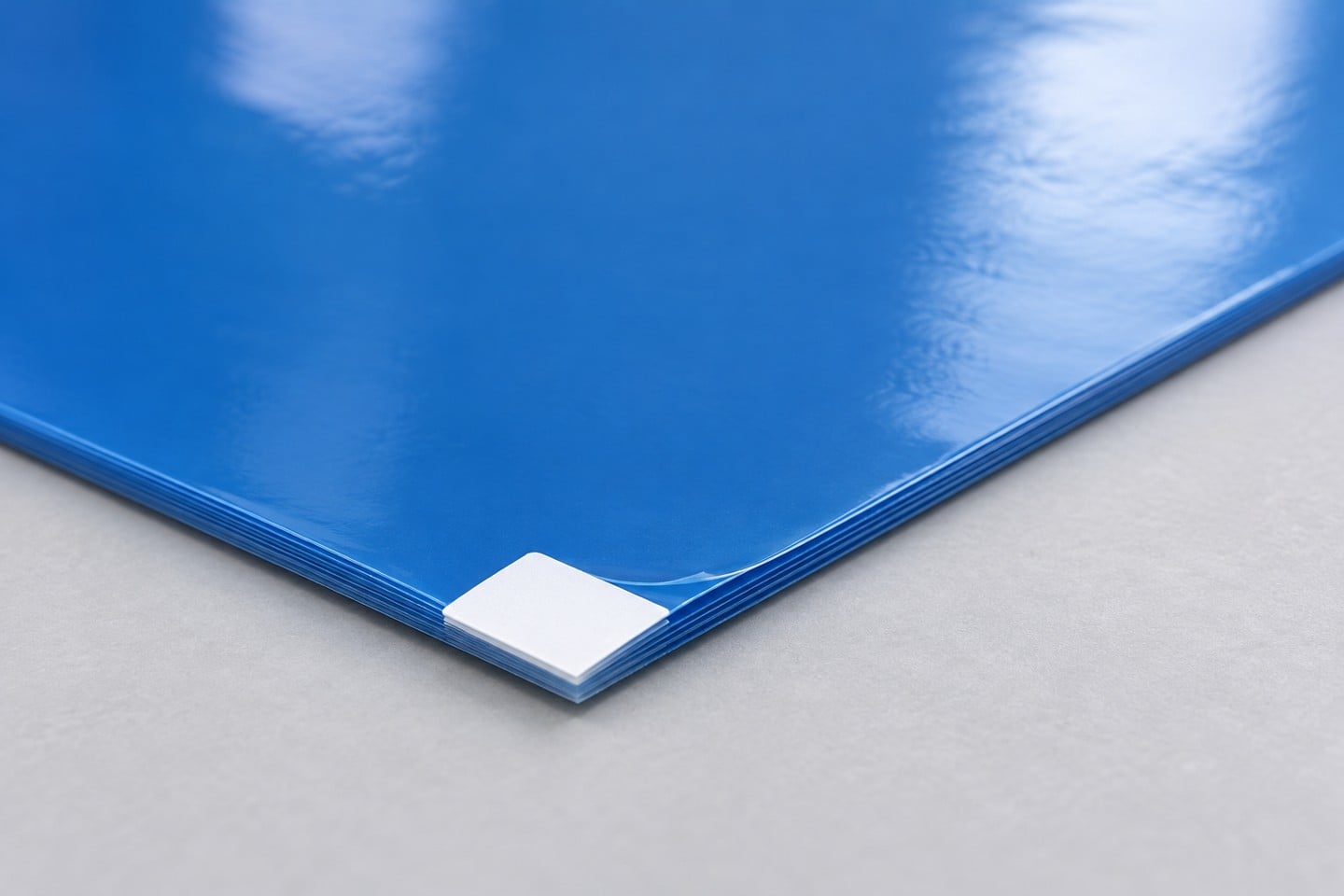
Lift only the intended sheet
Use the approved removal method for the supplied mat. The operating goal is to remove the contaminated layer while controlling its dirty side and preserving the next surface. Before starting, arrange the approved waste container and any required protective equipment so that the lifted sheet does not have to be carried through an occupied work area while the operator searches for disposal space.
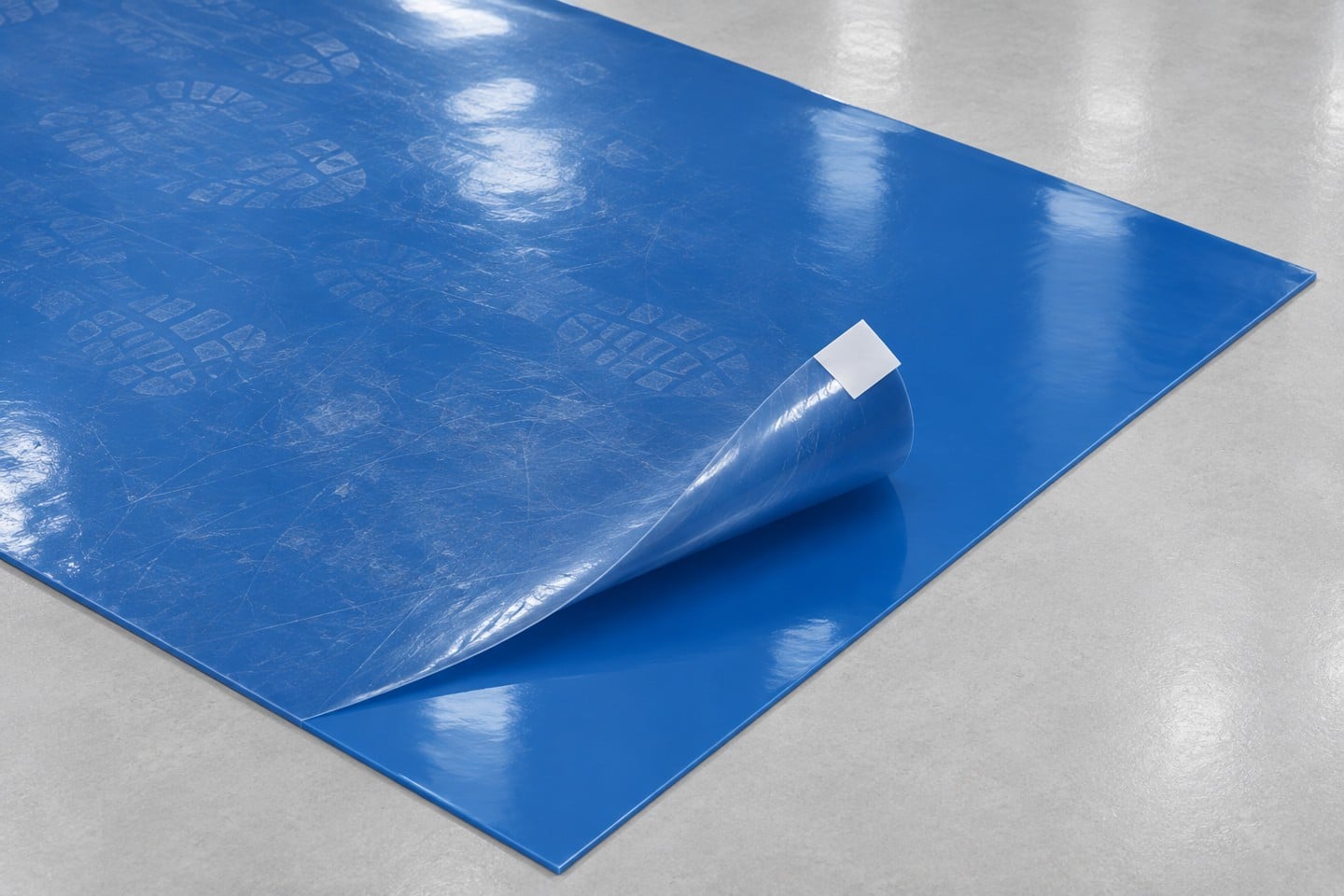
If the tab is accessible and the sheet can be identified, lift only the intended layer and continue the controlled movement described in the work instruction. Keep the removed film contained rather than making a fast outward pull across a clean zone. Do not brush a used sheet over the newly exposed mat. If several sheets begin lifting together, pause rather than pulling harder to complete the action.
A damaged tab changes the starting condition. Do not automatically introduce adhesive tape, a scraper, a knife or another tool to create a substitute grip. These additions can damage lower layers or introduce material that has not been approved for the area. Have the responsible supervisor or quality person define the permitted recovery method, or arrange complete replacement if controlled removal cannot be achieved.
Make the hold decision clear
The table below is a proposed local decision aid. It distinguishes a visible observation from the action requiring approval. It is not a universal manufacturer instruction. Use the exact mat instructions and your facility’s contamination-control requirements to decide which actions operators may take and which need escalation.
| Voorwaarde | Operator decision | Review needed |
|---|---|---|
| Intact visible tab and clear sheet edge | Follow approved single-layer removal | Confirm fresh surface and attachment |
| Tab folded underneath | Pause if grip or sheet identity is uncertain | Use approved recovery method |
| Tab or corner torn | Prevent improvised cutting or scraping | Decide controlled removal or replacement |
| Multiple sheets lift together | Stop pulling and preserve evidence | Check layer separation and procedure |
| Whole mat lifts or curls | Treat as placement and safety issue | Review attachment before reopening path |
A hold should prevent further uncertain handling. Mark or segregate the affected material according to the local procedure and provide a safe route or approved replacement where necessary. A note saying tab issue is insufficient if users continue crossing a curled mat. The person responsible for the entrance needs to know whether the mat remains in service, has been removed, or has been replaced.
Where the mat is part of an electronics clean area, keep electrical acceptance in scope. Peeling a sheet, handling a discarded film and changing a mat can alter the materials present in that area. Follow the site ESD plan instead of assuming that the product name makes every removal technique acceptable. Neither a visible tab nor an intact blue surface demonstrates electrical performance.
Check the new surface before reopening the path
cURL Too many subrequests by single Worker invocation. To configure this limit, refer to https://developers.cloudflare.com/workers/wrangler/configuration/#limits.
cURL Too many subrequests by single Worker invocation. To configure this limit, refer to https://developers.cloudflare.com/workers/wrangler/configuration/#limits.
cURL Too many subrequests by single Worker invocation. To configure this limit, refer to https://developers.cloudflare.com/workers/wrangler/configuration/#limits.
cURL Too many subrequests by single Worker invocation. To configure this limit, refer to https://developers.cloudflare.com/workers/wrangler/configuration/#limits
cURL Too many subrequests by single Worker invocation. To configure this limit, refer to https://developers.cloudflare.com/workers/wrangler/configuration/#limits.
De cURL Too many subrequests by single Worker invocation. To configure this limit, refer to https://developers.cloudflare.com/workers/wrangler/configuration/#limits cURL Too many subrequests by single Worker invocation. To configure this limit, refer to https://developers.cloudflare.com/workers/wrangler/configuration/#limits.
cURL Too many subrequests by single Worker invocation. To configure this limit, refer to https://developers.cloudflare.com/workers/wrangler/configuration/#limits.
Connect the task to the cleanroom operating programme
The public scope of ISO 14644-5:2025 addresses an operations control programme covering areas such as personnel, transfers, cleaning, maintenance and monitoring. It does not supply a universal recovery method for a torn tab or establish the compatibility of a particular cleaning chemical. Treat this checklist as a proposed task within the facility’s programme, not as an assertion that completing it certifies compliance.
IEST’s cleanroom housekeeping recommended practice is a relevant reference for developing cleaning procedures and monitoring. Consult the applicable controlled documents when defining the local task. The operating method still needs to identify the actual mat, allowed handling, waste route and response to a damaged layer. A reference title alone cannot release a failed mat for use.
The IEST educational video below discusses electrostatic contamination in cleanrooms. It provides context for keeping particle control and electrostatic behavior in the same review. It is not a demonstration of this mat or a substitute for the approved sheet-removal method. Use the text and the supplied instructions to define the physical steps, and the facility’s plan to establish required verification.
Include the tab arrangement in a supplier enquiry
Send the supplier the item identity, pack or lot information, photographs of the corner and a clear description of when the damage was found. Ask for the supplied tab design, layer-identification convention, storage precautions and permitted response to a damaged corner. If dimensions or layer counts matter to the order, request them in the current item-specific documentation rather than reading them from an illustration.
For a repeat problem, add the installation and traffic context. Explain whether the issue appears before installation, after a defined period in service, or during removal. State the affected quantity separately from the quantity inspected. This helps the supplier address the actual issue without turning a single tab observation into an unsupported claim about an entire delivery.
The practical acceptance decision is straightforward: the intended layer can be identified and removed by the approved method, the fresh surface remains suitable, and the mat stays safely positioned. Where one of those conditions cannot be confirmed, keep the action open until a responsible person resolves it. That is more useful than recording a sheet change that leaves uncertainty at the entrance.
Veelgestelde vragen
Does a damaged tab always require replacing the whole mat?
Not necessarily. The approved local procedure must determine whether controlled single-layer removal remains possible or replacement is needed.
Can I use a knife to find the sheet edge?
Do not improvise with a sharp tool. Obtain an approved recovery method or replacement decision.
Does the tab number prove how many usable sheets remain?
Only use it with the numbering convention for the supplied item. Do not guess when the number or sheet identity is unclear.
What should be checked after a layer is removed?
Check the newly exposed surface, remaining attachment, sheet fragments and edges that could enter the traffic path.
Does successful peeling prove the mat meets ESD requirements?
No. Electrical acceptance depends on the exact product and the facility ESD control plan, not the appearance of the tab.
Plaats een reactie