- Turbo
- Blog
Floor marking tape storage should preserve the identity and condition of unused rolls until an approved installation. Keep rolls in the product’s specified storage environment, protect them from contamination and deformation, and retain the information needed to connect each issue to accepted stock. Do not invent a universal shelf life or copy temperature limits from a different tape. The adhesive, backing and supplied packaging can differ between products. This guide concerns warehouse and partial-roll control before installation, rather than inspection of installed markings or qualification of the actual floor surface.
Begin with the actual tape and its instructions
Identify the supplier designation, color or pattern, width and any other controlled variant. Retrieve the available storage instructions, date information and applicable stock-rotation requirement for that item. A sales category such as “floor tape” is too broad to establish handling conditions. Ask the supplier to resolve missing product-specific instructions before relying on an assumed temperature range, storage duration or expiry interpretation.
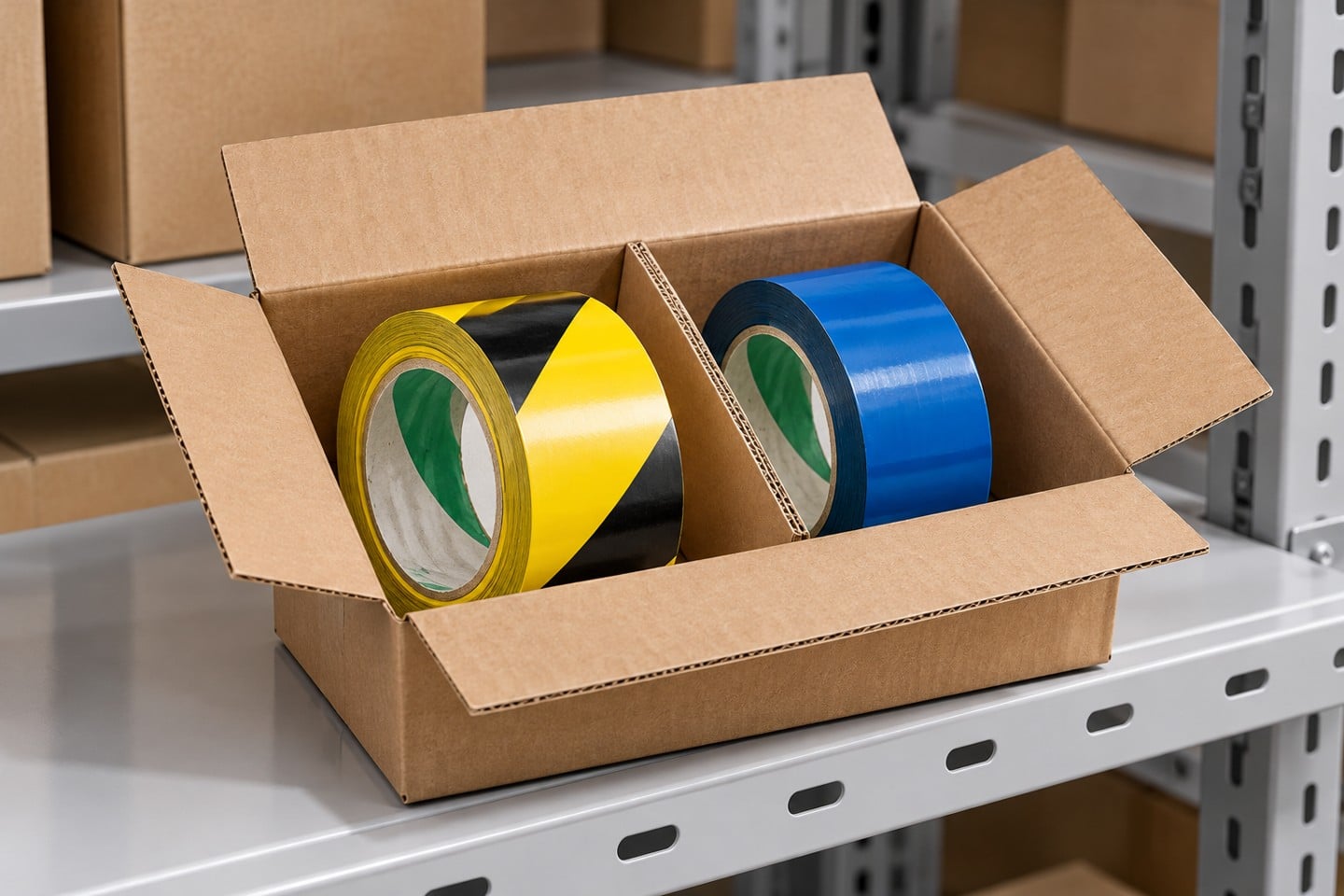
The Produk pita penanda lantai SWESD is the physical reference for this workflow. The visible smooth rolls and color variants help identify practical questions about edges, cores and stock separation. Their appearance does not establish an adhesive formulation, electrical property, cleanroom classification or storage life. Keep those claims outside the record unless applicable product evidence supports them.
Separate receiving acceptance from storage control
Receiving checks determine whether a delivered item can enter inventory under the agreed requirements. Storage control maintains its identity and condition after that decision. Record the receipt and acceptance reference before moving a roll into a normal picking location. If documentation is outstanding or damage is unresolved, use the applicable hold status rather than letting an attractive-looking roll migrate into usable stock.
Gunakan yang sedia ada incoming tape inspection guide for shipment identity and initial condition checks. Storage should preserve that result, not repeat the same inspection under a different name. Define who owns the stock after transfer, where its status is visible and how an issue is recorded. A carton left between receiving and stores can become an uncontrolled location even when both departments maintain good individual records.
Choose a protected location using product information
Follow the actual manufacturer’s instructions for the product and packaging. Avoid treating a general warehouse recommendation as a validated requirement for every tape. Consider whether the proposed location exposes stock to direct sunlight, nearby heat, water, dust, chemicals or physical traffic. Review these conditions against the available product guidance and the site’s storage rules. If a requirement cannot be met, seek an authorized disposition or alternative location.
Keep stock accessible for inspection and counting without repeated unnecessary handling. A protected location should also let personnel identify the item and stock status. Do not pack cartons so tightly that identification requires unloading a whole shelf, or place loose rolls where maintenance materials can fall onto them. The objective is not a cosmetically tidy photograph; it is a storage arrangement that can preserve product information and support controlled issue.
Prevent crushing and uncontrolled surface contact
Use the supplied packaging and an agreed support arrangement to prevent deformation during normal storage. Do not assume every roll can support a tall stack merely because it remains upright in a photograph. Consider the actual carton condition, support surface and handling route. Where stacking or orientation requirements are unclear, obtain product or packaging guidance rather than inventing a load capacity or a universal maximum height.
Protect exposed edges and adhesive surfaces from avoidable contact. Keep loose items, oil-stained tools and unidentified cleaning materials out of the tape storage area. Do not apply a solvent or dusting treatment to restore a questionable roll without an approved method. A roll that looks clean afterward may have a different history and condition. Record the observation and seek disposition when the required product condition is uncertain.
Retain roll identity when cartons are opened
Before separating rolls from an outer carton, establish how each issued quantity will remain connected to the product and required lot or receipt information. Use an approved method that does not interfere with the tape’s functional surfaces or future installation. A shelf label alone can become misleading if several variants share the location or if replenishment replaces the stock without updating the record.
Differentiate manufacturer information from internal inventory identifiers. An internal receipt reference can help trace a delivery, but it is not a manufacturer batch number. If the required original information is absent, record that fact and resolve it rather than inventing a plausible code. Photographs of original packaging can support records, but they do not replace the ability to determine which roll actually came from that packaging after stock is mixed.
| Stock observation | Tindakan sebelum pengeluaran | Information to preserve |
|---|---|---|
| Original package and identity intact | Check status and applicable storage instructions | Product variant and receipt or lot reference |
| Roll removed from outer carton | Maintain an approved identity link | Original identification and assigned location |
| Storage exposure uncertain | Separate pending responsible review | Known event and unresolved information |
| Partial roll returned from work | Apply the approved return and condition review | Issue identity and handling history |
| Date meaning unclear | Request clarification before applying a life limit | Actual date label and supplier response |
| Kerosakan atau pencemaran yang kelihatan | Hold for disposition under site rules | Affected roll, observation and decision |
The table is a qualitative stock-decision aid. It contains no universal adhesive-life or environmental limits. Apply the actual item instructions and approved acceptance requirements to the observed condition. Keep a record of the decision when stock is held, moved or released after an exception. A staff member should be able to explain why a particular roll is usable without relying on the memory of whoever originally opened the carton.
Rotate stock according to the dates that actually exist
Determine which date is provided and what it means. Manufacture date, delivery date and a supplier-stated expiry date are different information. Use the applicable stock rule for the actual product. Do not calculate a fictional expiry by adding an arbitrary number of months to a receipt date. Where the supplier specifies a shelf life, confirm its starting point and storage conditions before incorporating it into inventory instructions.
If no shelf life is supplied, request clarification rather than presenting unlimited usability as the default. The appropriate action may be a documented supplier response, a site-defined review or a hold pending required evidence. Keep the distinction visible between a supplier limit and an internal review date. An internal reminder is useful for managing uncertainty, but it should not be represented as a manufacturer guarantee or a verified material-performance boundary.
cURL Too many subrequests by single Worker invocation. To configure this limit, refer to https://developers.cloudflare.com/workers/wrangler/configuration/#limits
cURL Too many subrequests by single Worker invocation. To configure this limit, refer to https://developers.cloudflare.com/workers/wrangler/configuration/#limits.
cURL Too many subrequests by single Worker invocation. To configure this limit, refer to https://developers.cloudflare.com/workers/wrangler/configuration/#limits.

cURL Too many subrequests by single Worker invocation. To configure this limit, refer to https://developers.cloudflare.com/workers/wrangler/configuration/#limits
cURL Too many subrequests by single Worker invocation. To configure this limit, refer to https://developers.cloudflare.com/workers/wrangler/configuration/#limits.
cURL Too many subrequests by single Worker invocation. To configure this limit, refer to https://developers.cloudflare.com/workers/wrangler/configuration/#limits cURL Too many subrequests by single Worker invocation. To configure this limit, refer to https://developers.cloudflare.com/workers/wrangler/configuration/#limits cURL Too many subrequests by single Worker invocation. To configure this limit, refer to https://developers.cloudflare.com/workers/wrangler/configuration/#limits.
Keep ESD claims separate from marking appearance
Colored or striped tape can communicate a location or boundary without providing an electrical control function. Do not identify a black roll as conductive or grounding-capable from color. Where a tape is intended to serve a specific ESD function, obtain the applicable product evidence and technical review. A stock label should preserve approved claims accurately; it should not create a new performance claim through shorthand or color coding.
The Penjelasan Persatuan EOS/ESD mengenai prosedur kawalan dan bahan provides background for that distinction within an ESD program. It is not an adhesive-storage specification for this tape. Similarly, the association’s panduan latihan dan pengauditan supports making procedures understandable and reviewable, rather than supplying a universal tape shelf life or warehouse inspection interval.
Manage storage exceptions and feedback
If stock is exposed to an unapproved condition, identify the affected rolls and separate them pending review. Record what is known about the event, which information is uncertain and what guidance was requested. Avoid declaring stock failed solely from a guessed exposure, or releasing it solely because no visible change appears. The responsible decision should use the available product information and applicable requirements, with the reasoning retained.
Send recurring installation observations back to stores and purchasing when stock history may be relevant. Preserve the receipt and issue links so the investigation can distinguish a particular supply from surface-preparation or application problems. The panduan pemeriksaan pita yang dipasang addresses lifting edges and replacement decisions after use. That separate workflow can reveal questions for storage review without proving storage was the cause of every installed defect.
ESD context video
The following EOS/ESD Association educational video explains background relevant to the ESD-program discussion. It does not demonstrate tape warehousing, verify adhesive life or certify any pictured roll. Use product-specific instructions for storage decisions and the site’s approved marking plan for installation. The stock identification and exception process described above stands independently of the video.
Soalan Lazim
Adakah setiap pita lantai mempunyai jangka hayat yang sama?
No. Use the actual product information and clarify missing requirements with the supplier.
Bolehkah tarikh resit dipanggil tarikh pengilangan?
No. Preserve the meaning of each actual identifier and date.
Does storage acceptance prove floor compatibility?
No. The actual floor, preparation and installation require their own approved assessment.
Can partial rolls return to unopened stock automatically?
No. Follow the approved return process and preserve their different handling history.
Does black marking tape provide electrical grounding?
Do not infer electrical properties from color. Obtain applicable product evidence for any intended ESD function.


Tinggalkan Balasan