- 터보
- 블로그
ESD magazine rack labels should identify the reusable rack and the PCB lot without confusing those two records. Give the rack a stable asset ID, then attach or associate a removable traveler for the board part number, revision, lot, quantity, process status and destination. Place labels where they can be read and scanned without blocking slots, adjustment locks or inspection points. Reconcile the physical boards at each handoff; a barcode scan cannot prove that the rack contains the expected lot unless the loading step was controlled. This guide gives SMT and warehouse teams a practical labeling rule set while leaving code format and retention periods to their approved quality system.
Separate rack identity from product identity
The magazine rack is a reusable asset. Its permanent ID supports maintenance, cleaning, repair and location history. The boards loaded into it change, so their work order and lot must be treated as a separate, temporary association. Putting a PCB lot number on a permanent rack label creates a stale label after the rack is emptied. Conversely, using only the rack asset ID forces every operator to look up content remotely, which can fail during a line interruption.
Define exactly when the content association starts and ends. At loading, a trained operator verifies the part, revision, lot and quantity, then records the rack ID. At unloading, the destination confirms the received quantity and clears or updates the temporary association. At return, old travelers are removed before the next lot is loaded. The GS1 US explanation of event-based visibility distinguishes tracking events from the data needed to describe them; a rack handoff should capture both the event and the correct product identity.
Choose the minimum fields that prevent mix-ups
For the rack itself, use a unique durable ID and, where required, model, revision or maintenance status. For the temporary product traveler, use controlled identifiers such as board part number, revision, manufacturing lot or serial range, quantity, process step, status and next destination. Add a timestamp and operator or system event when the process needs an audit trail. Avoid copying every available system field onto a tiny card; crowded text becomes unreadable and makes the important distinctions hard to find.
그 IPC standards overview identifies traceability standards for electronic products. The specific customer contract and quality procedure determine which fields your organization must retain. Do not claim that a generic magazine-rack label by itself satisfies all traceability requirements. A damaged or mixed lot still needs product-level records and disposition.
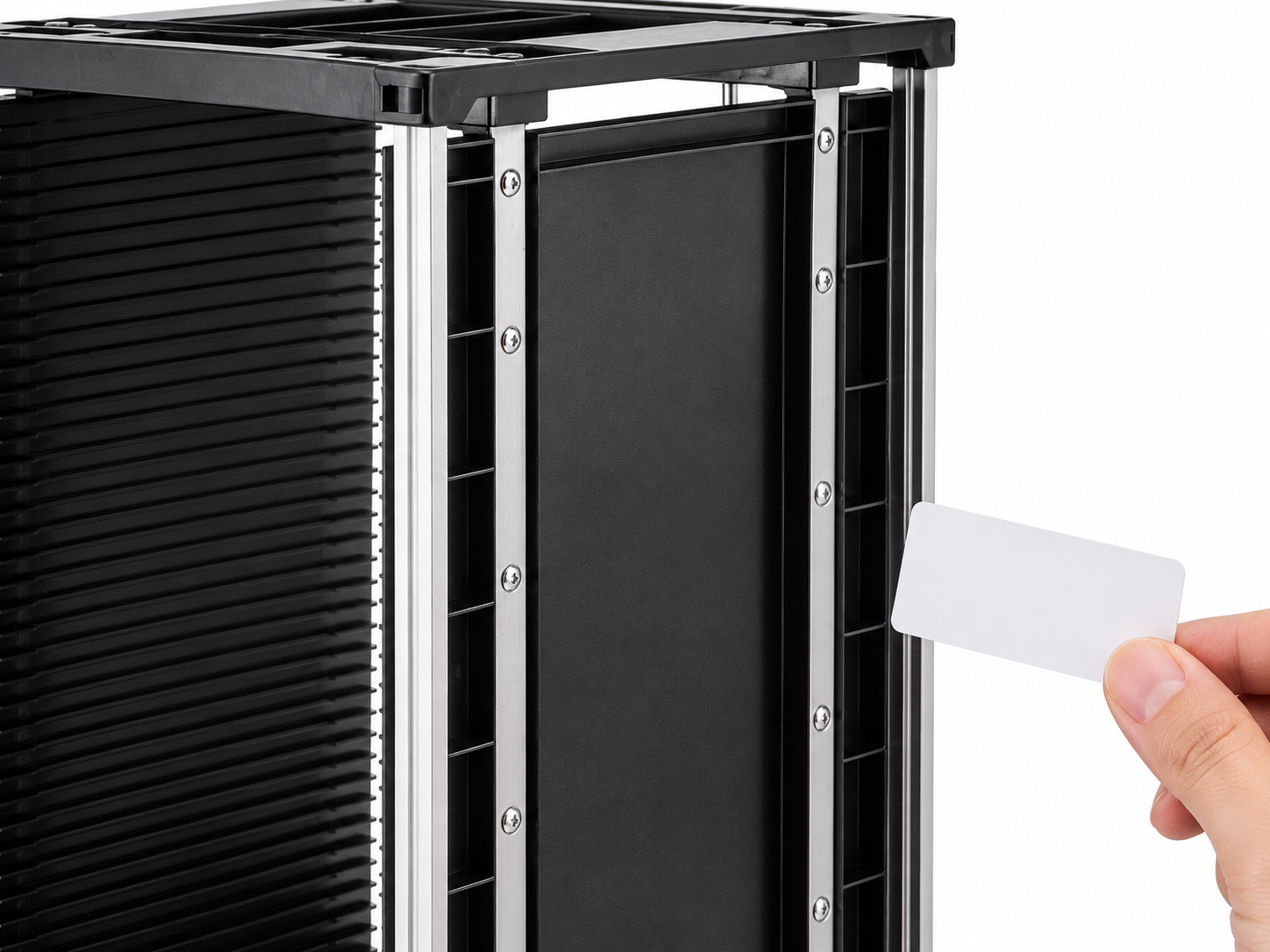
Place labels without changing rack performance
Select a flat, accessible location visible in the rack’s normal orientation. Avoid slot entrances, moving adjustment rails, handles, feet, machine docking surfaces and the PCB contact zone. Test the position on a loaded rack and at the actual scanner angle. A label that is easy to read on a bench may disappear when the rack is in a loader or behind a cart guard.
Check label material and adhesive with the ESD coordinator. Ordinary film or tape can be a process-essential insulator or shed adhesive residue. The EOS/ESD Association’s materials guidance
Design a data-to-rack table for handoffs
| Handoff | Identity to check | Record to create or clear |
|---|---|---|
| Empty rack issued | Rack asset ID and service status | Location and readiness event |
| PCB lot loaded | Part, revision, lot, count and rack ID | Temporary rack-to-lot association |
| Rack moved to next step | Rack ID, destination and physical count | Transfer event with sender/receiver |
| Partial unloading | Remaining board count and lot identity | Update association; do not leave stale quantity |
| Rack emptied and returned | No boards remain; rack condition acceptable | Close lot association and remove traveler |
| Rack quarantined | Rack ID and affected product lots | Hold and quality-disposition record |
This is a workflow table, not an instruction to use a specific barcode symbology. GS1 US guidance on GS1-128 explains that a barcode can carry attributes such as a batch or lot, but a site’s internal rack asset code can be designed differently if its approved system requires it. The key is to make the encoded value, human-readable text and system record refer to the same object and event.
Verify the scan against the physical contents
A scanner may read the rack ID flawlessly while the wrong boards sit inside. At loading, verify the board part and revision against the traveler or work order before linking the lot to the rack. At transfer, count or otherwise confirm the expected quantity according to the process risk. At a partial unload, update the remaining count immediately. Do not permit a new lot to be added to an existing rack merely because an empty slot is available unless mixed-lot rules and physical separation are formally approved.
Test exception handling: unreadable label, duplicate rack ID, scan that points to a closed work order, missing traveler, or a rack whose physical boards disagree with the system. A robust workflow stops and resolves the mismatch. It should not allow operators to type a guessed ID and move on. The ESD tray labeling and MES guide
Define who may correct a wrong association. The person who notices the error should contain the rack, but a trained inventory or quality owner should authorize the correction after checking source documents and actual boards. Preserve the original erroneous event and the correction reason in the audit trail when the system supports it. Silently deleting the first scan makes later investigation harder, especially if the rack has already passed through another station.
Control label changes and cleaning
Choose materials that survive the approved cleaning process without leaving residue, peeling into slots or obscuring damage. Specify who replaces a worn permanent label and who may print a temporary traveler. The old temporary label must be removed or positively invalidated before a different lot is loaded. If a rack is sent to maintenance, its asset ID should remain traceable even if a side panel is replaced. Reapply and verify it under the approved procedure.
Test the scanner after cleaning and under production lighting. A scratched cover, glossy reflection or changed rack orientation can reduce read reliability. Keep a human-readable fallback identifier; a barcode alone is inconvenient during a network or scanner outage. Document how the operator records a manual event and how it is reconciled afterward. The rack cleaning and inspection guide
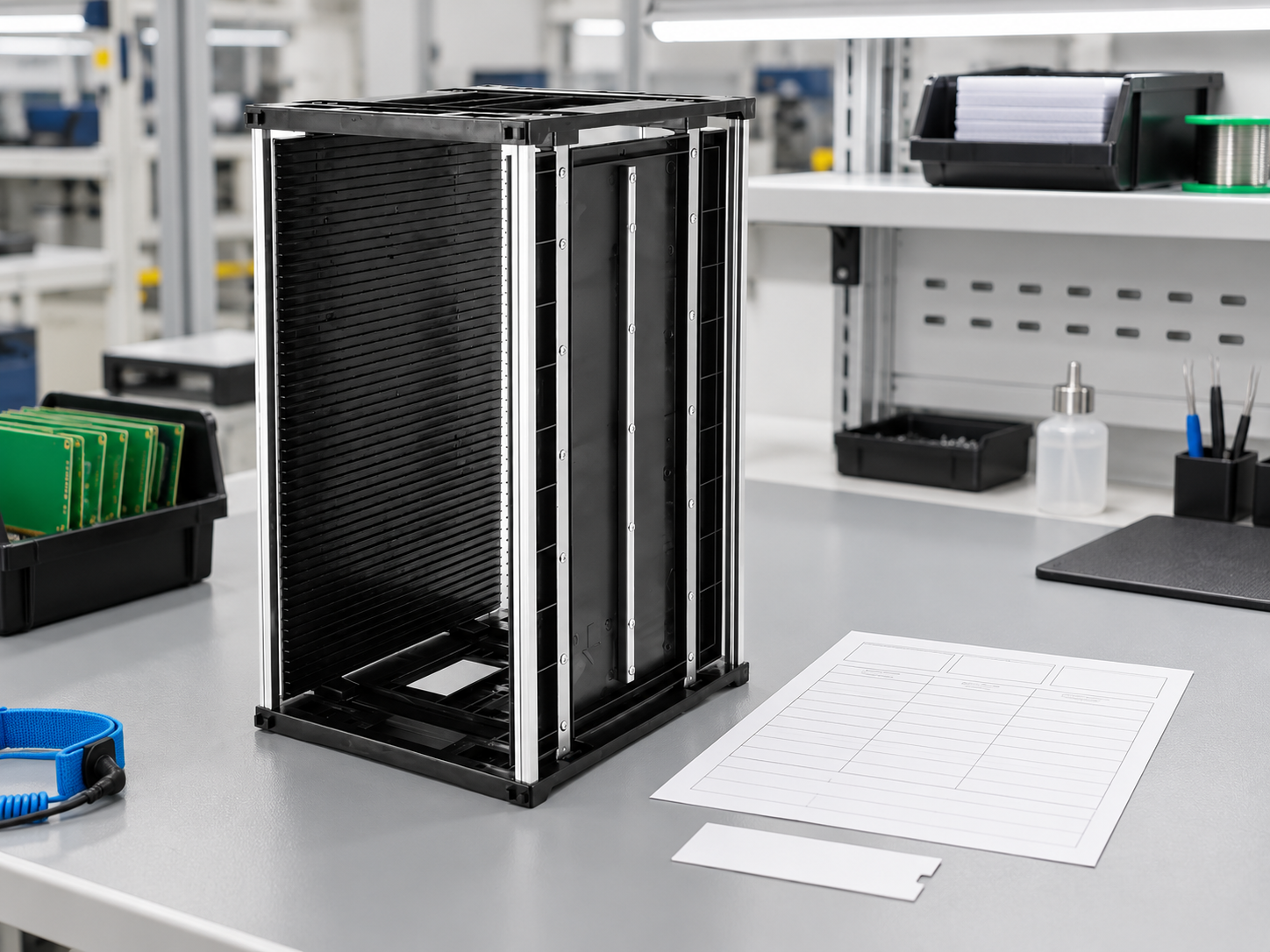
Choose a rack with labeling in mind
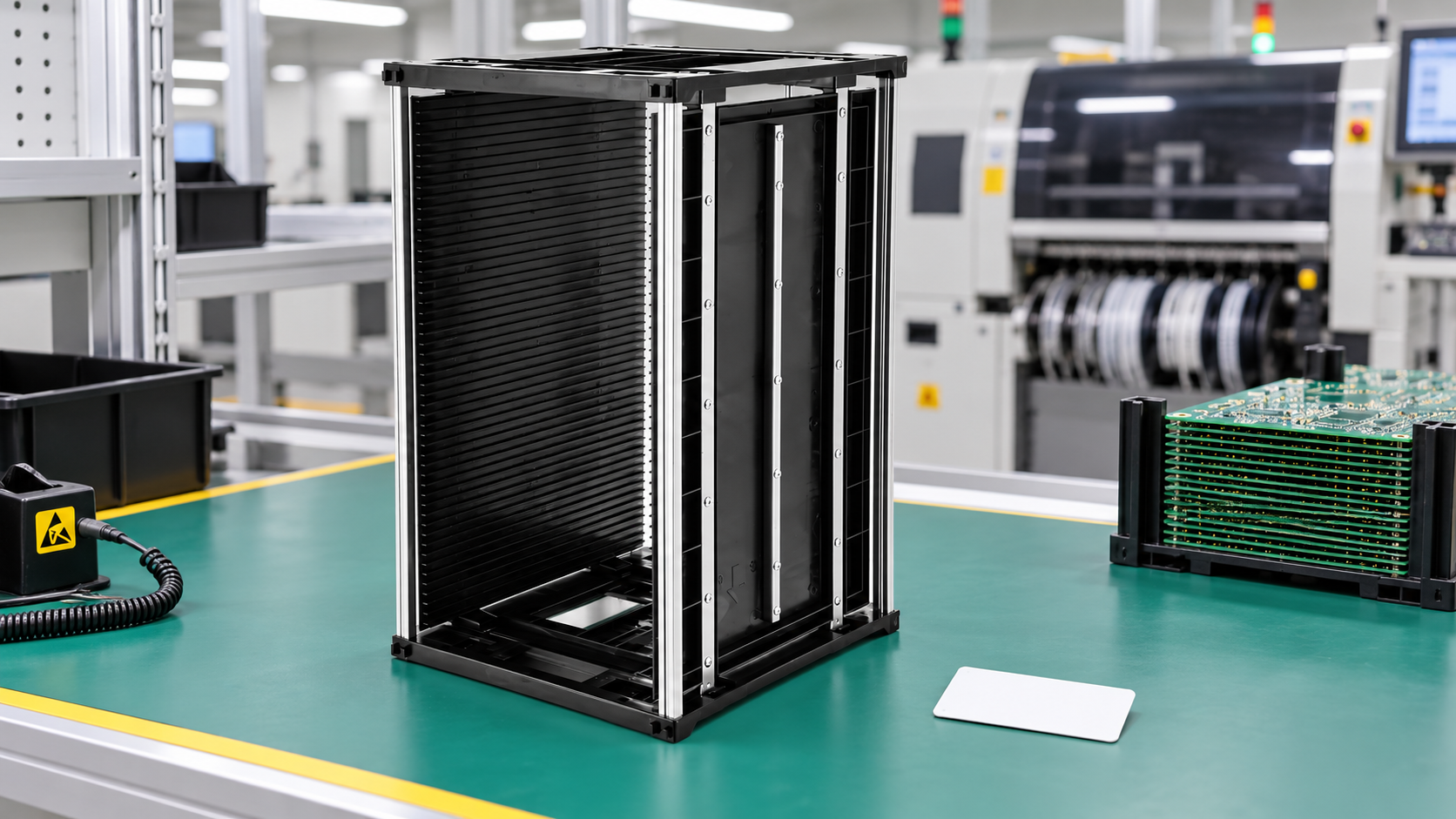
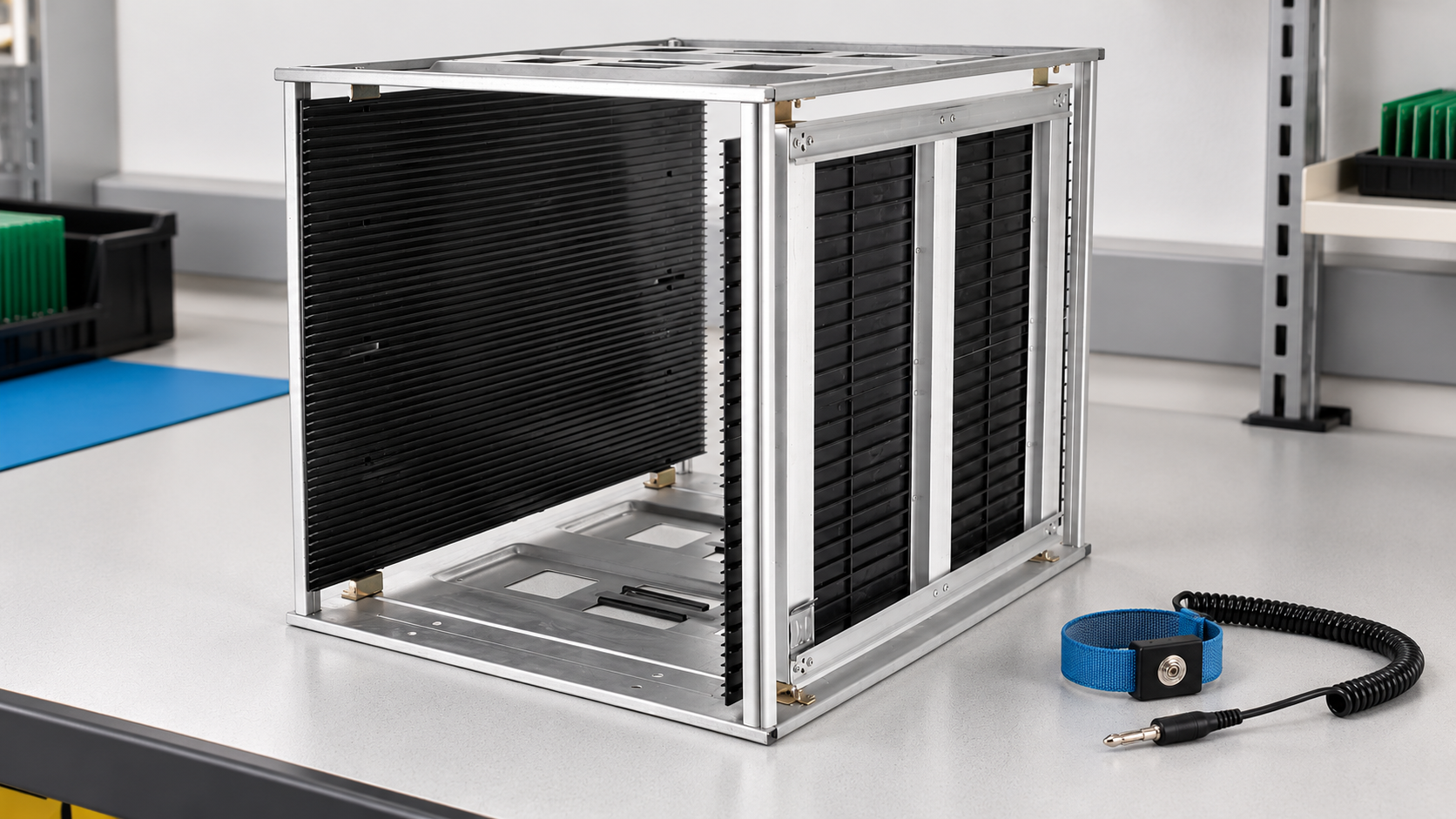
When buying new racks, ask for a controlled asset-label location and a compatible temporary label or holder option. Test it in the widest and narrowest adjustment positions. If the magazine enters automated equipment, verify that the label is visible to the reader and does not interfere with machine guides. The illustrated magazine rack product shows a real frame and panel arrangement; the final label placement must be confirmed on the exact ordered version rather than assumed from the photograph.
Ask whether replacement panels preserve the label location and asset ID. A new panel that covers the old tag can break maintenance history even if board fit remains correct. For line-side buffer locations, the SMT magazine rack buffer guide
Try the label with the real printer, scanner and cleaning material before approving a bulk purchase. Verify print contrast after routine wiping, adhesion after repeated handling, and readability when the rack is inside the selected loader. If an ESD-qualified label holder is required, obtain its material evidence separately; a holder can alter dimensions or introduce a protrusion. Capture the accepted placement in a photo-based work instruction so later operators do not move it to a convenient but unsafe surface.
Audit the traceability chain
Choose a random loaded rack and trace back to the loading event, original board lot and work order. Then trace forward to the next station and eventual empty-rack return. Confirm that the rack ID did not acquire two simultaneous incompatible lots, that partial counts reconcile, and that the temporary traveler was cleared. Record any manual overrides and why they occurred. A successful scan rate is not a complete traceability audit if the underlying associations are wrong.
Train operators on the three identities: rack asset, PCB lot and transaction. Most mix-ups occur when one label is treated as all three. Use visual examples of a stale lot card, a duplicate rack ID and a mismatched physical board. Make containment clear: segregate uncertain material, protect its ESD status and let quality decide disposition. The goal is an unambiguous chain of custody that survives normal changeovers, not a decorative barcode on a reusable rack.
Further learning: traceability events
GS1, a neutral standards organization, explains why events and identifiers matter in a traceable supply chain. Apply the principles to your approved PCB and rack workflow; the video does not prescribe a specific rack label.

자주 묻는 질문
Should a PCB lot number be the rack’s permanent ID?
No. Keep the reusable rack asset ID stable and associate changing PCB lots through temporary travelers and system events.
Can one scan prove the correct boards are loaded?
No. Loading and handoff must reconcile the physical part, revision, lot and quantity with the system record.
Where should a rack label go?
Use an approved visible location that does not obstruct slots, adjustments, machine interfaces or inspection points.
What happens after partial unloading?
Update the remaining count and preserve the correct rack-to-lot association before the rack moves again.
When should a temporary traveler be removed?
Remove or invalidate it as soon as the rack is verified empty and the prior lot association is closed.

댓글 남기기