- Turbo
- Blog
PCB magazine rack transfer between SMT and DIP operations should preserve board support, orientation and process identity through every handoff. Use a carrier approved for the assembled board and the actual route, then verify any loader, buffer or workstation interface separately. Do not assume a magazine that fits the SMT line is compatible with the next operation or suitable for thermal exposure. Define where boards enter and leave the rack, which process states may share a carrier, and how interrupted or suspect material is controlled before production uses the route.
Map the handoff rather than only the travel distance
Record how the board leaves SMT, where it waits, how it is transported and how it enters the next operation. The label DIP may be used informally for a through-hole or downstream assembly area, but the actual operations and equipment determine the route. Identify any manual insertion, inspection, soldering or fixture-loading step that changes support or orientation. Do not select a rack solely because two departments both use PCB carriers.
Include temporary buffers and exception locations. A board may spend more time waiting for release than moving along the aisle. Establish who controls it during that interval and which surface or carrier may support it. The PCB magazine compatibility guide addresses equipment interfaces; this transfer guide concerns the complete handoff and process-state record across departments.
Review the board after the upstream assembly step
Use the populated-board envelope and identify permitted support edges. Components added at SMT can change the clearance needed in a groove or between occupied slots. A downstream operation may introduce additional connectors or other projections. Record which stage each rack configuration covers. A carrier accepted for an earlier board state should not be assumed suitable after its assembled shape changes.
Check whether the board’s orientation must change for the next station. If so, define where and how that change occurs under the approved handling conditions. Avoid turning or resting a board on an unapproved surface because the rack opening is inconvenient. The correct arrangement should support a deliberate transfer sequence, including the gripping points and the destination fixture, rather than relying on operators to invent a workaround during production.
Define responsibilities at the department boundary
Use the table below to make each handoff explicit. It provides no universal spacing, capacity or process temperature. Obtain those requirements from the board, carrier and equipment documentation. The receiving operation should confirm the accepted product state rather than inferring it from the carrier’s location.
| Handoff | Question to resolve | Responsible record |
|---|---|---|
| SMT release | Which board state and variants may leave the operation? | Product and process release information |
| Carrier loading | Which orientation and edges are supported? | Accepted model, width and occupied-slot rule |
| Buffer waiting | How are available and held boards separated? | Current lot and process-state association |
| Transport | How is the loaded magazine supported and retained? | Approved trolley configuration and route conditions |
| Downstream receiving | Does the next support or loader accept the configuration? | Interface trial and receiving identification |
| Exception return | Where does a removed or reworked board remain controlled? | Updated board status and designated carrier or location |
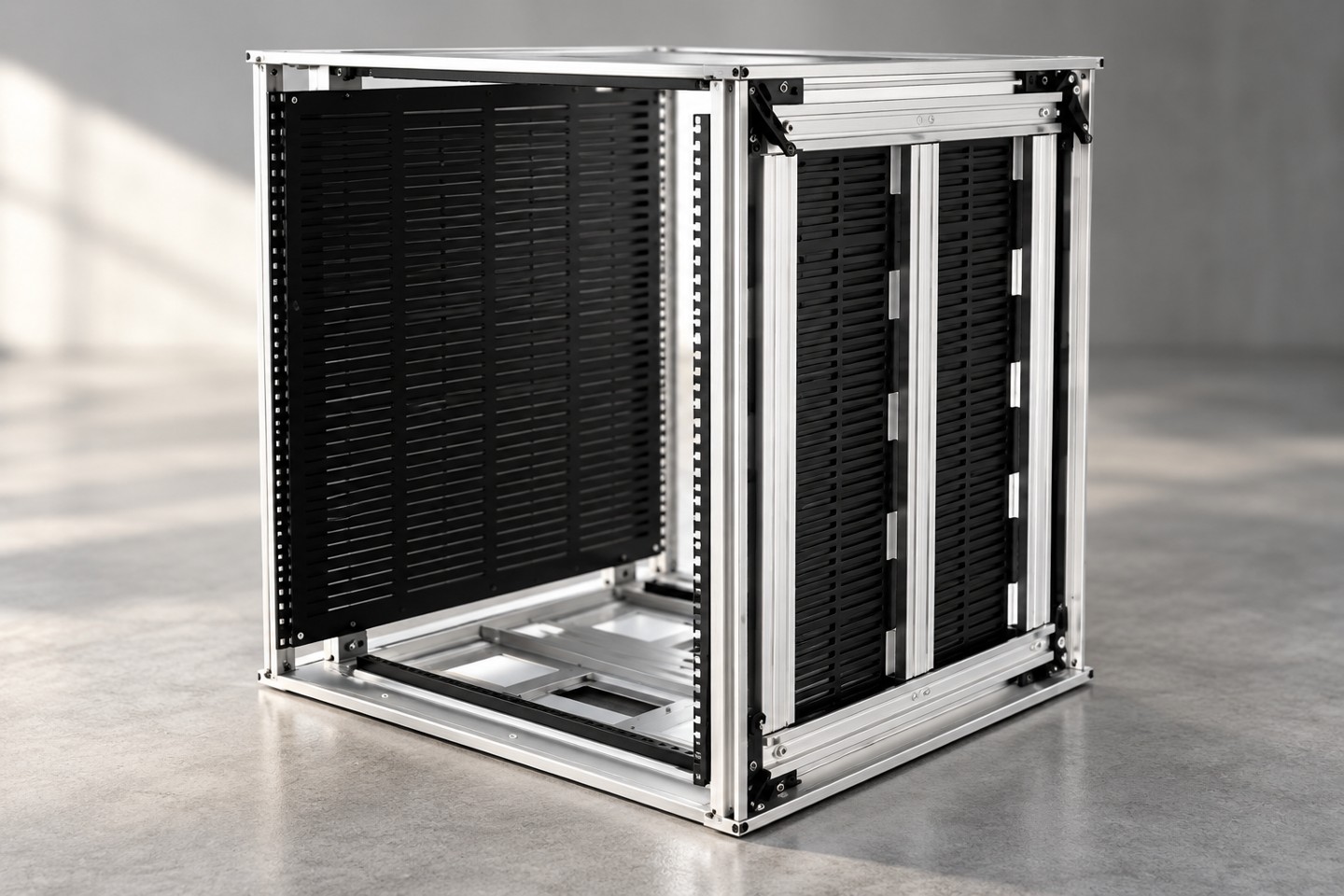
For a physical reference, review the SWESD silver-frame PCB magazine rack. Confirm the exact model, material, base and adjustment arrangement with the supplier. The illustration shows a rack at a transfer point; it does not demonstrate that the carrier has passed an automatic interface or a heated-process qualification.
Keep carrier identity separate from process completion
A rack identifier can link to the current load, but it cannot by itself prove that each board has completed an operation. Define the relationship between carrier, lot, board identity and process record. Decide whether the accepted grouping is one lot per magazine or another controlled arrangement. When a board is removed for inspection or rework, preserve its status and make the destination explicit.
Gunakan magazine labeling guide to review the carrier-level information. Do not leave obsolete route labels on a rack that has been cleared for a new load. If operators use visual status cards, specify who updates them and how they relate to the production system. A visible card that disagrees with the electronic record should trigger a controlled resolution rather than a guess.
Verify ESD controls throughout the transfer
Determine which portions of the route remain inside the EPA and whether any boundary requires a different protective package. The EOS/ESD Association’s ESD control principles distinguish packaging functions inside and outside controlled areas. An open magazine rack does not automatically provide discharge shielding when the board leaves the EPA.
Assess the actual personnel handling, carrier, trolley and transfer surfaces under the site plan. Ask for the relevant electrical evidence and define the installed verification procedure with qualified staff. A conductive rack on an unreviewed transport arrangement is not proof that the complete route is accepted. Keep electrical verification independent from the mechanical interface trial: successful movement into a loader does not establish ESD performance.
Check carrier and transport equipment together
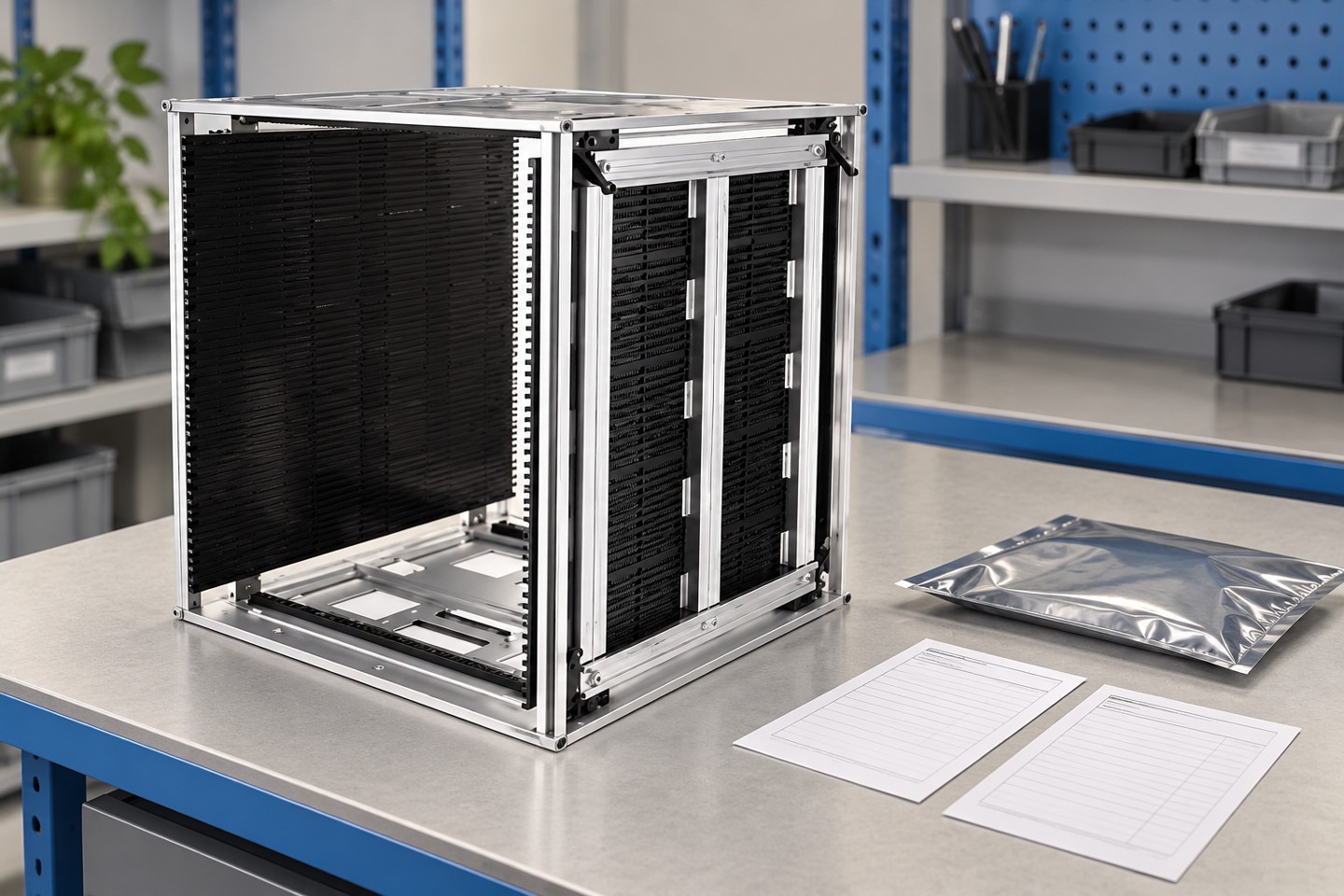
If a trolley moves the magazine, confirm how the rack is supported and retained under the approved configuration. Include the complete loaded mass and distribution in the transport review. A rack that stands stably on a bench can shift when placed on a different supporting surface. Avoid improvised straps, hooks or spacers unless the responsible suppliers and engineer approve their use and the affected configuration is evaluated.
Examine the actual route for floor transitions, corners, door clearances and parking points. Keep handling conditions within the accepted trolley arrangement and the site’s safety procedure. The multi-layer trolley guide provides related carrier questions. Do not infer a permitted load or speed from a demonstration photograph; use the documented equipment conditions and representative route trial.
Keep thermal-process approval separate
The rack may be a buffer near soldering equipment without being suitable to enter its process path. Ask which temperatures and exposure conditions are covered by the exact supplied material and configuration. If boards are warm after an operation, obtain the process owner’s approved cooling and handling instructions. Do not guess a safe cooling duration or assume the rack’s metal frame determines the behavior of all its panels and accessories.
Itu magazine temperature-resistance guide covers the evidence needed for thermal claims. Any proposal to share a carrier with a soldering fixture requires explicit review of the actual process and equipment. Keep a qualified storage or transfer arrangement outside the heated path unless that additional use is specifically approved.
Run a transfer trial with representative boards
Choose a sample set covering the approved board variants and occupied-slot arrangement. Demonstrate loading at the upstream point, the normal route, identification at receiving and unloading into the destination support or fixture. Observe component clearance, board retention and operator gripping. Include an interruption such as a held board or a stopped receiving station so the temporary handling location is evaluated too.
Use the equipment owner’s commissioning and safety procedure for automatic movement. Do not force boards, bypass guards or change settings informally to make one run succeed. Record the accepted rack configuration and relevant interface information. A result applies to the tested combination; later changes to board assembly, groove spacing, base or transport equipment should trigger the appropriate review.
Maintain the configuration between shifts
Inspect the grooves, base, frame and adjustment features that matter to support and repeatability. Keep the accepted width and loading rule visible in the setup record. A rack adjusted for another product should not rejoin the route without verification. Control cleaning and replacement parts so maintenance does not quietly change the arrangement. The EOS/ESD Association’s auditing guidance provides context for documented requirements and verification.
Release the route with clear responsibilities for loading, status updates, transport, receiving and exception handling. Include the accepted board family, carrier model, occupied-slot rule and restrictions on thermal use. The useful outcome is a reproducible transfer that keeps the product supported and identified across the handoff. It is not a general promise that one magazine works with every SMT and downstream line.
Further learning: production material flow
The NPTEL lecture below provides background on material handling systems and buffer locations. Apply the concepts to the actual department handoff while retaining the board-specific, electrical and equipment requirements described above.
Educational video: Lec 27: Material handling systems, NPTEL IIT Guwahati.
Pertanyaan yang sering diajukan
Can the same rack serve both SMT and downstream assembly?
Use it only where the board states, support conditions and equipment interfaces are covered by the accepted configuration.
Does an open rack provide shielding outside an EPA?
Do not assume it does. Determine the required protective package for any route segment outside the controlled area.
Should the route include waiting locations?
Yes. Temporary buffers and interrupted transfers need approved support, identification and responsibility as well as the normal movement path.
Can a rack used near soldering enter the heated process?
Only after explicit approval of that additional use. Staging suitability and thermal-process qualification are different decisions.
What preserves traceability through a handoff?
Maintain the relationship between carrier, board or lot identity and the actual process record, including removed, held and reworked boards.
Postingan Terbaru
-
-
 ESD Wrist Strap Test Frequency and Recordkeeping12 Okt,2026
 -
 Handheld vs Fixed Electrostatic Field Meters12 Okt,2026
Tinggalkan Balasan