- Blog
Screw-clamp and belt-screw (gear-belt) ESD magazine racks both set PCB width between side guides—the difference is how fast operators can change that width and how reliably the setting stays locked. Choose screw adjustment when panel width is stable; choose belt-screw or gear-belt adjustment when high-mix SMT lines re-set guides several times per shift.
This comparison is for production engineers and procurement teams evaluating Râteliers ESD for automated or manual SMT buffering. For handle-operated RFQ fields, see the handle-adjustable RFQ guide; for general buffering, see the guide de mise en mémoire tampon pour magasin antistatique.

Sommaire
- Part 1. How do screw-clamp and belt-screw adjustment work?
- Part 2. Which mechanism fits your changeover frequency?
- Part 3. How do locking and repeatability compare?
- Part 4. What about cost, weight, and spare parts?
- Part 5. Do heat class and automation change the choice?
- Part 6. Fit Boundary: who should choose which type?
- Part 7. How should Sanwei buyers proceed in RFQ?
Part 1. How do screw-clamp and belt-screw adjustment work?
Screw-clamp adjustment loosens multiple clamp screws so a moveable side wall slides to the target PCB width, then re-tightens. Public summaries of Cab Series 600 magazines describe this as a cost-focused approach when width changes are infrequent.
Belt-screw or gear-belt adjustment uses a toothed belt and pulley (sometimes labeled gear track or rack-and-pinion) so operators pull or crank the moveable wall into position within seconds. Cab Series 700 summaries and multiple SMT catalogues position this family for lines that adjust width often.
| Fonctionnalité | Screw-clamp | Belt-screw / gear-belt |
|---|---|---|
| Typical adjust time | Minutes (tool + clamps) | Seconds to low minutes |
| Hardware complexity | Baisser | Higher (belt, pulleys, locks) |
| Best when | Stable PCB width | High-mix width changes |
| Lock method | Clamp screws | Belt lock + often thumb screw safety |
| Training focus | Torque and parallelism | Lock verification after each adjust |
Neither label guarantees ESD performance—verify surface resistance and heat class on the exact SKU.
Part 2. Which mechanism fits your changeover frequency?
Use operational data, not habit:
| Signal | Lean toward | Why |
|---|---|---|
| One panel width per shift | Screw-clamp | Adjust cost rarely paid back |
| 3+ width changes per shift | Belt-screw / gear-belt | Labor and mis-set risk drop |
| NPI-heavy EMS site | Belt-screw / gear-belt | Width bands change weekly |
| Dedicated high-volume SKU | Screw-clamp | Lock once during install |
| Manual buffer, no loader | Either with lock SOP | Automation clearance less critical |
Important : A fast adjustment mechanism does not fix loader mismatch. Provide ear height, outer width, and handle clearance drawings to the supplier when magazines index in OEM equipment. — Source: Sanwei anti-static magazine rack guide automation clearance notes.
Industry spec tables (for example maxsharer B01 rows) list Adjust. columns as Vis versus Gear track alongside temperature and slot counts—use those rows as RFQ templates, not as Sanwei model numbers.
Part 3. How do locking and repeatability compare?
Both mechanisms fail in the same way: moveable wall drift causes slot misalignment and PCB edge damage.
Screw-clamp strengths:
- clamps, when torqued evenly, resist vibration during transport;
- simpler audit: visual check of clamp position.
Belt-screw / gear-belt strengths:
- faster return to labeled width settings between jobs;
- some designs add safety thumb screws to prevent accidental movement.
Repeatability practices (either type):
- Mark approved width settings on the frame.
- Photo-document settings in work instructions.
- Sample slot alignment with a gauge PCB after each adjust.
- Include lock hardware in preventive maintenance.
Quality, logistics, and production teams should review mechanism choice together—not unit price alone—because mis-set width creates scrap faster than hardware savings.
Part 4. What about cost, weight, and spare parts?
Screw-clamp frames often weigh slightly less and cost less upfront when adjustment hardware is minimal. Belt-screw systems add pulleys, belts, and lock components that belong in spare parts BOM.
| Cost element | Screw-clamp | Belt-screw |
|---|---|---|
| Upfront unit price | Usually lower | Usually higher |
| Changeover labor | Higher over a year on mixed lines | Lower on mixed lines |
| Spares | Clamps, screws, side guides | Belts, locks, guides |
| Downtime risk | Slow adjust during rush changeover | Belt wear if PM skipped |
Compare total cost of ownership over 12 months of changeovers, not first quote.
Pilot two shifts on each candidate mechanism and log adjust minutes, misalignment events, and loader stops before plant-wide standardization. That dataset settles screw versus belt-screw debates faster than catalog marketing language.
Part 5. Do heat class and automation change the choice?
Heat exposure and loader interfaces constrain both mechanisms equally—wrong guide material fails regardless of adjust type.
Sanwei Page de solution de rack à magazines ESD publishes 160 °C standard heat resistance with qualité 200°C en option, 10⁶–10⁹ Ω surface resistance, and customizable slot pitch. Apply those Sanwei-stated limits when reviewing Sanwei materials; third-party screw or belt racks may differ.
Automation checklist (both types):
- outer L×W×H within loader spec;
- loaded weight within OEM rating;
- reversible/stackable needs if double-sided boards;
- transport lock if magazines move on carts between buildings.
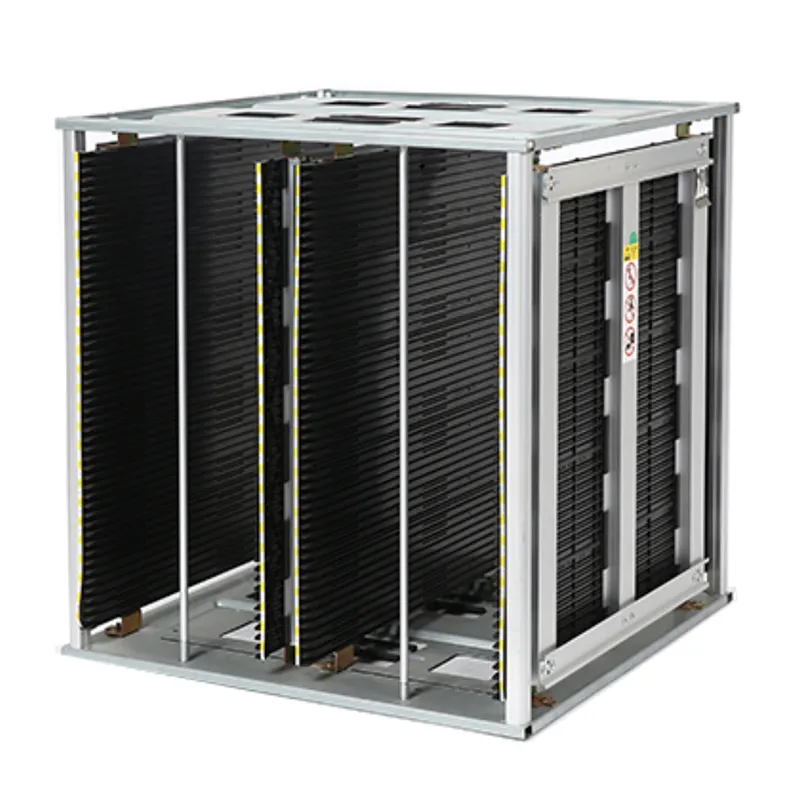
Warm queues after reflow require heat-rated guides even if width changes rarely—do not downgrade heat class to save cost on screw-clamp racks sitting near ovens.
Part 6. Fit Boundary: who should choose which type?
| Buyer profile | Screw-clamp | Belt-screw / gear-belt |
|---|---|---|
| Stable width, high volume | Recommended | Optional |
| High-mix SMT or EMS | Acceptable if changeovers rare | Recommended |
| Heavy multilayer boards | OK with metal base + even clamp torque | OK with verified lock + metal base |
| Export multi-site standard | Good when all sites run same width | Good when sites share mixed mix |
| Tight capital budget | Favor if changeovers prove rare | Justify with logged changeover labor |
Avoid stocking both mechanisms without color/label rules—operators grab the wrong rack and force emergency adjusts during downtime.
Part 7. How should Sanwei buyers proceed in RFQ?
Recommandation de produit
Sanwei lists multiple footprints on its Catégorie de présentoirs de magazines ESD—from 355×320 mm class through 630×530 mm sizes. Mechanism and pitch customization flow through engineering/OEM channels per the page de solution et OEM/ODM entry.
For wider panel programs, start technical review with the 535(L)×460(W)×H mm listing and compare against your PCB width band before selecting adjust hardware.

RFQ fields specific to mechanism choice
| Champ | Screw-clamp buyer | Belt-screw buyer |
|---|---|---|
| Width range | Min–max mm | Min–max mm |
| Changeovers per shift | Low (justify screw) | High (justify belt) |
| Lock verification | Torque / clamp witness mark | Belt lock + safety screw |
| Spares | Clamp kit qty | Belt + lock kit qty |
| Loader OEM | Required if automated | Required if automated |
Submit drawings through Contactez-nous with quantity bands and destination country for export documentation.
FAQ
What is the difference between screw and gear-belt adjustment?
Screw-clamp uses fasteners at the moveable wall; gear-belt uses a belt/pulley path for faster travel. Both require a verified lock before loading PCBs.
How often should PCB magazine width be adjusted?
Only when PCB width changes. High-mix lines may adjust several times per shift—that frequency pushes toward belt-screw or gear-belt hardware.
Which rack type is best for high-mix SMT?
Belt-screw or gear-belt adjustment is usually easier to justify when width changes are frequent; confirm with logged changeover data.
What is gear belt width adjustment?
A toothed belt connects the moveable side wall to an adjustment handle or crank so width changes without loosening multiple screw clamps.
How do you lock width after adjustment?
Screw-clamp: re-tighten clamps evenly. Belt-screw: engage belt lock and any safety screw; verify with a gauge PCB.
Can a plant use both types?
Yes, if color codes and work instructions separate stable-SKU lines from mixed lines.
Do screw-clamp racks fail ESD audits?
Only if resistance is unverified or guides are damaged. Mechanism type does not replace Ω test logs.
Should buyers run a pilot before standardizing?
Yes—run two shifts per line type, log adjust time, misalignment events, and loader jams before global PO.

Laisser un commentaire