- Turbo
- Blog
Low charging packaging and conductive packaging describe different functions. Low charging concerns the charge generated through contact and separation during handling. Conductivity concerns the material’s ability to conduct charge under defined conditions. A resistance result does not, by itself, prove low charging behavior, and a low charging claim does not prove discharge shielding. Buyers should specify the functions required for the device and route, then request separate evidence where those functions require different methods. This guide explains how to keep the claims distinct when comparing samples, reading reports and approving a completed package.
Start with the handling event, not the color of the material
Describe what happens when the component enters, moves within and leaves its package. The relevant contacts might involve a carrier pocket, a pouch surface, a liner or a support. Identify which materials touch the device and where separation occurs. Include unpacking at the receiving site rather than treating dispatch as the end of the protection requirement.
La EOS/ESD Association principles of ESD control explains charge generation through contact and separation and the different behavior of conductive and insulating materials. Use those concepts to ask useful questions about the handling event. Do not interpret a material’s familiar appearance as a measurement of what occurs during that event.
A silver pouch, black tray or pink film is not a complete functional specification. Different constructions can look similar, and the finished package may combine several materials. Ask which surface and which delivered product the supplier’s statement covers. Keep the actual package configuration visible in the discussion, including closures, supports and anything added by the packing team.
Understand what a resistance report can establish
A resistance report describes the result obtained for an identified specimen with an identified method and conditions. Review the test arrangement, specimen preparation, conditioning and units before using the result. A surface measurement is not automatically interchangeable with a volume measurement, nor does a reading at one location establish every property of an assembled package.
The report is useful when it answers a defined purchasing requirement. If the supplier states “conductive,” ask how that classification was determined and what finished item was evaluated. Check that the method and acceptance rule align with the controlled specification you are using. Do not choose a universal numerical threshold from an unrelated web article and retrofit the purchasing document around it.
For a broader discussion of material choices, use the static-dissipative packaging material guide. This article focuses on separating a charging claim from an electrical-conduction claim, rather than replacing that general selection guide or presenting a laboratory test procedure.
Ask a different question about low charging behavior
Low charging is about limiting charge generation in the relevant contact and separation process. A purchasing review should therefore ask what contact pair, handling action, conditions and evaluation support the claim. A material that is described as low charging in one context should not automatically be treated as approved for every component surface and packing routine.
La EOS/ESD Association discussion of control materials distinguishes low charging, conductive or dissipative properties and discharge shielding in protective packaging. Its practical implication for a buyer is to avoid collapsing the functions into a single “ESD safe” checkbox. Specify the required functions and determine what evidence addresses each one.
Do not invent a quick rubbing test for exposed production devices. Have the ESD coordinator or a qualified laboratory define the applicable assessment and its limits. An informal observation may help identify a question, but it should not become a release certificate. Keep exploratory work separate from formal qualification, with clearly identified samples and approved handling conditions.
Keep discharge shielding as a separate approval question
Some packages must also protect against discharges originating outside the package. That is a different requirement from reducing contact-generated charge or conducting charge through a material. Evaluate the route and the applicable control requirements, then ask for the evidence appropriate to the completed protective configuration. Do not infer shielding from color, a symbol or one resistance value.
Closures, openings, punctures and the actual packing arrangement belong in that review. A material sample may not represent a pouch after it has been folded, labelled, loaded or damaged. If the evidence covers only an unused flat specimen, ask the qualification owner how the finished configuration is addressed. Avoid making a new shielding claim simply because the material is described as metallic.
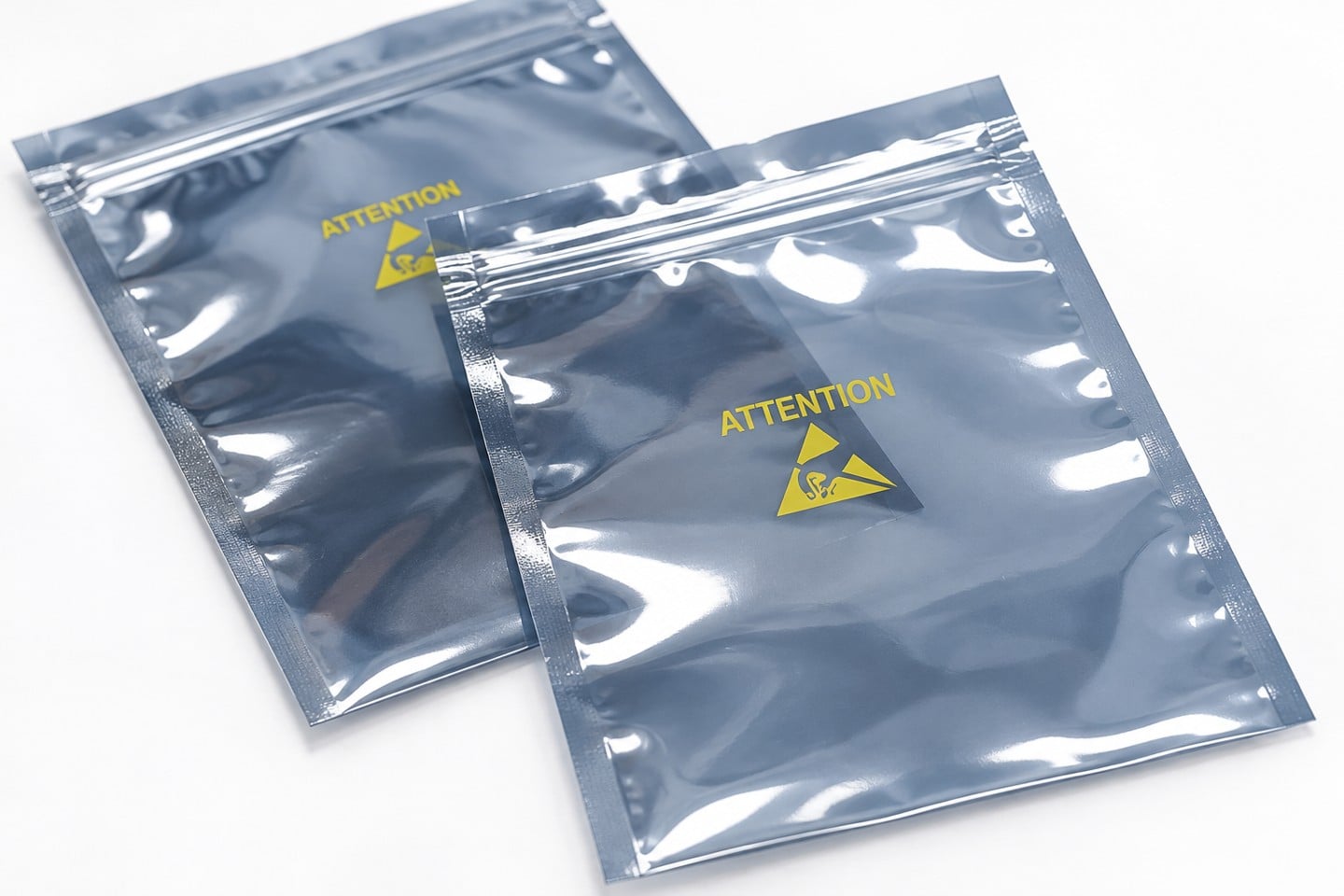
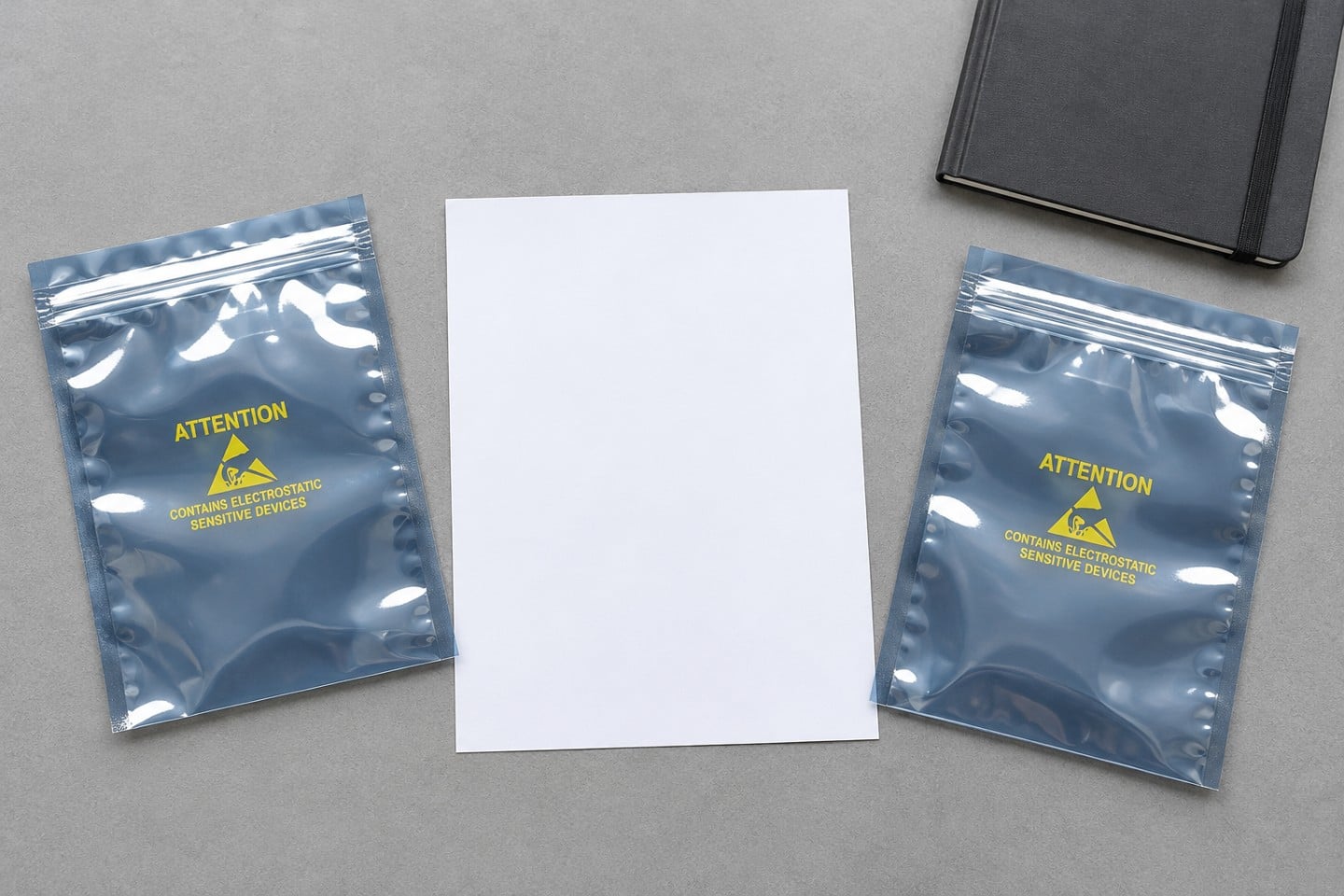
La SWESD shielding bag product is a relevant starting point for a sample and document request. The photographs here preserve that product’s pouch form, closure and reflective appearance; they do not establish layer chemistry, numerical performance or approval for a particular device. Request the current product evidence and application instructions before release.
Review a supplier claim with a function-by-function matrix
The following matrix is a practical document-review tool. It identifies questions and evidence categories, not universal limits or a substitute for the applicable controlled methods. Keep any unresolved function visibly open until the responsible owner accepts the evidence.
| Function or review field | Question to ask | Evidence to connect |
|---|---|---|
| Low charging | What contact and separation operation supports the claim? | Applicable evaluation, identified materials and conditions |
| Electrical conduction | Which property was measured on which specimen? | Relevant resistance method, conditions, units and results |
| Discharge shielding | Does the required finished configuration have supporting evidence? | Applicable package evaluation and identified closure arrangement |
| Mechanical and process fit | Can the package be loaded and closed as approved? | Representative fit and handling review |
| Traçabilité | Does the report apply to the supplied product? | Product code, report identity and controlled construction |
| Change control | What modifications require technical review? | Supplier notification and documented reapproval decision |
Copy the exact product code, report reference and configuration into your review record. If a supplier uses one general certificate for several products, ask which results apply to the offered item and how that connection is controlled. A report bearing the right technical term is not sufficient if its specimen cannot be linked to the purchased package.
Inspect the scope and conditions behind the evidence
Start with the report’s purpose. Was it a material-development study, a qualification of a finished package or a routine check of a production lot? Each can be useful, but they answer different questions. Identify the laboratory, method, revision, sample identity, reported conditions, measured results and the acceptance basis used by the report’s author.
Check whether the specimen was new, conditioned, cleaned, aged or otherwise treated. Record those facts rather than assuming the same behavior after every shipping cycle or cleaning operation. If the intended use differs, ask what additional evidence is needed. Avoid inventing a lifetime or an allowable number of reuses from a successful initial test.
Compare like with like when evaluating suppliers. Different reporting units, methods or sample arrangements may prevent a direct ranking. In that case, mark the comparison as unresolved and request a common evaluation plan. An apparently better number can be less useful than a clearly traceable result obtained under the conditions your specification actually requires.
Map every added material and packing operation
A package specification should show which material contacts the device and which layer provides another required function. Include inserts, labels, closure aids and any packing materials added at the workstation. Ask whether a proposed substitution changes a relevant contact surface, geometry or closure. Do not approve an additional liner simply because it is described as antistatic.
Observe a representative packing and unpacking sequence with qualified personnel. Record movement of the item, interference with closure, handling difficulties and opportunities for accidental substitution. Keep the trial within approved ESD controls and use suitable test articles where the package is not yet released. A realistic process review does not require exposing customer product to an unapproved arrangement.
La PCB packaging specification guide addresses the wider packing specification. Use the present distinction to make its material requirements clearer: identify each required function and the evidence behind it, then connect that evidence to the exact arrangement operators will use.
Turn the comparison into a clear RFQ
Send a supplier the device or assembly information they are authorized to receive, the intended route, contact arrangement and relevant protection requirements. Ask for separate responses on charging behavior, electrical material properties and any shielding requirement. Request the actual method and evidence reference instead of accepting a single sentence claiming that the product is suitable for electronics.
Include mechanical fit, contamination concerns, closure method and identification needs as separate fields. These do not disappear when electrostatic requirements are met. A package can address an electrical concern yet fail because the device moves, a projection punctures the pouch or the receiving operator cannot identify the contents safely. Keep those approval decisions connected without treating them as the same test.
Require suppliers to identify substitutions and changes that affect the released construction or evidence. The purchasing record should distinguish the approved product from an apparently similar catalog option. If the supplier cannot provide the requested information, state which approval remains incomplete and who will resolve it; do not silently downgrade the requirement to obtain a quotation.
Control the package after approval
At receipt, compare delivered identity, construction and documentation with the approved record. Define what operators should do when a package is damaged, an unexpected material appears or the intended closure cannot be achieved. Make the correct configuration easy to identify at the packing station so people do not have to infer it from color or memory.
If an investigation follows a shipment problem, preserve the relevant layers and their identities. Separate observations about visible damage, material properties and device failure mechanism. The packaging failure analysis guide covers that evidence-preservation workflow; a failed device does not by itself identify which packaging function failed.
Review changes using the same function-by-function record. A revised contact material may require a charging review, while a changed closure may raise a different protection question. Have the responsible technical owner decide the evaluation scope and retain the reason. This approach makes the decision repeatable without assuming that every change needs the same set of tests.
The EOS/ESD Association introductory lecture provides background on charge generation and ESD control. It is an educational supplement, not a test report for the pictured pouches or a replacement for your package qualification.
Foire aux questions
Does conductive mean low charging?
No. Conductivity and charge generation describe different properties; one resistance result does not establish both.
Does low charging mean discharge shielding?
No. Specify shielding separately where it is required and request evidence for the relevant completed package.
Can package color establish its electrical performance?
No. Color and appearance cannot replace the product identity, relevant test evidence and application review.
Should buyers compare every resistance number directly?
Only after confirming comparable methods, specimen arrangements, conditions and reporting units.
What is the most useful RFQ change?
Separate the required functions and request evidence linked to the exact finished configuration rather than using one general ESD-safe checkbox.



Laisser un commentaire