- Turbo
- Blog
Reusable ESD trays are valuable when the same part family moves repeatedly between receiving, inspection, storage, production and return logistics. The decision is not simply “plastic tray versus disposable packaging.” A reusable program must control electrical performance, fit, cleaning, inspection, loss, repair and replacement. The best tray is the one that protects the component, survives the route and can be returned to service with a predictable inspection record.
When a reusable ESD tray program makes sense
Estimate the number of trips, one-way packaging cost, return freight, cleaning labor and expected service life. Reuse usually becomes attractive when a tray makes several controlled trips and the return route is reliable. If trays routinely disappear, arrive contaminated or require manual rework, the apparent savings can disappear. Include the cost of damaged parts and line interruptions in the comparison.
| Decision factor | Question to answer | Evidence to collect | Warning sign |
|---|---|---|---|
| Electrical control | Does the material meet the applicable requirement? | Supplier declaration and test method | Color used as proof |
| Mechanical life | Does the tray stay flat and locate correctly? | Cycle sample and dimensional checks | Rocking, cracks or bowing |
| Cleanability | Can the process remove residue without damage? | Cleaning trial and visual inspection | Residue, fading or sticky labels |
| Return control | Can every tray be accounted for? | Asset ID and movement record | Unknown quantity in the loop |
Separate tray identity from part identity
Give each reusable tray a durable asset identity and use a removable material label for part number, lot, quantity and status. This keeps the tray history intact when the contents change. A tray asset record can include size, revision, material, purchase date, cleaning status and inspection outcome. The material record should link to the customer’s lot and work order.
La EOS/ESD Association ESD fundamentals explain why packaging controls must be considered as a system. The ANSI/ESD S541 overview provides packaging context. Neither source makes a particular tray color or supplier claim sufficient by itself.
Build a receiving and inspection standard
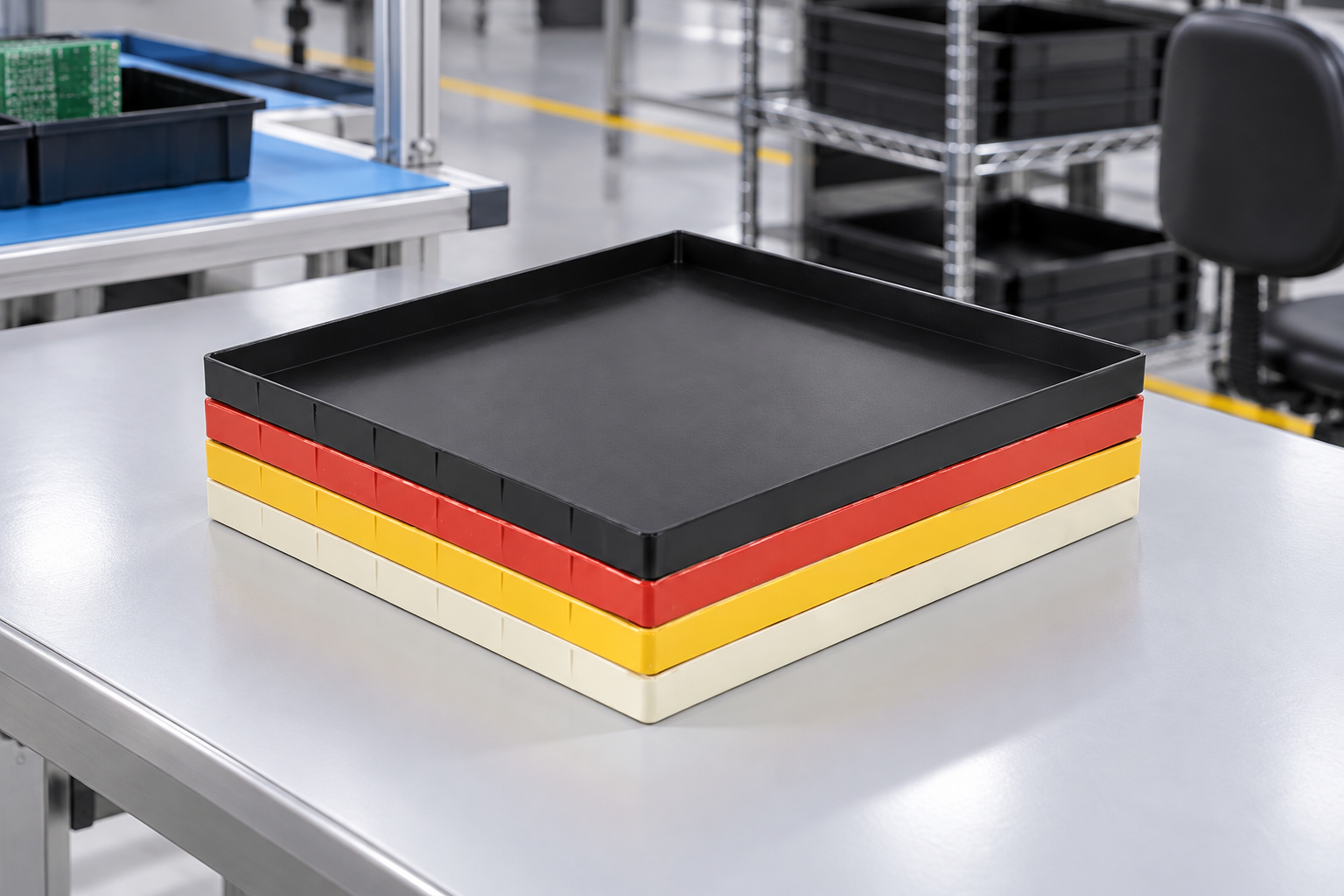
At receiving, check the tray footprint, rim, corners, base, label zone and visible contamination. Stack two empty trays and test the approved interface. Then inspect a loaded sample with the actual liner or separator. Record defects by asset ID. Do not return a tray to service because it looks clean if it no longer locates or supports the load correctly.
Use simple dispositions: release, clean, repair review, quarantine or scrap. Define who can change each disposition. If a tray is cleaned outside the normal process, require a new inspection before it enters the production loop.
Design cleaning around the material
Choose a cleaning agent, concentration, temperature, rinse and drying method that the tray material and labels can tolerate. Test the complete assembly, including holders and liners. Look for whitening, swelling, warping, residue, loss of contrast and changes to the surface. Never add an unapproved coating to restore appearance or electrical behavior.
Set a maximum time between cleaning and use when dust or humidity matters. Store clean trays covered or in a controlled location. Separate dirty returns from released trays so an operator cannot accidentally load components into an uninspected unit.
Measure lifecycle cost honestly
Track trays issued, returned, cleaned, repaired, quarantined and lost. Add cleaning labor, return freight, storage space, labels, inspection time and disposal. Compare the cost per successful trip, not just the purchase price. A reusable tray that is cheap but frequently unavailable may cost more than a higher-quality design with better return control.
Use a pilot with representative routes and part loads. Measure actual cycle time, defect rate and missing-asset rate. Keep a baseline for disposable packaging so the team can compare service, damage and waste as well as direct cost.
Repair and end-of-life rules
Define which defects are repairable. A removable label or liner may be replaced, but a cracked wall, distorted rim or damaged support surface may invalidate the tray. Do not blend repaired and new revisions without recording the change. At end of life, remove labels and follow the material and customer disposal requirements.
Train users and control the return loop
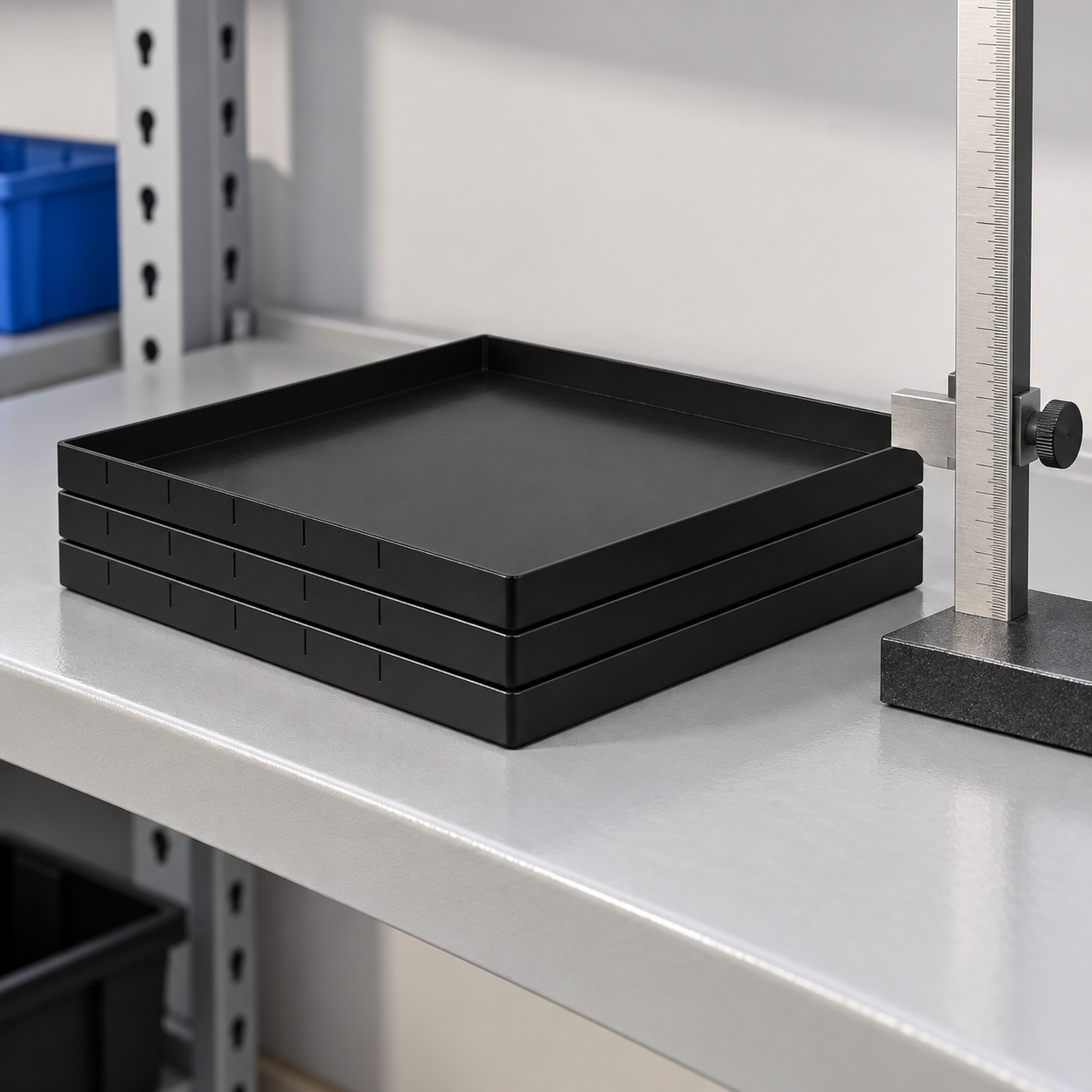
Show operators how to lift a stack, where to place dirty returns, how to report a damaged label and when to quarantine a tray. The return instruction should state the allowed orientation, maximum stack quantity and destination. Put the same rules on carts and storage racks. A reusable program fails when the empty-return process is treated as an afterthought.
Use barcode or RFID transactions where the value and volume justify them. A scan should record issue, move, return, cleaning and release. When a tray cannot be scanned, use a controlled manual exception and reconcile it later.
Prevent common reuse failures
The first failure is mixing clean and dirty returns. Solve it with physically separate lanes and a status that cannot be changed by anyone who is not trained. The second is allowing a tray with an old label to carry a new lot. Remove or invalidate the old label before loading. The third is assuming a tray remains dimensionally stable forever. Check the base and rim at a defined interval and after any incident that could create impact or heat.
Another failure is using a liner that is easy to install but difficult to clean. Validate the tray and liner as one assembly, including retention, particle generation, drying and replacement. If the liner changes the support path or the part height, repeat the stack and clearance check. A reusable program should have a change-control trigger for resin, colorant, label holder, liner, cleaning agent and equipment.
Finally, make the process measurable. Review monthly return rate, missing assets, quarantine rate, cleaning failures, damage by route and successful scans. A rising quarantine rate may signal a cart problem, a poor stack height or an unsuitable cleaning step. Use the trend to improve the route instead of simply buying more trays.
When setting inspection frequency, use risk rather than an arbitrary calendar. A tray that stays on a protected rack may need less frequent dimensional review than one loaded onto carts, conveyors and trucks every day. Keep the reason for the interval in the quality record. If customer requirements specify a shorter interval, follow the stricter rule.
Include a clear owner for every handoff. Receiving owns identification, cleaning owns chemical control, quality owns disposition, production owns correct use, and logistics owns return reconciliation. The names can differ by company, but the responsibilities must be visible. This prevents a tray from waiting indefinitely because everyone assumes another department will inspect it.
A short pilot should include normal and worst-case parts, the longest realistic dwell, representative cleaning, a full return trip and at least one deliberate label exception. Document the results with photographs and sample IDs. Approve the reusable loop only after the evidence shows that the component, tray, operator and system remain aligned.
Keep rejected units physically separated and make the quarantine reason visible. If a tray is later released, record the corrective action and inspector. This small discipline protects the production team from reintroducing an apparently clean but unverified tray into a controlled process.
Use the same inspection language in the supplier agreement, internal checklist and return instruction. Consistent terms make trend reviews easier and prevent a “minor” defect in one department from becoming a release decision in another. Reuse is successful when the physical tray and its documented history remain together for every trip.
Review the pilot with operators before full rollout. Their feedback on stacking, carrying, cleaning and scanning often exposes a practical failure earlier than a spreadsheet model. Correct the instruction and retrain the affected shift before expanding the loop.
How to specify reusable ESD trays
- Part envelope, cavity or liner requirements.
- Material and electrical property requirements with test method.
- Stacking, nesting, cart and conveyor interface.
- Cleaning chemistry, temperature and drying limits.
- Inspection points, defect photographs and disposition rules.
- Asset identity, label zone and return data.
- Sample quantity, pilot duration and acceptance criteria.
Utilisez SWESD ESD tray range as the physical starting point. The anti-static component tray guide explains broader selection. Review load validation, MES labeling et color-coding controls before approving a return loop.
Further learning

Foire aux questions
How many times can an ESD tray be reused?
There is no universal number. Set life from the material, load, cleaning process, handling route and inspection evidence.
Can cleaning restore a damaged tray?
Cleaning removes approved contamination; it does not restore a cracked wall, warped base or failed locating interface.
Should the tray ID change with every lot?
No. Keep the tray asset ID stable and assign the lot and contents through a removable label or system record.
Is reusable always cheaper?
No. Compare cleaning, return freight, storage, loss, inspection, repair, damage and availability as well as purchase price.
When should a tray be quarantined?
Quarantine it when it is cracked, bowed, contaminated, untraceable, difficult to clean or unable to locate and support the approved load.
Laisser un commentaire