- Turbo
- Blog
ESD trolley load capacity must cover the complete working load and its distribution, while the frame, shelves, fasteners and casters remain suitable for the real route. Do not multiply one caster rating by four and call the result the trolley rating. Confirm the assembled trolley's approved capacity, individual shelf limits, caster test conditions and stability with representative loads. Electrical suitability is a separate acceptance requirement. This guide helps procurement specify evidence and trials for PCB and component transport; it does not assign an unverified weight rating to a pictured SWESD trolley or transfer a competitor's specification to it.
Define the load before requesting a rating
List every item that travels on the trolley: boards, magazines, trays, boxes, fixtures and handling accessories. Record the maximum normal quantity and measured mass for each configuration. Distinguish payload from the trolley's own mass. Procurement documents sometimes use “total load” for different quantities, so ask the supplier to state what its rating includes. A shelf limit, assembled payload limit and caster load are different specifications and should appear separately.
Write the use case beside the mass. A cart parked beside an SMT line experiences different demands from one repeatedly crossing door joints with tall magazines. State whether the trolley is manually pushed, towed or used as stationary storage. Do not approve towing merely because the cart rolls freely. Speed, turning, stopping and the route must stay within the assembly's approved duty. If operators routinely add an extra box, include that in the permitted configuration or explicitly prohibit it.
Trace the weakest part of the assembly
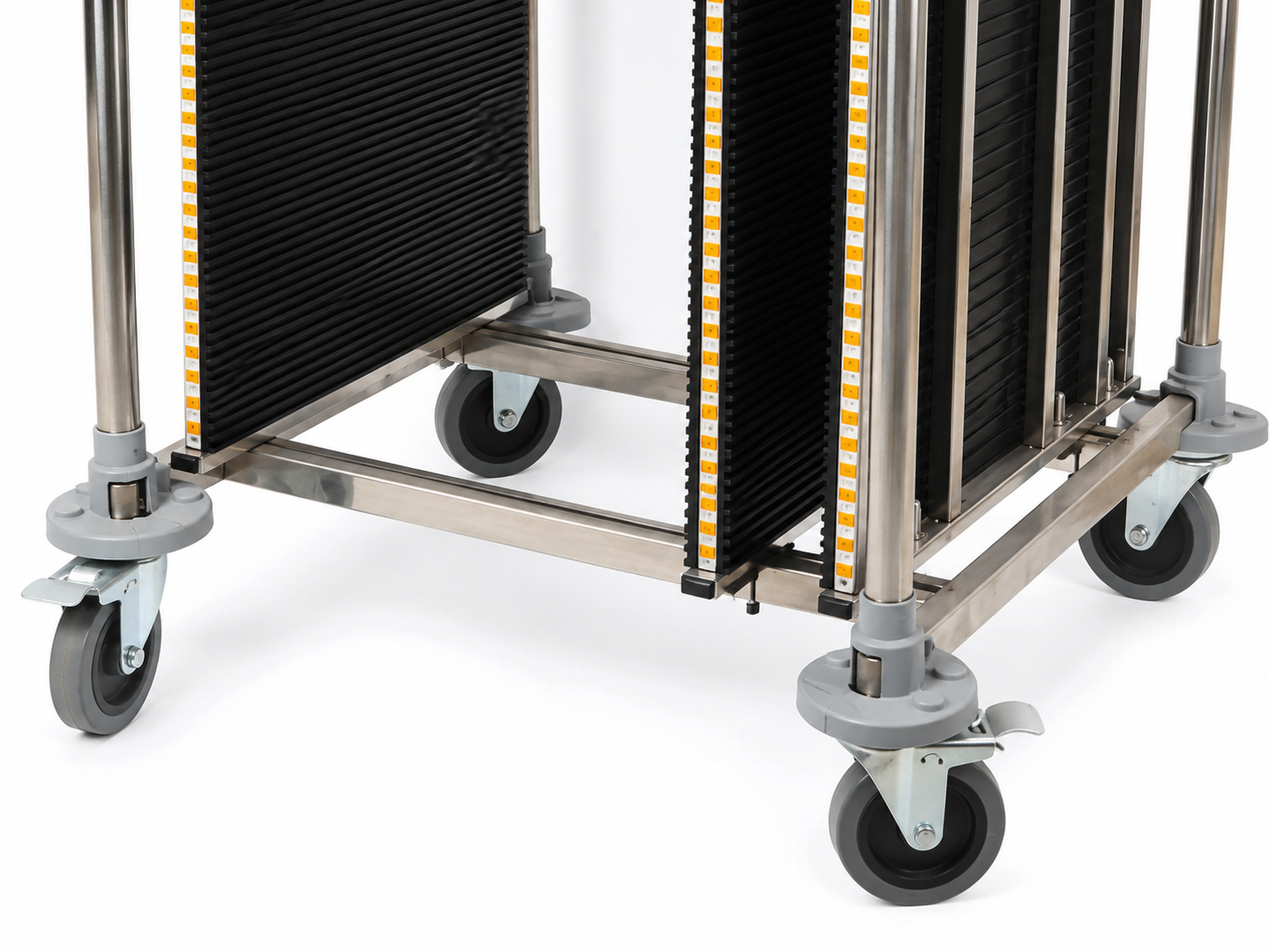
Follow each load through its support: shelf or magazine rails, brackets, uprights, base, caster mount and wheel to the floor. The allowable assembled load cannot exceed an applicable limit along that path. A high caster rating does not compensate for a weak shelf bracket. Conversely, a strong frame may overload a caster mounting plate when the floor is uneven. Ask for the complete trolley rating rather than combining unrelated catalog values.
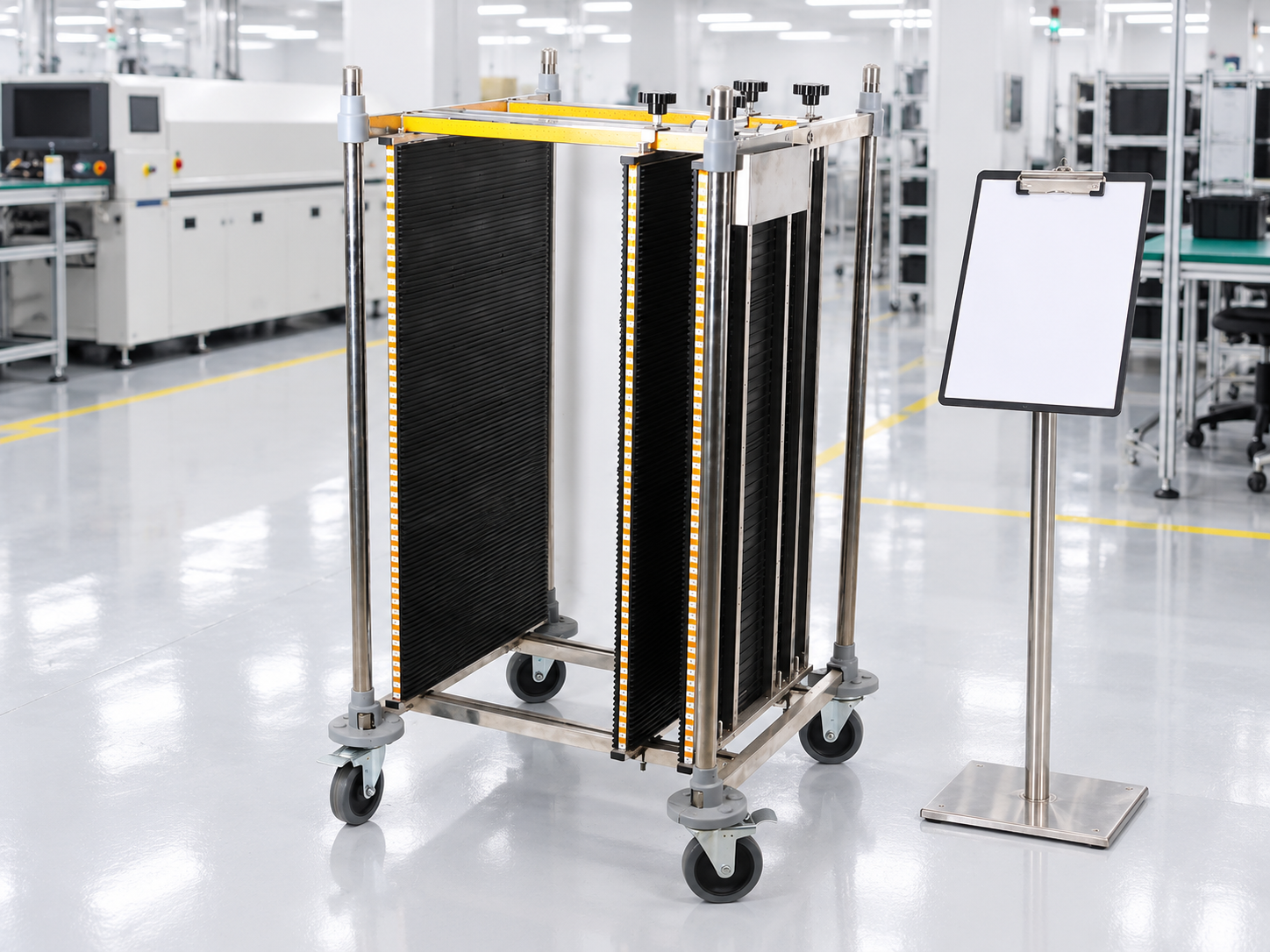
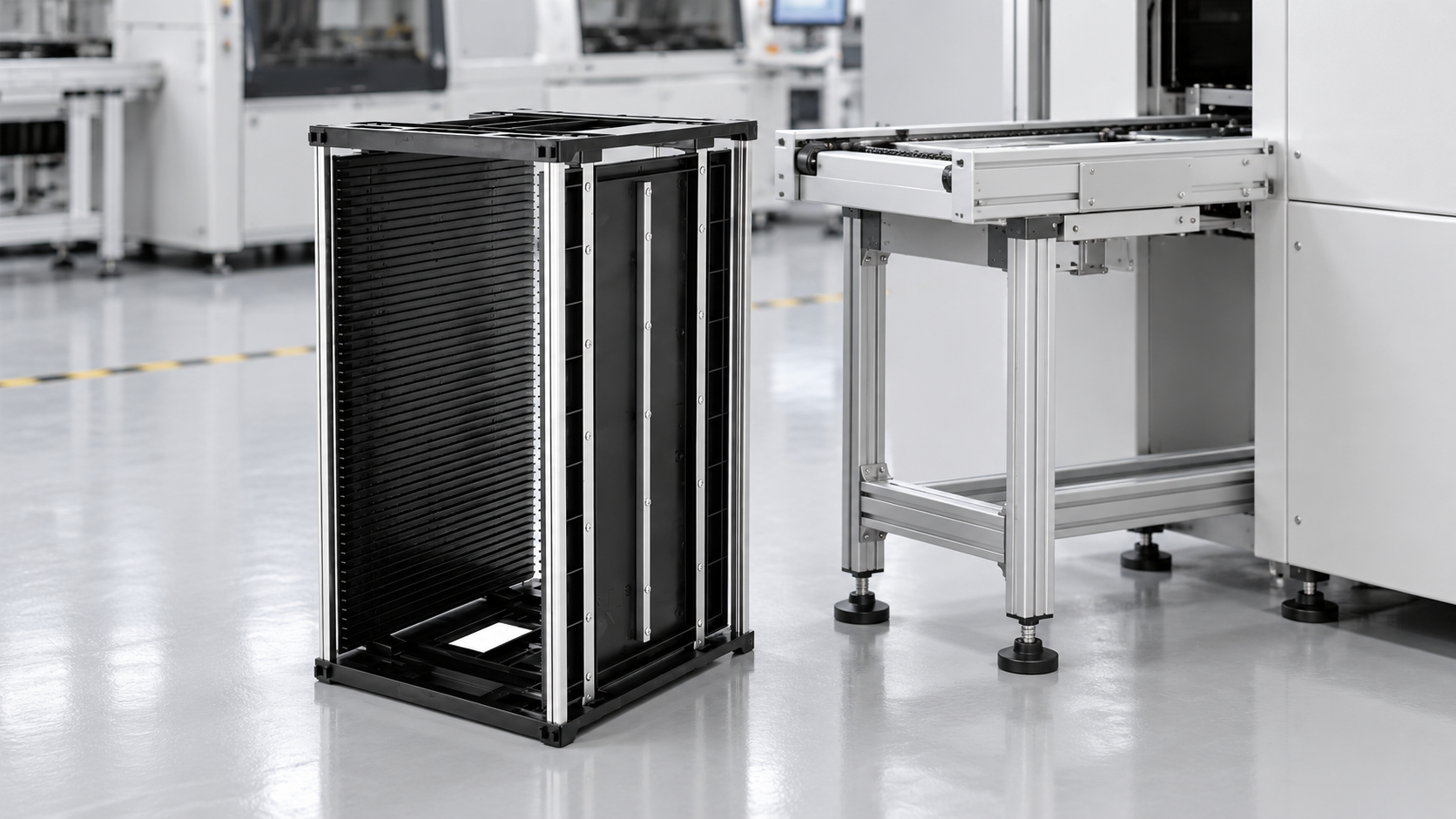
El SWESD line-side trolley reference shows a real magazine transport structure. Confirm which purchased revision, accessories and load arrangement the supplier approves. A photograph shows structure but cannot prove capacity or test compliance. The trolley and magazine combination guide covers the broader system choice; this article concentrates on load evidence and acceptance for that system.
Specify shelves and supports individually
For a shelf trolley, define the load on every shelf and the complete payload. State whether loads are spread across the surface or concentrated through small feet. A distributed shelf rating may not cover a heavy fixture standing on two narrow supports. For a magazine trolley, identify exactly where the magazine base sits and which members prevent sideways movement. Do not treat open rails as a universal platform for unrelated containers.
Check shelf spacing with the loaded container and with the operator's handling motion. A box may fit vertically while leaving no safe room to lift it. Keep the heaviest permitted items in the approved low positions and avoid extending loads beyond the supported footprint. The ESD tote dimension guide helps compare external container dimensions with the available support. Clearance and fit still need the actual trolley drawing and trial.
Ask what the caster rating actually means
Caster data should identify the complete assembly, wheel material, diameter, mounting method and rated operating conditions. Ask whether the stated rating is static or dynamic and whether it applies on the intended floor and at the intended speed. A wheel-only rating is not necessarily the swivel assembly rating. The frame designer or trolley supplier should account for unequal load sharing, impacts and the installation rather than leaving buyers to invent a universal safety factor.
In a simplified evenly balanced stationary example, an 80 kg payload and a 20 kg trolley produce 100 kg total supported mass. Dividing by four gives 25 kg per caster only under the assumed equal sharing. That arithmetic is an illustration, not a selection rule. A floor joint, off-center load or twisted frame can change sharing. Use the supplier's approved design method and assembled rating for purchase; do not use this example to approve four nominal 25 kg casters.
Separate stiffness, strength and stability
Strength concerns fracture or permanent yielding. Stiffness concerns deflection under load. Stability concerns tipping, shifting or rolling when the trolley should remain still. A shelf can remain intact yet bend enough to jam a box or misalign a magazine. A rigid trolley can still tip if a tall load shifts during a turn. Define acceptance observations for each property instead of asking only whether the frame “held the weight.”
Brakes also need the intended parking conditions. Verify which wheels are braked and whether the arrangement is approved for the route and operating position. Do not use a brake as a substitute for a safe layout or an approved restraint. OSHA's materials handling requirements provide general principles for stable storage and clear passageways. They are a workplace safety reference, not a product load rating or a certification of the illustrated cart.
Use a load qualification checklist
| Item | Qué especificar | What the trial must establish |
|---|---|---|
| Complete assembly | Payload and approved distribution | Frame and supports remain within approved limits |
| Shelf or rails | Individual loads and contact footprint | No unacceptable deflection or container interference |
| Casters and mounts | Assembly rating and rated conditions | Secure mounts and suitable loaded movement |
| Stability | Loaded height and permitted partial loads | No tipping or uncontrolled load movement |
| Brakes | Approved parking arrangement | Trolley stays in its intended position |
| ESD performance | Assembly test and floor conditions | Affected electrical properties meet the site plan |
The acceptance criteria in this table require project limits where measurements are involved. Record the instrument, location and configuration so another inspector can repeat the test. NIST measurement terminology helps distinguish repeatability from results obtained under changed conditions. A supplier statement without the tested load pattern and conditions is incomplete evidence for a different installation.
Trial the real route with representative loads
Begin with an inspection of the empty trolley: mounts, fasteners, rails, wheels, swivel action and brakes. Then apply the approved representative load in the approved arrangement. Check level, deflection and clearance before movement. Use a controlled trial route that represents normal floor joints, turns and stopping points. The responsible safety and equipment owners should define the method; do not improvise overload tests in an active production aisle.
Include a partial or uneven load if it is permitted in normal service. Note changes in steering effort, wheel contact, container movement and frame behavior. Stop for instability, binding or unexpected noise. After unloading, inspect for permanent deformation, loosened joints and damaged tread. Keep photographs and measured comparisons. A trial is useful only when its result can be tied to the exact trolley revision, load arrangement and route that operators will later use.
Maintain electrical qualification after load trials
Mechanical loading can change joints, mounts and contact points that matter to the trolley's electrical behavior. Verify the complete assembly under the site's ESD plan after qualification and significant repairs. The EOS/ESD Association control-material guidance explains why material selection and grounding belong within a control program. A conductive wheel label alone does not establish the trolley-to-floor path throughout its route.
Keep electrical and mechanical results separate in the acceptance record. Do not claim shielding for an open trolley or assume that an approved EPA cart protects exposed boards outside the EPA. If the route crosses ordinary flooring, review the required packaging and transfer controls. Wheel replacement affects both rolling performance and electrical behavior; the trolley maintenance checklist provides a related maintenance framework, while the load approval must remain tied to its tested configuration.
Write an RFQ that supports repeatable acceptance
Provide the maximum payload, load per shelf or support, container drawings, center-of-mass concerns, duty cycle, route, floor joints, operating speed, parking arrangement and electrical requirements. Ask for assembled and component ratings, controlled drawings, load test conditions and revision identification. Request a sample and a documented approval process. A supplier can then identify limits before production rather than leaving operators to discover them after delivery.
Include change control for shelf material, frame joints, caster models and mounts. Keep an accepted reference configuration and assign responsibility for periodic inspection. Remove damaged carts from use under the site's disposition procedure; replacing a bent member or fitting a stronger-looking caster does not automatically restore approval. Review recurring damage against the real load and route. If the cart is consistently overloaded, the corrective action may be a revised transport configuration, not a shorter inspection interval.
Keep the accepted load visible to operators
Put the approved configuration in the work instruction with a simple description of the maximum permitted contents and their positions. Distinguish any shelf limit from the total payload limit. If different product families use the same trolley, show which arrangement applies to each family and how a change is authorized. Avoid relying on a single handwritten weight number without a configuration reference. Supervisors should be able to compare the actual load with the accepted pattern during normal work. This also makes an incident investigation more useful: the record shows whether the trolley, route or loading practice changed after qualification.
Further learning: handling systems and movement
NPTEL IIT Guwahati's manufacturing automation lecture explains the role of material handling systems. Use it as background for planning movement and interfaces. The lecture does not establish trolley load limits or replace the supplier's acceptance evidence.
Preguntas frecuentes
Can I multiply a caster rating by four?
Not as a complete trolley rating. The assembly designer must account for unequal load sharing, mounts, frame limits and the actual rated conditions.
Does trolley payload include the trolley mass?
Terminology varies. Ask the supplier to distinguish payload from total supported mass and state what each rating covers.
Does a shelf rating apply to a concentrated fixture?
Only if its approved conditions include that contact pattern. A distributed rating does not automatically cover small concentrated supports.
Should the trial include partial loads?
Yes when they are permitted in normal use, because load distribution and stability may differ from a full balanced load.
Is a passed weight trial sufficient for ESD approval?
No. Verify affected electrical properties separately using the site ESD plan and the actual floor and assembly conditions.


Dejar un comentario