- مدونة
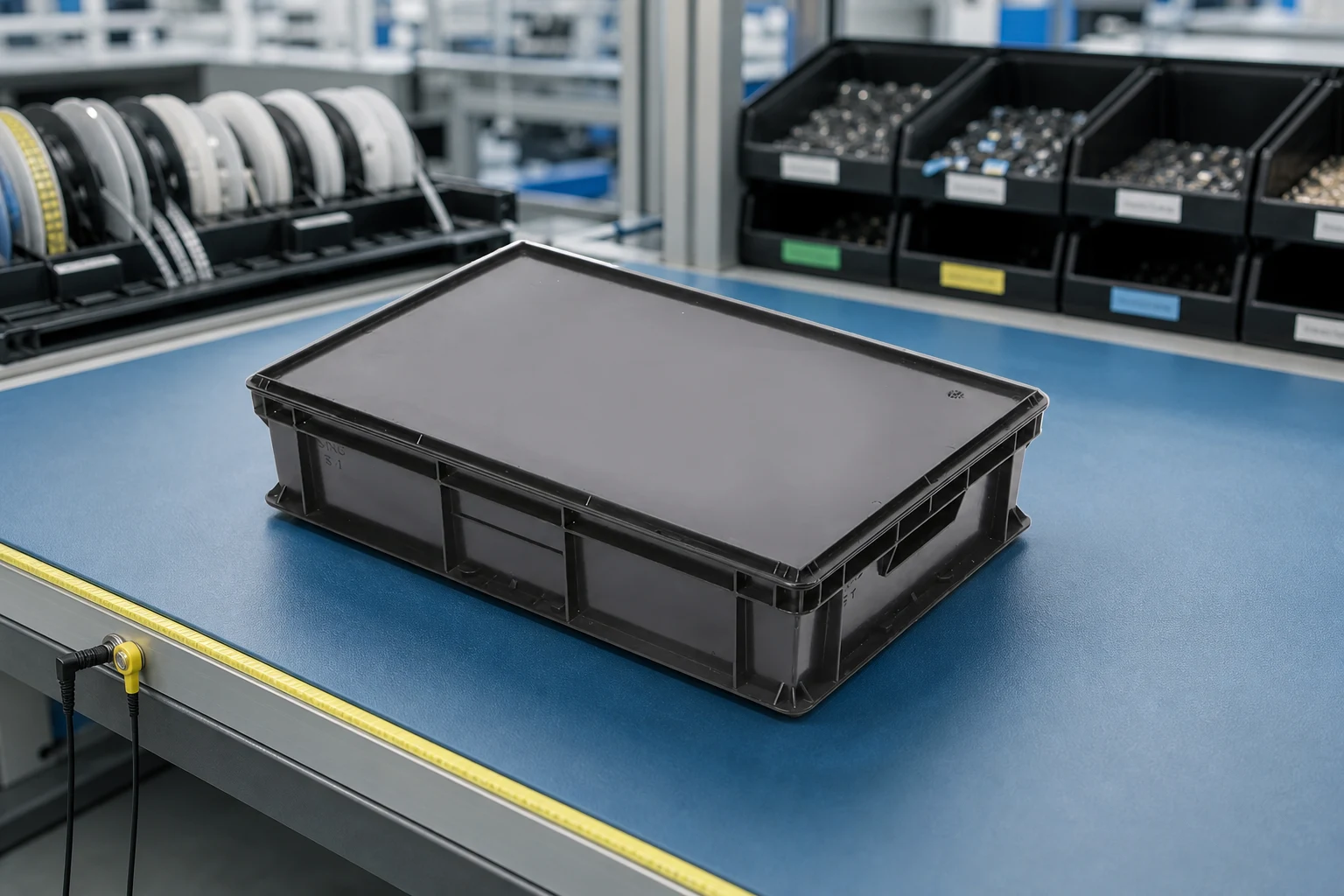
A conductive PP box uses carbon-filled polypropylene to limit charge on surfaces that touch static-sensitive devices during kitting, line-side staging, and short warehouse moves. This guide explains material classes, sizing, stack load, grounding, and RFQ discipline for global electronics teams. Written for worldwide B2B buyers; specify 50 or 60 Hz plant power only where grounding hardware interfaces matter.
Part 1. What is a conductive PP box?
A conductive PP box is a polypropylene tote or container molded with carbon or other conductive fillers so surfaces stay in a controlled resistance band. Buyers use them to stage, kit, and ship static-sensitive electronics inside EPAs and between warehouses.
Permanent conductive PP differs from topical anti-static sprays that can wear off in wash cycles. Procurement should request material certificates and point-to-point resistance logs for the exact SKU.
Conductive PP boxes are not shielding Faraday enclosures by themselves—they work with grounding, personnel controls, and program rules defined in IEC 61340-5-1 and ANSI/ESD S20.20.
Cross-site standards prevent regional buyers from ordering incompatible accessories during MRO emergencies.
Returnable loops need damage criteria—cracked surfaces can harbor insulative debris that fails audits.
Programs that skip inbound resistance checks often discover out-of-spec lots only during customer audits—build sampling into receiving SOPs.
Pilot two shifts per line and log mis-picks, grounding misses, and wash time before plant-wide mold standardization.
Box styles in export catalogs
Stackable totes with lids, divider grids, and label slots are common. Corrugated conductive PP suits lightweight shipper loops; injection shells suit repeated line-side handling.
| Style | Typical use | Note |
|---|---|---|
| Stackable tote | Line-side kitting | Interlock feet |
| Dividable grid | Mixed components | Cell labels |
| Lidded shipper | Short transit | Match lid class |
| Circulation box | Closed-loop logistics | Wash interval |
Part 2. Conductive versus dissipative versus anti-static labels
Suppliers may market conductive PP, dissipative PP, or anti-static additives in the same catalog. Your ESD coordinator should map each claim to measured Ω/sq or point-to-point readings—not color alone.
Dissipative surfaces limit charge accumulation at a controlled rate; conductive surfaces bleed charge faster. Both can be valid when grounded; the wrong class paired with an insulative shelf still isolates charge.
Marketing terms like anti-static do not replace program-level definitions. Align supplier data to the control items in your audit checklist.
Digital photos of grounded layouts accelerate export desk quoting more than verbal descriptions alone.
Engineering reviews should include EHS, quality, and logistics—not only unit price.
When multiple contractors share one kitting bench, color and label standards matter more than small unit price differences between mold families.
Warehouse humidity swings change resistance readings—log facility RH when comparing supplier certificates across seasons.
Documentation buyers should demand
Material datasheets, RoHS declarations, and resistance test methods (RH, probe geometry) belong in the RFQ response—not optional appendices.
Part 3. Where conductive PP boxes fit in electronics plants
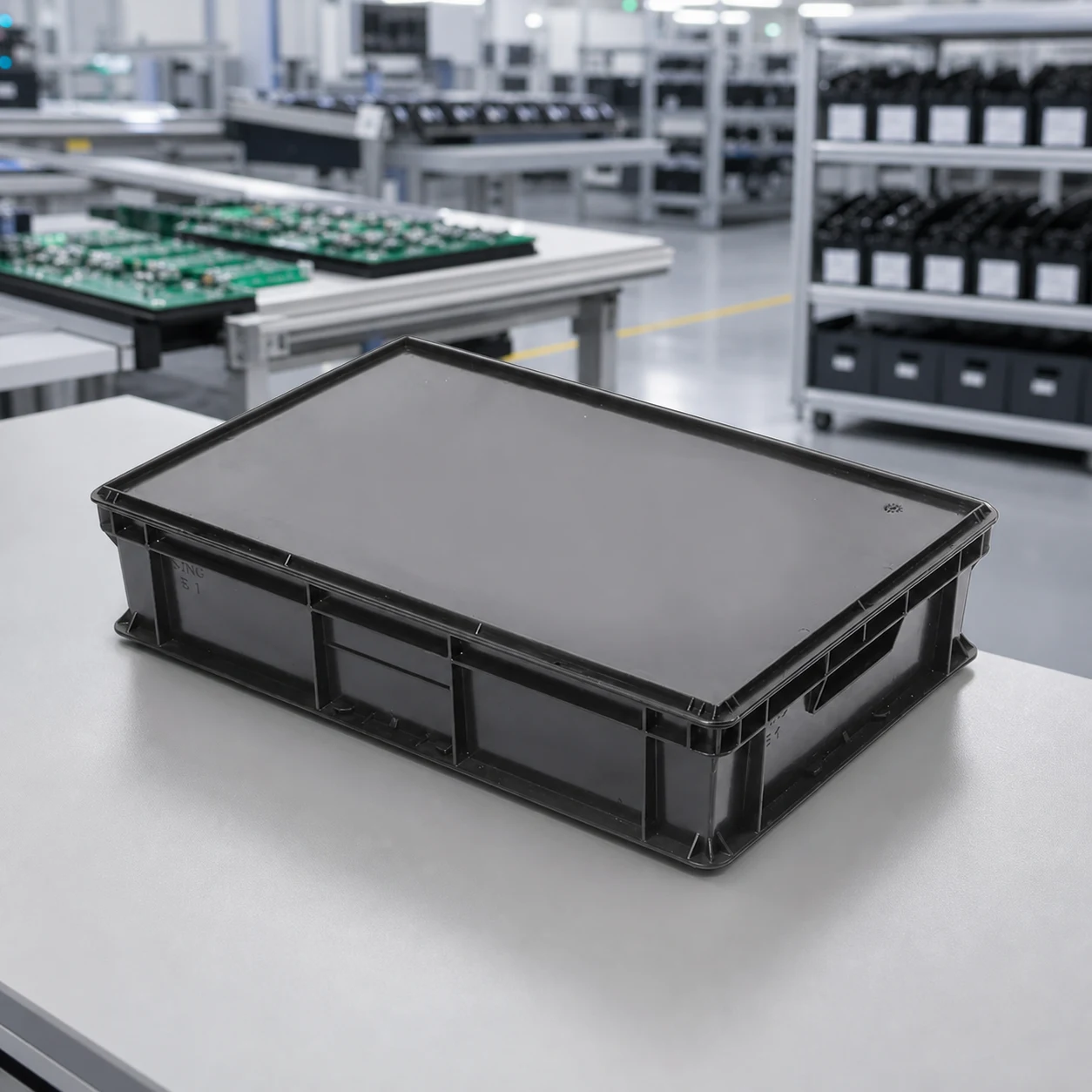
Kitting desks preload boxes with the next BOM while the current SKU runs. Grounded carts move boxes to SMT lines without loose reel handling on insulative tables.
Warehouse inbound uses boxes for sample lots and supplier qualifications before a plant standardizes mold numbers.
Rework and QC hold areas color-code boxes so quarantined assemblies never share cells with released lots.
Seasonal humidity shifts can change resistance readings—schedule checks before customer audits.
Document carton dimensions early so inbound logistics avoids repallet charges at port.
Export freight models need outer carton L×W×H and gross weight per nested stack—unexpected overhangs trigger repallet fees at hub ports.
Contract EMS sites should freeze mold numbers in customer QA packs to avoid silent substitutions during component shortages.
Box versus bin versus tray
Deep totes and drawer bins suit high-mix storage; shallow trays suit visible cells. Pick the unit of flow—bulk kit versus classified pick—before standardizing conductive PP.
| Zone | Typical load | Grounding |
|---|---|---|
| Kitting | Mixed SMD kits | Cart to mat |
| Line side | Odd-form parts | Bench mat |
| QC hold | حجر صحي | Separate color |
| Export pack | Finished PCBA | Bag if long move |
Part 4. Temperature, stack load, and mechanical durability
Standard conductive PP totes often cite roughly -20 °C to +80–100 °C continuous service depending on wall thickness. Heat staging near equipment needs a higher grade—not a standard tote misapplied.
Stack load ratings matter when boxes nest in high-bay storage. Catalog photos may show taller stacks than your EHS policy allows.
Carbon-filled PP trades impact strength for conductivity—train handlers on drop limits and inspect ribs for cracks that trap insulative debris.
Contract manufacturers should align specs with customer EPA questionnaires before onboarding new SKUs.
Label each storage family to prevent night-shift lot mixing.
Digital work instructions with photos of grounded placement outperform PDF catalogs alone for night-shift onboarding.
Wash and chemical exposure
Confirm isopropyl wipe compatibility and whether flux mist requires more frequent cleaning intervals than the supplier default.
Part 5. Sizing conductive PP boxes for PCBs and components
Inner length and width must clear connector overhangs and heat sinks—height often drives box selection more than board length.
For mixed mechanical and electronic kits, divider grids reduce lot mixing but add wash steps. Specify divider material class matching the shell.
Automated conveyor lines need outer footprint and bottom rib patterns so belts track correctly—provide CAD early.
Video clips of correct grounding reduce training time during contractor rotations.
Inbound inspection should sample resistance on guides and bases, not only shells.
Spare divider and latch MOQ should be negotiated before peak season; stockouts stall kitting faster than shell shortages.
OEM programs sometimes require dual-language molded markings and lot traceability stickers—confirm artwork approval lead time separate from production MOQ.
Conductive PP circulation boxes in automotive electronics may need impact tests beyond resistance logs—align drop specs with your EHS policy.
When switching from cardboard to conductive PP, update recycling contracts and scrap handling—carbon-filled streams differ from OCC programs.
Reserve sample units for stack tests when safety policy exceeds catalog marketing photos.
Ergonomic and weight limits
Large 600×400 mm class totes can exceed 15 kg when loaded with PCBA—define manual carry limits with EHS before rollout.
| Spec | لماذا يهم الأمر | مالك |
|---|---|---|
| Inner L×W×H | Fit assemblies | عملية |
| Divider layout | Lot separation | Materials |
| Outer footprint | Conveyors | الأتمتة |
| Stack load | Safety | EHS |
Part 6. Grounding, lids, and closure systems
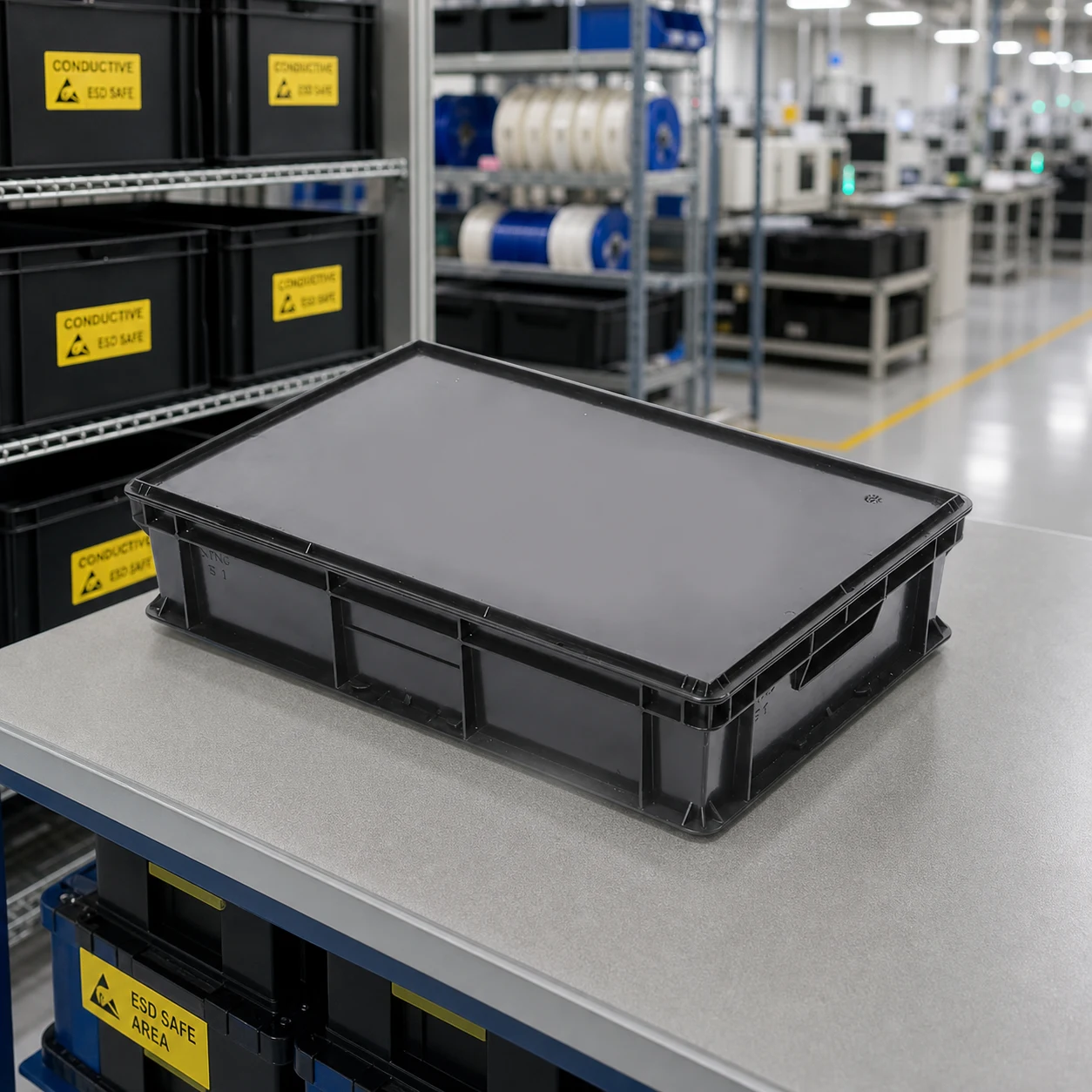
Boxes must sit on grounded mats, racks, or carts. Personnel remain grounded while loading—containers do not replace wrist-strap controls.
Lids and latches should be the same ESD material class as the base. Mixed classes create weak points at the seal line.
Label holders and barcodes speed traceability—place labels where scans do not block grounding contact between base and mat.
Spare accessory MOQ should be budgeted before peak season—shortages stall kitting during ramp.
Multi-plant rollouts need a controlled BOM for dividers so regions do not substitute incompatible inserts.
Facilities operating both 50 Hz and 60 Hz equipment still specify one ESD material class per program—grounding audits focus on discharge paths.
Transport beyond the EPA
Long warehouse moves may require shielding bags inside lidded boxes per your program—open totes alone may not satisfy travel rules.
Part 7. Procurement mistakes to avoid
Buying commodity black totes without resistance logs is the most common audit failure.
Mixing divider inserts from another vendor often fails slot tolerance and ESD continuity at corners.
Quoting only unit price ignores wash labor, spare lid MOQ, and accessory compatibility across plants.
Switching molders mid-program without inbound resistance checks risks drift in filler loading.
Facilities running 50 or 60 Hz lines still specify the same ESD material class; audits focus on resistance paths.
Compare total cost of ownership: wash labor and spare lids often exceed unit price deltas.
Returnable container loops require crack and chip criteria—damaged ribs can trap insulative debris that fails visual EPA walks.
RFQ checklist
Attach quantity bands, destination logistics, color plan, cleaning chemicals, and photos of bench or cart layout.
| Document | Content | When |
|---|---|---|
| Resistance report | Ω at defined RH | Before PO |
| RoHS/REACH | Material decl. | Export |
| Stack rating | kg per box | Warehouse |
| Drawing | Outer dims | الأتمتة |
Part 8. Selecting conductive PP boxes for your program
Programs standardizing conductive PP usually pick one lid/divider family and document grounding photos for each plant before global rollout.
Start from inner dimensions and stack policy, then confirm resistance at your RH band—humidity matters more than mains frequency for material choice.
What to send export engineering
Share layout photos, part envelopes, annual quantity bands, and required markings. Sanwei export engineering can match box footprints, accessories, and carton data.
Share your inner dimension needs, divider layout, and quantity bands with Sanwei export engineering via Contact Us for conductive PP box matching and resistance documentation.
أسئلة متكررة
ما هي مقاومة السطح التي يجب أن تلبيها وحدة التخزين المضادة للتفريغ الكهربائي (ESD)؟
تذكر البرامج عادةً 10⁴ إلى 10¹⁰ أوم اعتماداً على الفئة. قم بتأكيد طريقة اختبار المورد والقراءات الداخلية/الخارجية وفقاً للمعيار IEC 61340-5-1.
كيف يتم تأريض حاويات تفريغ الشحنات الكهربائية الساكنة (ESD) في منطقة حماية التفريغ الكهربائي (EPA)؟
يوضع على حصائر أو عربات مؤرضة، أو تستخدم كبلات معتمدة. المواد الموصلة وحدها لا تضمن التفريغ بدون مسار معروف.
ما الذي يجب على مشتري التصدير تضمينه في طلب عرض الأسعار (RFQ)؟
تُقلل أنواع الأجزاء، ونطاقات الكميات، وارتفاع التراكب، وطريقة التأريض، والوسم، وصور تخطيط من أخطاء التحجيم.
هل الحاويات البلاستيكية السوداء آمنة تلقائياً ضد التفريغ الكهروستاتيكي (ESD)؟
لا. تحقق من شهادات المواد وسجلات المقاومة لرمز SKU الدقيق ودفعة القالب.
كم مرة يجب تنظيف مناطق تخزين التفريغ الكهروستاتيكي (ESD)؟
Wipe when flux residue or oils accumulate; dirty surfaces can shift resistance readings.
Can the same container family serve warehouse and line-side?
Often yes, but define separate color/label rules so quarantine lots never share cells with released material.
Do lids need to match the base material class?
Yes. Mixed dissipative bases with insulative covers break enclosure integrity.
When should buyers request samples?
Before bulk orders—confirm footprint, divider fit, and resistance at your facility RH band.
المراجع
أحدث مشاركة
-
 ESD Gloves Resistance Testing and Replacement Criteria16 أكتوبر,2026
 -
 ESD Slippers vs ESD Safety Shoes for Electronics Factories16 أكتوبر,2026
 -
 ESD Shoe Sole Resistance: Test Methods and Acceptance Limits15 أكتوبر,2026
اترك ردًا