- توربو
- مدونة
An ESD shielding bag identification label placement review should keep the package identity readable while preserving the approved closure, existing protective markings and access needed for inspection. Check a representative finished package rather than choosing a label position on an empty drawing alone. A product label does not establish shielding performance, and a recognizable ESD symbol does not identify the component inside. This guide proposes a practical label-layout review for electronics packing teams; it does not specify a universal label size, adhesive, location or qualification result for every shielding bag.
Define which label problem you are solving
Separate the contents identifier, the packaging material identifier and the ESD handling information. They answer different questions: what is inside, which packaging was used and what handling awareness is needed. A barcode that identifies an assembly may not identify its packaging lot. An original yellow marking on a bag may communicate an ESD purpose without telling a warehouse worker which customer order it belongs to.
Start with the actual packing instruction, customer requirement and supplier information for the bag. List what must remain visible and which fields operators or receiving staff need to read. Identify the approved label revision and the record from which its content is generated. Do not add several overlapping labels simply because each department wants its own version of the same product description.
ال EOS/ESD Association discussion of packaging and marking systems distinguishes packaging documentation from marking arrangements and discusses reliance on markings already present on materials. It is a dated educational discussion, not a replacement for the applicable current standard or customer instruction. Use it to frame the questions, then document the actual arrangement your process requires.
Review the finished package and its opening sequence
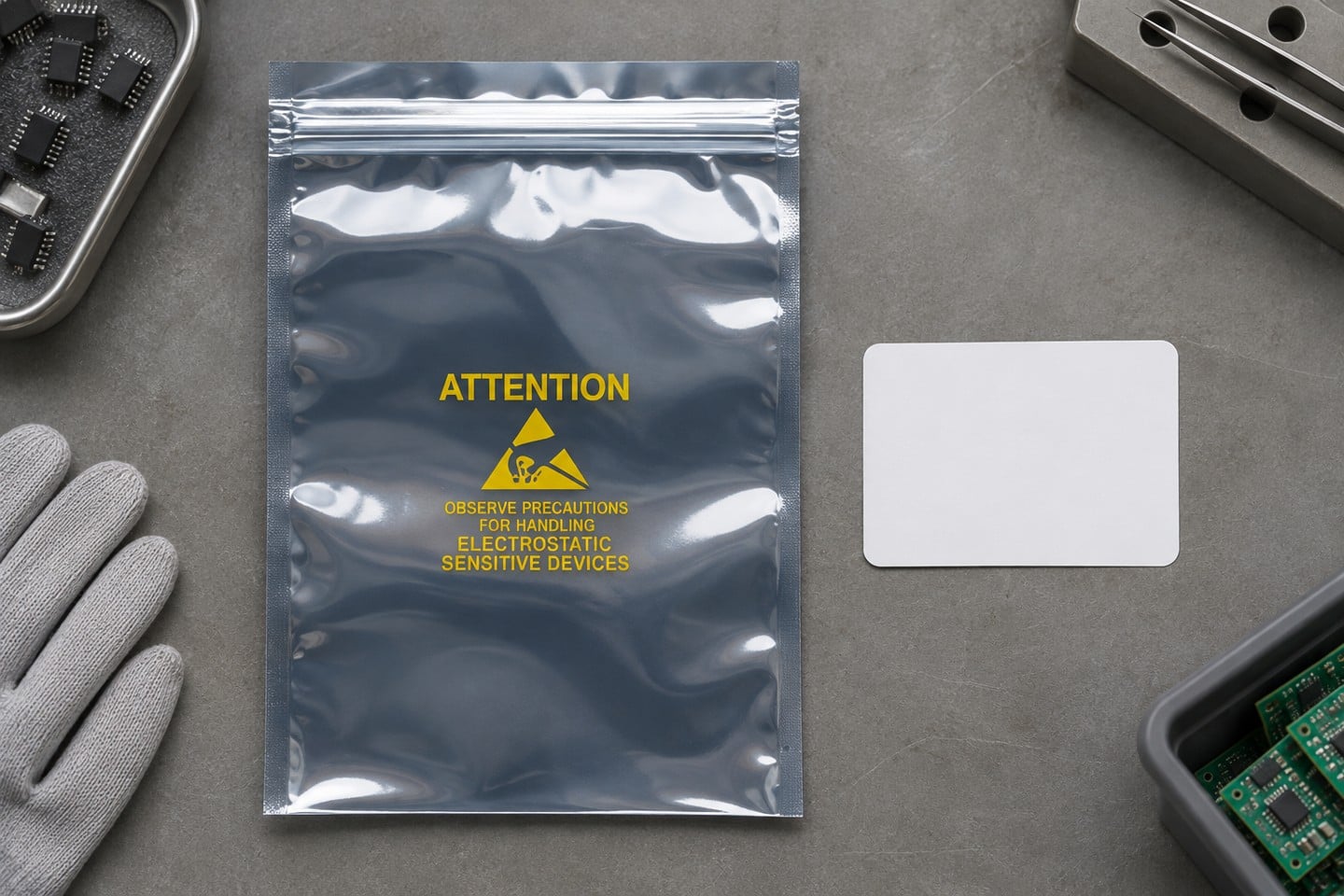
Use a representative bag with the approved internal support and a suitable dummy or otherwise authorized sample where needed. Observe how the packer inserts contents, closes the package, adds the label and places it in the outer container. A label position that seems clear when the bag is flat may become hidden behind the product or pressed into a fold when the package is filled.
Identify the closure area and any space the operator needs to grip or inspect it. Keep the proposed identifier from creating an unapproved bridge across a zipper, seal or opening path. This is a layout check, not a universal statement that no label can ever be part of a closure. Where the approved construction uses a particular closure label, assess that defined arrangement under its own instructions.
Record how a receiver will open the package. The identifier should not force the worker to cut or peel near the contents merely to learn what is inside. Consider whether the label or its backing could become loose material during the opening sequence. Do not improvise a new opening method to compensate for an inconvenient identifier; revise the layout through the responsible packing instruction.
Preserve the meaning of the original markings
Locate the actual supplier printing, including any relevant product code, lot reference and ESD information. A new white label should not unintentionally conceal information that the approved process needs. If the bag is too small to accommodate all fields, escalate that constraint. Shrinking text until nobody can read it does not resolve an identification requirement.
Do not reproduce or add a protective-performance symbol merely to make a package look more technical. Establish what the bag is documented to provide and use the marking arrangement approved for that application. A printed symbol, a silver appearance and a successful barcode scan answer different questions. None alone proves that the finished package satisfies every required protective property.
جمعية EOS/ESD إجراءات ومواد التحكم الأساسية لمكافحة ESD explains packaging as part of protection during handling and transport. This supports keeping identification changes within the package-control process. The specific label layout below is a proposed workflow, not a quotation from that source or a claim that the illustrated bags have been tested as a labeled system.
Use a placement checklist with observable outcomes
Walk through the questions in the table using the real packing route. The outcomes are qualitative because there is no verified universal offset, adhesion value or barcode grade for the unspecified label and bag combination.
| سؤال المراجعة | Observe on a representative package | قرار التسجيل |
|---|---|---|
| Contents identity | Read the correct item and revision | Source record and label revision match |
| Original markings | Check visibility after label application | Required original information remains available |
| Closure access | Follow the approved closing sequence | No unapproved interference or closure change |
| Opening sequence | Observe receiving and unpacking | Identity can be checked without improvised opening |
| Code reading | Use the intended scanner and transaction | Correct identity reaches the next process |
| Relabeling | Review obsolete and current identifiers | Only the approved current identity is actionable |
| Outer pack handoff | Check what the next recipient can see | Relevant identifiers remain associated |
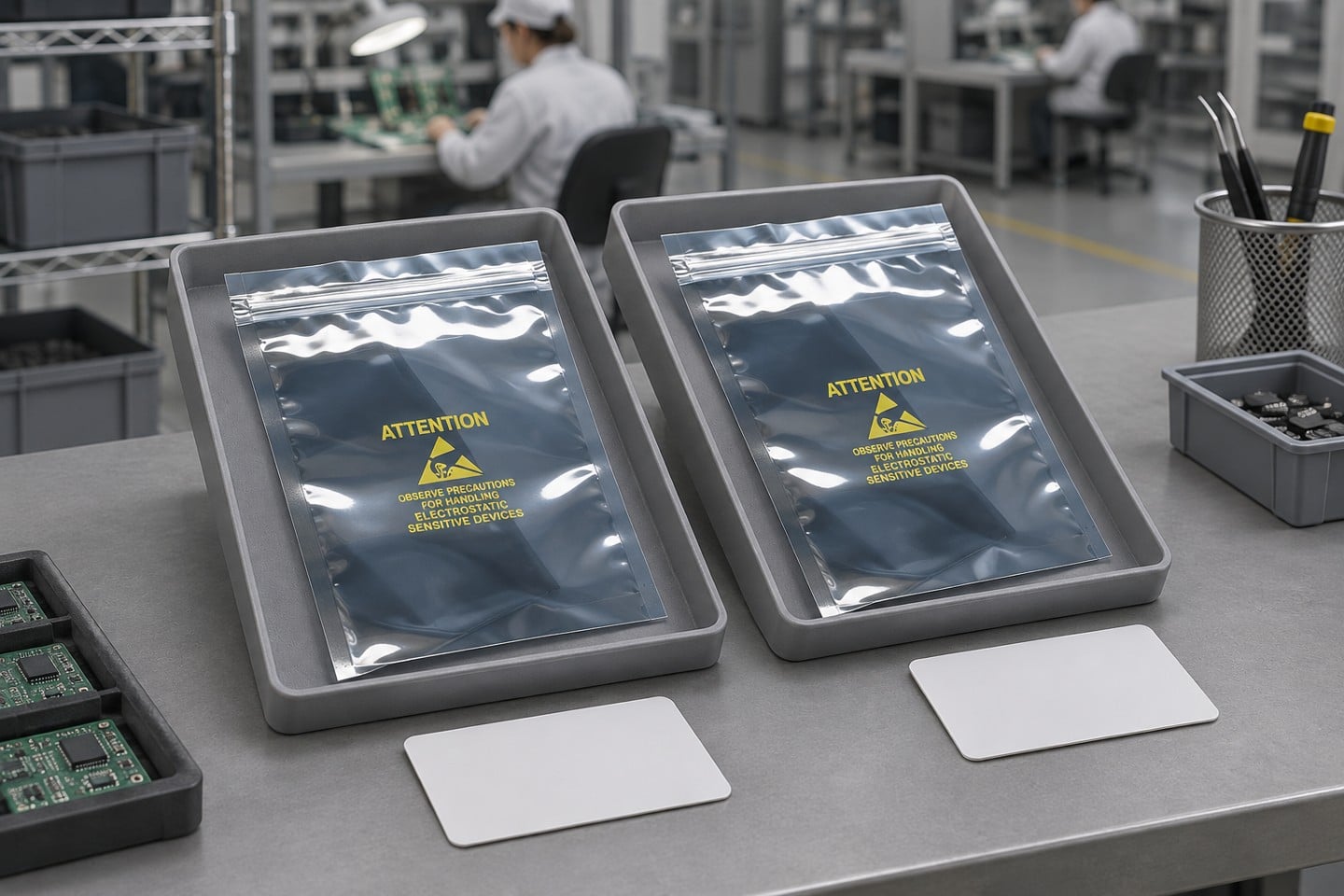
Save a dated photograph or approved layout record of the accepted configuration. Identify the bag, label revision, representative contents and outer pack used in the review. If the label can be applied in several positions, define the acceptable region in the instruction. An unbounded direction to place it wherever convenient is difficult to train and impossible to compare consistently between shifts.
Check readability under the actual handling conditions
Review human-readable information as well as the barcode. A scanner can return a value while a person struggles to distinguish a part revision or quantity. Conversely, readable text does not prove the code will scan through a wrinkled or reflective presentation. Use the scanner, lighting and normal handling distance relevant to the station rather than a convenient desk test with different equipment.
Compare the scanned result with the intended record. The important question is whether the correct package identity reaches the next process, not merely whether the scanner beeps. Where the process uses several nearby barcodes, check that an operator can choose the intended one without covering markings or manipulating the bag in an unapproved way. Record which code was read and what transaction it created.
Check the outer container too. If the inner bag label is hidden after boxing, the next handoff may require a separate approved identifier. That does not mean copying every inner field onto every outer surface. Determine what each recipient needs and maintain a controlled relationship between identifiers. Customer or contract-specific marking instructions take precedence over a general layout preference.
Evaluate label materials without guessing compatibility
Obtain the actual label stock and adhesive information rather than describing every white sticker as equivalent. Ask the responsible technical owner what evidence is needed for the intended contact and environment. Do not infer low charging, cleanroom suitability or chemical compatibility from a supplier’s generic permanent-adhesive description. Such claims need evidence appropriate to the actual application.
Keep mechanical observations separate from electrical qualification. A label that remains attached during a short handling trial has demonstrated only that observed behavior under those conditions. It has not established a universal adhesion life or the shielding properties of the whole package. Similarly, a label that peels away cleanly once is not proof that repeated removal leaves the bag suitable for reuse.
If the proposal changes the way the bag is closed, use the shielding bag closure process change review rather than approving that change as a minor artwork adjustment. If the question is the bag construction or overall fit, begin with the ESD shielding bag selection guide. Keeping those decisions distinct makes each review more useful.
Handle relabeling and split quantities explicitly
A corrected label should not leave two apparently current package identities. Define who can authorize the correction, how the original record is preserved and how the obsolete identifier is controlled. Avoid repeatedly peeling labels from a bag unless the actual reuse and relabeling procedure permits it. Where suitability is uncertain, obtain an approved repacking decision instead of concealing the old information with another sticker.
For split quantities, determine whether the new identifier describes the contents or the unused packaging stock. Our shielding bag split-pack traceability guide addresses the latter identity chain. This article concerns where and how the identifier is presented. A good location cannot repair an incorrect lot association, and a correct database record cannot help a receiver if the only visible label belongs to another item.
When preparing a change, keep trial material separate from released production. Identify any sample that carries an experimental label and prevent it from entering normal dispatch by mistake. Record which version was selected and remove obsolete instructions from the relevant station through the approved document-control route. The aim is a reproducible packing action, not a collection of equally plausible sample photographs.
Put clear questions into the supplier inquiry
استخدم SWESD ESD shielding bag product page as the starting point for the actual product reference. State the intended contents, closure arrangement, handling route and identification fields. Ask for information relevant to the proposed label contact and placement rather than requesting a broad statement that any sticker will work. Confirm what evidence belongs to the bag and what still needs evaluation as a complete package.
Provide the relevant sample layout when requesting advice. A close view of the closure and original marking is usually more informative than a photograph of a sealed outer carton alone. Identify whether the label is already used, newly proposed or a customer requirement. Do not imply that a supplier has approved a configuration simply because it acknowledged receiving your drawing.
Release a layout people can follow
The final instruction should identify the actual bag and label revision, show the accepted placement and describe the checks at the handoff. Assign the person who resolves an unreadable code, missing field or unexpected interference. Record any restriction discovered in the trial, such as a layout that works only for one package orientation, without extending the conclusion to other sizes or contents.
Review the first relevant production use after release. Observe the ordinary sequence, including replenishment of label stock and transfer to the next station. If operators routinely move the label to finish the task, investigate the constraint and correct the instruction. A practical, controlled layout reduces identification errors while keeping package-protection decisions attached to their own evidence.
خلفية تعليمية حول حماية ESD
The EOS/ESD Association introduction below explains ESD protection concepts. It provides context for treating a shielding package as a protective system; it is not an adhesive test or a label-layout qualification. The written checklist above supplies the operational review and remains understandable without the video.
الأسئلة الشائعة
هل هناك موضع ملصق صحيح لكل حقيبة حماية؟
No. Review the actual bag, closure, contents, required information and handling route under the applicable instructions.
هل يثبت رمز ESD أن محتويات الحقيبة تم تحديدها بشكل صحيح؟
No. Protective marking and contents identification answer different questions.
Can any adhesive label be assumed suitable?
No. Obtain information and evidence relevant to the actual label stock, adhesive and intended application.
Does a successful scan verify shielding performance?
No. A scan checks an identification function, while protective performance needs its own relevant evidence.
Can a label change also change the bag closure?
Treat any closure change under the applicable package change review rather than approving it as artwork alone.
أحدث مشاركة
-
-
 جهاز قياس المجال الكهروستاتيكي الساقط: امسك، قيم، وأطلق25 نوفمبر,2026
-
 سحب مورد قفازات الغرف النظيفة: تسوية المخزون وإغلاق الثغرات25 نوفمبر,2026
اترك ردًا