- توربو
- مدونة
ESD packaging cost reduction should lower the total cost of delivering acceptable, identified components while preserving the protection required by the product and route. Start with a measured baseline, remove process waste, evaluate appropriately sized qualified packaging, and verify any proposed change through a controlled pilot. A cheaper bag is not a saving if it increases rejected shipments, repacking, or unresolved quality risk. This guide addresses purchasing and process decisions for electronics factories. It does not authorize downgrading protective functions, infer performance from product appearance, or assume that every shielding bag is suitable for reuse.
Measure cost per accepted shipment
Choose a comparable unit before collecting prices. It might be one accepted shipment of a defined assembly, a completed production kit, or a protected transfer of a specified quantity. Keep product mix and route visible because a small part family cannot be compared fairly with a heavy or fragile assembly simply by counting bags. Record packaging purchases, packing labor, preparation, inspections, storage, transport charges, returns, repacking, and waste handling where these are relevant and measurable. State which costs are missing instead of treating them as zero.
Calculate observed cost per accepted shipment as the included period costs divided by the number of accepted shipments in the same scope. Do not mix annual purchases with one week’s deliveries or include returned containers twice. For example, an illustrative pilot with 100 comparable accepted shipments and $420 of included costs has a cost of $4.20 per accepted shipment. If a second pilot has $390 of included costs and 100 accepted shipments under comparable conditions, the observed difference is $0.30 per shipment. These invented numbers explain the calculation only; they are not SWESD prices, results, or a savings promise.
Freeze the protection requirements before optimizing
Write the required ESD functions, component-handling restrictions, mechanical support, closure arrangement, and route conditions into the baseline. Identify separately specified moisture or cleanliness requirements. The PCB ESD packaging specification guide helps organize that requirement sheet. Cost work should change an identified cost driver while retaining the accepted protection boundary, or submit a formally reviewed design change when the boundary must change. A supplier description such as antistatic or conductive is too broad to settle every required function.
ال EOS/ESD Association material-control overview provides context on ESD packaging functions. Keep that technical purpose attached to the cost discussion. An open handling tote may be useful in a controlled process, but it is not automatically an equivalent replacement for qualified outbound shielding packaging. Avoid removing a layer simply because another layer looks metallic or carries an ESD symbol. Ask the technical owner which function each accepted element supplies.
Find waste in the existing packing process
Observe a representative packing sequence before negotiating material substitutions. Look for repeated searching, uncertain part identification, unnecessary handling, incorrect packaging selection, and rework caused by unclear instructions. Measure the frequency and time involved. A clear packing specification, organized work area, and accurate replenishment signals can reduce process cost without changing the protective material. Compare the observed process with the approved sequence so an apparent shortcut does not omit a required inspection or closure step.
Review the causes of discarded packaging. Wrong sizes, obsolete product revisions, purchase quantities that exceed usable demand, damaged stock, and uncontrolled storage can create waste before a shipment leaves the factory. Record those causes separately rather than reporting one total scrap percentage with no explanation. A purchasing change aimed at obsolete inventory will differ from a training change aimed at incorrect closure. Prioritize a cause with evidence, an owner, and a measurable outcome before investing in a new package design.
Review package size without creating a new failure
Examine whether the accepted package dimensions and outer shipping arrangement create avoidable empty space or handling difficulty. Use the actual component geometry, required support, safe insertion and removal, closure allowances, and route restrictions. A smaller bag may reduce material use, but an excessively tight fit can make handling difficult or expose edges to damage. A smaller outer carton also needs sufficient approved protection and space for the complete accepted arrangement. Size decisions belong in a sample trial rather than a price-only spreadsheet.
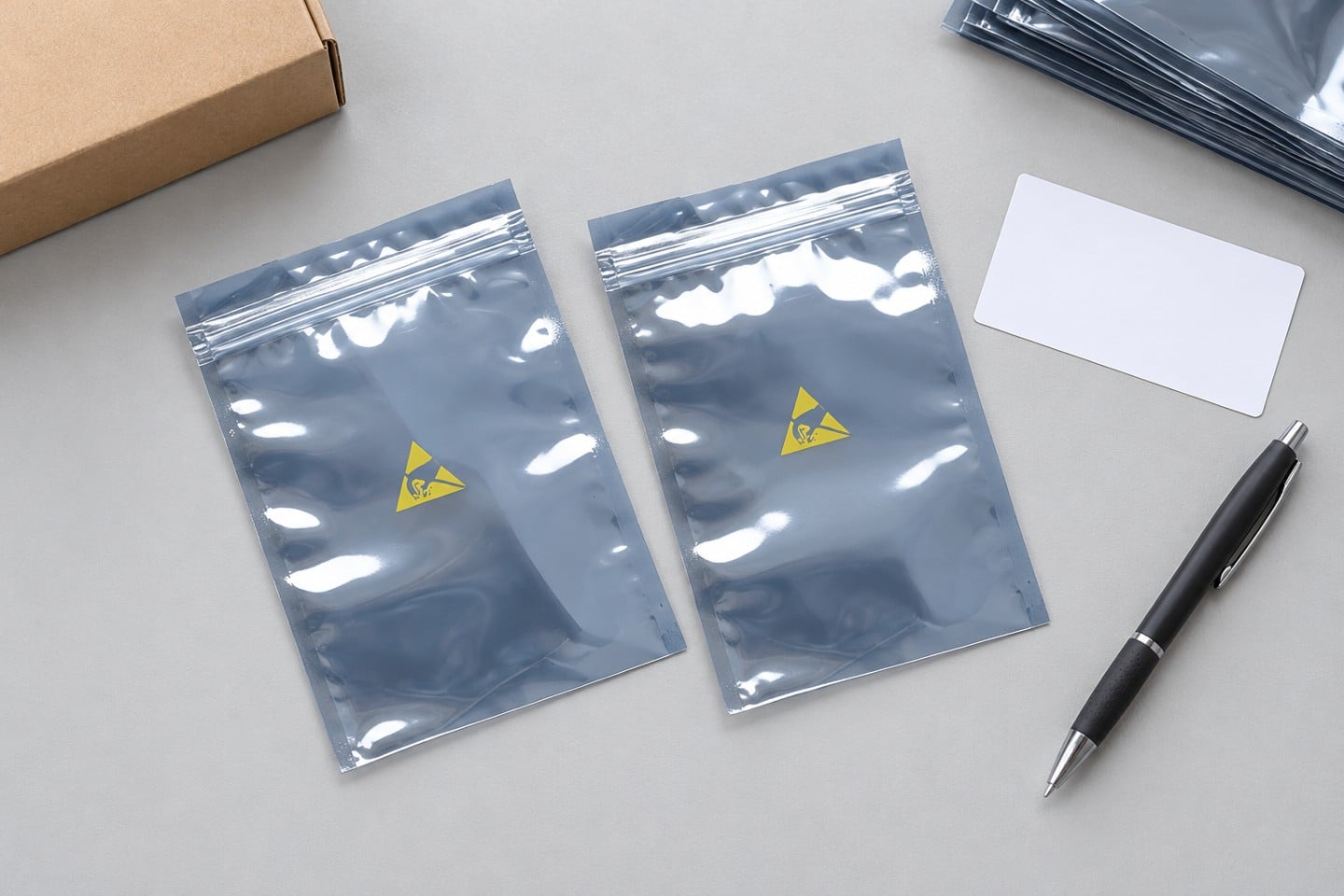
ال SWESD shielding bag product reference supplies a starting category for inquiries about available configurations. Ask for the exact offered dimensions, construction, closure, and relevant evidence. The illustrations show the visible reference product and do not demonstrate a specific packing capacity or approved shipment setup. For the purchasing distinction between flexible packaging and a container, consult the ESD bag versus shielding-tote guide instead of assuming their prices describe interchangeable protection.
Use a decision table for each proposed saving
Tie every proposal to the cost it addresses and the evidence needed before release. The following table provides qualitative review questions. It sets no universal thickness, lifetime, reuse count, or electrical acceptance limit. Populate the internal approval record with the actual controlled requirements and pilot observations for your product.
| Proposal | Cost driver | Review before release |
|---|---|---|
| Improve packing-stock organization | Searching and wrong selection | Retain approved sequence and measure actual time |
| Adjust order quantities | Obsolete or excess stock | Compare demand, storage and supplier lead conditions |
| Right-size qualified packaging | Material and shipment volume | Check fit, closure, support and relevant evidence |
| Introduce controlled reuse | Replacement purchases | Approve construction-specific policy, history and rejection criteria |
| Change package construction | Unit material cost | Review required protective functions and qualification |
| Use a returnable pool | Repeated disposable purchases | Include return, inspection, losses and administration costs |
Separate low-disruption process changes from material or construction changes. Improving the location of approved packing stock may require a workflow review, while changing the bag construction can require additional technical evidence and qualification. Keep the proposal scope clear so a pilot of better replenishment does not quietly include a cheaper substitute material. Where several changes are necessary, identify their effects individually before attributing the total saving to one supplier or product.
Evaluate reuse as a controlled system
Reuse needs an approved application, inspection and rejection criteria, handling rules, traceability where required, and an owner for replacement decisions. A bag that looks intact does not thereby prove that its protective functions remain acceptable. Consider exposure, contamination, closures, abrasion, puncture risk, and the uncertainty of its history. Ask the ESD technical owner what evidence supports the proposed reuse policy for the exact construction and route. This guide does not recommend a universal number of cycles or declare used bags qualified by appearance.
For a returnable container pool, include collection, sorting, cleaning where authorized, inspection, losses, return freight, storage, and administration in the cost model. The returnable ESD packaging pool guide explains the related logistics controls. A reusable system may cost more during a short pilot because equipment and return arrangements are being established. State the evaluation period and utilization assumptions rather than claiming that every reusable container will be cheaper than disposable packaging.

Keep environmental goals connected to product protection
ال US Environmental Protection Agency sustainable-packaging overview provides a broader framework for considering packaging design, materials, and waste. Apply environmental and cost goals alongside the product’s protection requirements. Record material use or waste reductions separately from financial savings. A lower material quantity is measurable, but it does not establish electrical suitability, mechanical protection, or overall environmental benefit without an appropriate assessment.
Discuss end-of-use routes with the responsible waste or recycling provider. Do not assume a multilayer packaging material can enter the same collection stream as an ordinary single-material bag. Ask the supplier for relevant material information and check the actual local route. Avoid presenting a generic recyclable claim as a verified outcome for your facility. Where a simpler package is proposed, obtain the protection evidence before treating reduced material complexity as a completed improvement.
Validate construction changes and transport consequences
Any change that affects protection needs review by the appropriate technical owner. Identify exactly what changes: material construction, dimensions, closure, support, outer package, or packing sequence. Review whether existing qualification remains relevant and what additional evaluation is required. The International Safe Transit Association testing overview helps frame discussion of shipment evaluation for the complete packed unit. It does not establish that an illustrated bag or a cost-reduction proposal has passed a transport test.
Use representative product and route conditions in the pilot within the approved limits. Record visible package damage, identification errors, repacking, handling difficulties, and any relevant product-quality observations. Keep those results alongside the cost figures. Absence of reported ESD failures during a small pilot is not enough by itself to prove equivalence of a changed protective construction. Electrical evidence, mechanical evaluation, and production observations answer different questions and should retain their separate acceptance decisions.
Design a pilot that produces comparable evidence
Specify the baseline process and candidate process, product scope, shipment route, duration or completion condition, cost inclusions, inspection plan, and stop conditions. Use the same acceptance definition for both groups. Record quantities started, accepted, held, reworked, and rejected so the denominator cannot be selected only from favorable deliveries. Where demand or freight pricing changes during the comparison, document the effect instead of attributing every cost difference to packaging.
Calculate the observed saving with the actual pilot figures. For a percentage comparison, divide the difference between baseline and candidate cost per accepted shipment by the baseline cost and multiply by 100. A zero baseline does not support that calculation. In the earlier illustrative example, $0.30 divided by $4.20 is approximately 7.1 percent. Treat that figure as arithmetic for the example, not a target. Explain what the pilot excludes and whether start-up costs or delayed returns could change the result.
Turn a successful pilot into a stable purchasing rule
Approve the exact package and process that were evaluated. Update purchasing descriptions, packing instructions, receiving checks, and replenishment arrangements as needed. Keep supplier change-notification requirements in place so a lower-cost construction is not substituted without review. Preserve the evidence file and the agreed application limits. A successful pilot should not authorize every component family or shipping route unless the evaluation supports that broader scope.
Monitor the original cost driver and the protection-related outcomes after release. Compare actual savings with the pilot, review rework and rejection patterns, and investigate deviations. If the new arrangement creates repeated handling problems, assess the full cost rather than defending the initial unit-price reduction. A durable saving is one that continues to deliver acceptable components under the defined process and has records that purchasing, production, and quality can all interpret.
Educational background
The EOS/ESD Association educational video below provides background on ESD control. It supports understanding of why protective functions must remain visible during a cost project. It does not certify a proposed package, approve reuse, or demonstrate a financial saving.
الأسئلة الشائعة
Is the lowest bag price the lowest packaging cost?
Not necessarily. Compare the included total cost per accepted shipment, including relevant labor, rework, logistics and waste.
Can intact-looking shielding bags be reused automatically?
No. Use a technically approved policy for the exact construction and application, with evidence, inspection and rejection criteria.
Does a smaller package always reduce cost safely?
No. Evaluate component fit, handling, closure, support and route protection before accepting smaller dimensions.
Does a small pilot without product failures prove ESD equivalence?
No. Use relevant protection evidence and appropriate evaluation; a small number of observations cannot establish every required property.
How should savings be reported?
Use comparable observed costs and accepted-shipment counts, identify exclusions and assumptions, and keep quality and protection outcomes visible.
أحدث مشاركة
-
 ESD Packaging Cost Reduction Without Losing Protection14 أكتوبر,2026
 -
 ESD Packaging Qualification Tests for New Suppliers14 أكتوبر,2026
 -
 ESD Ground Continuity Test Failures: Causes and Corrections14 أكتوبر,2026
اترك ردًا