- مدونة
A slant-edge ESD bin turns stock level into something a person can read from the aisle. The angled mouth exposes remaining parts to an angled sight line, so shortages surface before a feeder runs dry — but only when the profile is matched to shelf heights and paired with written color, label, and refill rules. Map the sight lines first; confirm the model in the RFQ.
High-mix assembly multiplies part numbers faster than it multiplies floor space. Within the صندوق ESD category, the slant-edge profile — the oblique-mouth format in Sanwei’s published classification — is the geometry buyers reach for when the job is seeing stock, not just storing it.
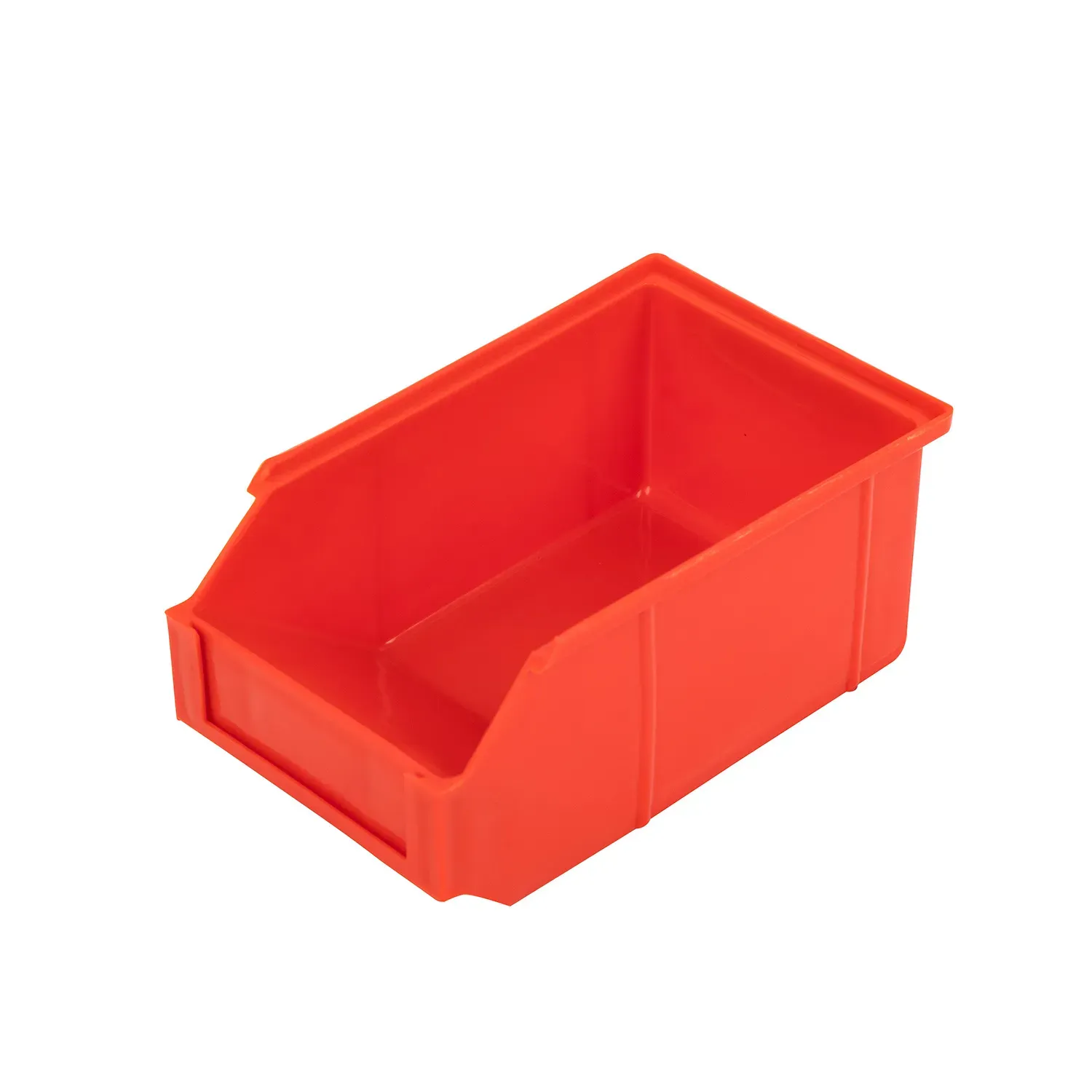
Part 1. Why does high-mix assembly lose sight of its stock?
Shortages in high-mix cells are rarely a counting problem; they are a seeing problem. Stock hides in closed boxes, behind vertical bin walls, and on shelves above eye level, so the first warning is an empty hand at the machine.
| Visibility failure | Where it happens | Cost it creates |
|---|---|---|
| Closed or deep containers | Bench stock in lidded boxes | Level checks require opening and handling |
| Vertical front walls | Straight-wall bins on upper shelves | Only the bin, not the level, is visible |
| Unmapped shelf heights | Racks reused from the warehouse | Top rows unreadable from the aisle |
| No refill trigger | Stations refilled on complaint | Shortages found at the feeder, not before |
| Mixed color meanings | Colors assigned ad hoc per station | Wrong-family picks and slow audits |
Every row above is a process gap first and a container question second. The bin profile helps only after the team decides who must read stock levels, from where, and what happens when a level looks low.
Part 2. How does a slant-edge mouth support visual inventory?
The slanted edge lowers the front of the mouth and tilts the opening toward the viewer. Standing in the aisle, a material handler reads the fill level of an angled bin several shelf rows deep, which is exactly the walk-and-scan routine that keeps high-mix lines fed.
Three placements benefit most. Eye-level rack rows read almost straight in; rows above shoulder height need the mouth angled downward, which is where the slant earns its keep; bench-edge rows serve the seated operator and the passing handler at once.
The same profile sets limits. An open, sloped mouth lowers the safe fill line, suits parts that tolerate open exposure, and assumes the bin stays at its station. Where parts must move between areas in the container, or need covers for dust or long idle periods, the bin-type overview points to enclosed formats instead.
Part 3. How does buyer language map to the published Sanwei bin family?
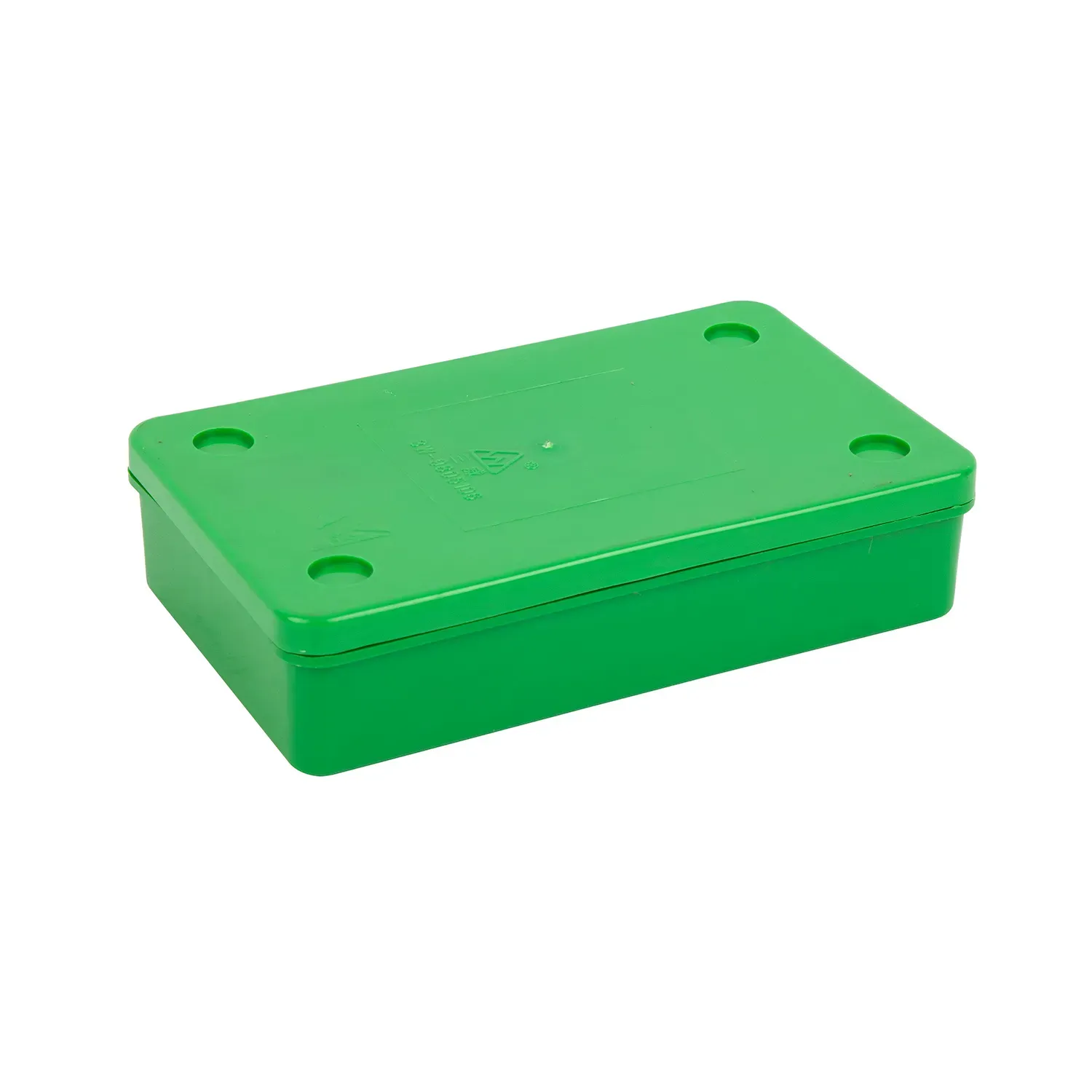
“Slant-edge,” “slanted mouth,” and “oblique mouth” describe the same profile intent. In Sanwei’s published language, the صندوق مكونات ESD family classification includes oblique-mouth component bins alongside flat-mouth, covered, and drawer formats, with diverse colors, customizable sizes, stacking, and optional anti-static label, cover, and partition accessories on listed models.
System context comes from the ESD Bin & ESD Rack solution page, which describes an open hopper front for access and a back label holder for barcode or part-number identification, with modular racks and grounding-compatible design language.
Boundaries stay firm. The cited pages do not verify a mouth angle for a given shelf height, a rack fit for a given aisle, a load rating, dimensions for a selected order, price, MOQ, or lead time. Those items are quotation questions, and the sample review is where the sight-line claim is tested against the buyer’s own racks.
Part 4. Which color, label, and refill rules turn visibility into control?
Give color one job and the label a different one. Color reads from distance and should mean a family-level fact; the label reads up close and identifies the exact part.
| Rule | Working version | What it prevents |
|---|---|---|
| Color meaning | One written map, such as family, line, or status | Colors drifting into station-local dialects |
| Label fields | Part number, description, location, revision or date | Picks from lookalike neighbors |
| Label position | Front face or holder, readable at the installed angle | Tipping bins to identify contents |
| Refill trigger | A visible minimum line or empty-slot rule | Shortages discovered at the feeder |
| Refill route | Named owner and a fixed walk pattern | Random refills that skip quiet corners |
| Return rule | Emptied bins cleaned and relabeled before reuse | Old identification traveling with new stock |
Color families need discipline more than variety. A plant that means “urgent” by red in one cell and “defective” in the next loses the distance-reading benefit; the red bin color-family guide shows how one color carries a consistent job.
Inside the bin, segregation is its own rule set. Where one location must hold two or three variants, use a documented partition rule from the partitioned-bin segregation guide rather than trusting operators to keep loose piles apart.
Part 5. Which ESD evidence and fit boundaries still apply?
Visual inventory changes nothing about electrical discipline. The bins sit inside the buyer’s EPA rules for grounding, handling, and acceptance, with program-level context from IEC 61340-5-1 and the ANSI/ESD standards route.
| طلب أدلة | Why it belongs in the file | حدود |
|---|---|---|
| Quoted model and accessory list | Ties the sight-line plan to one configuration | A classification entry is not model confirmation |
| Material identification | States what will be supplied | Color never identifies a material |
| Electrical evidence with test method | Matches the EPA acceptance rule | Published family ranges are confirmed per model |
| Rack pairing confirmation | Records bin-on-rack intent against the solution language | System wording is not a fit guarantee |
| Sample or lot traceability | Connects evidence to delivered goods | Keep it with receiving records |
ملائمة الحدود
| وضع المشتري | طريق معقول | تجنب |
|---|---|---|
| Dozens of part numbers needing aisle-readable levels | Slant-edge profile mapped to shelf heights and sight lines | Buying a profile before mapping who reads it |
| Two or three variants per location | Partition rule inside a documented bin layout | Loose mixed piles behind one label |
| Stock that travels with the line | Movement container with its own route rule | Letting presentation bins wander between areas |
| Dusty areas or long-idle stock | Covered or enclosed formats | Treating an open mouth as protective storage |
Part 6. What should the RFQ and sample review include?
Quote the method, not just the bin. A supplier can confirm a configuration only when the sight-line and labeling plan arrives with the part data.
| حقل طلب عرض سعر | مدخلات المشتري |
|---|---|
| Area summary | Cell count, rack and shelf heights, aisle sight lines |
| Part data | Part-number count, families, envelope, and weight class |
| Profile requirement | Slant-edge mouth intent per shelf band |
| Color plan | Written color map and quantities per color |
| تحديد | Label fields, position, and holder or print method |
| Refill method | Trigger rule, route owner, and return loop |
| ESD requirement | Buyer-defined electrical criteria, test method, and acceptance rule |
| Commercial request | Quantity bands, destination, and required documentation |
| Sample plan | Sight-line trial on the actual racks before release |
توصية المنتج
Start the model review with the Sanwei ESD Component Bin family, whose published classification includes the oblique-mouth profile, and use the ESD Bin & ESD Rack solution page when bins and racks are specified together. This is an RFQ starting point, not a statement that a listed model reads correctly on a particular rack.
Do not order a color set or profile from a photo. Ask Sanwei to confirm the selected model, mouth profile, colors, accessories, electrical evidence, and commercial terms in writing, then walk the sample past real shelf heights before release.

Send the area summary, sight-line map, color and label plan, refill rules, and acceptance criteria through اتصل بسانوي for quotation review.
أسئلة متكررة
What is a slant-edge ESD bin?
It is an ESD-safe bin whose mouth is cut at an angle so the remaining stock is visible from an angled sight line. The term is buyer language for the oblique-mouth profile and describes an intent, not a standardized specification.
Is a slant-edge ESD bin the same as an oblique-mouth bin?
The intent is the same, and Sanwei’s published component-bin classification uses the oblique-mouth wording. Supplier naming varies, so confirm the selected model’s actual mouth geometry in the quotation.
Does a slant-edge bin help visual inventory in high-mix assembly?
It can, because fill levels become readable from the aisle across many part numbers. The benefit depends on mapped shelf heights, sight lines, and written refill rules, which the buyer defines before quoting.
How should colors be used on ESD bins?
Give color one written, plant-wide meaning — such as part family, line, or status — and keep exact identification on the label. Diverse colors are a published family option to confirm per model and quantity.
What should a slant-edge bin label show?
Use part number, description, location, and a revision or date, placed on the front face or a holder that reads at the installed angle without touching stock.
Can slant-edge ESD bins be used on racks?
Rack pairing is the normal deployment, and the cited solution page describes modular racks with back label holders. Confirm the selected bin-and-rack combination and any load question in the RFQ.
What ESD evidence should be requested for visual-inventory bins?
Request the quoted model, material identification, electrical evidence against the buyer’s own criteria with the test method stated, and traceability from the reviewed sample to supplied lots.
What should be confirmed on a sample?
Check mouth readability at the real shelf heights, label position at the installed angle, color assignments against the written map, stacking or rack behavior, and the ESD evidence required by the buyer’s program.
المراجع
أحدث مشاركة
-
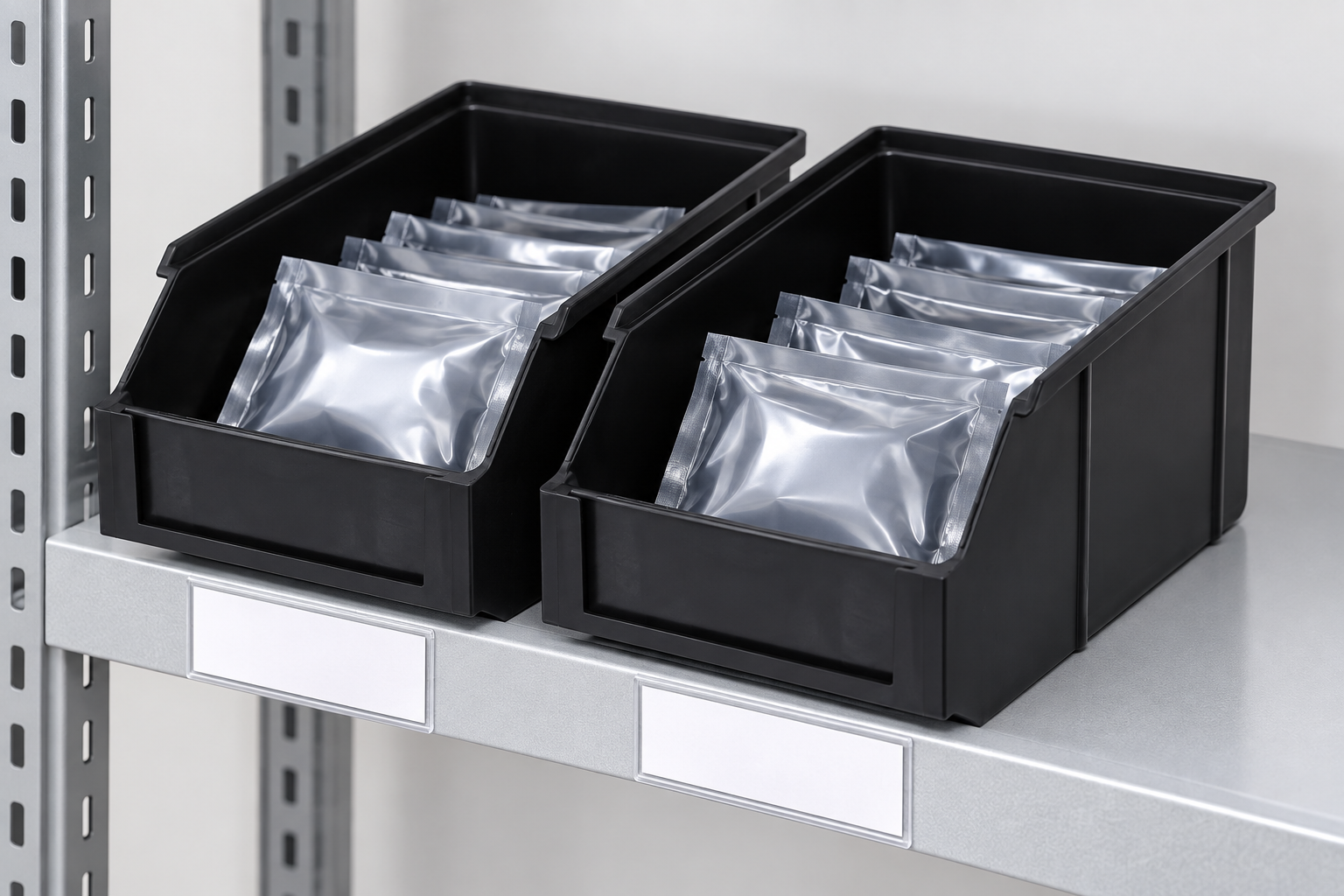 ESD Picking Bins: Front Access, Labels and Replenishment29 سبتمبر,2026
 -
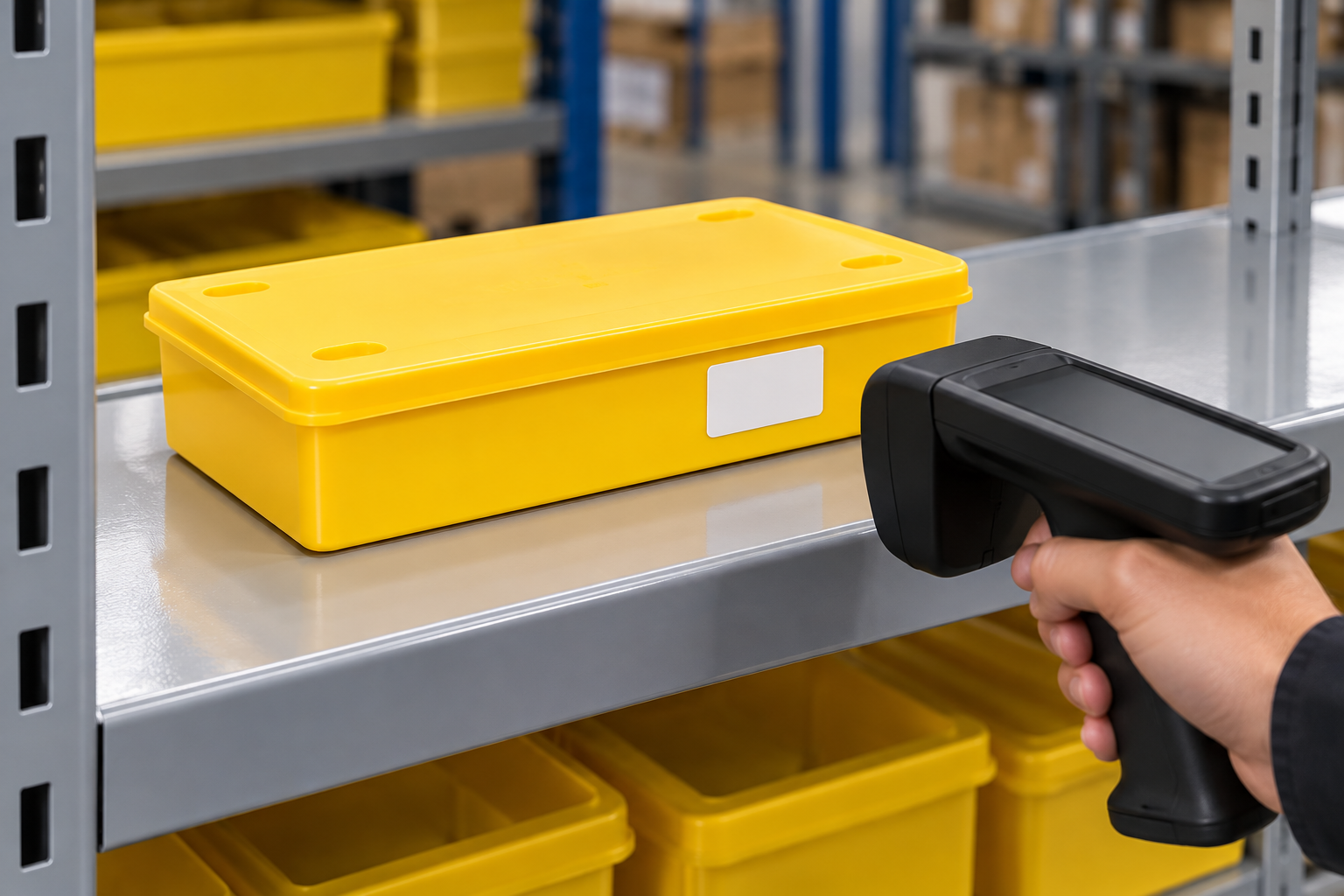 RFID Labels for ESD Storage Bins: Placement and Validation28 سبتمبر,2026
 -
 Reusable ESD Trays: Cleaning, Inspection and Lifecycle Cost28 سبتمبر,2026
اترك ردًا