- مدونة
An adjustable-width ESD rack pays off when a documented range of PCB and panel sizes must share storage positions — and when every width change has an owner and a verification step. Document the mix as bands first; the adjustment feature manages nothing on its own.
Start from the ESD Rack category to see the published slotted rack families, one of which Sanwei presents as an adjustable PCB storage rack. This article turns that feature into a governed, modular storage plan for high-mix production.
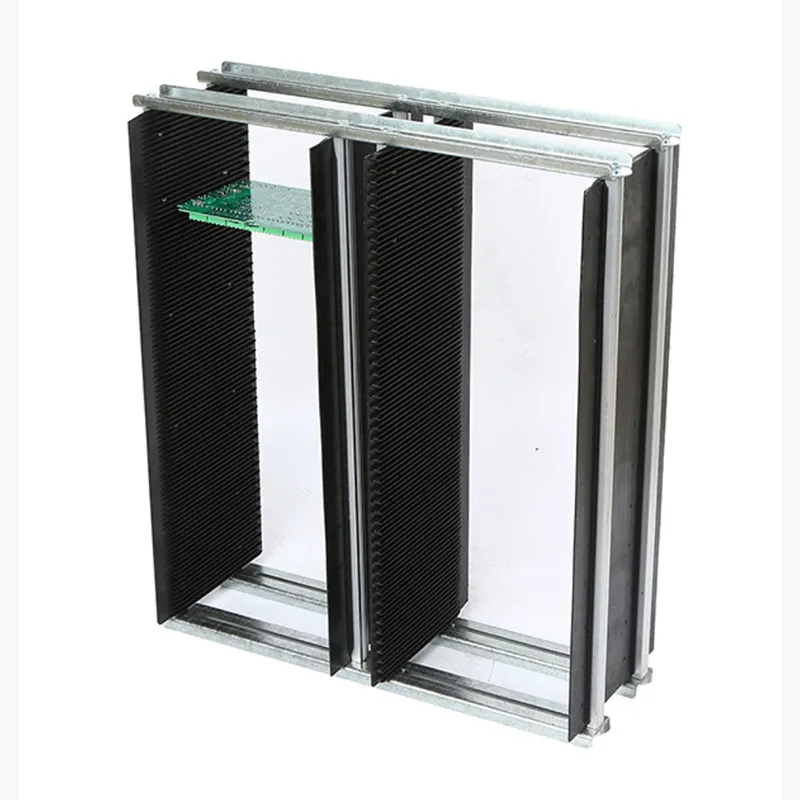
Part 1. When do mixed PCB sizes justify an adjustable rack?
Count the sizes before counting the racks. High-mix production tends to accumulate dedicated racks product by product, until storage positions outnumber the space and half of them sit empty between runs.
An adjustable family earns its place when several size groups rotate through the same positions, changeovers are frequent enough to matter, and the team can govern the settings. One stable dominant size argues the other way: a fixed rack with no moving decision is simpler to control.
| Production situation | Reasonable storage direction | What to define before buying |
|---|---|---|
| Several PCB size groups rotating through the same area | Adjustable-width positions shared across bands | Size bands, setting owner, and verification |
| One stable size with rare exceptions | Dedicated fixed racks; handle exceptions separately | The exception path only |
| New products arriving each quarter | Adjustable positions plus a growth allowance in the RFQ | Who reviews new sizes against existing bands |
| Unknown or undocumented size range | Documentation first; hardware second | The size-mix table in Part 3 |
For the wider family context, the broader ESD rack and buffering guide covers how storage racks sit alongside other line-side equipment.
Part 2. What does adjustable width mean on a storage rack?
On an open slotted storage rack, adjustable width means the distance between the slotted faces can be changed so different board widths sit securely in the same frame. Sanwei presents one ESD Rack family as an adjustable PCB storage rack, with an adjustment-range row and a customizable aluminum-strip note on its published model rows.
Read the feature as a per-model row, not a family promise. Which range a named model covers, and how a given board sits at a given setting, are quotation questions; this article deliberately quotes no range values.
The word adjustable also appears in a different cluster. The magazine-rack adjustment guide and its sibling posts cover handle-, screw-, and wrench-adjusted ESD magazine racks — enclosed magazine holders for loaders and unloaders. Those are magazine-rack decisions with their own mechanism logic, and nothing here replaces them; this article stays with open storage racks.
Part 3. How should the PCB size mix be documented?
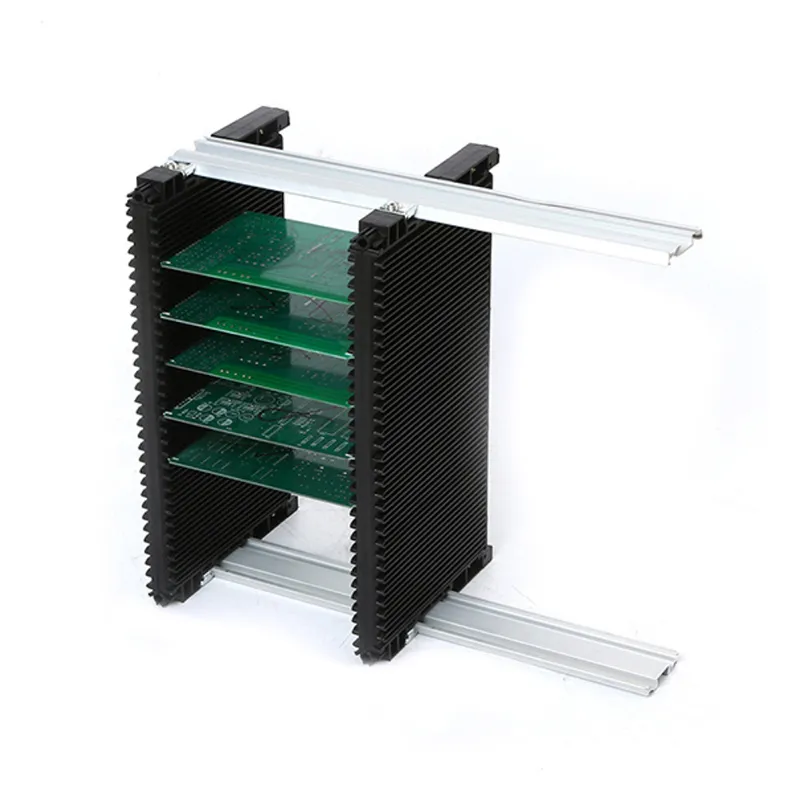
Turn the product list into size bands. A band groups boards that can share one width setting, so the rack changes settings per band instead of per product, and the changeover count drops.
The banded table is the core RFQ attachment. It tells the supplier what the family must cover and tells the line which setting each band uses.
| Size-mix input | What the buyer records | لماذا يهم الأمر |
|---|---|---|
| Board and panel envelopes | Occupied width, length, and thickness per product, loaded condition | Bands are built from real envelopes, not nominal names |
| Band definition | Which products share one setting | Fewer settings, fewer changeover errors |
| Quantities per band | Boards waiting per band at peak | Slot counts and rack counts become checkable |
| Growth expectation | How new products enter a band or open a new one | The quotation can include headroom |
| Orientation limits | Faces, edges, or components that restrict how a board sits | Prevents a band that fits on paper and fails loaded |
Part 4. Who owns width changes and verification?
Name one setting owner per area. When anyone can move the slotted faces, one urgent panel reconfigures a shared rack and every other band loses its verified fit without anyone recording it.
Verification closes each change. After a width change, the owner checks the setting against the band definition — a marked scale position, a gauge board, or the buyer’s own defined method — and records who changed it, when, and for which band.
| Event | Setting rule | Owner action |
|---|---|---|
| Planned changeover to another band | Setting moves to the band’s recorded position | Owner verifies and logs the change |
| Urgent nonstandard board arrives | Exception path, not a quiet adjustment | Supervisor approves and schedules restoration |
| Setting found off its recorded position | Rack status changes to unverified | Owner re-verifies before further loading |
| New product enters the mix | Band review, then a recorded setting decision | Planner updates the size-mix table |
Part 5. How do settings and slot allocation stay modular?
Modular means any rack in the pool can take any band with a known procedure. Label each rack with its current band and setting, keep the band table at the area, and store settings as recorded positions rather than tribal knowledge.
Allocate slots by band, not by habit. When a band occupies defined racks and slots, the team sees capacity per band at a glance, and a growing band triggers a planned expansion instead of a quiet takeover of a neighbor’s positions.
Keep the loaded condition visible in the plan. Boards that overhang or sit loosely at a setting are a band-definition error to fix in the table, and the ESD PCB rack overview shows how such governed positions fit the wider rack family.
Part 6. Which ESD evidence and configuration details need confirmation?
The ESD acceptance path does not change because a rack adjusts. ANSI/ESD S20.20-2021 describes requirements for an ESD control program; it does not approve a rack model, a width setting, or a changeover procedure.
Sanwei’s rack family pages publish static-index rows alongside the structure rows, with optional accessories on selected pages. Request the test method, evidence, and traceability the buyer’s program requires for the quoted model, and leave range values, dimensions, load behavior, materials, and temperature limits to the quoted model rows.
Part 7. What belongs in the RFQ and sample-use review?
Send the banded mix, not a request for an adjustable rack. The supplier confirms which named models cover the bands; the buyer confirms governance is ready before the racks arrive.
| طلب تقديم عرض أسعار | يجب على المشتري توفير |
|---|---|
| Size-mix table | Banded envelopes, quantities, growth expectation, and orientation limits |
| Setting governance | Setting owner, verification method, and change log format |
| Changeover profile | Frequency of band changes and acceptable changeover effort |
| Slot allocation | Racks and slots per band with labeling rule |
| تحديد | Band labels, setting marks, and status fields |
| ESD request | Required method, evidence, and acceptance criteria |
| Sample-use review | Loaded fit per band, setting change trial, verification walk-through, and label check |
Start the model review from the Sanwei adjustable ESD Rack family, whose page carries the adjustment-range row and structure rows the quotation should confirm against the banded mix. The family page is the entry point for a quote-confirmed selection, not a promise that one model covers every band.
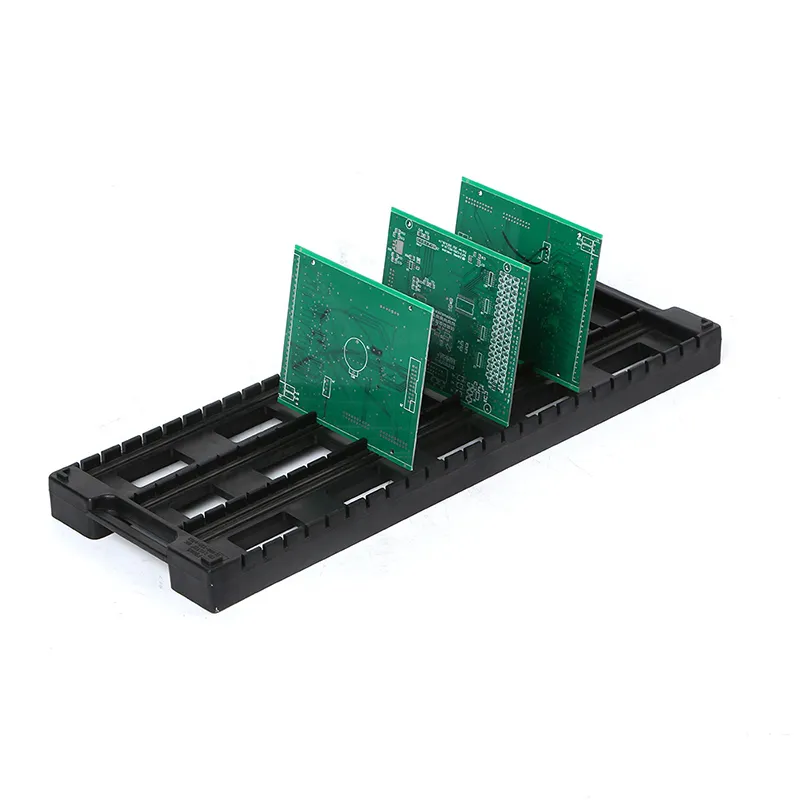
ملائمة الحدود
| وضع المشتري | طريق معقول | تجنب |
|---|---|---|
| Documented multi-band size mix sharing positions | Adjustable-width racks with governed settings | Buying the feature without the governance |
| One stable dominant size | Dedicated fixed racks | Paying for adjustability nothing will use |
| Loader and unloader magazine handling | The ESD magazine-rack cluster and its adjustment guides | Treating this storage-rack guide as magazine guidance |
| Undocumented size range | Build the banded table first | Letting the first delivery define the bands |
Send the banded size mix, governance plan, and ESD evidence request through اتصل بسانوي for a quote-confirmed review of adjustable rack models against the bands.
أسئلة متكررة
What is an adjustable width ESD rack?
It is an open slotted storage rack whose slotted faces can be repositioned so different board widths sit securely in one frame. Which range a named model covers is a quotation question against its published row.
When do mixed PCB sizes justify adjustable racks?
When several size groups rotate through the same storage positions, changeovers are frequent, and the team can own every setting change. A single stable size is usually better served by fixed racks.
How is this different from an adjustable ESD magazine rack?
A magazine rack is an enclosed PCB magazine holder for loaders and unloaders, and its handle-, screw-, and wrench-adjustment guides belong to that cluster. This article governs open storage racks for shelf-style PCB staging.
How should a team document its PCB size mix?
Record loaded envelopes per product, group them into bands that share one setting, add quantities and growth expectations, and keep the banded table as the controlled RFQ attachment and line reference.
Who should be allowed to change rack width?
One named setting owner per area, working from recorded band positions. Everyone else routes urgent exceptions through an approval that schedules restoration of the verified setting.
Should each width setting be verified after a change?
Yes — against the band definition, using the buyer’s own defined method, with the change logged. An unverified setting means an unverified fit for every board that follows.
What ESD evidence should buyers request for adjustable racks?
Request the test method, evidence, and traceability the buyer’s program requires for the quoted model, using the program context of ANSI/ESD S20.20; the published static-index row supports but does not replace that request.
What should a sample review check before a mixed-size rollout?
Loaded fit for each band at its recorded setting, a full setting-change trial with verification, label and status visibility, and the change-log walk-through with the setting owner.
المراجع
أحدث مشاركة
-
 ESD Picking Bins: Front Access, Labels and Replenishment29 سبتمبر,2026
 -
 RFID Labels for ESD Storage Bins: Placement and Validation28 سبتمبر,2026
 -
 Reusable ESD Trays: Cleaning, Inspection and Lifecycle Cost28 سبتمبر,2026
اترك ردًا