- مدونة
A handle-adjustable ESD magazine rack lets operators set side-guide spacing quickly for mixed PCB widths on SMT lines— but “handle adjustable” in a catalogue must still translate into measurable RFQ fields. Specify adjustable width range, outer footprint, slot pitch, heat class, base material, and resistance test logs before you compare quotations.
This guide is for export buyers, EMS procurement teams, and line engineers who standardize رفوف مجلات ESD across plants. For general buffering concepts, see the site’s anti-static magazine rack buffering guide.

Contents
- Part 1. What does “handle adjustable” mean on an ESD magazine rack?
- Part 2. When does handle or quick adjust fit high-mix SMT lines?
- Part 3. Which dimensional fields belong in every RFQ?
- Part 4. How do heat class and base material limit your shortlist?
- Part 5. How should buyers verify resistance and EPA fit?
- Part 6. What belongs in an export RFQ packet?
- Part 7. Which Sanwei racks should buyers shortlist?
Part 1. What does “handle adjustable” mean on an ESD magazine rack?
An ESD magazine rack holds PCBs vertically in dissipative or conductive slots for buffering between SMT machines, inspection, and manual stations. Handle adjustable usually describes a quick width-setting mechanism—often a handle driving gear track or rack-and-pinion hardware—so operators can move side guides without fully disassembling screw clamps at four corners.
Industry catalogues also list screw-clamp adjustment: lower hardware cost and very stable settings, but slower changeovers when PCB width changes every few jobs. Public summaries of Cab PCB magazine families contrast Series 600 screw clamp with Series 700 gear-belt adjustment for that reason: frequency of width changes drives mechanism choice.
For procurement language, map marketing terms to testable fields:
| Marketing term | Ask supplier to confirm | Why it matters |
|---|---|---|
| Handle adjustable | Mechanism type (gear track, belt, crank) | Training and spare parts |
| Quick adjust | Time/steps to set width; lock feature | Changeover KPI |
| ضبط التروس | Pitch stability after locking | Prevents slot misalignment |
| Screw adjustable | Clamp count and torque spec | Stable width on single-SKU lines |
Sanwei’s published ESD Magazine Rack solution page lists customizable slot pitch and stackable design with IEC 61340-5-1 and ANSI/ESD S20.20 alignment—use that page for program-level compliance context, then confirm readings on the exact SKU and production lot.
Part 2. When does handle or quick adjust fit high-mix SMT lines?
Quick-adjust handles earn their cost when PCB width changes often—mixed panel sizes on one line, frequent NPI runs, or contract manufacturers serving multiple customers from shared equipment.
Use a simple decision path:
- Count width changes per shift. If operators re-set guides more than a few times daily, prioritize handle/gear mechanisms.
- Check automation indexing. Loader/unloader OEMs expect consistent outer width and ear height; quick adjust still requires a lock and verification step.
- Standardize spare guides. High-mix lines wear side plates first—bundle spare guide MOQ in the RFQ.
| Line profile | Typical mechanism | Risk if underspecified |
|---|---|---|
| Single SKU, stable width | Screw clamp may suffice | Overpaying for quick adjust |
| High-mix SMT | Handle/gear quick adjust | Slow changeovers, mis-set width |
| Manual buffer only | Either, with lock audit | Loader mismatch at automation step |
| Warm queue near reflow | Heat-rated guides + metal base | Warped guides, slot misalignment |
Tip: Photograph the locked width setting and store it in MES or work instructions so night shifts repeat the same guide position. — Source: Sanwei
/blog/anti-static-magazine-rack/line-standardization practice.
For mechanism comparisons beyond handles, the companion article on screw versus belt-screw adjustment (scheduled in the same content batch) covers screw-clamp versus belt-driven families.
Part 3. Which dimensional fields belong in every RFQ?
Catalogues show many outer footprints—355×320×563 mm is a common mid-size example on Sanwei’s solution page, while larger 535×530 mm units serve wider panels. Never assume one “standard” size fits your loader.
Minimum dimensional RFQ set:
| Field | Example record | Owner |
|---|---|---|
| PCB length × width range | 350 × (50–250) mm | Process engineering |
| Outer rack L×W×H | 355×320×563 mm (confirm) | Automation |
| Slot count | 50 slots | Production |
| Slot pitch | 10 mm (confirm) | PE |
| Slot depth / width | 3–3.5 mm depth; 5–5.5 mm width | Quality |
| Loaded weight estimate | Full magazine kg | Logistics |
Provide loader brand and model when magazines must index in automated equipment. Subtle ear-height or handle clearance errors stop lines even when slot pitch is correct.
Cross-check panel outline drawings with ±3 mm discipline early—automation stops on clearance errors that manual buffering tolerates.
Part 4. How do heat class and base material limit your shortlist?
Magazine guides must match the hottest zone the rack enters. Boards leaving reflow can radiate heat that exceeds ambient HVAC setpoints near the oven exit.
Sanwei publishes 160°C standard heat resistance with optional 200°C grade on its solution page. Treat those figures as supplier-stated grades for Sanwei materials—not as universal limits for every black plastic rack in the market.
| Component | Question for supplier | Fit boundary |
|---|---|---|
| Side guides | Continuous service vs short warm queue | Do not use room-temp guides in sustained hot queues |
| Top/bottom plate | Metal vs plastic base | Metal improves rigidity on heavy multilayer loads |
| Coating | Galvanized or coated base in wash areas | Ask corrosion behavior near cleaning zones |
| Color / material | PP vs PBT/PET alloy (if stated) | Match to cleaning chemicals used |
If panels only dwell briefly at room temperature, paying for 200°C-grade guides adds cost without benefit. If racks sit in warm buffers after reflow, heat class moves to P0 in the RFQ.
Part 5. How should buyers verify resistance and EPA fit?
ESD control programs under IEC 61340-5-1 and facility practices aligned with ANSI/ESD S20.20 require verified resistance, not color assumptions.
Sanwei’s solution page cites 10⁶–10⁹ Ω surface resistance (EIA-541 context). Request:
- test method and probe geometry;
- inner versus outer readings on guides and base;
- lot certificate or periodic test log;
- grounding path when racks sit on عربات ESD or grounded carts.
Racks buffer PCBs, not loose components—pair magazines with ESD bins or trays for kitting upstream of placement.
Incoming inspection should sample resistance after transit—not only at first article—because humidity and contamination shift readings.
Part 6. What belongs in an export RFQ packet?
Send one package to reduce back-and-forth across time zones:
- Panel drawings with max component height and thickness stack.
- Width adjustment range and preferred mechanism (handle/gear vs screw).
- Heat exposure (zones, dwell time, peak temperature).
- Loader/unloader OEM and interface photos if available.
- Quantity bands for trial, ramp, and annual volume.
- Destination country for packing and documentation.
- Labeling (lot ID, barcodes, color coding by customer).
- Spare parts (side guides, feet, locks) and acceptable MOQ.
| RFQ section | Common omission | Result |
|---|---|---|
| Automation | Missing ear height | Magazine jams in loader |
| Heat | “Reflow nearby” without dwell | Wrong guide material |
| Resistance | No test method | Non-comparable supplier logs |
| Logistics | No nested empty-rack carton size | Freight rework at hub |
Compare quotes on included spares, adjustment hardware, and test documentation—not rack unit price alone.
Document Incoterms, destination port, and who owns inbound resistance testing at receiving. Export programs that skip logistics fields often receive quotes that cannot be compared across suppliers because freight and packing assumptions differ by region.
Part 7. Which Sanwei racks should buyers shortlist?
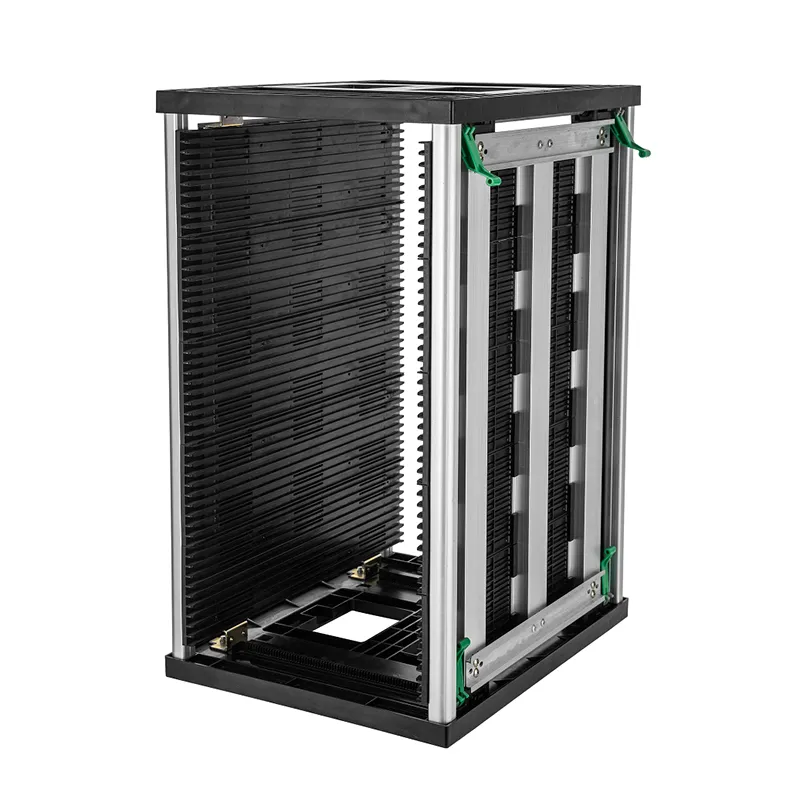
Start matching from Sanwei’s live ESD Magazine Rack category, which lists multiple footprints from 355×320 mm through 630×530 mm class sizes.
When RFQ centers on handle or gear-style width adjustment for mid-size panels, review the 355(L)×320(W)×H mm gear-adjust listing as a conversation anchor. For wider panels, compare 460(L)×400(W)×H mm and larger category SKUs before custom mold discussions.

Fit Boundary
| Buyer situation | Reasonable path | Avoid |
|---|---|---|
| High-mix SMT with frequent width changes | Handle/gear quick-adjust family + lock SOP | Single screw-clamp rack without changeover plan |
| Stable single width | Screw clamp may suffice | Paying for premium adjust hardware unused |
| Warm queue after reflow | Confirm heat grade and metal base | Room-temp guides in hot zones |
| No loader drawings | Manual buffer only | Assuming automation fit |
Send drawings and quantity bands through اتصل بنا or the OEM/ODM page when slot pitch, color, or logo engraving differs from catalog listings.
أسئلة متكررة
How do you adjust the width on an ESD magazine rack?
Moveable side guides slide on gear track, belt, or screw-clamp hardware until the PCB width is set, then lock the mechanism. Confirm steps and lock type with the supplier manual for your SKU.
Is handle adjustment the same as gear-belt adjustment?
Buyers use both terms for quick width changes. RFQ should name the mechanism and lock method, not only “handle.”
What surface resistance should ESD magazine racks meet?
Programs commonly cite dissipative ranges such as 10⁶–10⁹ Ω depending on tier. Request supplier test logs with method noted—Sanwei publishes 10⁶–10⁹ Ω on its solution page for its magazine rack line.
What temperature rating should SMT buyers specify?
Match the guide heat class to the hottest dwell zone. Sanwei lists 160°C standard with optional 200°C grade on its solution page; verify against your process before bulk PO.
What dimensions should be in an RFQ?
Outer L×W×H, adjustable PCB width range, slot count, pitch, depth, loaded weight, and loader OEM when automated.
When are screw-clamp racks enough?
When PCB width is stable and changeovers are rare—see the screw versus belt-screw comparison for side-by-side selection logic.
Should buyers request first articles?
Yes—confirm footprint, lock integrity, resistance at your facility RH, and loader fit before plant-wide rollout.
Can one Sanwei rack family serve multiple sites?
Yes, if all sites share the same PCB mix and loader interfaces. Freeze mold numbers in customer QA packs to prevent silent substitution.
المراجع
- IEC 61340-5-1 — Electrostatics (ESD control program)
- ANSI/ESD S20.20 — ESD Association program standard
- Cab PCB Magazines 600/700 series product summary (Hawker Richardson) — third-party mechanism comparison context only
أحدث مشاركة
-
-
 Stencil Wiper Selection Guide for SMT Printing31 أغسطس,2026
 -
اترك ردًا