- مدونة
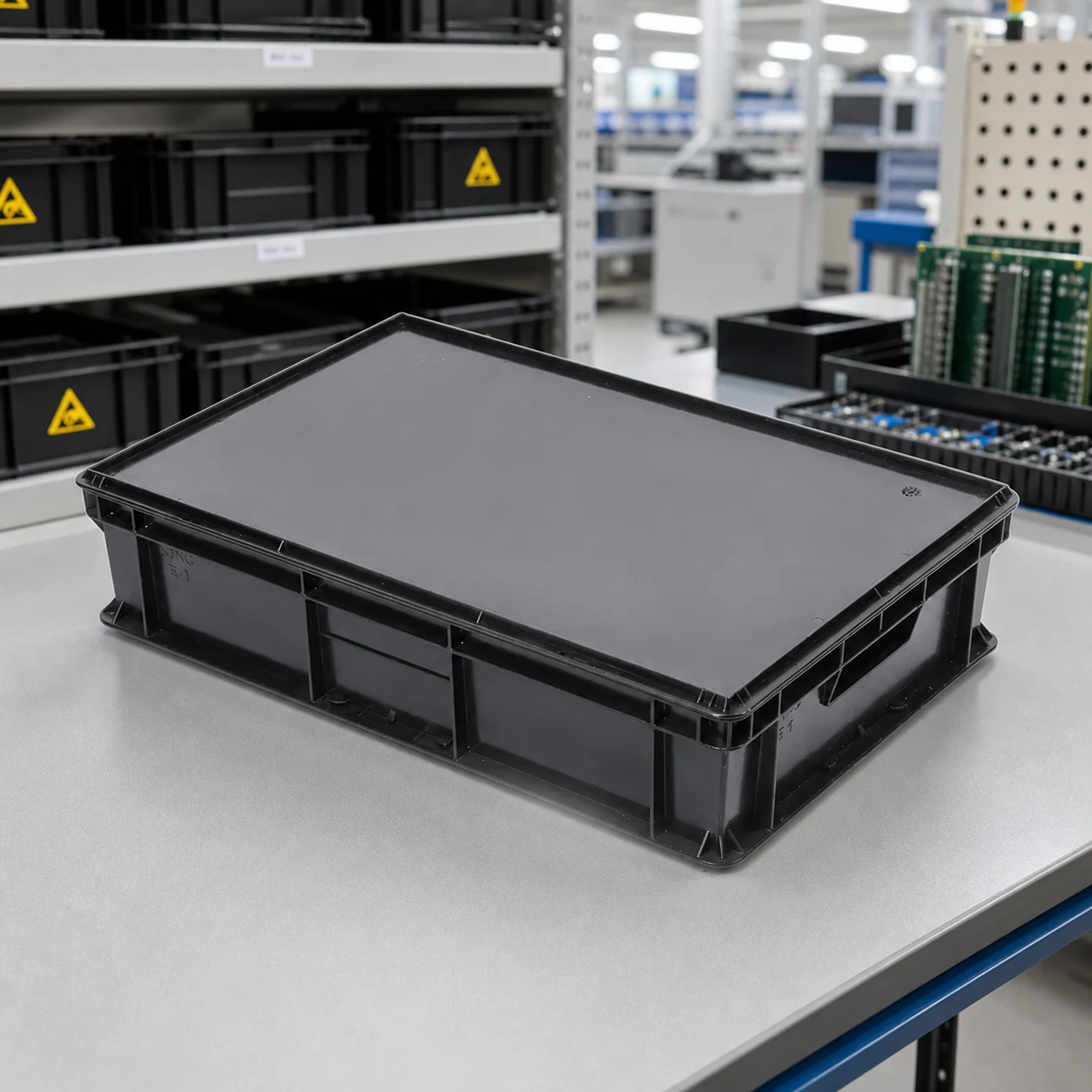
A heat resistant ESD box is a conductive polypropylene container rated for elevated service temperatures while still limiting electrostatic charge on surfaces that touch sensitive devices. Buyers use them for staging assemblies near warm equipment, in aging rooms, or in export climates—but they are not substitutes for in-process oven fixtures. Written for global electronics manufacturing and EPA teams—specify 50 or 60 Hz plant power only where electrical grounding interfaces matter, not for material selection.

Part 1. What makes an ESD box heat resistant?
Standard conductive PP totes often cite continuous service from roughly -20 °C to +80–100 °C, with short-term tolerance slightly higher depending on load and wall thickness. Heat-resistant grades use modified PP or alternative fillers to reduce creep and warping.
ESD performance and thermal performance are separate tests. A box can remain dissipative while still softening if it exceeds its heat class. Always request both resistance logs and temperature rating from the molder.
Wall thickness and rib design influence how long a box can hold warm boards without distortion. Deep stacks of hot assemblies concentrate heat in the center panels.
Cross-site programs benefit from a single drawing register for storage hardware so MRO orders do not drift across regions.
Facilities running both 50 Hz and 60 Hz equipment should still specify the same ESD material class; grounding audits focus on resistance paths, not mains frequency.
Cross-site programs benefit from a single drawing register for storage hardware so MRO orders do not drift across regions.
Facilities running both 50 Hz and 60 Hz equipment should still specify the same ESD material class; grounding audits focus on resistance paths, not mains frequency.
Field evaluation notes
Document who owns ESD audits versus procurement sign-off—misaligned approvals delay standardization across plants.
Capture photos of existing layouts before RFQ; dimensions inferred from memory often underestimate clearance for drawer pull or rack handles.
| Grade | Typical use | Caution |
|---|---|---|
| Standard conductive PP | Room-temp EPA staging | Avoid oven zones |
| Elevated-temp PP | Aging / warm queues | Confirm dwell time |
| With lid + latch | Dust control | Check latch material rating |
| Corrugated PP | Lightweight shipper | Lower rigidity |
Part 2. Applications on the shop floor
Post-reflow holding areas sometimes use heat-rated boxes when assemblies cool in batches before inspection. The box protects from mechanical damage while ESD controls remain active.
Aging and burn-in rooms may require racks or boxes rated above normal floor temperatures. Confirm whether the requirement is continuous heat or periodic peaks.
Export warehouses in hot climates benefit from boxes that resist warping when stacked near loading docks—distorted lids compromise ESD closure and dust protection.
When contractors rotate frequently, label standards and color codes matter more than marginal cost differences between models.
When contractors rotate frequently, label standards and color codes matter more than marginal cost differences between models.
Integration with EPA programs
Map each storage zone to ANSI/ESD S20.20 and IEC 61340-5-1 control items applicable to your program tier.
Training beats hardware alone: operators must know when to ground personnel and when to move assemblies in shielding bags for warehouse transits.

Part 3. Material science basics for buyers
Polypropylene homopolymer melts near 160 °C, so no PP box belongs inside reflow ovens. Heat-resistant claims refer to handling and staging windows, not process equipment.
Carbon-filled conductive PP trades impact strength for conductivity. Dropping a loaded box from a bench can crack ribs—pair material choice with realistic handling training.
Copolymer PP blends improve low-temperature toughness and dimensional stability; suppliers may market them for automotive or medical electronics programs.
Export shipments should list carton L×W×H and gross weight per stack so freight forwarders avoid repacking that breaks interlocks.
Facilities running both 50 Hz and 60 Hz equipment should still specify the same ESD material class; grounding audits focus on resistance paths, not mains frequency.
Export shipments should list carton L×W×H and gross weight per stack so freight forwarders avoid repacking that breaks interlocks.
Facilities running both 50 Hz and 60 Hz equipment should still specify the same ESD material class; grounding audits focus on resistance paths, not mains frequency.
Field evaluation notes
Document who owns ESD audits versus procurement sign-off—misaligned approvals delay standardization across plants.
Capture photos of existing layouts before RFQ; dimensions inferred from memory often underestimate clearance for drawer pull or rack handles.
Measurement and record keeping
Log resistance checks after cleaning cycles; flux and oils can shift readings over weeks of production.
Store supplier certificates with lot numbers so audits trace back to the mold run—not a generic material family.
Part 4. Resistance, lids, and closure systems
Surface resistance targets mirror other ESD packaging: commonly 10³–10⁹ Ω depending on program tier. Lids must be the same material class as the base so the enclosure does not create a dissipative base with an insulative cover.
Stackable lids with interlocking edges save space in warehouses. Verify stack load when upper boxes contain heavy PCBA.
Foam inserts, if used, must be ESD-grade and rated for the same temperature window; generic pink foam may not match the box heat class.
Digital work instructions with photos of correct grounding beat verbal handoffs during overtime shifts.
Digital work instructions with photos of correct grounding beat verbal handoffs during overtime shifts.
Integration with EPA programs
Map each storage zone to ANSI/ESD S20.20 and IEC 61340-5-1 control items applicable to your program tier.
Training beats hardware alone: operators must know when to ground personnel and when to move assemblies in shielding bags for warehouse transits.
| Closure | ESD note | Heat note |
|---|---|---|
| Detachable lid | Ground lid when handling | Check latch polymer |
| Hinged lid | Faster access | Hinge wear at heat |
| Open tote | Requires bags for long storage | Better airflow |
| Divider grid | Cell-level organization | More wash steps |
Part 5. Sizing and load planning
Inner length and width must clear component overhangs—connectors, heat sinks, and RF shields often dictate box height more than board length.
Calculate loaded weight for manual carry limits; conductive PP totes at 600 × 400 mm can exceed 15 kg when filled with PCBA.
For automated conveyors, specify outer footprint and bottom rib pattern so belts track correctly.
If your MES tracks lot numbers, align label placement on drawers or rack faces so scans do not block ESD contacts.
Facilities running both 50 Hz and 60 Hz equipment should still specify the same ESD material class; grounding audits focus on resistance paths, not mains frequency.
Contract manufacturers should align storage specs with customer EPA audits before onboarding new SKUs—surprise findings delay shipments.
Third-party logistics hubs need the same grounding instructions as internal lines; otherwise bins arrive compliant but sit on insulative pallets.
When migrating from cardboard to conductive PP, update waste handling and recycling contracts—carbon-filled scrap streams differ from OCC.
Document maximum cleaning chemical exposure; aggressive solvents can craze conductive PP and change surface resistance over time.
Engineering reviews should include EHS, quality, and logistics—not only unit price—before locking a global standard.
For multi-plant rollouts, issue a controlled BOM for storage accessories so regional buyers do not substitute incompatible dividers.
Video clips of correct drawer pull and rack insertion reduce training time more than PDF catalogs alone.
Reserve sample units for destructive stack tests when safety policy exceeds supplier marketing stack photos.
If your MES tracks lot numbers, align label placement on drawers or rack faces so scans do not block ESD contacts.
Facilities running both 50 Hz and 60 Hz equipment should still specify the same ESD material class; grounding audits focus on resistance paths, not mains frequency.
Field evaluation notes
Document who owns ESD audits versus procurement sign-off—misaligned approvals delay standardization across plants.
Capture photos of existing layouts before RFQ; dimensions inferred from memory often underestimate clearance for drawer pull or rack handles.
Part 6. Procurement and compliance documentation
RFQ packages should list peak temperature, dwell time, ESD class, cleaning chemicals, and whether RoHS or REACH declarations are required.
Color coding helps material handlers separate heat-rated boxes from standard totes—black is common but not sufficient alone; use labels.
Pilot orders should include third-party resistance checks on arrival, especially when switching suppliers mid-program.
Seasonal humidity swings can change resistance readings—schedule checks before customer audits, not only after failures.
Seasonal humidity swings can change resistance readings—schedule checks before customer audits, not only after failures.
Integration with EPA programs
Map each storage zone to ANSI/ESD S20.20 and IEC 61340-5-1 control items applicable to your program tier.
Training beats hardware alone: operators must know when to ground personnel and when to move assemblies in shielding bags for warehouse transits.
| Document | Content | When needed |
|---|---|---|
| Temperature rating letter | Max continuous °C | Aging room use |
| Resistance report | Ω at defined RH | EPA audit |
| RoHS / REACH | Material declaration | EU customers |
| Stack load | kg per box | High-bay storage |
| Drawing | Outer L×W×H | الأتمتة |
Part 7. Alternatives when heat exceeds PP limits
For true high-temperature process fixtures, buyers move to metal frames, specialized composites, or manufacturer-specific aging carriers—not general-purpose ESD totes.
If only a few minutes of warm hold are needed, shorter queue design with standard boxes may cost less than heat-rated inventory for the whole plant.
Magazine racks with metal frames sometimes outperform plastic totes for hot board buffers because metal frames tolerate higher service temperatures.
Spare parts strategy should cover latches, dividers, and replacement feet before the first peak season after go-live.
Facilities running both 50 Hz and 60 Hz equipment should still specify the same ESD material class; grounding audits focus on resistance paths, not mains frequency.
Spare parts strategy should cover latches, dividers, and replacement feet before the first peak season after go-live.
Facilities running both 50 Hz and 60 Hz equipment should still specify the same ESD material class; grounding audits focus on resistance paths, not mains frequency.
Field evaluation notes
Document who owns ESD audits versus procurement sign-off—misaligned approvals delay standardization across plants.
Capture photos of existing layouts before RFQ; dimensions inferred from memory often underestimate clearance for drawer pull or rack handles.
Part 8. Selecting heat-rated ESD boxes for staging zones
Heat-resistant ESD boxes address warm holding after reflow or aging-room queues—not in-oven tooling. Match peak surface temperature and dwell time to the quoted PP grade.
Lid material class must match the base; mixed dissipative bases with insulative covers break enclosure integrity.
Compare total cost of ownership: accessory compatibility, spare MOQ, and cleaning labor often exceed unit price deltas.
Request carton photos and pallet patterns for inbound logistics—unexpected overhangs drive repallet charges at port.
Compare total cost of ownership: accessory compatibility, spare MOQ, and cleaning labor often exceed unit price deltas.
Request carton photos and pallet patterns for inbound logistics—unexpected overhangs drive repallet charges at port.
When boxes beat racks for hot buffers
Boxes protect assemblies from mechanical bumps during short warm queues. Metal-framed magazine racks sometimes outperform plastic totes when radiant heat is high but dwell is short.
Pilot and incoming inspection
Pilot orders should include third-party resistance checks on arrival, especially when switching molders mid-program. Log peak temperature at the staging location with a data logger, not HVAC setpoints alone.
Provide peak temperature, dwell time, and inner dimension needs to Sanwei export engineering via Contact Us for heat-class matching and stack load ratings.
أسئلة متكررة
What surface resistance should ESD storage bins meet?
Most buyers specify dissipative or conductive ranges commonly cited as 10⁴–10⁹ Ω, aligned with IEC 61340-5-1 and ANSI/ESD S20.20 program requirements. Confirm the supplier test method and whether resistance is measured on inner and outer surfaces.
Can stackable ESD bins replace magazine racks?
They solve different problems. Drawer and stackable bins organize components, reels, and kits at the bench. Magazine racks buffer PCBs between SMT machines. Many lines use both in sequence.
How should buyers document ESD storage in an RFQ?
Include part types, temperature exposure, stacking height, grounding method, color or labeling needs, and target quantities. Photos of the workstation layout reduce sizing errors.
Are heat-resistant ESD boxes suitable for reflow ovens?
Standard conductive PP boxes are for handling and staging, not inside reflow or wave solder processes. Specify peak temperature and dwell time so the supplier can quote the correct grade.
What is the minimum order quantity for custom colors?
MOQ varies by mold and pigment load. For export programs, buyers often standardize on black conductive PP first, then add color variants after pilot runs.
How often should ESD storage be cleaned in production?
Wipe down bins when flux residue, oils, or particulates accumulate—dirty surfaces can raise resistance readings. Follow your EPA audit checklist and the supplier care instructions.
Should ESD racks be conductive or dissipative?
PCB magazine racks typically use conductive or static-dissipative materials with metal frames. Verify slot pitch, PCB width range, and whether the unit must enter a burn-in or aging room.
Where can I request samples before a bulk order?
Request samples through the supplier export desk with model numbers, quantities, and destination country so logistics and compliance documents can be quoted together.
المراجع
أحدث مشاركة
-
 ESD Slippers vs ESD Safety Shoes for Electronics Factories16 أكتوبر,2026
 -
 ESD Shoe Sole Resistance: Test Methods and Acceptance Limits15 أكتوبر,2026
 -
 How to Verify Cleanroom Sticky Mat Contamination Removal15 أكتوبر,2026
اترك ردًا